For first-time visitors, the big decision on Busan to Jeju flights is the route-versus-fare tradeoff: direct convenience and shorter airport-day logistics often cost more than itineraries with connections or strict luggage rules. Practically, choose whether you value fewer steps through the airport (check-in, security, boarding) and predictable baggage handling, or prefer to squeeze savings from tighter fares and stricter carry-on policies. Before searching, have exact travel dates, the number of travelers, and realistic baggage needs ready. That information changes how you interpret fare rules, connection risk, and minimum airport time. This guide gives the quick answer up front — how to pack and how much airport time to build in — then walks through routing choices, baggage and connection risks, schedule fit, and the fare conditions you must verify before hitting book. If you compare live options, you can check Trip.com for availability but always confirm baggage allowances, transfer rules, and the carrier’s final booking page.

See live routes for your exact travel day
Compare direct and connecting choices with the same baggage and traveler details.
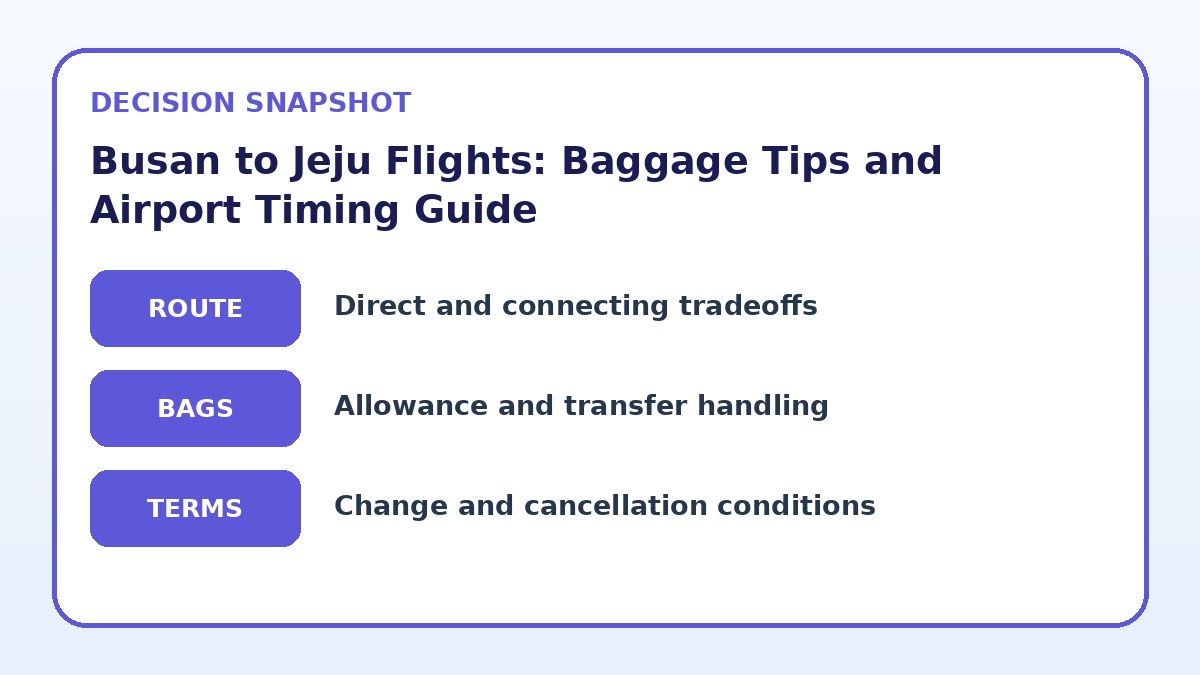
Routing: direct flights versus connecting itineraries
Direct Busan to Jeju flights simplify the day: one check-in, one security screening, and arrival where your baggage is usually handled only once. For a first-time traveler, that reduces the number of steps you must learn and the chance of missing a connection. Direct routing is also easier if you’re on a tight schedule — fewer moving parts mean less stress. When searching, filter for nonstop options and check the airport terminals involved so you know where to go on the travel day.
Connecting itineraries can appear cheaper on a fare search, but they introduce transfer points, additional boarding and security steps, and potential baggage reclaims if the connection is not protected. If you consider a connection to save money, verify whether the carrier or booking platform treats the segments as one ticket with through-checked baggage or as separate tickets that require you to collect and recheck bags. That distinction is crucial for planning how much time to allow and whether you need to collect luggage between flights.
Baggage and connection risk: plan how luggage will move
Start by listing how much luggage each traveler will carry: checked bags, carry-ons, and any special items like sports gear. For direct flights, the usual process is to check baggage at the departure airport and retrieve it at your destination. For connecting itineraries, look for wording such as ‘through-checked’ or ‘interline’ on the booking page; if the segments are sold separately you may be required to claim and recheck baggage, which adds time and uncertainty. Always confirm baggage size and weight limits on the final carrier page before booking.
If you must transfer luggage between separate tickets or carriers, build extra time and know the baggage reclaim and recheck desks’ locations at the transfer airport. Keep valuables and necessities in your carry-on in case of delay or misrouted checked items. Consider traveling with one checked bag per household or shared packing to reduce total checked-item risk. When a fare limits checked bags, compare the cost of paying for a bag versus a higher fare that includes it — sometimes the convenience is worth the price difference.
Compare flight-selection strategies
| Flight strategy | Best for | Risk to check |
|---|---|---|
| Book the direct flight with baggage included | Travelers prioritizing simplicity and minimal airport steps | Usually higher base fare but fewer logistics and lower connection risk |
| Choose a low-fare direct flight with no checked baggage | Light packers who can travel carry-on only and want lower fares | Saves money but requires strict packing and may incur gate-check risk |
| Select a connecting itinerary to reduce base fare | Budget-focused travelers willing to accept longer travel days | Adds transfer steps, potential baggage reclaims, and higher missed-connection risk |
| Pay slightly more for flexible fare with included baggage | Uncertain plans or travelers wanting easy changes and peace of mind | Higher upfront cost but reduces stress and unexpected fees later |
Recheck the complete itinerary
Confirm airports, connection handling, baggage, and change conditions before deciding.
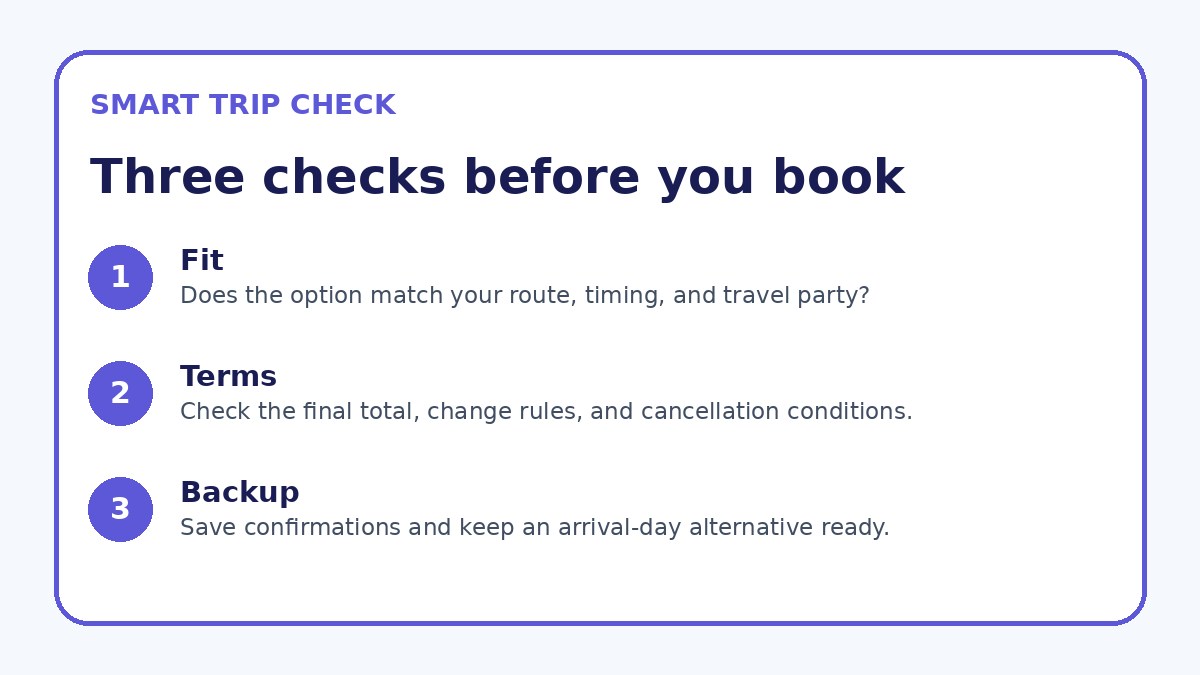
Schedule fit: how to choose airport arrival and connection buffers
Decide what kind of day you want: conservative or lean. For most first-timers, a conservative airport day reduces stress; arrive at the airport earlier than the minimum required. If your itinerary is direct, aim to be at the terminal with completed online check-in and carry-ons ready about 60–90 minutes before the scheduled departure. This buffer covers baggage drop, security screening, and unexpected queues while leaving time for getting lost in an unfamiliar terminal or purchasing last-minute essentials.
When a connection is involved, add additional protection time at the transfer airport. Use 90–150 minutes between flights for separate tickets or unknown terminals; shorter if the airline guarantees a minimum connection time and both segments are on the same booking. Look at realistic transfer paths — distance between gates, possible shuttle needs, and whether you must exit and re-enter security. If your morning plans are tight in Busan, consider choosing a later direct flight instead of a risky early connection.
Flight details to verify
- Confirm exact travel dates, times, and passenger ages before comparing fares on any booking site.
- Decide whether you can travel carry-on only; weigh the cost of paid checked bags versus a higher inclusive fare.
- Check the final carrier booking page for baggage size, weight limits, and gate-check policies.
- If considering connections, verify whether baggage is through-checked or must be reclaimed and rechecked.
- Plan to arrive at the Busan terminal 60–90 minutes before a direct flight, and add 30–60 minutes for unfamiliar terminals.
- Save digital and paper copies of booking confirmations, baggage receipts, and the carrier’s contact info for day-of-travel issues.
Fare conditions: what to verify before you book
Fare rules determine what you can change, refund, or bring. Before purchasing, check if the fare includes checked baggage, what size and weight limits apply, whether seat selection costs extra, and what penalties or fees apply for changes and cancellations. Verify whether the fare is refundable or offers free changes — especially important if your trip dates may shift. Also check for any carry-on restrictions that could force you to check a bag at the gate for an added fee.
If you’re comparing a cheap fare to a higher-priced option that includes baggage and flexible change terms, calculate the all-in cost: add checked-baggage fees, seat selection, and change fees to the base fare. Confirm the carrier’s exact wording on the final booking page; that page is the authoritative source for baggage allowances, transfer protections, and any additional service fees. Finally, if you book through a third party like Trip.com, verify the carrier’s policies on the airline’s own site as well.
Flight Guide questions travelers ask
How much time should I allow at Busan airport before a flight to Jeju?
For first-time travelers on a direct Busan to Jeju flight, plan to be at the terminal 60–90 minutes before departure to allow for check-in, baggage drop, and security. If you’ve completed online check-in and only have carry-on luggage, you can reduce that slightly but still allow extra time for unfamiliar signage and potential queues. For itineraries with connections or separate tickets, add at least 30–60 additional minutes to the transfer airport buffer, and confirm whether you need to reclaim and recheck baggage between segments.
Can I travel carry-on only on Busan to Jeju flights, and what should I check?
Many travelers can manage Busan to Jeju flights with carry-on luggage, but you must verify size and weight limits on the carrier’s final booking page. Before committing, pack a trial carry-on and ensure it meets the airline’s rules; keep essential items and a change of clothes in your carry-on in case checked bags are delayed. Remember that some lower-fare tickets restrict overhead cabin space and may require gate-checking oversized carry-ons, so check the fare’s cabin baggage policy before you book.
What if my flight has a connection—how do I reduce baggage or missed-connection risk?
If you choose a connecting itinerary, prioritize purchasing on a single ticket when possible so baggage is more likely to be through-checked and the airline takes responsibility for missed connections. If separate tickets are your only option, leave longer connection times, pack essentials in a carry-on, and confirm the baggage reclaim and check desks’ locations at the transfer airport. Also check refund or change rules for each segment; flexible fares or travel insurance can reduce financial risk if a delay causes you to miss a connection.
Final decision note
When planning Busan to Jeju flights as a first-time visitor, make choices that simplify the airport day: direct flights and fares that include baggage reduce handling and stress, while low-cost options require stricter packing and more careful timing. Prepare exact traveler details, your preferred luggage plan, and acceptable buffers before running searches so you can make an apples-to-apples comparison of total cost and convenience. Verify baggage allowances, transfer rules, and change/cancellation conditions on the carrier’s final booking page, and consider using a third-party platform like Trip.com only as a comparison tool — always confirm policy details with the airline itself. With clear travel dates and packing decisions up front, you’ll choose the right balance between fare savings and a smooth airport experience.
Continue planning
Check current options and final conditions
Use the provider page to confirm live availability, the final total, cancellation terms, and every condition that matters to your trip.
This evergreen planning guide was created with AI-assisted drafting and a structured quality review. It does not display live prices, schedules, availability, visa guidance, or provider rankings. Verify current details before booking. Some links are affiliate links; we may earn a commission at no additional cost to you.