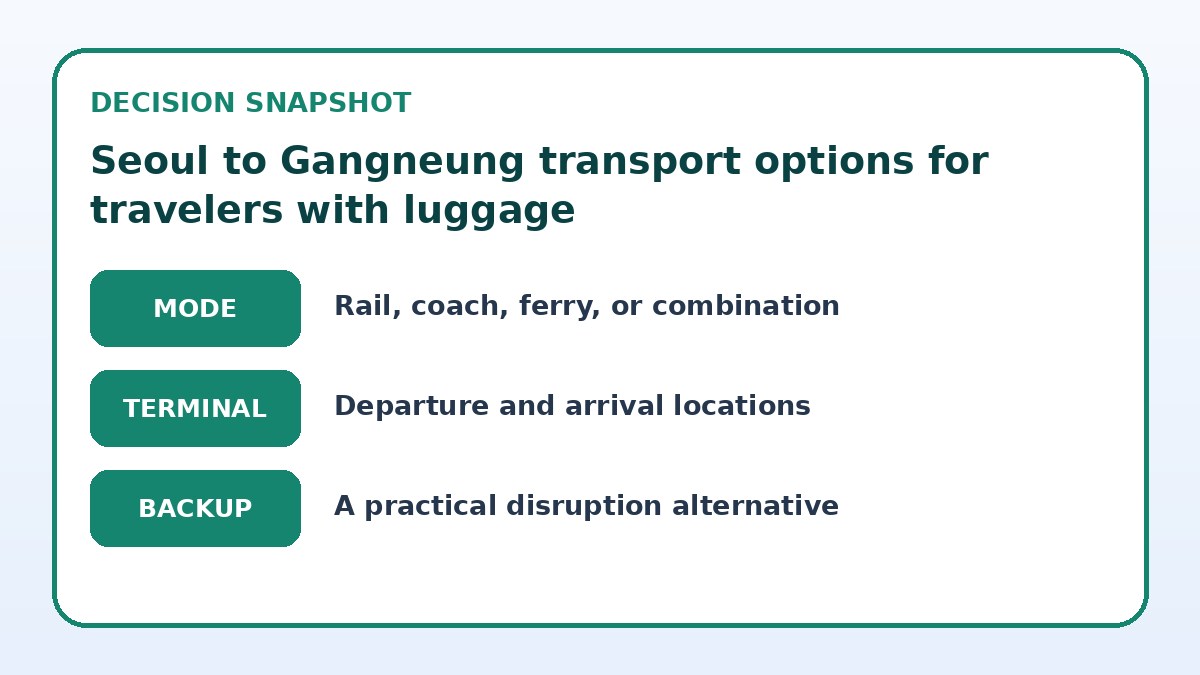
Practical answer first: choose high-speed or express rail when you want the least handling and a predictable ride; pick a private car or taxi transfer if door-to-door convenience with heavy or many bags matters most; use coach if you prioritize cost and can manage luggage on roof racks or in bays; combine modes when station access, hotel check-in times, or onward transfers make a single option awkward. The rest of this article explains the tradeoffs that affect travelers heading from Seoul to Gangneung with extra luggage: how terminals fit your bags, transfer friction at each end, timing flexibility you can expect, and what to have ready if disruptions happen. Focus on end-to-end practicality—how you get from your Seoul door to your Gangneung door—not just the ride itself.
Choosing the right mode: rail, coach, car, or a mix
Start by prioritizing the single most important luggage factor: total weight/volume, number of pieces, or need for protective handling (instruments, fragile items). High-speed and regional trains usually offer the simplest flow—you walk on with bags, stow near your seat or in a dedicated luggage area, and walk off once the train arrives. That reduces repeated lifts and curbside juggling. Coaches and long-distance buses can be economical but often require loading into underfloor bays; this means one bulky lift at each end but also dependence on baggage handlers and a fixed luggage bay size.
Private car or taxi transfers eliminate most handling: the driver loads and unloads at both doors. That’s the clearest win for oversized or irregular items, or if you’re traveling with children and multiple bags. The tradeoff is cost and potential road variability. Combining modes—rail for the long distance and a short taxi at either end—lets you balance price and convenience: use the train for the main leg and book a pre-arranged car for doorstep pickup in Gangneung to avoid station transfers with heavy luggage.
Choose the end-to-end journey plan
| Journey approach | Best for | Friction to check |
|---|---|---|
| Rail (high-speed/regional) | Minimizing repeated handling and relying on predictable timetables | May require a short taxi at either end; check luggage carriage rules and platform access |
| Coach/bus | Lower-cost bulk travel with moderate luggage if you can handle one lift at each end | Fixed pickup points and underfloor bays can mean more handling and less flexibility |
| Private car/taxi transfer | Door-to-door convenience with heavy or many bags and minimal lifting | Higher cost and potential road delays; confirm vehicle capacity and pickup logistics |
| Mixed mode (train plus short transfer) | Balancing comfort and cost while keeping handling low for the long leg | Requires coordination between bookings and buffer time for connections |
Check live intercity options
Look beyond the ride itself and compare terminals, transfers, luggage, and arrival fit.
Terminal fit and transfer friction
Assess the stations and terminals at both ends. In Seoul, several large rail stations have elevators, ramps, and staffed concourses that make moving a trolley or suitcase easier; smaller suburban bus terminals can be narrower and require stairs or curbside lifts. In Gangneung, check whether your hotel or final stop is within a short taxi ride from the station or bus terminal; a 10–20 minute door-to-door transfer with a taxi or hotel shuttle dramatically reduces the practical effort of moving heavy bags.
Also plan the last-mile sequence: are there escalators only, or are lifts and level access available at platforms and ticket halls? If you must change trains or leave a station on foot, count the steps, stairs, and distance between platforms. If you have oversized items, confirm pickup/drop-off points and whether the vehicle can stop close to the entrance—this often matters more than which carrier you choose. For shared coaches, ask about door-to-door drop points; some stop at central terminals not near accommodations.
Timing flexibility and scheduling considerations
Match your luggage needs to the schedule. If you need firm arrival times (hotel check-in windows, day trips), choose options with more frequent departures or the ability to book a private transfer that waits for you. Trains often run on reliable timetables; coaches can be less frequent. If your luggage makes you slower moving through stations, allow extra buffer time in any plan. When planning connections—train arrival to taxi pickup—factor in time to collect bags from overhead racks, walk to the station exit, and find your driver.
Bring timing contingencies: choose trains or coaches that leave a safety margin before a fixed appointment, or arrange a flexible private transfer that can adjust pickup if earlier or delayed. If you combine modes, try to book the long-leg carrier first and then the short transfer so you can update the pickup window. Always verify the boarding location and platform on the provider’s final booking page; station gates and boarding points sometimes change on the day and can add unexpected walking with luggage.
Compare the practical alternatives
Use the final page to confirm what is actually offered on your dates and save a workable fallback.
Intercity travel checklist
- Measure and photograph each oversized item; confirm vehicle trunk dimensions or luggage policies with your carrier before booking.
- Reserve a private transfer from the arrival station if you need door-to-door service or cannot manage a station-to-hotel walk.
- If using rail, reserve seats in advance and check whether the train offers dedicated luggage racks or space for bulky items.
- Confirm exact station boarding points and platform numbers on the provider’s final booking page to minimize walking with bags.
- Pack essentials and valuables in a small carry-on you keep with you to avoid accessing checked luggage during transfers.
- Keep digital and printed copies of bookings and local contact numbers (driver, hotel, station helpdesk) for fast rebooking in case of disruption.
Disruption backup and what to verify before booking
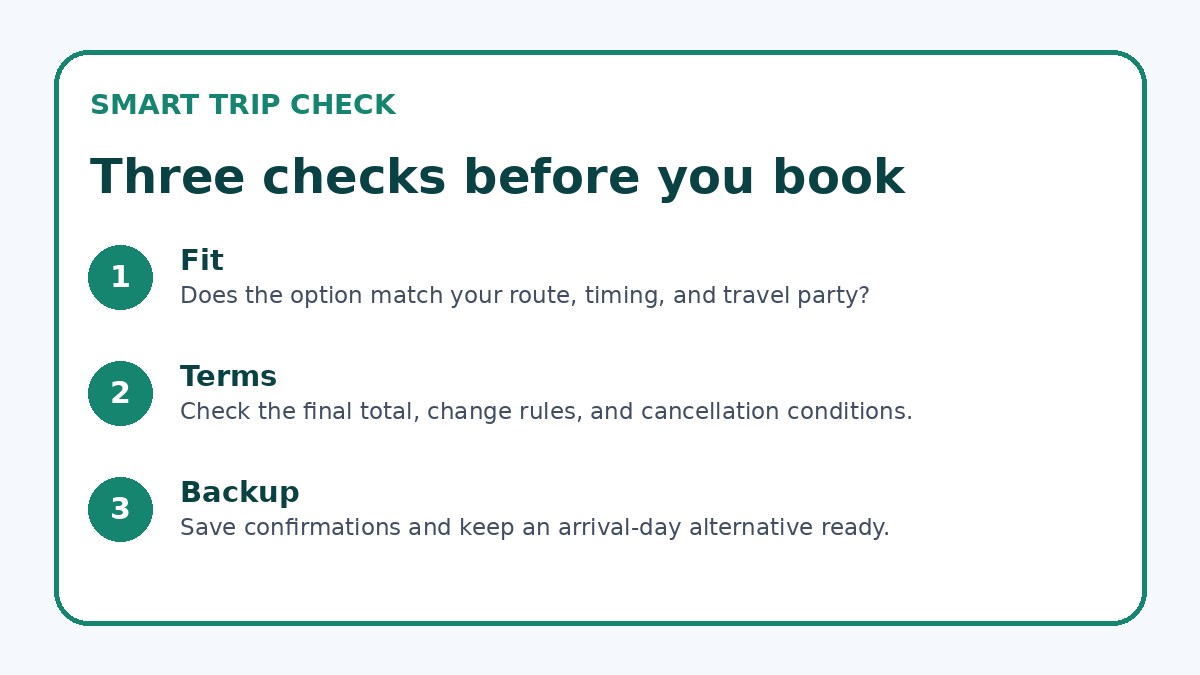
Prepare a simple backup plan: if your scheduled option is delayed or canceled, know the alternative mode you can use without handling luggage multiple times—another train, a coach, or a ride-hailing/taxi service. Keep important confirmations accessible (booking numbers, pickup references, and contact numbers) so a driver or station agent can locate you quickly. When traveling with extra luggage, the aim of a backup is to minimize repetitive loading and unloading rather than simply reaching the destination by any means.
Before final booking verify these items on the provider’s page: luggage size and number allowances, whether a reservation reserves overhead or dedicated luggage space, pickup and drop-off exact addresses, vehicle size and trunk dimensions for car hires, and whether assistance is provided for loading. If using a hotel transfer, confirm the meeting point and any extra handling charges. You can compare live availability and service details on aggregator sites like Trip.com, but always confirm the final terms with the carrier or hotel.
Rail & Intercity Transport questions travelers ask
Can I bring oversized or sports equipment on trains and coaches between Seoul and Gangneung?
Policies vary by carrier and vehicle type. Many trains allow reasonable oversized items if they fit in designated areas or do not block aisles, while coaches often require large items to go into underfloor bays. Before booking, check the carrier’s section on luggage or special items on their official booking page. If you have unusual equipment (bikes, surfboards, musical instruments), contact the carrier or the station helpdesk to confirm whether reservations, special packaging, or additional fees apply and whether assistance is provided for loading and unloading.
How should I plan transfers if my hotel in Gangneung has a strict check-in window?
Book the long-haul leg to arrive with a comfortable buffer before the hotel’s check-in window—allow time to collect luggage, find a taxi, or meet an arranged driver. If your arrival time is uncertain, reserve a flexible private transfer that can adjust pickup, or contact the hotel to ask about luggage holding if you arrive early. Confirm where drivers can stop for loading (curbside, designated taxi ranks) so you avoid long walks. Always include phone numbers for the hotel and the transfer provider in case of delays.
What’s the easiest way to avoid multiple lifts and reduce strain when traveling with many suitcases?
Aim for as few touchpoints as possible: choose a door-to-door private transfer or a single long-leg train ride with a short taxi at one end. If you must use a coach, consolidate items so fewer pieces are handled, use luggage with wheels and sturdy handles, and request help loading heavy pieces at pickup. On trains, place bulky items in designated luggage areas close to your seat to avoid moving them during the journey. Plan for assistance at both ends—reserve portage through your hotel or hire a porter service if available to minimize manual lifting.
Final decision note
Traveling from Seoul to Gangneung with extra luggage is primarily a logistics problem: limit the number of times your bags must be lifted, choose modes that reduce walking and stairs, and secure a reliable last-mile plan. For most travelers carrying bulky or multiple pieces, a private car or a rail-plus-short-transfer approach gives the best balance of convenience and predictability. Coaches can be a cost-effective choice if you’re willing to manage underfloor loading. Whatever you choose, verify luggage rules, pickup points, vehicle dimensions, and contingency options on the provider’s final booking page and keep contact details handy so you can adapt quickly if plans change.
Continue planning
Check current options and final conditions
Use the provider page to confirm live availability, the final total, cancellation terms, and every condition that matters to your trip.
This evergreen planning guide was created with AI-assisted drafting and a structured quality review. It does not display live prices, schedules, availability, visa guidance, or provider rankings. Verify current details before booking. Some links are affiliate links; we may earn a commission at no additional cost to you.