If you need to travel from London to Paris for business, decide first whether flexibility or convenience is the priority—both shape which fares and routings make sense. For a same-day return or tightly timed meetings, convenience (fewer transfers, airports closer to your meeting locations) often matters most. If your calendar has built-in slack or you want a lower fare with change options, schedule flexibility becomes the dominant factor. This guide gives the practical answer up front: choose a direct routing with a higher-fare, refundable or change-permitted ticket when meeting-time certainty matters; choose a flexible-fare or routing with permitted changes and careful baggage/connection planning when price and adaptability are the priorities. Read on to compare routing options, baggage and connection risks, schedule fit, and fare conditions so you can prepare exact dates and traveler details before checking live options.
See live routes for your exact travel day
Compare direct and connecting choices with the same baggage and traveler details.
Routing: direct vs connecting options
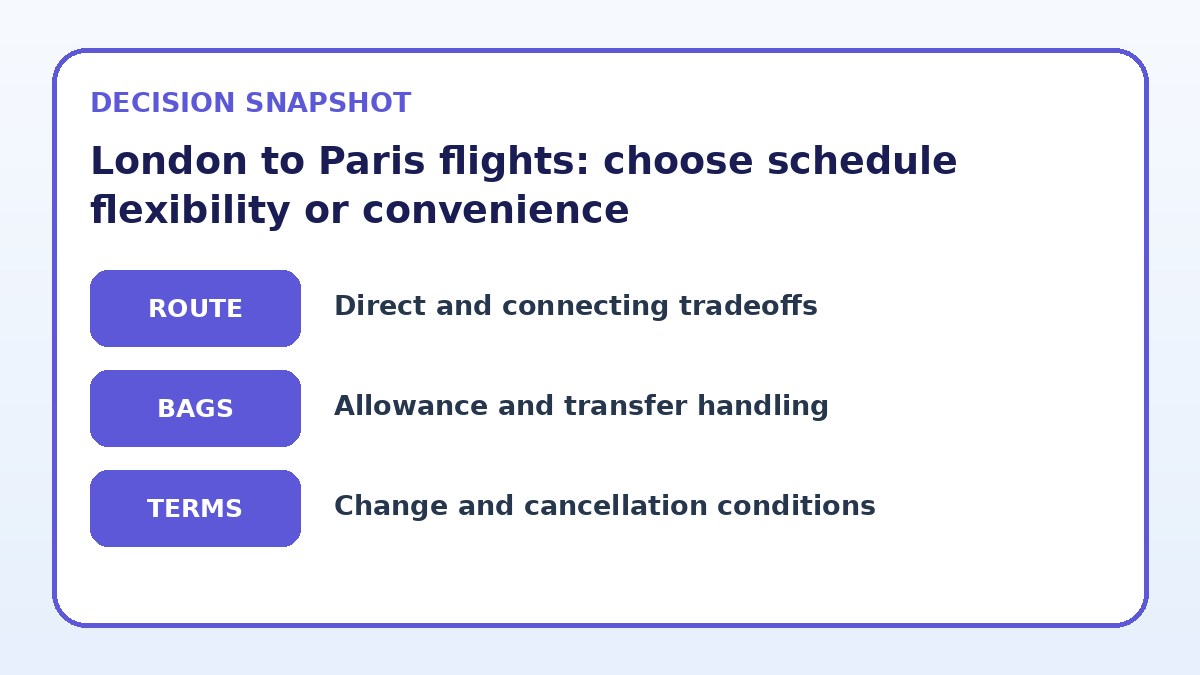
Routing is the first tradeoff: direct flights reduce airport-to-airport uncertainty but often cost more or use different airports that change ground logistics. Business travelers should compare direct flight options with alternative routings—short connections or multimodal options like Eurostar—looking at total door-to-door time, number of transfers, and how each option aligns with your meeting location. For example, a direct flight to an airport farther from your meeting could be slower overall than a train into central Paris when you count transfer time and traffic variability.
When you inspect options, list exact departure and arrival airports, typical ground transit times at your travel hour, and whether the routing requires leaving one airport to enter another for a connection. Don’t assume a single provider’s connection will be seamless: verify whether bags transfer automatically and whether any connection requires rechecking at security or passport control. These details determine whether a nominally faster airborne time translates to a faster, more reliable trip for your schedule.
Baggage and connection risk: what to verify
Baggage handling is a frequent hidden risk for business travelers who rely on an efficient return. Before booking, verify on the booking page if your ticket allows through-checked baggage on connecting itineraries, or whether you must collect and recheck bags during a transfer. If you plan a same-day return or have a short connection window, favor routings and fares that explicitly permit through-checked bags and show minimum connection times that match your schedule buffer.
Connection risk also includes immigration and security steps when moving between airports or switching from air to rail. Check whether your connection involves border control or separate terminals that require leaving the secure zone. If you have carrying-on-only, you can reduce baggage risk, but still confirm whether connecting flights are on separate tickets—this can affect your protection if a delay causes you to miss the onward leg.
Compare flight-selection strategies
| Flight strategy | Best for | Risk to check |
|---|---|---|
| Direct flight, refundable or flexible fare | Tight schedules and same-day meeting certainty | Higher fare but minimal connection and baggage risk; better on-time reliability for tight windows |
| Low-cost direct fare with add-on flexibility | Cost-conscious travelers who still want backup change options | Lower base price but extra fees for changes or luggage; verify final fare rules before purchase |
| Connecting flight on a single-ticket itinerary | Travelers seeking lower fares with accepted single-carrier protection | Lower headline fare but connection delays still risk missed onward flight; confirm through-checked baggage |
| Multimodal (rail-air or train-only) or separate-ticket combinations | Central-city meetings where door-to-door time beats airport distance | Can be faster and more convenient but may lack baggage or rebooking protection if segments are booked separately |
Recheck the complete itinerary
Confirm airports, connection handling, baggage, and change conditions before deciding.
Schedule fit: aligning flights with meeting windows
Fit the flight schedule to the meeting day rather than the calendar date alone. Start by defining absolute arrival and departure windows that accommodate unexpected delays and time for ground transit. For morning meetings, aim to arrive the evening before or take the earliest direct option that still gives you at least 90–120 minutes between landing and your first appointment, adjusted for local commute times. For same-day returns, prioritize departures that leave a comfortable cushion after your meeting ends, accounting for overruns and security checks.
When comparing schedules, note that advertised flight times omit potential ground delays like traffic or peak transit congestion. If your meeting is central Paris, rail or flights into closer airports may save time; if your meeting is near an airport, a later flight could be acceptable. Build a conservative buffer—add 30–60 minutes to transfer estimates—and select options with straightforward ground connections or predictable rail links to reduce stress on the travel day.
Flight details to verify
- Confirm exact meeting start and end times, then create required arrival and departure windows with at least 90–120 minutes buffer for local transit.
- Decide whether you will travel with checked baggage or carry-on only and verify through-checked baggage policies on the provider’s final booking page.
- Prepare passport name spelling, frequent flyer/corporate account details, and traveler contact info before entering dates to avoid booking errors.
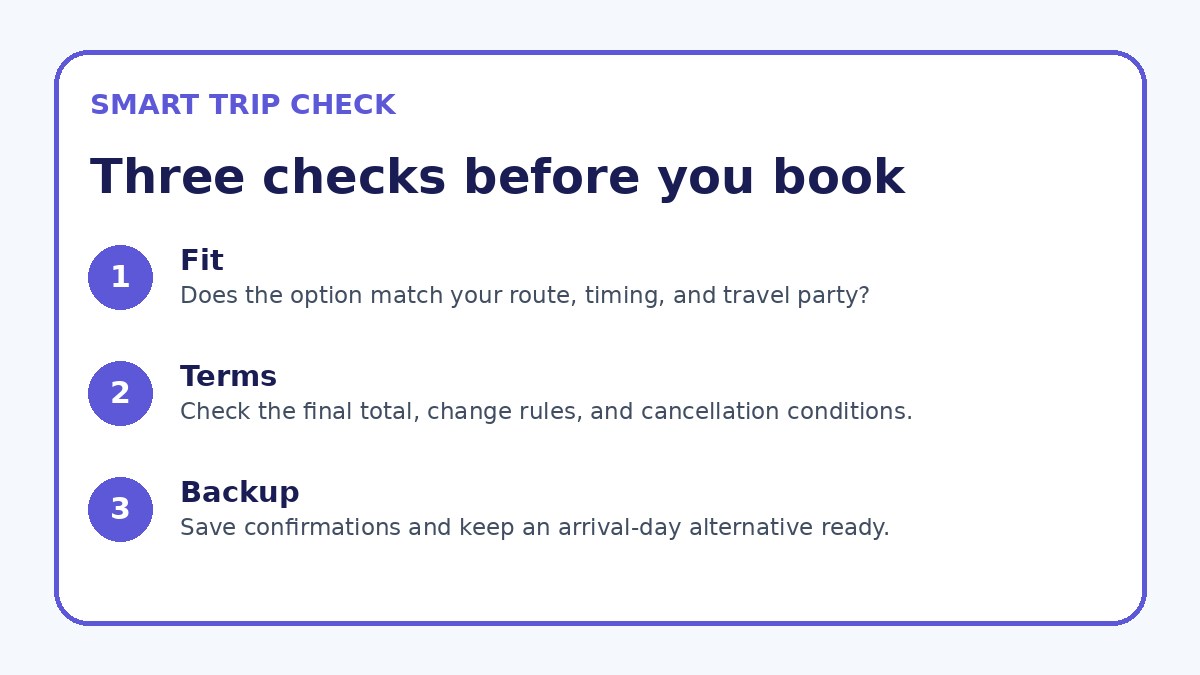
- On the booking page, expand the fare rules and document change fees, free-change eligibility, and refund conditions in writing or a screenshot.
- Compare total door-to-door travel time—including transfers, train rides, and expected traffic—rather than airborne time alone.
- If booking separate tickets, plan at least two hours between segments and buy a ticket with flexible change terms to protect against missed connections.
Fare conditions: change, refund, and seat priority
Fare rules determine how well you can adapt when plans shift. Before booking, expand the fare conditions on the final provider page and confirm change fees, fare difference policies, refundability, and whether seat selection or priority boarding is included. Business travelers often benefit from fares that allow free or low-cost changes, even if the base fare is slightly higher—this protects you from losing the whole ticket value when schedules change. Note too whether earning status benefits or corporate rates apply; these can alter the effective value of a fare.
Also verify baggage allowances tied to specific fare classes and whether upgrades or standby options are allowed without penalty. Don’t rely on summary lists; the detailed fare rules section on the provider’s booking page is where change fees, timing restrictions for free changes, and cancellation conditions are specified. If a fare looks attractive but the fare rules are unclear on the final page, contact the provider or consider a more transparent option.
Flight Guide questions travelers ask
Should I always choose a direct flight for business travel between London and Paris?
Not always. Direct flights reduce the number of steps that can go wrong, which is valuable for tight schedules. However, if a direct flight lands at an airport that adds significant ground travel to your meeting location, a well-timed indirect option or a rail service to central Paris can be faster door to door. Decide by comparing total travel time, baggage handling, and the fare’s change policies. If schedule certainty matters more than fare savings, lean toward direct options with flexible change or refund conditions.
How do I handle baggage when booking connecting or separate-ticket itineraries?
First, check the booking page to see whether baggage is through-checked on connecting itineraries; some single-ticket connections will transfer bags automatically, others will not. If bags are not through-checked, plan time to collect and recheck them, or travel carry-on only to reduce risk. For separate tickets, assume no protection for missed connections unless you buy explicit protection or leave a large buffer. If losing a checked bag would disrupt meetings, consider a direct routing or higher-fare ticket that includes checked baggage and through-checking.
What exactly should I verify on the provider’s final booking page before paying?
On the final booking screen, expand the detailed fare rules and confirm change fees, free-change windows, refundability, and the baggage allowance associated with your fare class. Verify airport codes and terminals, whether bags are through-checked for connections, and any required transfer procedures. Also confirm whether the fare includes seat selection, priority boarding, or early check-in—these affect boarding speed and comfort. If anything is ambiguous, contact the provider or choose a clearer fare option.
Final decision note
Balancing schedule flexibility and convenience on London to Paris flights starts with a clear priority: if meeting-time certainty is paramount, pick direct routings and flexible or refundable fares that limit connection and baggage risks. If budget and date adaptability win out, choose fares with explicit change permissions, prepare to travel carry-on or allow generous transfer buffers, and verify the final fare rules before purchase. Always prepare exact travel dates, passport name, meeting windows, and preferred airports before searching live inventory so you can compare real conditions accurately. Use these tradeoffs to select the option that minimizes business disruption while fitting your company policy and personal risk tolerance.
Continue planning
Check current options and final conditions
Use the provider page to confirm live availability, the final total, cancellation terms, and every condition that matters to your trip.
This evergreen planning guide was created with AI-assisted drafting and a structured quality review. It does not display live prices, schedules, availability, visa guidance, or provider rankings. Verify current details before booking. Some links are affiliate links; we may earn a commission at no additional cost to you.