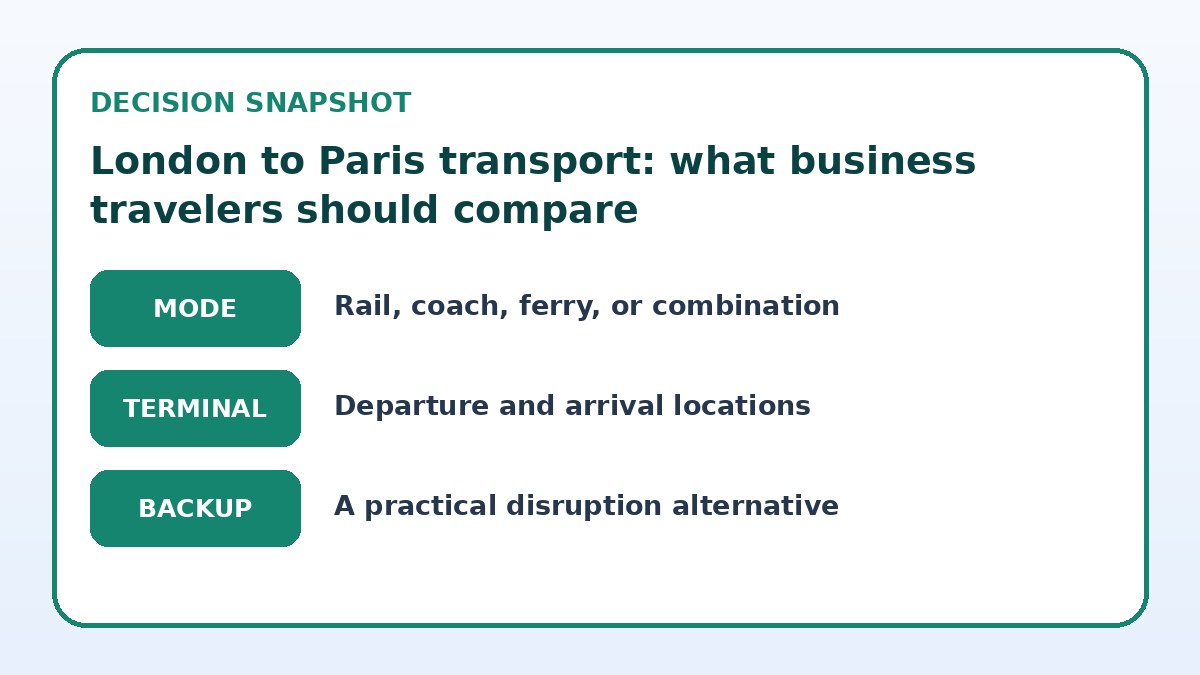
For most business travelers prioritising speed, predictability and minimal handoffs, high-speed rail between central London and central Paris is typically the most practical choice — but only if your meeting location meshes with the train terminals and you can manage luggage transfers efficiently. If your itinerary favours doorstep convenience, airport flights combined with car transfers or an executive pick-up may win despite longer total travel time. Coaches and ferry-plus-drive combinations still make sense when cost, schedule flexibility, or specific start/end points matter more than absolute speed. The decision comes down to terminal fit, how much luggage and hand-carry you have, how sensitive you are to schedule disruption, and where your business appointments sit at each end. Below I explain those tradeoffs, how to prioritize them, and practical checks to run on booking pages and ground transport options before you lock anything in.
Terminal fit: where journey ends matter as much as where it starts
The most important practical judgment is not the vehicle but the terminals and how they match your meetings. Central stations put you nearer many corporate addresses in both cities; arriving at a city centre rail terminal can shave taxi time and avoid airport security, whereas airports are best when your meetings are outside central areas or you need a hotel with airport shuttles. Think through the exact street address of your first meeting and the best door-to-door route from each possible arrival point. If the station or airport has efficient express transfers to your meeting neighbourhood, that changes the balance in favour of that mode.
Also factor pedestrian and public-transport access, not only distance. A short taxi from a station can still be slower if heavy luggage means longer walks or multiple transfers. Confirm whether your arrival terminal has reliable business lounges or facilities for last-minute prep and whether appointment locations accept courier or same-day parcel drop-offs if you plan to send firm materials ahead. On booking pages, verify terminal names and ground transfer options; don't assume a single terminal label equates to a convenient local arrival.
Choose the end-to-end journey plan
| Journey approach | Best for | Friction to check |
|---|---|---|
| Central high-speed rail (city-centre to city-centre) | Business travellers needing minimal city ground time and predictable city-centre arrivals | May be less convenient if meetings are nearer an airport or if you travel with oversized luggage |
| Flight plus pre-booked car transfer | Those whose origin or destination is nearer an airport or who need a door-to-door chauffeur service | Longer total door-to-door time and more pre-departure check-in and security steps |
| Coach or scheduled coach-plus-ride-hail | Travellers prioritising lower cost and flexible departure windows from specific suburban points | Longer journey time, more luggage handling and potential variability in terminal pickup locations |
| Ferry-plus-drive or mixed-mode road routes | When you require vehicle access at arrival or have bulky cargo not suited to train/plane rules | More complex door-to-door logistics and higher chance of schedule variability due to weather or traffic |
Check live intercity options
Look beyond the ride itself and compare terminals, transfers, luggage, and arrival fit.
Luggage and transfer friction: count the handoffs
Every time you change vehicles or modes you add friction: dragging a case through a crowded station, queuing at security, re-checking bags or standing in a taxi line. For short business trips with just a carry-on, transfers weigh less; if you travel with samples, a suit bag or multiple cases, prioritise options with minimal handling. Trains typically allow easy onboard storage and no security re-check for hand luggage, while air travel usually requires early check-in and security time. Coaches and ferries may have stricter limits on large or multiple pieces, and loading/unloading can be time-consuming.
Plan for the last mile: how you get from the terminal to the office matters more than the main leg duration. Pre-booked airport cars or station taxis reduce wait time but add cost. If you rely on ride-hail services, verify typical pickup points and any surge/practice constraints near major terminals. When comparing offers, inspect the provider’s final booking page to confirm luggage policies, pickup/drop-off addresses, and whether reserved seating or priority boarding is available—these practical details can sway the final choice.
Timing flexibility: align schedules with meeting windows
Business travel rarely follows the timetable of public transport; build margin around important meetings. When your schedule is tight, favour options with frequent departures and fast, predictable transfer times. High-frequency trains reduce dependence on a single departure and let you adapt if a meeting runs over. Flights can be fast in the air but are subject to check-in windows and airport delays; if you need to arrive by a strict time, compare total door-to-door journey reliability, not just airborne time.
Also consider the return leg and potential extensions. If you might leave later the same day, look for departures that match meeting end times without forcing an overnight. Coaches and lower-frequency connections require more careful planning. For real-time changes or urgent adjustments, check whether the provider’s booking page allows easy rebooking or flexible tickets; if not, pre-book a backup train or book refundable ground transfers as a disruption buffer.
Compare the practical alternatives
Use the final page to confirm what is actually offered on your dates and save a workable fallback.
Intercity travel checklist
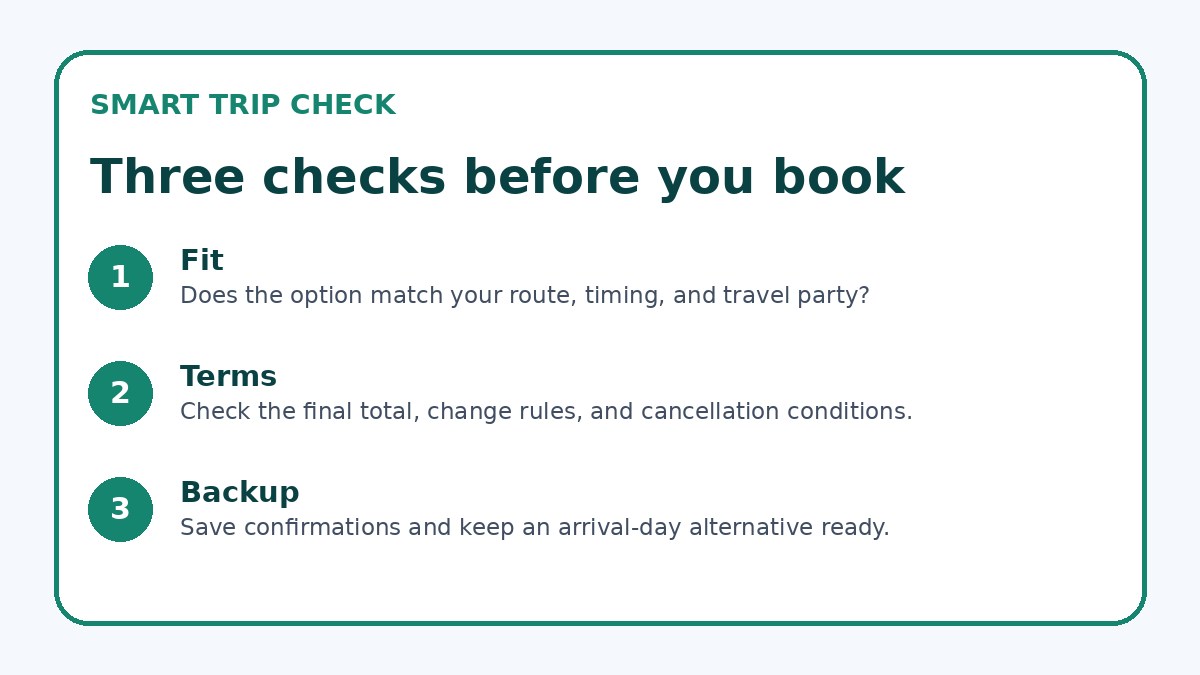
- Confirm exact station/airport names and door-to-door travel time to your first meeting before booking any main-leg transport.
- Check luggage allowances, carry-on rules and any size/weight restrictions on the provider’s final booking page.
- Pre-book ground transfer or reserve a pickup point with clear instructions to avoid ride-hail delays at busy terminals.
- Identify at least one later departure and one alternate route you would accept if your preferred option is cancelled or delayed.
- Record change and cancellation policies from the final booking confirmation so you can act quickly if plans shift.
- Arrange contactable backup transport (chauffeur company or travel desk) and save direct numbers for on-the-ground assistance.
Disruption backup: practical alternatives when things go wrong
Plan a realistic backup rather than hoping for the next available option. Good backups are those you can execute quickly: a later train with available seats, a pre-authorised chauffeur that can be dispatched, or a routed coach that still reaches a practical arrival point. Avoid relying solely on ad-hoc ride-hail availability at busy terminals. If rail strikes or weather are plausible during your trip, identify alternative city-centre train routes, or confirm which airports have multiple daily flights so you can switch without a huge time penalty.
Document exact steps for your backup before travel: which later departures you'll accept, contact numbers for your ground transfer provider, and where to move a pre-booked car if your arrival terminal changes. Use the final booking pages from transport providers to note cancellation and change policies, and consider using a travel management service or corporate travel desk if you need guaranteed alternatives. Trip.com can be used to compare current availability, but always verify disruption handling on the provider’s direct booking page.
Rail & Intercity Transport questions travelers ask
Is the train always the best choice for business travel between London and Paris?
Not always. Trains commonly win for city-centre to city-centre convenience and fewer security hassles, but that advantage depends on where your meetings are located and how much luggage you carry. If your appointments are closer to an airport or require a vehicle on arrival, flying plus a pre-booked car can be more practical despite extra check-in time. Compare the door-to-door journey, including transfer times and potential traffic, rather than deciding on mode alone. Verify terminal locations and transfer options on providers’ booking pages before you commit.
How much buffer time should I allow between arrival and an important meeting?
Allow more buffer than you think you need: for business trips between London and Paris, plan for potential delays in transfers, luggage collection and local traffic. A common practical approach is to build at least 60–90 minutes between arrival at a city-centre terminal and a downtown meeting, and 90–150 minutes if arriving at an airport. Increase margins when travelling with large luggage, during peak hours, or when you may need to dress or prepare materials. Check the provider’s booking page for typical transfer times and plan backups if your schedule is tight.
What’s the best backup if my preferred train or flight is cancelled?
Choose a backup you can execute quickly: a later high-frequency train that still reaches the same city-centre terminal, a reliable chauffeur service pre-authorised to extend pickup times, or a flight on a different carrier with a nearby airport. Avoid relying on ad-hoc ride-hail in busy periods. Before you travel, confirm rebooking and refund rules on the provider’s final booking page and save the contact details of your chosen backup provider so you can switch with minimal friction.
Final decision note
For business travellers evaluating London to Paris transport, the practical choice is the one that minimises door-to-door time, reduces luggage handoffs, and matches your meeting locations. High-speed rail often fits those priorities when both ends are central, while flights with a pre-booked car or chauffeur become preferable when airports are closer to your schedule or venue. Coaches and mixed road/ferry options remain relevant for specific needs like bulky cargo or flexible suburban start points. Run a short checklist before booking: confirm terminals, luggage rules, transfer logistics and at least one concrete backup. Always verify critical operational details on the provider’s final booking page and consider using a corporate travel desk for guaranteed alternatives.
Continue planning
Check current options and final conditions
Use the provider page to confirm live availability, the final total, cancellation terms, and every condition that matters to your trip.
This evergreen planning guide was created with AI-assisted drafting and a structured quality review. It does not display live prices, schedules, availability, visa guidance, or provider rankings. Verify current details before booking. Some links are affiliate links; we may earn a commission at no additional cost to you.