Practical answer up front: if you value the shortest door-to-door time and the least transfer hassle, prioritize a direct New York City to Los Angeles flight; if you want lower headline fares, more schedule options, or plan to break the trip for a stopover, consider a connecting itinerary. For solo travelers the real choice balances time saved against connection risk, baggage handoffs, and fare conditions that affect changes and refunds. Before you search, gather exact travel dates, preferred NYC airport (JFK, LGA, or EWR), preferred LA airport (LAX, BUR, or others), carry-on versus checked baggage plans, and how much buffer you need for connections. With those details you can compare total travel time, layover length, and change fees on the airline’s final booking page. Tools such as Trip.com can show current availability, but always confirm baggage allowances, minimum connection times, and change/cancellation terms directly with the carrier before purchase.

See live routes for your exact travel day
Compare direct and connecting choices with the same baggage and traveler details.
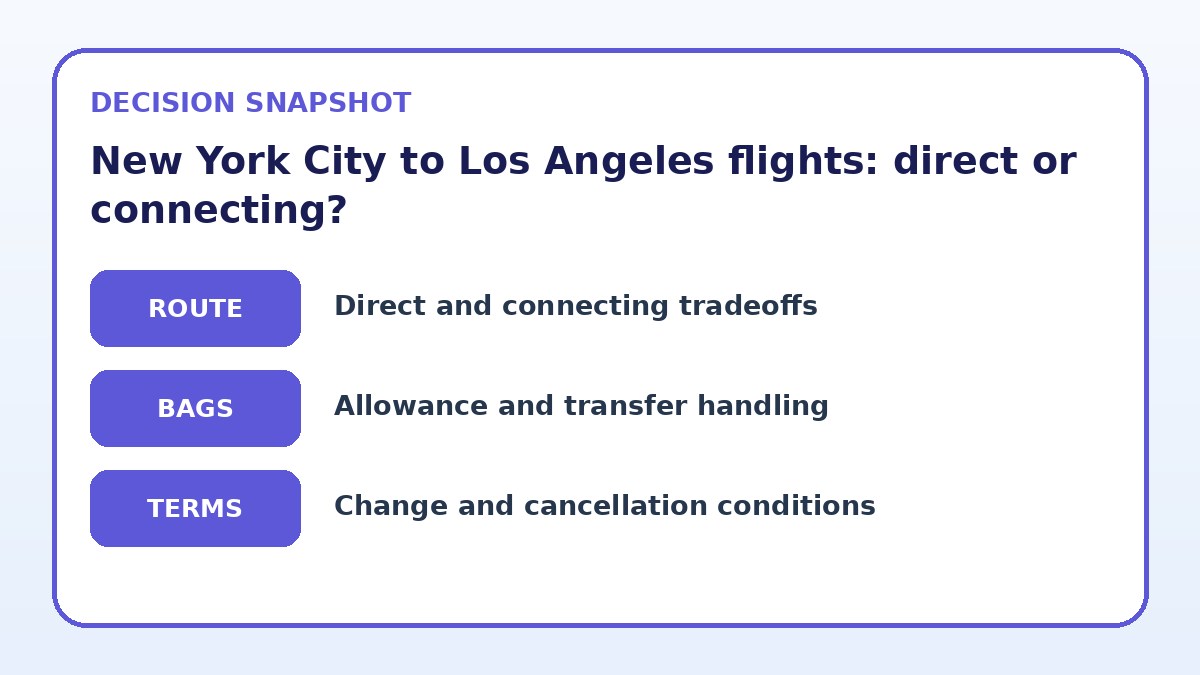
Routing: how direct versus connecting shapes your day
Direct flights reduce the number of moving parts: one boarding, one set of security checks before departure, and no in-airport transfers. When planning door-to-door time, account for transit to and from each airport, typical wait times for security at your chosen NYC terminal, and how traffic affects getting to a morning or late-night flight. If a direct option leaves or arrives at a less convenient airport — for example one farther from your lodging — a shorter flight time may not translate to a faster overall journey.
Connecting itineraries multiply the routing choices and may offer departures at times that direct flights do not. That can be useful if you need a specific arrival window or want to split the trip with a city break. However, connections add transfer time between gates and possibly terminals; when the itinerary changes airports at the connection point, you must plan extra time for ground transfer. For each candidate itinerary, write down the full sequence of airports, terminals and minimum connection times shown during booking so you can compare total elapsed travel time rather than flight time alone.
Baggage and connection risk for solo travelers
Checked baggage often moves automatically between flights on single-ticket itineraries, but exceptions exist. If your ticket is separate for each leg, you may need to claim and recheck bags, which adds time and risk. Solo travelers should decide whether to travel with carry-on only to eliminate baggage transfer worries; a well-packed carry-on reduces the chance of misrouted luggage and is easier to manage across terminals and security lines. Make a note of the size and weight limits for any airline you consider and what counts as carry-on versus personal item on the carrier’s final booking page.
Connection risk also includes missed flights when delays happen. Short layovers increase stress: you may need to sprint between gates or rely on quick rebooking help from an airline agent. Longer layovers lower that risk but lengthen your day. Check whether your itinerary is on a single ticket — which usually provides airline protection for missed connections — or two separate tickets where protection is limited. For international transfers or when re-clearing security is involved, add cushion time to allow for passport control and long security lines.
Compare flight-selection strategies
| Flight strategy | Best for | Risk to check |
|---|---|---|
| Direct nonstop flight | Travelers prioritizing shortest travel time and minimal transfer hassle | Fewer schedule options and sometimes higher base fares; verify baggage inclusions and airport locations |
| One-stop connection on a single ticket | Those wanting lower fares with airline protection for missed connections | Longer total travel time and potential for tight gate-to-gate transfers |
| Separate tickets or self-transfer | Flexible multi-carrier routing or planned stopovers with independent legs | Higher risk: you may need to re-check bags and handle missed connections yourself |
| Multi-hour layover to create a buffer or short stopover | Solo travelers who prefer reduced stress and time to refresh between flights | Adds overall journey time and can increase costs for food or lounge access during the layover |
Recheck the complete itinerary
Confirm airports, connection handling, baggage, and change conditions before deciding.
Schedule fit: arrival windows, time of day, and personal rhythm
Consider when you want to arrive in Los Angeles and how that aligns with local transit options, hotel check-in, and your planned activities. Direct flights often depart at peak times and can get you into LAX within about the same day, which is useful if you want to make the most of an afternoon or evening in the city. But peak departures also coincide with heavier traffic to NYC airports; allow extra ground travel time if you’re leaving from Manhattan during rush hour or early morning.
A connecting itinerary can let you choose an arrival at a non-peak hour or offer an overnight option that converts travel time into sleep time. If you have a tight schedule, break down arrival and departure times into arrival-to-hotel and departure-from-hotel windows, and pick flights that align with your personal energy and the transportation options you’ll use in LA. For solo travelers who prefer to avoid nighttime arrivals in unfamiliar neighborhoods, favor flights that arrive earlier in the day even if that means a longer layover on the outbound trip.
Flight details to verify
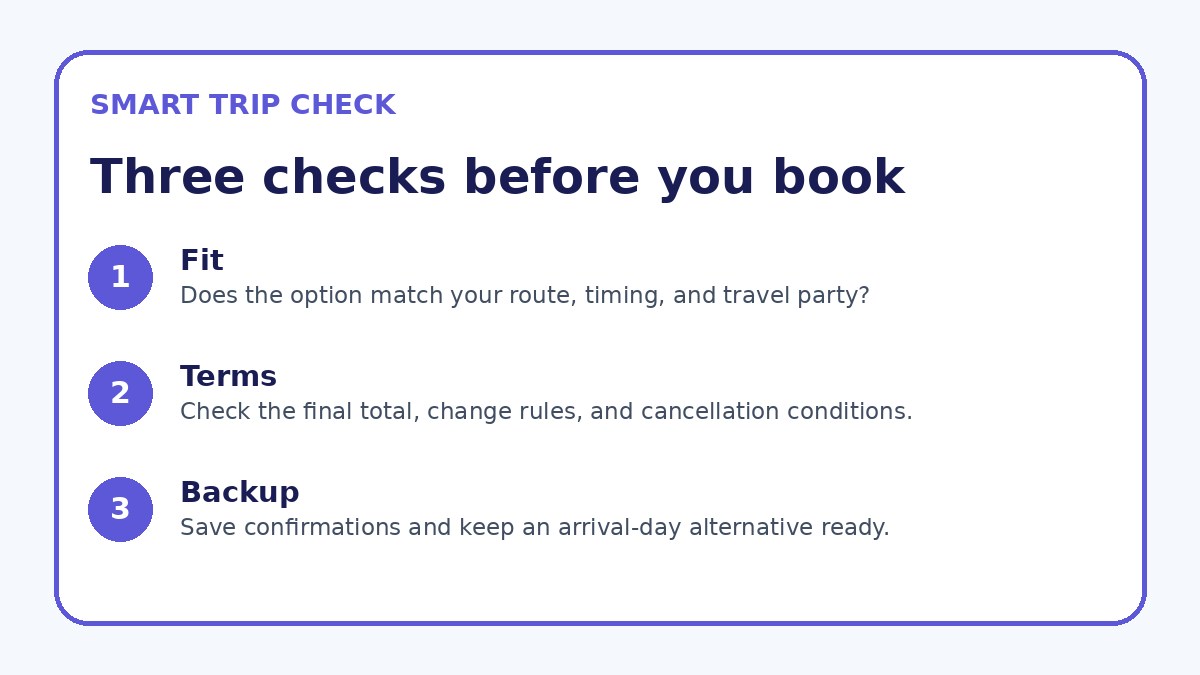
- Write down exact travel dates, preferred NYC and LA airports, and preferred arrival window before searching fares.
- Decide whether you will travel carry-on only or need a checked bag, and confirm the carrier’s baggage size and weight limits on the booking page.
- Compare total door-to-door time, not just airborne time: include ground transit, security, and expected layover durations.
- If considering connecting itineraries, ensure each leg is on a single ticket or understand baggage recheck requirements for separate tickets.
- Check fare rules on the airline’s final booking page: change fees, refunds, and seat assignment policies before purchasing.
- Save copies of your itinerary, airline contact numbers, and terminal maps on your phone and in printed form for quick reference.
Fare conditions: change fees, refunds, and what to confirm
Fare class rules can swing the value comparison between direct and connecting flights. A cheaper connecting fare may look attractive, but strict change or cancellation rules, nonrefundable tickets, or seat selection fees can negate perceived savings. Before booking, check the carrier’s final booking page for the exact cancellation policy, change fees (or whether changes are permitted at all), refundability, and whether fare differences apply when you modify dates. If you need flexibility, filter for fares that allow free changes or include partial refunds.
Also verify what is included in the fare: whether a checked bag is allowed or must be purchased, whether seat selection is included, and if onboard amenities matter to you. If you book a connecting itinerary composed of separate tickets, verify whether each leg’s fare conditions differ and how that affects refunds or rebooking. When using price-comparison sites or apps like Trip.com to shortlist options, use the airline’s own booking page as the final source for baggage rules, carry-on allowances, and any waivers or temporary policy changes.
Flight Guide questions travelers ask
Are direct flights between New York City and Los Angeles always the fastest option?
Direct flights usually give the shortest airborne time and fewer transfer steps, but fastest door-to-door travel depends on airport choice and ground transit. For example, a direct flight from an airport farther from your starting point might not save time once you add transit to and from the terminals. Also consider departure times — an off-peak direct that forces early morning travel across the city can be slower overall than a well-timed connecting flight. Before booking, compare total travel time from your door to your final destination and factor in typical traffic and transit times.
How much layover time should I allow for a connecting itinerary as a solo traveler?
Aim for a layover that balances lower stress and acceptable total travel time. For connections within the same terminal, 60–90 minutes often suffices; for inter-terminal transfers or when re-clearing security, plan 90–150 minutes. If international entry or deplaning procedures are involved, add additional buffer. Your exact comfort level depends on how well you know the airport, whether you travel carry-on only, and how much risk you’re willing to accept. Always verify the minimum connection times shown during booking and then add personal buffer time.
What should I verify on the airline’s booking page before final payment?
Confirm baggage allowances including size and weight limits for carry-on and checked bags, the exact fare conditions (change and cancellation fees, refundability), seat selection rules, and whether each leg is on a single ticket when you have connections. Also check terminal information, minimum connection times, and whether any airport changes occur during the itinerary. If you used a third-party comparison tool such as Trip.com, use the carrier’s page as the authoritative source before paying and note any additional carrier-specific requirements the booking site does not display.
Final decision note
Choosing between direct and connecting New York City to Los Angeles flights for a solo trip comes down to a few clear tradeoffs: direct flights simplify logistics and minimize connection risk, while connecting itineraries can offer more schedule flexibility and lower headline fares. Make the practical comparison by preparing exact dates and traveler details, checking total door-to-door time, confirming baggage rules and fare conditions on the airline’s booking page, and deciding how much buffer you need for transfers. If you prioritize a relaxed single-leg experience, favor direct service. If you want flexibility or a planned stop, choose a connecting option but protect yourself with reasonable layovers and clear knowledge of recheck and refund rules.
Continue planning
Check current options and final conditions
Use the provider page to confirm live availability, the final total, cancellation terms, and every condition that matters to your trip.
This evergreen planning guide was created with AI-assisted drafting and a structured quality review. It does not display live prices, schedules, availability, visa guidance, or provider rankings. Verify current details before booking. Some links are affiliate links; we may earn a commission at no additional cost to you.