After you collect your bags in Kyoto, the first hour shapes how relaxed your arrival feels. For a solo traveler the immediate decision is simple: confirm where and how you'll meet your ride so you can leave the airport without repeated calls or circling. Read the pickup instructions before you land—look for a named meeting point (terminal door, taxi rank, designated meeting area), a contact method (local phone number, messaging app, or driver name), and clear instructions for luggage handling and vehicle type. If instructions are vague, prepare a backup: a paid short-term station/taxi, a confirmed public transit route, or a hotel shuttle. This guide gives the direct answer up front—verify meeting-point text, contact details, and contingency rules on your supplier’s final booking page—and then explains the tradeoffs so you can pick the transfer approach that suits your comfort, schedule, and baggage.
Check options for your arrival details
Use your flight, luggage, party size, and accommodation address to compare current choices.
Luggage and party size: match vehicle instructions to what you carry
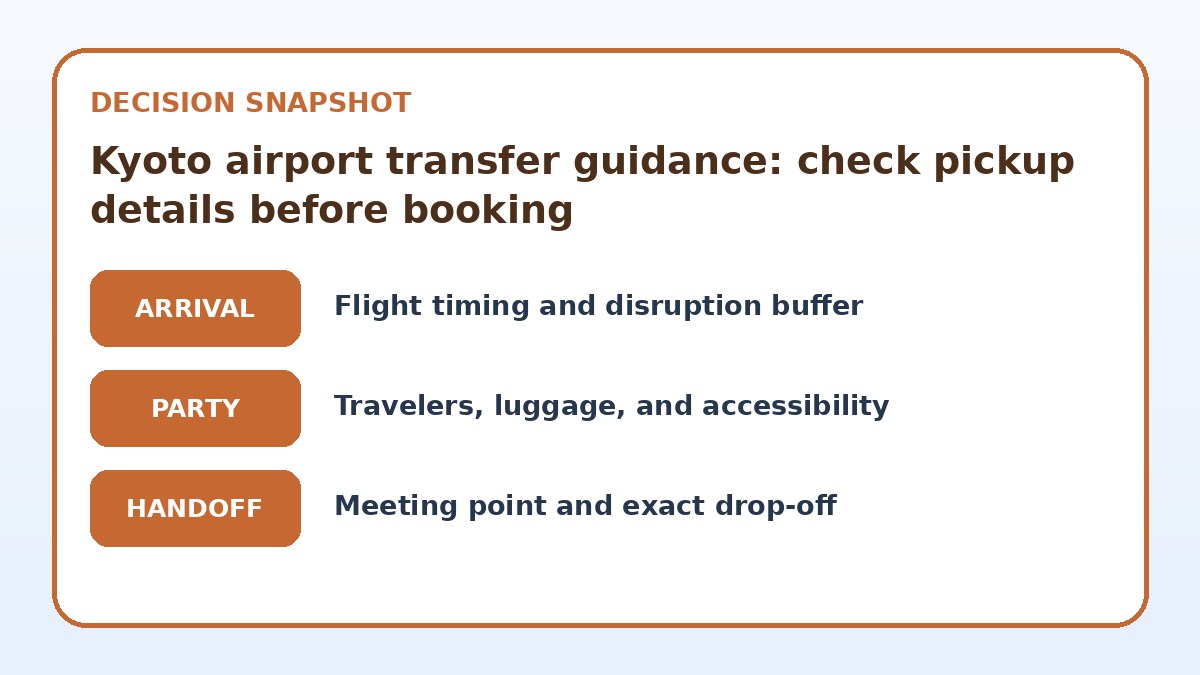
Solo travelers often underestimate how luggage changes choices. Pickup instructions should name vehicle type and maximum pieces; if they don’t, ask. A single medium suitcase and a backpack fits easily in compact cars, but oversize checked bags, sports gear, or instruments usually need an estate car, van, or trunk space explicitly noted in the booking. Also check whether the transfer includes assistance—will the driver meet you curbside and load luggage, or are you expected to handle it yourself? That detail affects how quickly you leave the terminal and whether you need to allow extra time for loading.
Think about party size even if you’re alone: you might be sharing a shuttle with other passengers, or you may be joining a pooled ride where stops add time and complexity. Pooled services often list ‘group’ or ‘shared’ in the instructions and show estimated boarding points; private transfers will specify a single pickup and direct drive. If you value a predictable, quick journey into central Kyoto with luggage handled, prioritize private or dedicated airport transfers and confirm the luggage allowance in writing before you travel.
Arrival details to have ready
- Save the supplier’s exact meeting-point text, take a screenshot of the location on a map, and pin it to your phone’s home screen or notes app.
- Store the supplier’s local contact (phone and messaging app option) and test international calling or mobile data before leaving home.
- Confirm the vehicle type and explicit luggage allowance in the booking confirmation; request a larger vehicle if you have oversize items.
- Ask the supplier about their driver-wait time, late-arrival policy, and the rebooking or contact procedure for disruptions.
- Copy your accommodation’s full address and GPS coordinates in Japanese and English and have them ready to show the driver.
- Prepare two backups: the official airport taxi rank procedure and a clear public-transit route to your area (station name and exit number).
Late or disrupted arrivals: what pickup instructions should say
Flights delayed or diverted are common. Good pickup instructions tell you how long the driver waits after scheduled arrival, what to do if the driver is late, and how to notify the operator if your arrival changes. If the booking page doesn’t state a grace period or rebooking policy, contact the supplier and get a clear message you can save. Also note whether the provider expects you to call a local number, use an app to update ETA, or simply wait at the meeting point—knowing the expected communication channel avoids confusion when your phone plan or time is limited.
When disruptions happen, a simple contingency reduces stress: if you can, buy a service that allows same-day rebooking or shows live driver tracking. If that isn’t available, plan a fallback such as using the airport taxi rank, official shuttle, or a staffed information desk. For solo travelers without local data, memorize the hotel address in Japanese, keep a paper copy of the supplier’s local number, and identify an easy terminal landmark to use as a rally point in case a driver doesn’t appear.
Match the transfer to your arrival
| Arrival approach | Best for | Detail to verify |
|---|---|---|
| Private door-to-door transfer | Solo travelers valuing speed, privacy, and luggage help | Often less flexible on late arrivals unless the provider offers a stated wait policy |
| Shared shuttle or pooled transfer | Budget-conscious solo travelers with moderate luggage and flexible timing | Longer trip time due to stops and more complicated pickup-point instructions |
| Public rail or bus plus short taxi | Travelers comfortable navigating transit and saving cost when schedules match | Requires more effort with luggage and precise timing between train/bus and taxi pickups |
| Airport taxi from the official rank | Last-resort or immediate departures when booked transfers fail or you are delayed | Less predictable fare and queue time; driver may not speak English or accept certain payment types |
Make the meeting plan clear
Check the final pickup instructions, waiting conditions, and exact drop-off coverage.
Meeting-point clarity: read exact words and map them
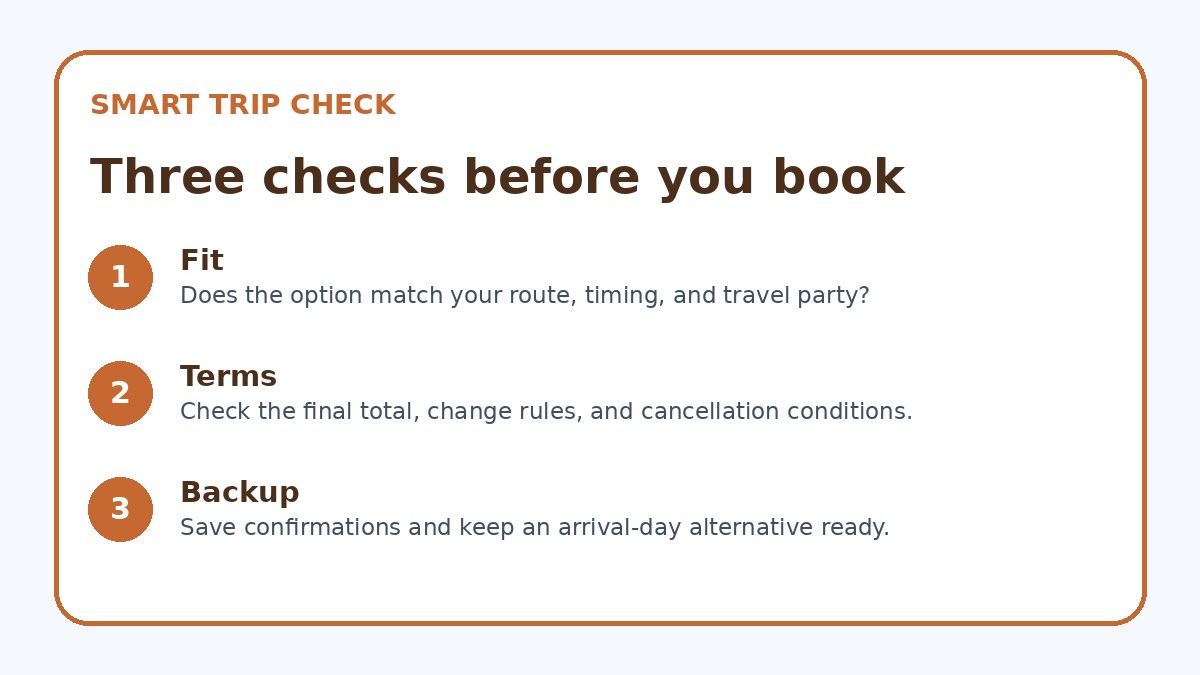
Small wording differences matter: ‘Terminal 2 arrivals, Exit A’ is different from ‘near Bus Stop 5 outside Terminal 2’. Before you leave home, copy the meeting-point text into your notes and open a satellite map to see where it is relative to customs exit, taxi ranks, and bus stops. Take a screenshot of the map area and the supplier’s pickup description so you can show it to airport staff or the driver if there’s a language gap. Also note whether the pickup is inside or outside security—some providers cannot enter arrival halls and will wait curbside.
If the instructions include a photo or a meeting-point landmark, save it prominently. If not, ask the provider to send one or to describe exactly how to get there from baggage claim. Some transfer services ask guests to wait by a clearly marked board or a fixed sculpture; others instruct guests to wait at the taxi rank. For solo travelers, meeting-point clarity reduces the chance of missing your ride and avoids repeated messaging while you’re tired after a flight.
Destination-side drop-off: where you’ll end up and how that links to walking or taxis
The pickup instructions should also say where the driver will drop you off in Kyoto—useful when your accommodation sits on a narrow street, above steps, or inside an area with limited vehicle access. If the supplier lists a generic ‘central Kyoto’ drop-off, ask for a more precise description so you can confirm the walking distance to your lodging. Solo travelers with late check-ins or heavy luggage should favor services that drop you as close to your building’s entrance as possible or at a fixed known landmark.
If your accommodation is in a pedestrian-only district or sits on a third-floor walk-up, make a plan for the final meters: request luggage assistance if available, check whether there’s a nearby public taxi stand, or confirm the walking time and route from the driver’s legal drop-off point. When the drop-off is unclear, save the accommodation’s exact GPS coordinates and an understandable local description in both English and Japanese to show the driver so you reach your room with minimal hassle.
Airport Transfer & Local Mobility questions travelers ask
What should I do if the driver doesn’t appear at the meeting point?
First, re-check the meeting-point text and map screenshot you saved. Use the supplier’s local contact number or app to message or call; if you have no mobile data, ask an airport information desk to place a local call for you. Wait at the specified location for the stated grace period if one exists. If you can’t reach the operator or the driver doesn’t arrive, follow your backup plan: proceed to the official taxi rank, head to the nearest staffed transfer desk, or use public rail/bus if that’s feasible for your luggage and time.
How do I confirm pickup instructions if the booking page is vague?
Contact the supplier directly using the contact method on your booking confirmation and request explicit details: the terminal and exit name, a photograph or landmark, the driver’s wait policy, and a local phone number. Ask whether the pickup is curbside or inside the arrivals hall and whether the driver will assist with luggage. Save the operator’s written reply—take screenshots or forward the message to your own email—so you have proof of the agreed instructions in case of a dispute at the airport.
Should I accept a shared shuttle if I have heavy luggage and arrive late at night?
Shared shuttles are generally less ideal with heavy luggage or late arrivals because they make multiple stops and may have limited waiting flexibility. If you arrive late or expect delays, prioritize a private transfer or ensure the shared service explicitly confirms a pickup window and luggage capacity. When in doubt and if budget allows, choose a private option for simpler logistics, or prepare a clear fallback like the airport taxi rank and a printed hotel address to avoid long waits or extra handling at night.
Final decision note
For solo travelers in Kyoto, the single most useful habit is reading and saving pickup instructions before you fly. That small investment—copying exact meeting-point wording, storing local contact details, confirming vehicle and luggage notes, and noting the drop-off format—shortens arrival stress and gives you reliable choices when schedules slip. Decide by weighing predictability against cost: private transfers are more straightforward with luggage and late flights; shared options save money but add complexity. Always verify any provider-specific policies (grace periods, contact steps, or rebooking terms) on the booking page, and keep the two-stage fallback of an official airport taxi or a clear public-transit route handy.
Continue planning
Check current options and final conditions
Use the provider page to confirm live availability, the final total, cancellation terms, and every condition that matters to your trip.
This evergreen planning guide was created with AI-assisted drafting and a structured quality review. It does not display live prices, schedules, availability, visa guidance, or provider rankings. Verify current details before booking. Some links are affiliate links; we may earn a commission at no additional cost to you.