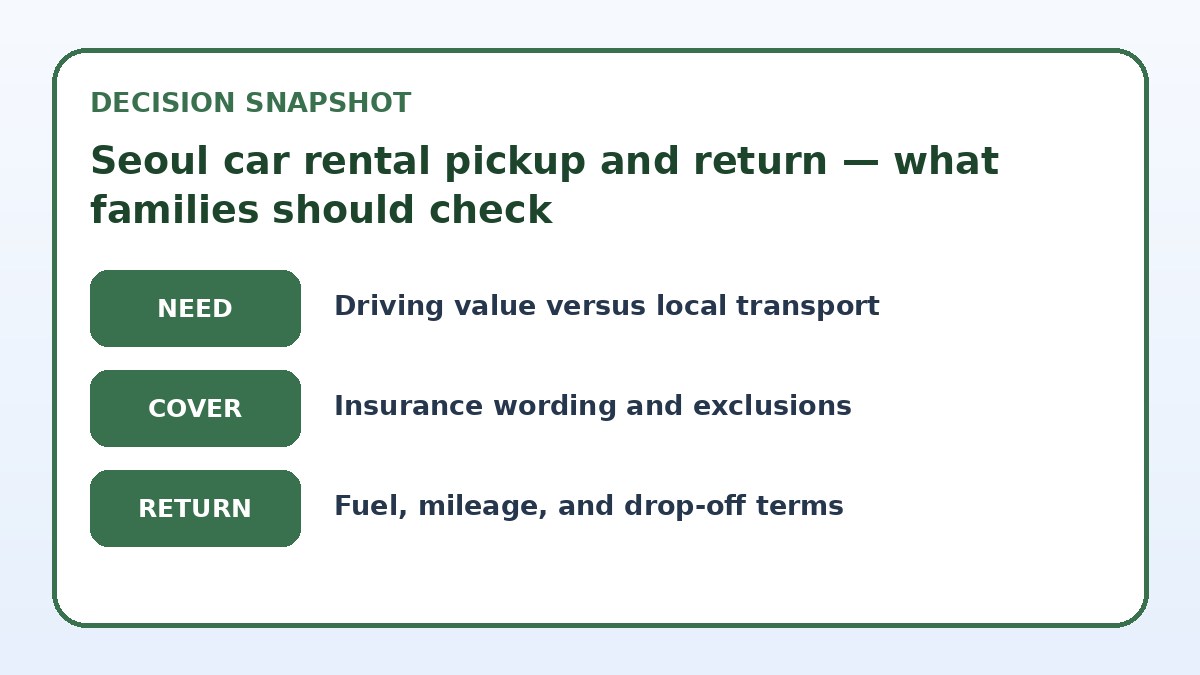
Practical answer up front: for most families visiting central Seoul, driving is rarely necessary and often adds friction; rent only if your itinerary includes suburban day trips, boundary-crossing routes, or luggage and timing needs that public transit can’t meet. Families who do choose a car should prioritize pickup and return terms that minimize time and stress: clear airport or downtown desk procedures, defined grace periods for late returns, documented fuel and mileage policies, and rental agreements translated or summarized in English. Read the insurance language closely — understand the difference between collision damage waivers, third-party liability, and local liability limits — and plan where you will park and return the car, because Seoul’s neighborhoods and parking rules affect the real cost and convenience. Below I’ll walk through route value, insurance wording to verify, pickup/return friction points, and a straightforward non-driving fallback that keeps children and schedules sane.
Route value: when a car actually helps a family in Seoul
A car makes sense for families when your plans include destinations that are poorly served by urban transit: coastal day trips, outlying parks, or multi-stop rural routes where public connections are infrequent or require long transfers. Consider the ages of your children and the number of bags: a car removes carrying and transfer strain, and lets you keep a predictable schedule for naps and meals. Weigh drive time against door-to-door alternatives — sometimes a 60–90 minute shuttle or express bus beats driving through unfamiliar traffic and paying for parking.
Also think about the full chain: getting a child seat installed, handling tolls and local parking rules, and potential overtime or late-return charges. If you need a car for only one or two long day trips, it may be cheaper and less stressful to hire a driver for that day or combine public transit with point-to-point taxis. For families whose Seoul plans focus on compact central neighborhoods, museums, palaces, and markets, the subway and short taxi rides usually provide faster, safer, and cheaper movement than a rental car.
Decide whether driving earns its place
| Mobility strategy | Best for | Cost or friction to check |
|---|---|---|
| Drive yourself (full rental) | Families with multi-stop suburban or rural plans needing flexibility and luggage space. | Higher admin at pickup/return, parking costs, and the need to manage insurance and local traffic rules. |
| Private transfer or driver-for-day | Families who want door-to-door comfort for single-day excursions without handling paperwork. | Less independence during the day and typically higher per-day cost than self-driving for multiple days. |
| Public transit plus taxis | Families staying mainly in central Seoul prioritizing low cost and frequent, reliable service. | Limited convenience for off-grid destinations and harder to transport large amounts of luggage. |
| Ride-hailing with occasional short rental | Families combining urban convenience with one or two planned car days for day trips. | Requires managing two booking flows and potentially paying extra to arrange child restraints or off-hour returns. |
Check live rental choices only after the route test
Use the exact driver, dates, pickup point, and return plan to compare current conditions.
Insurance and wording: what to verify on the booking page
Insurance terminology can be confusing; don’t assume coverage matches your expectations. On the provider’s final booking page, verify whether the vehicle includes a collision damage waiver (CDW) and what deductible applies, whether third-party liability coverage meets local legal minima, and whether additional drivers or young-driver surcharges change the policy. Confirm whether glass, tires, and undercarriage damage are excluded or included, and whether theft protection is part of the package. If a damage claim requires a police report, make sure the process is clear; ask how quickly claims are resolved and whether you’ll need to pay upfront and claim reimbursement.
Check whether the offered coverages are insurance or waivers — waivers limit the rental company’s claim against you but don’t substitute for third-party liability insurance. If you plan to use a credit-card rental insurance benefit, verify compatibility with the supplier’s terms and get the written confirmation required by the card issuer. Finally, if the booking page uses unfamiliar legal phrases, take screenshots or download the exact terms to avoid disputes at pickup or return.
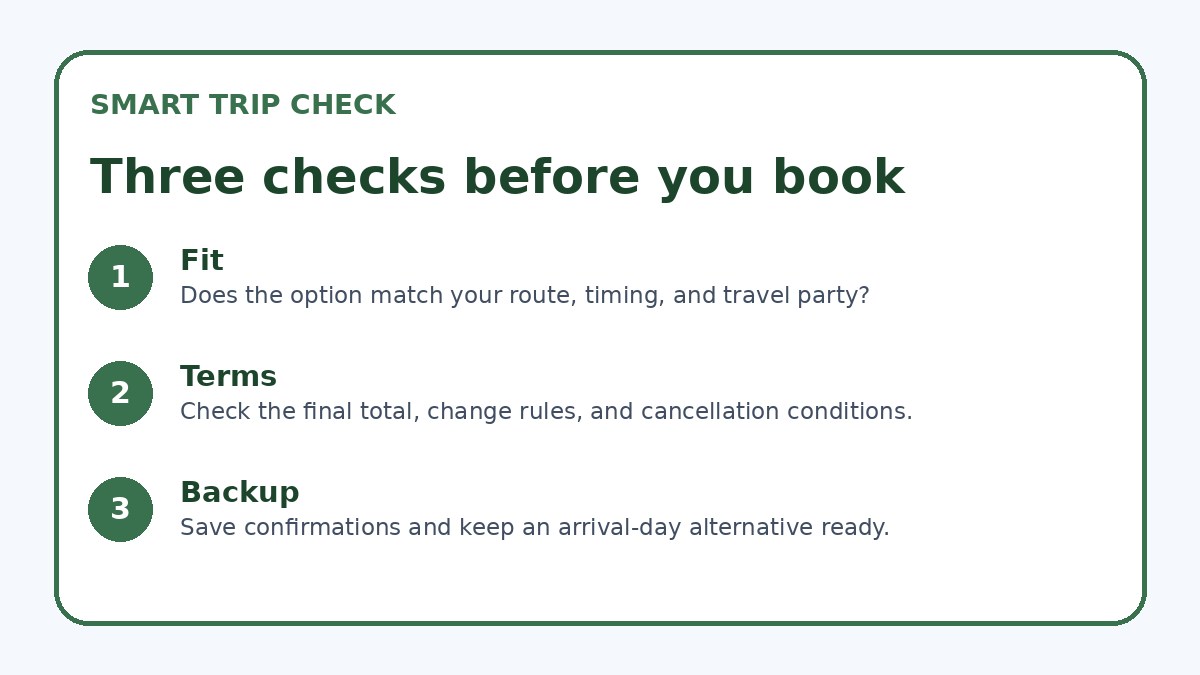
Compare the full rental conditions
Confirm insurance wording, exclusions, deposit, fuel, mileage, and return terms on the final page.
Pickup and return friction: specifics families should demand
At pickup, ask for a staffed counter that handles international customers or a clear key-collection procedure with English instructions. Verify exactly what documents are required — original driver’s licence, International Driving Permit if applicable, passport — and whether ID copies are stored or shredded after the rental. Inspect the car with the agent and document any scratch or damage with photos and a jointly signed checklist. Clarify fuel policy (full-to-full vs. pre-purchase), where to refuel before return, and if the company charges for missing fuel at a premium rate.
For returns, prioritize providers that publish an after-hours drop-off process and list any post-return inspection window that can trigger disputes. Ask whether there is a grace period for late returns and how late fees accrue. If returning at an airport, check if shuttle availability is included or if you must pay for drop-off at an offsite lot. Confirm where toll records or parking tickets will be charged and the process the company uses to notify you — immediate charges versus later invoices can create surprises after you leave the country.
Car rental terms to verify
- Confirm required driver documents (domestic license, IDP, passport) and bring originals plus photocopies when picking up the car.
- Photograph the vehicle from all angles with timestamps and ask the agent to sign a damage checklist at pickup.
- Request and download the complete rental terms, insurance wording, fuel policy, and after-hours return procedure before departure.
- Note the specific return location and available shuttle or transport options to your hotel or airport for the time you expect to return.
- Clarify late-return grace period and the exact fee schedule for late drop-off, cleaning, tolls, or unpaid parking tickets.
- If relying on credit-card insurance, obtain written confirmation of accepted coverages from the rental company and your card issuer.
Non-driving fallback and mixed-mobility planning
A robust fallback keeps your family mobile without a rental: build an itinerary around Seoul’s metro for most days, pre-book taxis for night returns, and reserve a single day rental or private transfer for any planned out-of-town excursions. The subway is extensive, frequent, and child-friendly, and taxis are plentiful for baggage-heavy legs or sleepier kids. For a mixed approach, plan which days require a car, book those separately to avoid multi-day rental fees, and map convenient rental locations (airport vs. central district) so pickup and return fit your hotel schedule.
Also prepare for last-minute needs: download local ride-hailing apps used in Korea and locate child-seat rental options if you might take taxis for some legs. Keep physical and digital copies of reservation confirmations and the rental company’s return instructions. If you do rent, leave a buffer day at trip end to resolve any damage or billing questions before international travel; if you don’t, use saved time to enjoy Seoul with less time spent navigating parking and traffic.
Car Rental & Road Trip questions travelers ask
Do families need an International Driving Permit to rent and drive in Seoul?
Driving document rules depend on your home licence and the rental company’s requirements. On the provider’s final booking page, verify whether the rental firm accepts your domestic licence alone or requires an International Driving Permit (IDP) and a passport. Some agencies insist on an IDP translated into Korean or an official translation for non-English licences. If you plan to rely on a credit-card company’s insurance, confirm that they accept rentals made with your licence type and any IDP; get the rental company to confirm in writing to avoid disputes at pickup.
What are the most common return fees families should watch for?
Common post-rental charges include refuelling at premium rates if you don’t return full, late-return penalties, cleaning fees for excessive dirt or food stains, and toll or parking fines passed on later. On the booking page, check whether the company bills tolls and violations directly to your card and how they document them. Also look for mandatory airport drop-off fees, after-hours service charges, and administrative costs for handling damage claims — these items are often listed in the fine print and can be minimized by documented pickup inspection and returning the car with a full tank.
How should families handle child seats and safety gear with rentals in Seoul?
If you require child seats, confirm availability, compatibility with your child’s age and weight, and any rental or installation fees on the final booking page. Some companies provide seats only by advance request and may charge per day or per rental; others may not guarantee correct fittings for international models. Consider bringing a travel car seat if your airline allows it, or reserve a seat from the rental firm and photograph its installation at pickup. Always check that the seat locks and straps operate correctly before driving away.
Final decision note
Families should treat a Seoul car rental as a deliberate tool, not an automatic convenience. If your itinerary is mainly central Seoul, the subway and taxis will usually be simpler, faster, and less stressful than a rental. Choose a car only when your itinerary genuinely needs rural or suburban access, lots of luggage movement, or a strict time schedule. When you do decide to rent, focus on pickup and return clarity: have written confirmation of allowed drivers, insurance limits and deductibles, fuel and mileage rules, and after-hours procedures. Verify these items on the provider’s final booking page, document the car condition at pickup, and plan a fallback that uses Seoul’s excellent public transit plus targeted transfers if the rental becomes impractical.
Continue planning
Check current options and final conditions
Use the provider page to confirm live availability, the final total, cancellation terms, and every condition that matters to your trip.
This evergreen planning guide was created with AI-assisted drafting and a structured quality review. It does not display live prices, schedules, availability, visa guidance, or provider rankings. Verify current details before booking. Some links are affiliate links; we may earn a commission at no additional cost to you.