If you need to reach Gangneung from Seoul for meetings, the most practical option is the one that minimizes door-to-door friction: choose the mode that best fits your terminal access, luggage needs, and schedule flexibility while leaving room for a realistic backup plan. For many business travelers that means prioritizing a direct rail or coach connection that drops you close to your hotel or meeting venue, or a mixed approach (rail plus local taxi) when direct options don’t match your timing. This article explains how to weigh terminal fit, transfer complexity, luggage handling, and schedule reliability. It avoids ride-time-only thinking and focuses on the full journey — from your Seoul lodging to your final Gangneung meeting location. Specific schedules and fares change often; verify times, seat classes, luggage rules and exact arrival terminals on official provider pages or a current aggregator such as Trip.com before booking.
Terminal fit: where the journey actually starts and ends
Choosing the most practical intercity option begins with terminal fit — the real starting and ending points matter more than advertised origin names. In Seoul, options may depart from different terminals or districts; pick the one that minimizes ground time. For example, a slightly longer ride that leaves from a convenient hotel-area terminal could be faster door-to-door than a supposedly quicker service that requires a long transfer across the city. Likewise, in Gangneung check whether arrival points are near the business district, your hotel, or require a separate taxi or bus.
Ask yourself: how easy is it to get to the departure point from where you’ll be staying, and how straightforward will the final transfer be to your meeting? Factor in peak-hour traffic around major terminals and the availability of elevators or level boarding if you have luggage. If the arrival terminal is a distance from your meeting, quantify the extra transfer time and cost (taxi, local bus, or shuttle) and weigh that against a different departure that lands you closer to your destination.
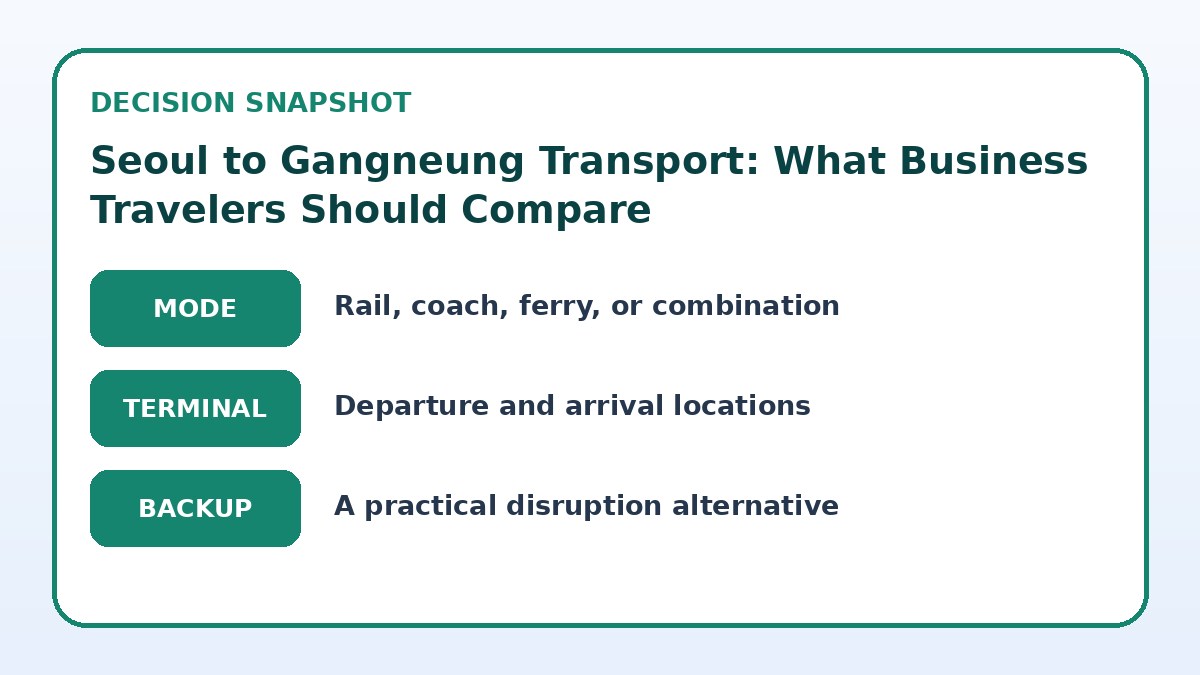
Choose the end-to-end journey plan
| Journey approach | Best for | Friction to check |
|---|---|---|
| Direct rail (single-seat or minimal transfer) | Travelers prioritizing predictable schedules and low transfer friction | May require reaching a specific station in Seoul and verifying luggage space; check exact arrival location in Gangneung for final transfer needs |
| Intercity coach from central terminals | Those who value a simple booking and often fewer platform or stair transfers | Coach terminals and stops may not be as centrally placed in Gangneung; traffic variability can affect door-to-door time |
| Drive or chauffeur service door-to-door | Small groups or tight itineraries needing direct pick-up and drop-off | Road conditions and travel times vary; parking and driver handoffs at arrival can add hidden minutes |
| Mixed approach (rail/coach + local taxi) | Travelers balancing schedule options with minimizing walking and luggage transfers | More moving parts to coordinate; requires quick local transfers and awareness of terminal pickup locations |
Check live intercity options
Look beyond the ride itself and compare terminals, transfers, luggage, and arrival fit.
Luggage and transfer friction: arriving ready to work
Luggage handling can be the deciding factor for business travelers. Evaluate whether the mode allows easy stowing of roller bags or briefcases, whether staff assist with large items, and how many times you’ll need to move bags between conveyances. A single-seat journey with generous luggage allowance avoids the bother of carrying bags across platforms or bus ramps. Consider bringing compact, secure luggage and a document sleeve for in-transit work to reduce set-up time upon arrival.
Transfers multiply friction: each change can consume time, create stress, and add the risk of lost items or missed connections. If your schedule tolerates it, prioritize options with fewer handoffs, even if the in-vehicle time is slightly longer. For mixed-mode journeys (for example, rail to local taxi), pre-book the taxi app or identify a reliable taxi stand at the arrival terminal to keep the final leg predictable and fast.
Timing flexibility and how to match services to meetings
Match your travel flexibility to the service frequency. If you need to arrive at a fixed meeting time, choose departures and combinations that leave comfortable margins for delays and transfers. For highly time-sensitive travel, look for departures with short and predictable boarding procedures and a buffer for unexpected traffic or station queues. If you have a flexible schedule, you can opt for slightly cheaper or less direct services that offer more departure times.
When planning, create a realistic timeline that includes pre-departure checks (tickets, ID, and device charging), terminal access time, and expected transfer time in Gangneung. If an evening meeting follows travel, consider value of arriving earlier to freshen up versus saving time and arriving just in time. In many cases, an earlier arrival enables last-minute prep and reduces stress, which is a practical productivity decision rather than a cost one.
Compare the practical alternatives
Use the final page to confirm what is actually offered on your dates and save a workable fallback.
Intercity travel checklist
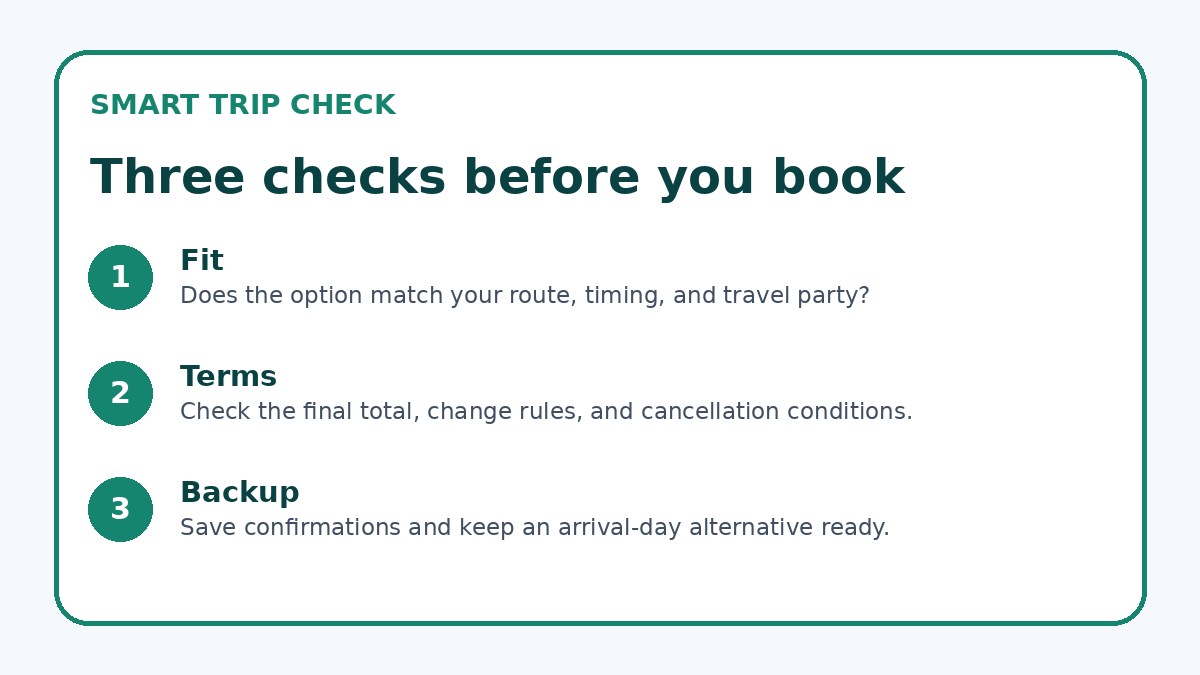
- Map door-to-door time including taxi or transit to the Seoul departure point and the final transfer in Gangneung before you compare options.
- Confirm luggage allowances and handling rules on the provider’s booking page to ensure roll-aboard bags fit and won’t require extra handling.
- Check the exact arrival terminal or stop in Gangneung and identify nearby taxis, shuttle services, or hotel pickup procedures.
- Build at least a 30–60 minute buffer between your planned arrival and any scheduled meeting, adjusting for transfer complexity.
- Save contact details for your accommodation and meeting host and have a local taxi app or number ready for the final leg.
- Before booking, review refund and change policies so you can quickly switch to an alternative without unexpected penalties.
Disruption backup: practical alternatives if plans change
Every business trip needs a clear backup plan. Identify at least one alternative departure later in the day and a different mode you could switch to if your primary option is delayed or full. For example, if you planned a direct service but it’s canceled, a combination of a different rail segment plus a local taxi, or a coach leaving from a different terminal, might still get you to your meeting with modest delay. Know the refund and change policies for your booking so you can make quick decisions without losing unpredictable funds.
Also prepare an on-the-ground play: keep contact numbers for your meeting host and hotel, pack a portable charger, and have a rideshare app or local taxi number saved for immediate last-leg pickup. If you rely on a single early-morning departure, identify nearby business lounges, co-working options, or café spaces in Gangneung where you could work for an hour if you arrive earlier than planned or face an unexpected wait.
Rail & Intercity Transport questions travelers ask
Should I prioritize shorter ride time or fewer transfers when traveling for a meeting?
Prioritize fewer transfers if your main goal is to arrive ready to work. Shorter ride time means little if you then have to drag luggage across stations or wait for connecting services. Fewer handoffs reduce stress, lower the chance of delay, and save energy for the meeting. However, if a significantly faster service departs from a convenient terminal and still keeps transfers minimal, that can be preferable. Always calculate the full end-to-end time and the condition you’ll be in on arrival.
How can I verify whether an arrival point in Gangneung is convenient for my meeting address?
Check the precise arrival terminal or stop listed on the booking confirmation and map it against your meeting address. Measure the transfer time by taxi or public transit during the time of day you’ll be traveling, and account for elevator or walking distances with luggage. If the booking page lacks specific arrival-location details, contact the provider or use a current aggregator like Trip.com to confirm. Also ask your hotel or meeting host if they offer pickups or recommend a reliable taxi service.
What’s a sensible backup plan if my booked service is delayed or canceled?
A sensible backup includes at least one later departure you could catch, and an alternate mode (coach, different rail route plus taxi, or a local chauffeur) that can still get you to Gangneung. Keep the ability to rebook quickly—know the provider’s change policy and have payment details ready. Communicate with your meeting contact about potential delays and have a contingency location (hotel lobby or nearby café) where you can work if arrival shifts. Pre-saving local taxi options speeds up the final-leg switch.
Final decision note
For business travelers, the most practical Seoul to Gangneung transport option is the one that minimizes door-to-door friction: the right balance of terminal convenience, low luggage handling, and dependable timing. Direct rail or coach that lands you near your meeting, or a mixed plan that reduces transfers, often makes the most sense; but always quantify the full journey rather than just ride time. Prepare a backup option, confirm luggage and arrival-terminal details on the provider’s booking page, and save local transport contacts for the final leg. These steps keep travel predictable and let you focus on the work that awaits in Gangneung.
Continue planning
Check current options and final conditions
Use the provider page to confirm live availability, the final total, cancellation terms, and every condition that matters to your trip.
This evergreen planning guide was created with AI-assisted drafting and a structured quality review. It does not display live prices, schedules, availability, visa guidance, or provider rankings. Verify current details before booking. Some links are affiliate links; we may earn a commission at no additional cost to you.