If you’re taking the route from Bangkok to Chiang Mai, the practical decision isn’t just which train, bus, or flight to pick — it’s how you’ll get between terminals, stations, and your door at both ends. For first-time visitors the easiest path is often: choose the transport mode that fits your luggage and schedule, book a single transfer or timed taxi to the departure terminal, and leave a buffer for traffic or immigration. This article gives a short, actionable plan up front, then explains the tradeoffs between rail, coach, and air; how to weigh terminal fit and luggage friction; planning for timing flexibility; and a straightforward disruption backup. The focus is door-to-door practicality: how to move when you land, arrive or change stations, and what to verify on booking pages so there are no surprises on travel day.
Choosing between train, coach, and flight for the whole door-to-door trip
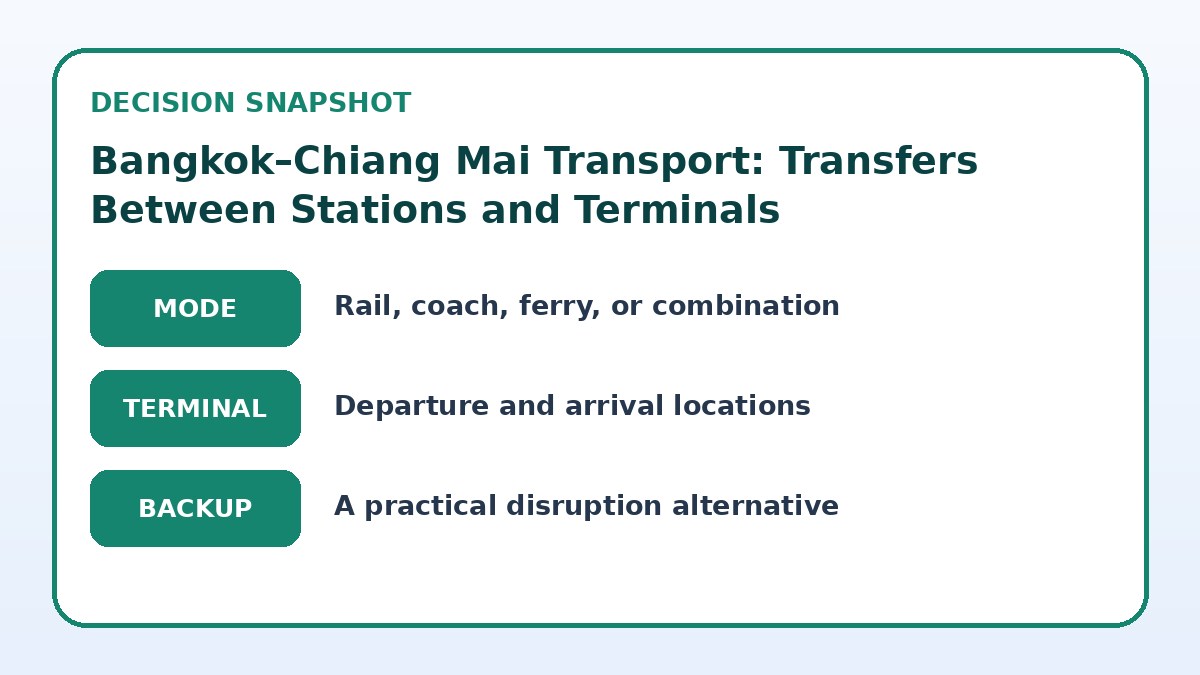
Start by looking beyond the ride itself: consider where each mode drops you in Bangkok and Chiang Mai, how your luggage will be handled, and what onward transfers are available. Trains usually depart from major stations that are well connected but may require a longer transfer from Bangkok hotels or airport terminals; coaches often leave from bus terminals that are close to city coach hubs; flights use airports that need a longer taxi or airport-rail connection. Compare total door-to-door time — not just moving time — and include time for check-in, security, and baggage retrieval.
Next, match the mode to your personal priorities. If you want a relaxed overnight option and minimal transfers at either end, some sleepers can do well for overnight rest but require you to reach the correct train station in Bangkok. If minimizing time on the ground is crucial, a flight shortens transit time but adds airport transfer complexity. For budget and simplicity, a direct daytime coach can be straightforward but may be affected by road congestion. Decide on luggage comfort, how many transfers you’re willing to tolerate, and whether you prefer fixed schedules over flexible arrival windows.
Choose the end-to-end journey plan
| Journey approach | Best for | Friction to check |
|---|---|---|
| Direct daytime coach from city terminal to city terminal | Travelers wanting simple, single-stage transfers with minimal terminal switching | Can be affected by road congestion; arrival terminal may still require a short local taxi |
| Overnight train with station transfers | Those who prioritize sleeping during travel and minimizing daytime transfer time | Requires reaching the correct train station and managing luggage during boarding and arrival |
| Flight with airport transfers at both ends | Travelers who need the shortest onboard time and can handle airport transfers | Adds airport check-in and security time plus potentially longer taxi transfers to central hotels |
| Mixed-mode: fly one way, train or coach the other | Flexible itineraries balancing time savings and scenic or cost preferences | Requires planning different terminal transfers and matching luggage handling between modes |
Check live intercity options
Look beyond the ride itself and compare terminals, transfers, luggage, and arrival fit.
Terminal fit and luggage friction: what matters on arrival and departure
Assess how each terminal handles luggage and passenger flows. Airport terminals often have dedicated baggage belts and taxis outside the arrivals hall, but reaching city centers can mean 30–90 minutes depending on traffic and distance. Major train stations have luggage storage and porters in some cases, though available services vary; check whether your train option includes space for large suitcases and whether you’ll need to carry bags up stairs or between platforms. Bus terminals usually place luggage under the coach and provide help loading, but expect to transfer from the terminal to your hotel by local taxi or tuk-tuk.
Think about friction points when planning connections: transferring between Bangkok’s different stations or between an airport and a train station can add time and effort. If you’re changing from plane to train, plan a buffer for immigration, baggage, and travel to the train station. For heavy luggage, choose modes and stations with lift access or book a private transfer that loads your bags for you. Verify what baggage rules and size limits each operator has on their booking page to avoid surprises at the terminal or station.
Timing flexibility: realistic buffers and when to tighten your schedule
Create a transfer plan with clear minimum and preferred buffers. Minimum buffer covers check-in/boarding and moderate traffic; preferred buffer adds time for delays, restroom breaks, and unexpected queues. For flights, include time for airport security and potential lineups; for trains and coaches, factor in earlier arrival if you want a seat choice or to store luggage. If you’re on a tight schedule because of onward connections or evening plans, pick earlier departures or book transfers that arrive well before the next leg—tight connecting windows increase stress and risk.
Tight schedules make sense only if you have reliable, short transfers or if you’ve booked a through-ticket or timed private transfer. If you’re flexible with dates or can travel overnight, you can compress your total travel days and reduce daytime transfer risk. For fixed appointments in Chiang Mai (events, tours), aim to arrive a few hours earlier than the activity start time. Always check real-time conditions on the day — traffic apps and station alerts — before departing your accommodation so you can adjust your transfer timing proactively.
Compare the practical alternatives
Use the final page to confirm what is actually offered on your dates and save a workable fallback.
Intercity travel checklist
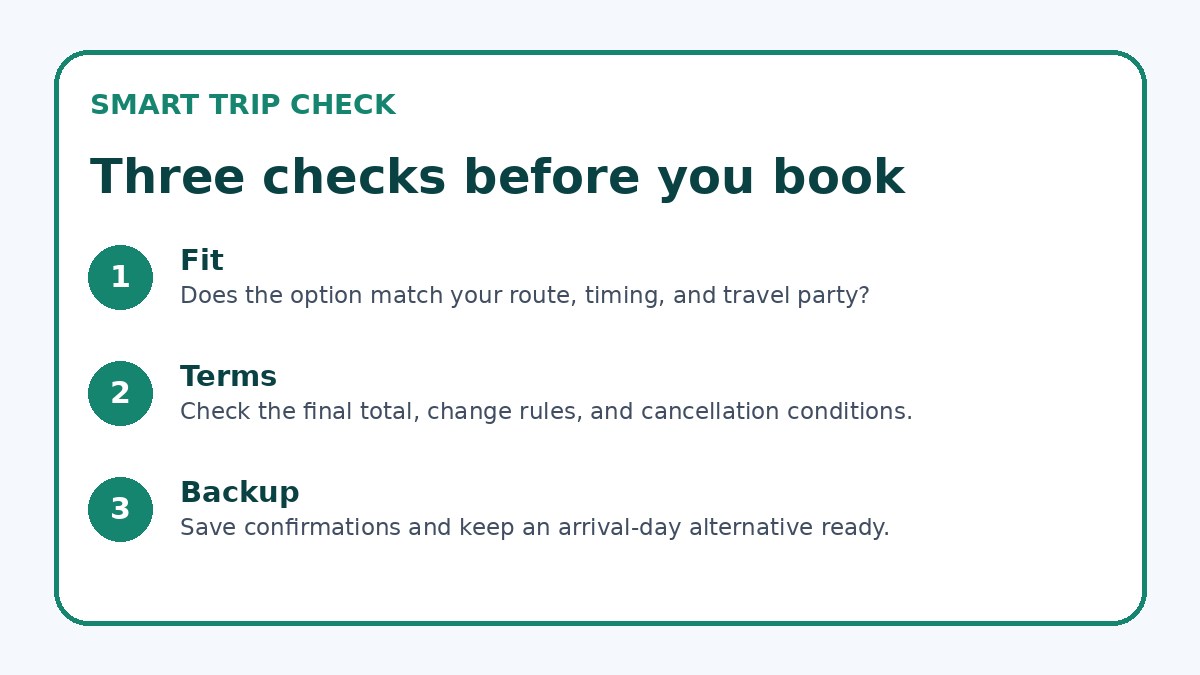
- Confirm the exact departure and arrival terminals/stations on your final booking page and save those addresses to your phone
- Map the transfer route from your accommodation to the terminal and note alternative routes in case of traffic or closures
- Book a timed taxi or private transfer if you carry heavy luggage or want door-to-door reliability
- Allow a conservative buffer (at least double your estimated travel time in peak traffic) for transfers in Bangkok
- Save screenshots of your bookings, train or flight numbers, and contact info for the operator and your hotel
- Identify at least two realistic alternative departures (later train/coach or next flight) and check rebooking rules
Disruption backups: practical alternatives and on-the-day rules to follow
Prepare at least two backup plans: one close alternative for small delays (later train, next coach, or a different flight) and another for major disruptions (overnight stay or switching modes). Know the next few departures for trains, buses, and flights from your origin so you can rebook quickly if needed. Keep contact details for your accommodation and any booked tours; sometimes adjusting a hotel check-in or tour start is easier than forcing a risky transfer. If you booked refundable or changeable tickets, confirm refund and change processes on the provider’s booking page before travel.
On travel day, follow a clear sequence: monitor your departure’s real-time status, leave with conservative time margins, and prioritize reaching the departure terminal rather than squeezing in extra sightseeing. If you face a missed connection, calmly gather booking references and ask staff about rebooking options. For international visitors, keep passport and booking confirmations accessible. Consider Trip.com or the provider’s official site to compare current alternative departures and policy details, but always confirm final rebooking steps with the operator you booked through.
Rail & Intercity Transport questions travelers ask
Which departure point in Bangkok is best for least transfer hassle to Chiang Mai?
There isn’t a single best departure point; choose the one that minimizes your door-to-door time. If you’re staying near the airport and value speed to the air, flying from Bangkok’s airport may be quickest despite airport check-in. If you’re in central Bangkok and prefer fewer luggage hassles, an overnight or daytime train from the main rail station could mean a simpler transfer to and from city hotels. Compare the exact addresses on your booking, estimate taxi travel time from your accommodation, and factor in peak traffic before deciding.
How much time should I leave between arriving in Bangkok and catching a train to Chiang Mai?
Plan for a buffer that covers immigration and baggage (if you’re arriving internationally), transit to the train station, and a margin for traffic. For international arrivals, allow extra time for passport control and baggage; then add realistic road travel time to the station and at least 30–60 minutes to spare before your train departs. If you prefer less risk, consider arriving a day earlier and staying near the departure station or airport so your onward journey is stress-free and not dependent on same-day transfers.
What should I verify on the provider’s booking page before finalising transport?
Check the exact departure and arrival terminals or stations, baggage allowance and any size/weight restrictions, the provider’s change and cancellation policy, and whether you need to print tickets or can use mobile boarding. Also confirm whether the ticket includes seat reservation, overnight berth assignments, or only basic carriage. If a through-transfer or combined ticket is offered, read how rebooking or missed connections are handled. For up-to-date departure alternatives and on-the-day statuses you can compare options on Trip.com, but always follow the provider’s official rebooking instructions.
Final decision note
For first-time visitors traveling Bangkok to Chiang Mai, make choices around transfers as consciously as you pick the main mode. Decide whether you prefer fewer, predictable transfers (paid timed taxi or private transfer) or are willing to accept more local transits for savings or scenery. Always check terminals and baggage rules on the final booking page, map the transfer route from your accommodation, and leave a sensible time buffer. Prepare two fallback options and have contact details and booking references handy. With realistic planning focused on door-to-door movement, you’ll reduce stress and make the trip itself more enjoyable.
Continue planning
Check current options and final conditions
Use the provider page to confirm live availability, the final total, cancellation terms, and every condition that matters to your trip.
This evergreen planning guide was created with AI-assisted drafting and a structured quality review. It does not display live prices, schedules, availability, visa guidance, or provider rankings. Verify current details before booking. Some links are affiliate links; we may earn a commission at no additional cost to you.