If you’re traveling from Osaka to Taipei with extra luggage, your first decision should be which Osaka airport will make the trip simplest and least risky. Kansai International (KIX) and Osaka Itami/Osaka International (ITM) present different tradeoffs for surface access, flight options, checked-bag allowances and transfer complexity. For travelers prioritizing fewer baggage handoffs and clearer checked-bag rules, the practical choice is the airport offering the most direct service to Taipei with straightforward baggage handling and a schedule that matches your arrival window at the Osaka airport. This guide gives the quick practical answer up front, then walks through routing differences, baggage and connection risks, schedule fit, and fare conditions so you can pick the departure airport that reduces stress, saves time at check-in, and limits potential fees. Prepare exact travel dates, passenger ages, and the number and weight of your bags before you compare live flight options.
See live routes for your exact travel day
Compare direct and connecting choices with the same baggage and traveler details.
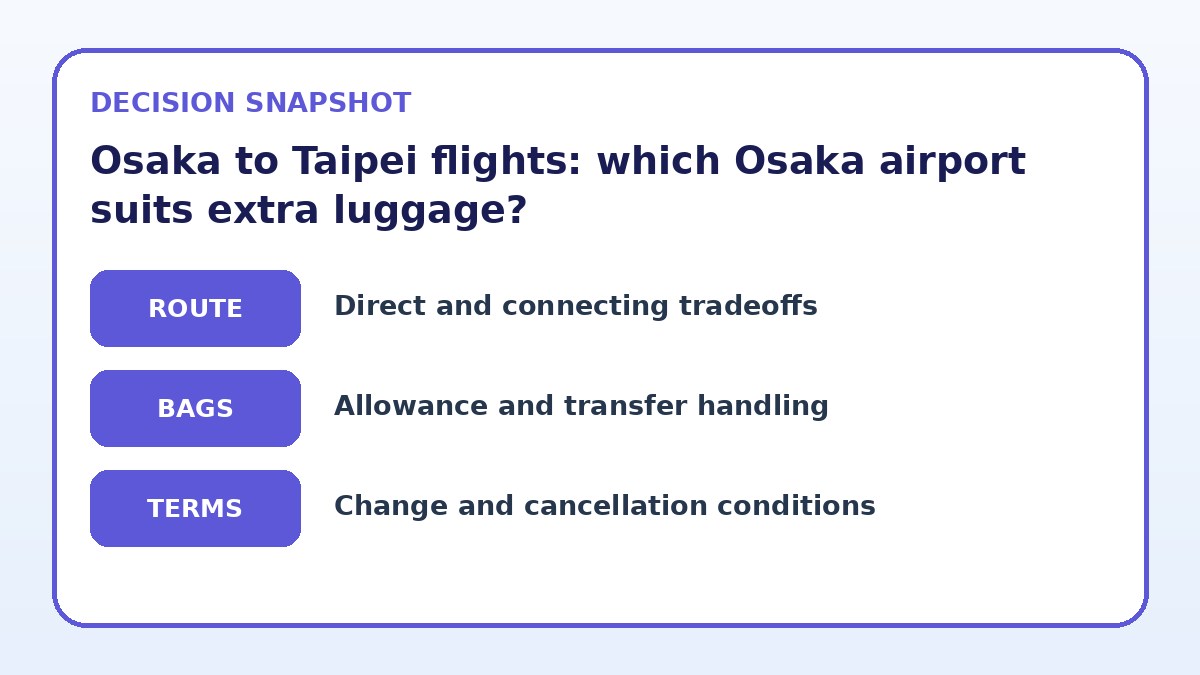
Routing: direct service and surface access
Direct flights from an Osaka airport to Taipei cut the number of times baggage changes hands and reduce the complexity of your trip. When comparing airports, list which ones offer nonstop options to Taipei Taoyuan or Taipei Songshan on the dates you plan to travel. If only one Osaka airport has direct service for your dates, that often makes it the practical choice for heavy or multiple bags because baggage stays with the same aircraft and airline handling systems for the shortest time possible.
Surface access also affects practicality. Consider how you will get to the departure terminal with bulky luggage—airport trains, express buses, taxis, or private transfers have different capacities and costs for heavy or oversize bags. Factor in the time and effort to move your luggage from a hotel or station to the specific terminal: a closer airport with fewer direct flights might still be better than farther airport connections that require extra transfers and handling.
Baggage and connection risk: single ticket vs separate legs
Booking a single ticket where the airline checks bags through to the final Taipei airport is the safest option for extra luggage. When flights are on the same ticket or operated by partners, airlines typically transfer bags between flights and accept joint responsibility for misrouted luggage. If you book separate tickets—say, a low-cost carrier from Osaka to another hub, then a separate ticket onwards—you assume the risk and must recheck bags through security and check-in for the next carrier. That increases the chance of delays and lost luggage.
If your itinerary includes a connection outside Osaka, check the minimum connection time recommended by the operating carriers for passengers with checked baggage. Allow extra cushion for customs and immigration if you must re-clear security or change terminals. When you cannot get a through-checked bag, bring essential items and at least one carry-on with valuables and any items you can’t risk losing, and plan a longer layover to safeguard against missed connections.
Compare flight-selection strategies
| Flight strategy | Best for | Risk to check |
|---|---|---|
| Choose the Osaka airport with nonstop flights to Taipei | Minimizing baggage handling and avoiding connections | Possibly fewer schedule options or higher fares versus alternate airports |
| Pick the closest or easiest-to-reach Osaka airport | Reducing ground transfer time and effort with heavy bags | May require a connecting flight with extra baggage transfers |
| Select the airport with more daily flights to Taipei | Flexibility if your plans change or you need a later flight | More options can mean varying baggage rules across carriers |
| Book via a single-ticket connection through a partner carrier | Through-checked luggage and consolidated responsibility | Longer total travel time and exposure to partner connection risk |
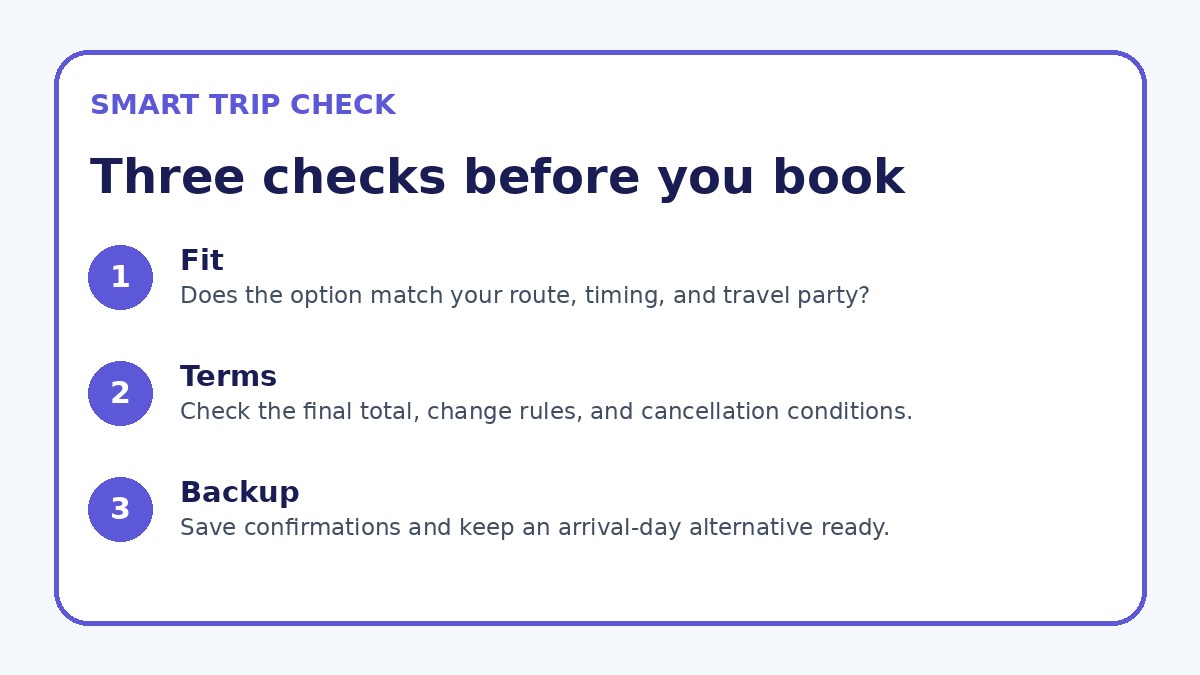
Recheck the complete itinerary
Confirm airports, connection handling, baggage, and change conditions before deciding.
Schedule fit: timing your check-in and transfers
Traveling with large or multiple checked bags requires more time at the airport. Verify the carrier’s recommended check-in window for checked luggage and add buffer time for possible oversize or security checks. Early-morning or late-night departures can be convenient for connecting flights but sometimes have reduced staffing—confirm that bag drop counters and transfer desks will be open at your departure airport for your flight time.
Also compare frequencies: an airport with more daily flights to Taipei gives you alternatives in case of delays; fewer flights mean you’re tied to a specific departure. If you need flexibility, prefer the airport where multiple flights operate throughout the day so you can move to a later flight with the same carrier if necessary. Always check the operating carrier’s final booking page to confirm departure time, check-in deadlines, and whether same-day changes are allowed for your fare.
Flight details to verify
- Confirm exact travel dates, passenger ages, number of checked bags, and weights before searching fares.
- Check each operating carrier’s checked-bag allowance, oversize and overweight rules on its official booking page.
- Verify whether your ticket will be issued on a single itinerary (through-checked bags) or separate tickets requiring recheck.
- Compare transfer times and terminal changes at each Osaka airport to ensure you can meet check-in and bag-drop deadlines.
- If you pack fragile or valuable items, reserve one carry-on so essentials stay with you if checked baggage is delayed.
- Before final purchase, call the airline’s baggage desk to confirm drop-off hours, any required labels, and oversize handling procedures.
Fare conditions: baggage allowances, change rules and refunds
Fare conditions determine whether your ticket includes checked bags and what counts as oversize or overweight. Low-fare economy tickets sometimes exclude checked baggage or limit the number and weight, while higher fare classes include more generous allowances. Before you book, compare the fare rules on the airline’s final booking page for included baggage, fees for additional pieces, and the cost to upgrade. Don’t rely on third-party summaries—verify weight limits, per-piece counts, and dimensions with the operating carrier before purchase.
Also check change and cancellation rules: if you foresee the need to shift dates because of connecting rail or ferry timetables, a slightly more expensive flexible fare might save stress and fees. If your itinerary mixes carriers, verify which carrier’s rules apply to baggage and changes for each flight segment. When in doubt, call the airline’s baggage desk or customer service and get exact instructions on how and where to drop oversized bags at your chosen Osaka departure airport.
Flight Guide questions travelers ask
Is it safer to fly from Kansai or Itami when I have extra luggage?
Safety for luggage mainly depends on whether your flights are direct and whether your bags are through-checked, not solely the airport. If Kansai (KIX) offers a nonstop or single-ticket pairing to Taipei on your dates while Itami (ITM) requires a connection, Kansai could be safer because bags stay on one itinerary. However, if Itami provides direct service on the day you travel and offers easier ground access from your accommodation, Itami may be the more practical choice. Verify nonstop options, baggage rules and check-in windows on the airline’s booking page for the definitive answer.
What should I do if my itinerary involves a separate ticket connection?
If you book separate tickets, plan to collect and recheck your baggage at the transfer airport—this means longer connection times and higher risk of missing the next leg. Pack essentials and valuables in a carry-on, and allow generous layovers to clear immigration or change terminals. Consider buying travel insurance that covers missed connections and delayed or lost baggage on separately ticketed journeys. Finally, check whether you can self-transfer baggage with assistance at the airports you’ll use and confirm recheck locations and times before departure.
How much extra time should I allow at the Osaka airport when traveling with large or multiple bags?
Allow more time than the standard recommendation to accommodate oversize inspections, bag drop queues and potential labeling procedures. Arrive early enough to complete check-in and drop oversized luggage without rushing—this often means adding 30 to 60 minutes beyond the carrier’s stated recommendation, especially during peak travel periods. Also factor in transit time to the terminal with heavy bags: moving between train stations and terminals can take longer than expected. Check the airline’s published check-in and bag-drop deadlines on its booking page and add a comfortable buffer.
Final decision note
For travelers with extra luggage on the Osaka to Taipei route, the most practical departure airport is the one that minimizes baggage transfers and matches your schedule and ground logistics. Prioritize direct flights or single-ticket itineraries that allow through-checked bags, and check the airline’s exact baggage allowances and check-in deadlines before booking. Balance surface access—how you’ll get to the airport with your luggage—against flight frequency and fare conditions. Prepare exact travel dates, passenger details and bag counts before searching live availability so you can compare apples to apples. When in doubt, contact the airline for baggage handling specifics and use a comparison site such as Trip.com only to view current options before confirming on the carrier’s official page.
Continue planning
Check current options and final conditions
Use the provider page to confirm live availability, the final total, cancellation terms, and every condition that matters to your trip.
This evergreen planning guide was created with AI-assisted drafting and a structured quality review. It does not display live prices, schedules, availability, visa guidance, or provider rankings. Verify current details before booking. Some links are affiliate links; we may earn a commission at no additional cost to you.