If your trip plan is to travel from Tokyo to Fukuoka, the practical choice often comes down to a single question: do you want the convenience of a nonstop flight or the potential flexibility and schedule options of a connecting itinerary? For most first-time visitors focused on simplicity, a direct flight from one of Tokyo’s airports to Fukuoka’s airport will save time, reduce stress, and keep ground transfers predictable. Connecting flights can make sense when direct seats are limited, when you’re building a multi-city itinerary, or when price and loyalty benefits favor a stopover. Read on to learn the decision criteria to compare flights, how to evaluate total door-to-door time, what to verify before booking, and a compact checklist to make the right choice for your travel style.
Practical differences: time, comfort, and luggage
When comparing direct and connecting Tokyo to Fukuoka flights, start by calculating total door-to-door time rather than only flight duration. Direct flights minimize the number of takeoffs and landings and remove the need to change aircraft, which reduces complexity for travelers with limited hand luggage or those unfamiliar with Japanese airports. That simplicity typically means less transit stress, fewer opportunities for missed connections, and a straightforward arrival at Fukuoka where you can proceed directly to baggage claim or onward transport. For first-time visitors, fewer moving parts often equals a more relaxing travel day.
Connecting itineraries can still be attractive, especially if your preferred departure time isn’t available non-stop. A connection gives you a broader selection of carriers, departure windows, and sometimes overall lower fares when you’re flexible. However, connections add checkpoints: you must know whether baggage checks through to your final destination, whether you need to pass immigration or security again, and whether different terminals require extra transfer time. These details affect comfort and luggage handling, so verify transfer procedures on the airline or booking page before committing.
When a connecting flight is worth considering
Consider connecting flights if your schedule is constrained by price, loyalty program benefits, or specific routing needs. If a nonstop departs only at inconvenient hours or is sold out, a connection that reduces overnight waits or aligns with a sightseeing plan in Tokyo might be better. Connecting options can also be useful when building a multi-leg trip across Japan or the region; for example, if you plan to stop in another city en route to Fukuoka, a planned connection can double as a short city visit without separate bookings.
That said, only pick a connection if the layover is long enough to comfortably clear any required procedures. Short layovers can be risky, especially across different terminals or airlines that do not interline baggage. If you value predictability and are traveling on a tight schedule—early meetings, guided tours, or railway connections from Fukuoka—lean toward a direct flight. But be pragmatic: when direct options are extremely limited, a well-planned connecting flight can be a practical alternative.
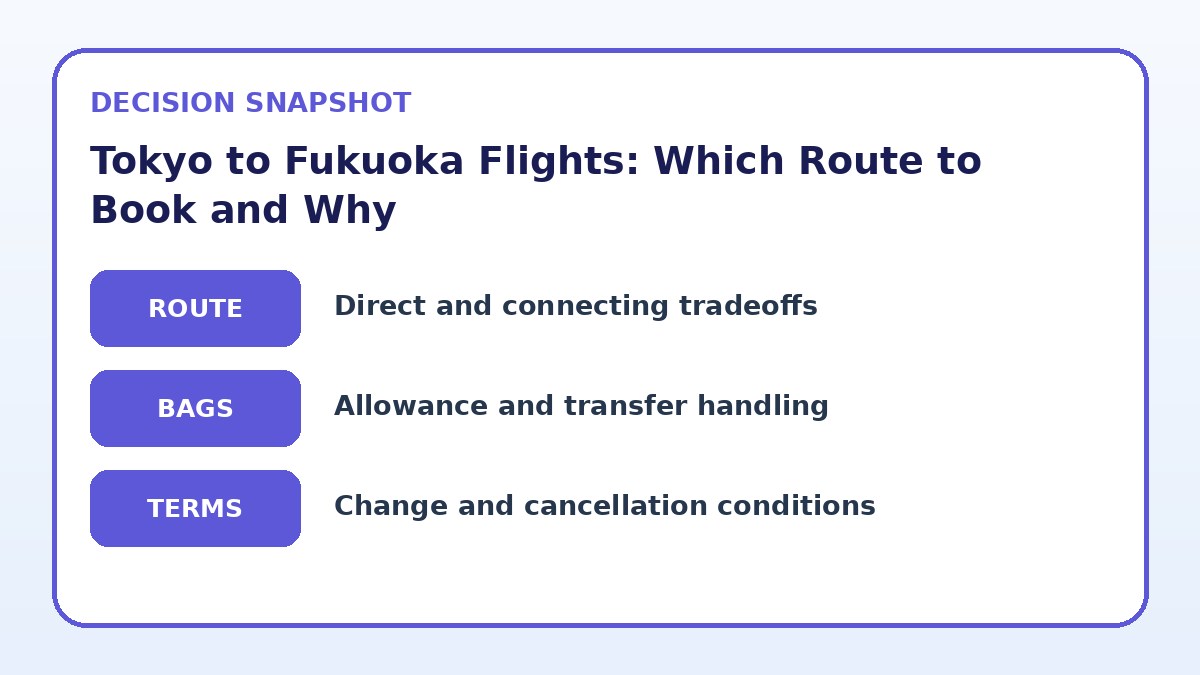
| Approach | Best for | Tradeoff to check |
|---|---|---|
| Direct flight | Travelers who prioritize simplicity, shorter door-to-door time, and minimal transfer risk. | Fewer schedule options and sometimes higher fares or sold-out seats at popular departure times. |
| Connecting flight on one ticket | Passengers seeking more schedule choices or better loyalty/reward routing with the protection of interline baggage transfer. | Longer total travel time and potential for missed connections if layovers are tight. |
| Self-transfer connecting flights (separate tickets) | Flexible, experienced travelers aiming to mix carriers or add a stopover at lower cost. | You assume baggage and recheck risk; missed legs can lead to extra expense and rebooking hassle. |
| Multi-city or stopover routing | Travelers who want to visit another city en route without separate tickets. | Requires careful time planning and potentially more luggage handling; adds complexity to the itinerary. |

How to compare total cost and convenience
When evaluating Tokyo to Fukuoka flights, include ancillary fees and convenience costs in your comparison. A cheaper connecting ticket may come with additional charges for checked bags, seat selection, or airport transfers that erode savings. Also factor in the cost of potential overnight stays during long connections and the value of your time; a seemingly small fare difference might not be worth the extra hours lost to travel. For many first-time travelers, the convenience premium of a direct flight is justified by lower hassle and simpler logistics at both ends.
Practical comparison means reading the booking page carefully: confirm whether the airline guarantees baggage transfer on a single ticket, whether you must recheck bags during a self-transfer, and what the minimum connection time is for the airports involved. The airline’s or booking platform’s final page will have those operational details — check them before paying. If you rely on a third-party site for comparison, validate the same rules on the operating airline’s official page to avoid surprises at the airport.
Before you book
- Confirm on the airline’s booking page whether checked baggage is immediately transferred to your final flight for connections.
- Compare total door-to-door travel time, including recommended airport arrival, transfers, and ground transport in Tokyo and Fukuoka.
- Verify minimum connection times and whether transfers require moving between terminals or customs/immigration.
- Check cancellation, change fees, and rebooking policies on the final ticket page before completing payment.
- If booking separate tickets, plan buffer time and understand that missed connections may not be protected by either carrier.
- Use a reliable comparison tool (Trip.com is an option) and then validate operational details on the operating carrier’s official site.
Deciding factors for first-time visitors
Priorities for first-time visitors usually center on simplicity, predictability, and minimizing unfamiliar procedures. If this describes you, choose a nonstop flight from Tokyo to Fukuoka when one is available at a suitable time. Nonstop flights reduce the number of airport transitions, lower the chance of misrouting luggage, and make arrival planning in Fukuoka easier—helpful when you’re navigating unfamiliar transport links, finding accommodation, or on a short trip.
If you’re comfortable with navigating airports, have flexible time, or want to save money, consider a connecting flight but plan conservatively. Pick connections with generous layovers (especially if terminals differ) and prefer itineraries on one ticket when possible so the airline has responsibility for missed connections. Finally, factor in your tolerance for risk, how well you handle airport procedures in foreign settings, and whether you’d rather trade a lower fare for a more complex travel day.
Frequently asked questions
How much longer does a connecting Tokyo to Fukuoka itinerary usually take compared with a direct flight?
Total additional time depends on the length of the layover and the transfer process, but connecting itineraries often add at least one to several hours to the journey. To estimate the real difference, add the scheduled layover plus any extra time required to change terminals or re-clear security. Remember to include recommended airport arrival windows and potential delays. For meaningful comparison, calculate door-to-door time from your starting point in Tokyo to your arrival location in Fukuoka rather than focusing solely on airborne time.
Can I check my bags through to Fukuoka on a connecting ticket?
Many airlines will check baggage through to your final destination when both flights are on the same ticket and the carriers have interline agreements. However, rules differ by carrier and fare class, so always confirm on the booking or airline’s official page. If you buy two separate tickets, you often need to claim and recheck luggage between flights—plan extra time. If baggage transfer is important to you, prioritize single-ticket itineraries or verify transfer arrangements with the airline before you book.
What layover time should I allow when choosing a connecting flight through a Tokyo airport?
Allow sufficient time to move between gates and terminals, clear any required security checks, and handle baggage if needed; conservative travelers should budget a generous cushion. Minimum connection times published by airlines and airports are a baseline but may not account for crowding, gate changes, or long walks between terminals. If you prefer reduced stress, choose connections with extra buffer time, and avoid very tight transfers—especially if you must change terminals or pass through customs.
Final planning note
For first-time visitors deciding how to travel from Tokyo to Fukuoka, start with your top priorities: simplicity, time, cost, and tolerance for airport navigation. A direct flight usually wins on simplicity and reliability, making it a smart default for travelers who want an uncomplicated arrival in Fukuoka. Connecting flights can be a sensible alternative when direct options don’t match your schedule or when you need a specific routing; they demand more planning around baggage, layovers, and potential terminal changes. Always verify the airline’s baggage transfer policy, connection minimums, and change/cancellation rules on the carrier’s final booking page before you pay. This focused check will help you pick the option that fits your itinerary and comfort level.
Continue planning
Check current options and final conditions
Use the provider page to confirm live availability, the final total, cancellation terms, and every condition that matters to your trip.
This evergreen planning guide was created with AI-assisted drafting and a structured quality review. It does not display live prices, schedules, availability, visa guidance, or provider rankings. Verify current details before booking. Some links are affiliate links; we may earn a commission at no additional cost to you.