If your trip to Singapore is work-focused, pick the hotel neighborhood first, then tune the room choice to that area. For most business travelers, proximity to meeting venues and efficient airport or MRT links matter more than a larger suite; conversely, if long in-room hours or client hospitality are expected, prioritize room layout and services. This guide gives a fast decision path: shortlist an area based on meetings and transit, map daily routes to spot friction, decide the minimum room features you need for productivity and rest, and confirm the booking terms you’ll rely on. The aim is to have a clear shortlist of 2–3 areas you can confidently open in a live booking tool—then pick the room type that matches your work rhythm and party size. Follow the sections below to weigh tradeoffs and make an efficient, defensible choice for business stays in Singapore.
Check live stays in the areas that fit
Use your dates and party size to compare current rooms after you narrow the neighborhood fit.
Neighborhood fit: pick the area that matches your agenda
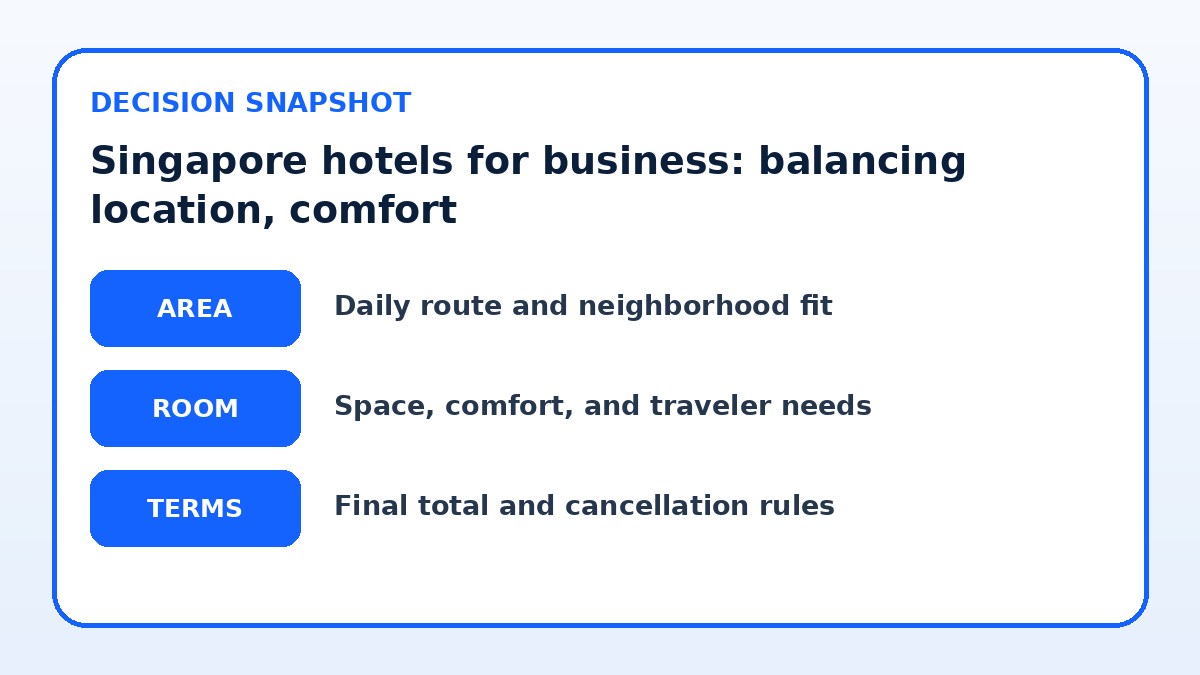
Begin by listing the addresses and times of your meetings, conferences, or office visits. Singapore’s compact size hides a meaningful difference between neighborhoods: the Central Business District (CBD) clusters corporate offices and convention centers; Orchard Road covers corporate and retail meetings with plenty of dining; Marina Bay puts you close to financial institutions and waterfront venues; and areas like Bugis, Tanjong Pagar, or Little India offer more affordable options with quick transit links. Choose the area that minimizes transit steps for your busiest day rather than chasing proximity to every address.
Balance that initial choice against personal preferences: do you value nightlife, quieter evenings, or quick airport access? If client dinners are common, prioritize neighborhoods with a variety of suitable restaurants within walking distance. If you’ll be working late in your room, pick an area where late-night taxis or MRT stations are reliable. The goal is a neighborhood that reduces friction for the majority of your schedule, not every single appointment.
Choose an area-selection strategy
| Area approach | Best for | Tradeoff to check |
|---|---|---|
| Stay in the CBD | Travelers with morning meetings at financial or corporate offices | Higher rates and busier streets, but shortest commutes to corporate hubs |
| Stay near an MRT interchange (e.g., Orchard/Bugis) | Travelers with multiple stops across the city | More transit flexibility but potentially more walking between lines and exits |
| Stay in Marina Bay | Travelers hosting clients at waterfront venues or conferences | Prestigious location with fewer budget room options and longer walks to some neighborhoods |
| Stay in peripheral business areas (Tanjong Pagar/Little India) | Cost-conscious travelers who still need good transit links | Shorter prices but potentially more transfers to reach central corporate addresses |
Daily-route friction: map transfers, not just distance
Once you have two or three candidate neighborhoods, map your typical day’s route: hotel → morning meeting → midday appointment → evening event → airport or back to hotel. Look at how many transfers are required and whether those transfers fall during peak hours. A short 10–15 minute taxi ride can still be slow if it crosses a congested corridor at 8:00–9:00 or 18:00–19:00. Check MRT interchange requirements: fewer line changes mean less risk of delays and easier recovery if schedules slip.
Also factor in check-in/out logistics and luggage handling if you’re moving between hotels or taking early/late flights. If you need to arrive or depart outside standard hours, compare how straightforward taxi or private transfer pickup is from each neighborhood. Finally, consider practical on-the-ground friction: elevator wait times in large buildings, foot traffic for short walking connections, and the availability of co-working or meeting rooms at or near the hotel when plans change.
Now compare like with like
Keep the same dates, guests, room needs, and cancellation preferences while you compare the final choices.
Room and party needs: what to prioritize in-room
Decide the minimum room features that will make you productive: a comfortable workspace (desk, chair, outlets), consistently fast Wi-Fi, blackout curtains for rest, and reliable climate control. If you routinely host clients in-room, you’ll also need a seating area, a hospitality tray or minibar that can be cleared, and clear privacy options. For single travelers on short trips, a compact but well-equipped business room may be ideal; for those entertaining a client or traveling with a colleague or partner, upgrade to a one-bedroom suite or adjoining rooms.
Think about sleep and downtime too: higher floor, quieter-facing rooms often reduce street noise; a bathtub or larger bathroom can help with relaxation after stressful days. If wellness and recovery matter, check whether the hotel has a fitness center with early hours or a 24-hour gym. Remember that room upgrades often come with better cancellation or breakfast terms—verify those on the booking page before selecting an upgraded category.
Hotel booking check before payment
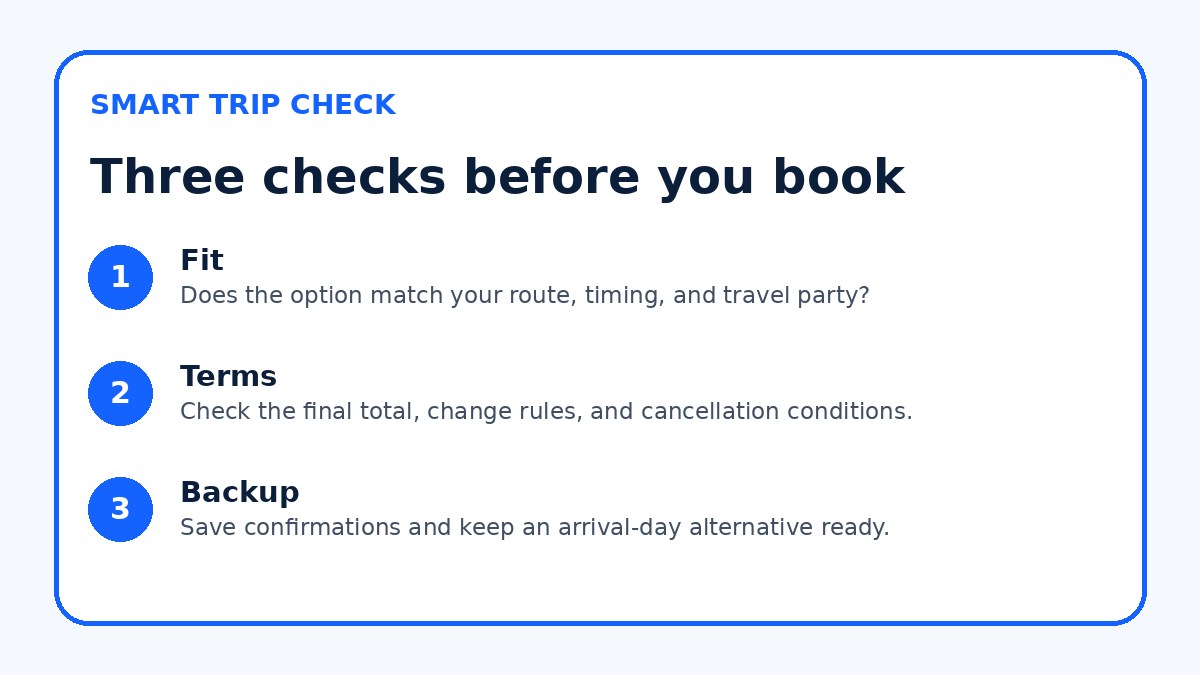
- Pin your most important meeting or office on a map and shortlist two nearby neighborhoods with the fewest transfers.
- Time a sample route between hotel options and your meeting venues during local peak hours to measure realistic travel friction.
- Confirm the room category has a dedicated workspace, reliable Wi-Fi, and blackout curtains before choosing a smaller room for savings.
- Verify cancellation, modification, and breakfast inclusion details on the hotel’s booking page and save the confirmation email.
- Check whether the hotel issues corporate invoices or supports third-party billing if you need expense reimbursement.
- Plan arrival logistics: note early-check-in, late-check-out policies, luggage storage, and the easiest taxi or transfer pickup points.
Final booking terms: what to verify before you book
On the provider’s booking page, confirm the cancellation and modification policy, whether breakfast, Wi-Fi and business-center access are included, and any deposit requirements. If you rely on receipts for expense reports, verify how invoices are issued and whether VAT/GST is separately itemized. For corporate travelers, check whether corporate rates, invoice billing, or third-party booking platforms are supported and whether you’ll need to present identification or company paperwork at check-in.
Also confirm arrival logistics: early check-in or late check-out policies, luggage storage availability, airport transfer options, and the hotel’s policy on additional guests or room-sharing if you plan client visits. When a provider-specific fact could change (for example, free breakfast hours or shuttle schedules), the booking page and the hotel’s direct communications should be your sources of truth. Trip.com can be used as one place to compare current availability, but always verify final terms on the hotel’s own confirmation.
Hotel Guide questions travelers ask
Should I prioritize hotel proximity to the airport or to the CBD for a short business trip?
For short business trips, prioritize proximity to your first or most time-sensitive meeting. Singapore’s Changi Airport is well connected, so a city-center hotel often saves more productive time than an airport-adjacent stay unless you have an early departure or arrival. If your schedule includes late-night flights or very early meetings at the airport, then consider the airport-adjacent option. Always compare door-to-door transfer estimates during peak hours and verify the hotel's shuttle or taxi pickup options on the booking page.
How do I judge whether a room’s Wi-Fi is reliable enough for video calls?
Look for explicit mentions of business-grade or high-speed internet on the hotel page and read recent guest comments for mentions of video call quality. If the listing lacks details, contact the hotel directly and ask for typical upload/download speeds and whether wired Ethernet is available in rooms. Also ask about peak-hour congestion and backup options (like a business center or a paid dedicated line). Confirm these details on the hotel’s official confirmation so you have a record if you need to escalate at check-in.
Is it worth upgrading to a suite for client meetings or hospitality?
Upgrading to a suite is worth it if you regularly host clients in-room, need separate sleeping and meeting spaces, or require a more formal area for small receptions. Suites give privacy and a seating area that feels less like a standard hotel room, but they cost more and may be farther from public areas like restaurants or meeting rooms. Compare whether the hotel offers complimentary meeting-room hours, an executive lounge, or accessible public spaces that could substitute for a suite when weighing the upgrade.
Final decision note
For business travel in Singapore, make your neighborhood decision first, then choose a room that supports your work rhythm. Shortlist areas tied to your meetings and map realistic daily routes to reveal hidden friction. Once you have a neighborhood, prioritize room essentials—workspace, reliable Wi-Fi, sleep quality, and the right layout for hosting—over extras that do not affect productivity. Finally, confirm cancellation and billing terms, verify facilities you depend on, and save booking confirmations. With those steps you’ll be able to open live inventory and quickly pick a hotel room that balances convenience and comfort for a stress-free business stay.
Continue planning
Check current options and final conditions
Use the provider page to confirm live availability, the final total, cancellation terms, and every condition that matters to your trip.
This evergreen planning guide was created with AI-assisted drafting and a structured quality review. It does not display live prices, schedules, availability, visa guidance, or provider rankings. Verify current details before booking. Some links are affiliate links; we may earn a commission at no additional cost to you.