If you’re flying solo from Seoul to Jeju, the single most useful decision is which Seoul airport will make your trip easiest: Incheon (ICN) or Gimpo (GMP). Practically speaking, Gimpo is usually the closer, quicker city-airport for domestic hops and often reduces transit time to the gate; Incheon offers more international connections and airline choices but can add complexity and extra time. For a solo traveler the tradeoff is simple: save door-to-gate time and connection risk with Gimpo, or accept longer transfers and potentially wider schedule/fare options with Incheon. This guide gives the practical answer up front, then unpacks routing, baggage and connection risk, schedule fit, and fare-condition checks so you can pick the departure point that matches your exact travel dates, baggage needs and tolerance for transit complexity.
See live routes for your exact travel day
Compare direct and connecting choices with the same baggage and traveler details.
Routing: why airport location matters more than flight time
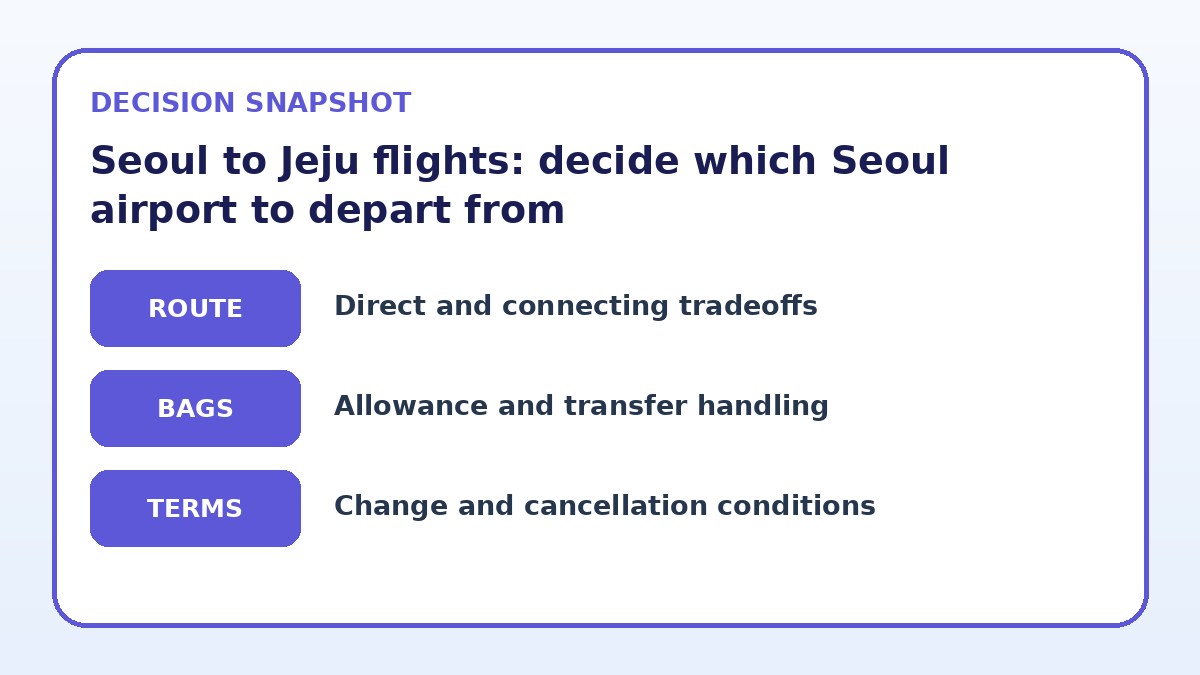
For solo travelers, the practical journey length is door-to-door, not just block time on the aircraft. Gimpo sits closer to central Seoul and several subway and bus lines, which typically shortens surface travel compared with the larger Incheon airport on the city’s western edge. That proximity cuts the amount of time spent navigating taxis, trains, or buses and reduces reliance on tight public-transport connections. If your plan is to depart from a hotel or guesthouse near central neighborhoods, the shorter journey to Gimpo can be the deciding factor that makes a same-day schedule realistic and less stressful.
Incheon’s strengths are different: it’s a hub for international flights and sometimes shows a wider set of schedule options for later departures or different carriers. If you’re connecting from an international flight or need a specific carrier that only flies from Incheon, the extra transfer time can be worth the broader network. Always map your door-to-gate timing for both airports and add a buffer for Seoul traffic, subway delays, or luggage handling so you pick the airport that keeps your overall travel window practical and realistic.
Baggage and connection risk: keep it simple when traveling solo
Baggage handling and transfer risk escalate with extra surface travel and airport hops. If you check a bag, factor in the time needed to drop baggage at check-in and the potential for delays in bag transfer or retrieval. Gimpo’s domestic operations often streamline baggage workflows for short-haul flights, reducing one variable you have to manage alone. Conversely, transferring baggage between international and domestic flights at Incheon can involve more steps—different terminals, security lines, or transfer desks—so verify baggage transfer rules with the operating airline before committing to an Incheon departure.
Connection risk also includes the possibility of missed flights due to traffic or long queues. Solo travelers carry the full burden of rebooking and managing unexpected changes, so favoring the airport with simpler, shorter ground connections lowers that risk. If you must use Incheon because of a carrier or schedule, build extra buffer time and confirm on the airline’s booking page whether your baggage will be checked through or needs recheck at the airport. That exact verification will tell you how much extra time on the ground to plan.
Compare flight-selection strategies
| Flight strategy | Best for | Risk to check |
|---|---|---|
| Prioritize Gimpo departures | Solo travelers based in central Seoul wanting minimal transit time and low connection risk | May have fewer late-night or specific carrier options than Incheon |
| Choose Incheon for schedule variety | Travelers connecting from international flights or needing specific carrier options | Longer door-to-gate time and more steps when transferring baggage or terminals |
| Book based on exact departure time | Those with strict arrival windows on Jeju who prioritize schedule over airport proximity | Could require a longer transfer and more buffer time for ground travel |
| Select by fare conditions and baggage rules | Solo travelers who value flexibility, changes, or checked baggage included in the fare | Sometimes higher ticket cost for better conditions or less restrictive rules |
Recheck the complete itinerary
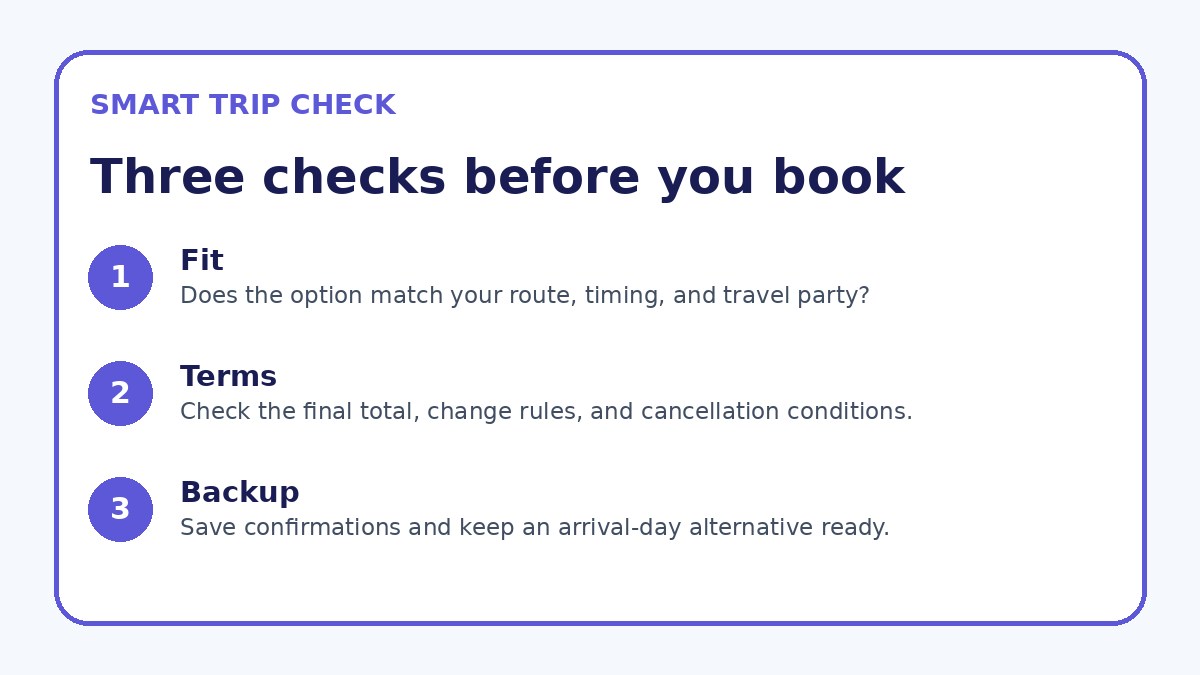
Confirm airports, connection handling, baggage, and change conditions before deciding.
Schedule fit: match departure choices to how rigid your time is
Consider how flexible your itinerary is. If your dates are fixed and you must be on Jeju at a particular hour, prioritize the airport and departure offering the most reliable arrival window from your starting point. For many solo travelers, earlier departures from Gimpo reduce the chance of afternoon delays caused by air traffic or domestic schedule congestion. If you’re comfortable with a moderate transfer and your timing is looser, the slightly wider scheduling at Incheon may let you choose a flight that better aligns with your onward plans on Jeju, such as late-afternoon connections to island activities or accommodation check-ins.
Also think about frequency: some routes may have many same-day departures from Gimpo, giving more backup options without committing to a long transfer. If a preferred time is only available from Incheon, weigh that against the added transit time and potential connection complexity. Use your exact travel date and preferred times to compare both airports’ available flights during booking so you can see whether frequency or a specific hour makes the extra transfer worthwhile.
Flight details to verify
- Write down exact travel dates, preferred departure and arrival times before searching live availability.
- Confirm whether your ticket includes checked baggage and whether bags will be checked through if transferring airports.
- Map door-to-gate travel time for both Gimpo and Incheon from your accommodation and add a conservative buffer.
- Read the carrier’s change, cancelation, and missed-connection policy on the booking page before purchase.
- Decide if you need mobile check-in or seat selection to save queue time and verify those options are available.
- Compare live schedules and fare conditions on at least two booking sites (you may optionally check Trip.com) before finalizing.
Fare conditions: read the ticket fine print before you commit
Solo travelers frequently value flexibility more than a marginal fare saving. Low-fare or basic economy-style tickets can restrict changes, seat selection, and carry-on allowances—important considerations if you want to travel light and move quickly through airports. Always examine cancellation and change fees, baggage allowance specifics, and the carrier’s policy on missed connections. If a cheaper flight requires a tight transfer into a separate airport or terminal, the true cost of a missed flight—time, stress, and rebooking fees—can outweigh any fare advantage.
When comparing fares, check whether the fare includes through-checked baggage and whether the carrier allows online check-in and mobile boarding to reduce queue time. Verify what happens if your inbound and outbound flights are on different tickets or different airports; many airlines won’t accept responsibility for missed connections in those scenarios. For final price and policy confirmation, read the carrier’s rules on the booking page and consider searching current availability on a comparison site such as Trip.com to see real-time options and restrictions before you finalize your choice.
Flight Guide questions travelers ask
If I have a tight schedule, which airport should I pick from central Seoul?
If speed and minimizing surface travel are your priority, Gimpo is typically the more practical choice from central Seoul because it’s closer and usually faster to reach by subway, bus or taxi. That reduces the chance of delays on the ground and lowers connection risk if your schedule is tight. However, check live flight times for your exact date: if the only usable flight is from Incheon, factor in extra transit time and confirm baggage transfer and check-in options on the airline’s booking page before committing.
Can I mix airports—fly into one and depart from the other on the same trip?
Mixing arrival and departure airports in Seoul is possible but increases complexity for solo travelers. If you plan to arrive at one airport and depart from the other, calculate the inter-airport transfer time and any extra luggage handling steps needed. Airlines generally do not take responsibility for missed flights when transfers between separate tickets or different airports are involved, so always verify transfer procedures and allow ample buffer. For risk management, prefer the same airport for arrival and departure when possible, or choose a longer connection window when you must switch airports.
How should I evaluate fares when comparing both airports?
Compare total door-to-door time, the fare conditions, and what the ticket includes—not just base fare numbers. Look for whether the ticket allows changes or refunds, includes checked baggage, and offers online check-in or priority boarding. Add the estimated cost and time of surface transfers (taxi, train, bus) to each airport and factor in the value of having more frequent departures. Always review the carrier’s full policy on the booking confirmation page; that final check will tell you if the fare actually meets your needs as a solo traveler.
Final decision note
For most solo travelers starting in central Seoul, the practical default is Gimpo: shorter ground travel, simpler baggage handling, and lower connection risk for short domestic flights to Jeju. Choose Incheon if you must connect from an international flight or need a specific carrier or departure time that only departs there—just plan extra transfer time and confirm baggage and change policies on the airline booking page. Before you book, gather exact dates, your luggage plan, arrival method to the airport, and any hard arrival times on Jeju. Compare live schedules and fare conditions using current booking tools (optionally Trip.com) and pick the airport that minimizes stress for your specific itinerary.
Continue planning
Check current options and final conditions
Use the provider page to confirm live availability, the final total, cancellation terms, and every condition that matters to your trip.
This evergreen planning guide was created with AI-assisted drafting and a structured quality review. It does not display live prices, schedules, availability, visa guidance, or provider rankings. Verify current details before booking. Some links are affiliate links; we may earn a commission at no additional cost to you.