If you’re arranging Dubai to Doha flights for a family, the most practical priority is balancing route convenience and fare flexibility. For many families the right choice isn’t the absolute cheapest ticket but the option that reduces connection stress: shorter transfer windows, predictable baggage handling, child-friendly seat options and easy rebooking terms. Start by gathering exact travel dates, ages of all children, whether you’ll check strollers or car seats, and any seat or meal needs. That information will change which fares and connections make sense. This guide gives quick, actionable criteria to compare direct and connecting itineraries, explains baggage and connection risk, and shows which fare conditions to verify on the carrier’s final booking page before you commit.
See live routes for your exact travel day
Compare direct and connecting choices with the same baggage and traveler details.
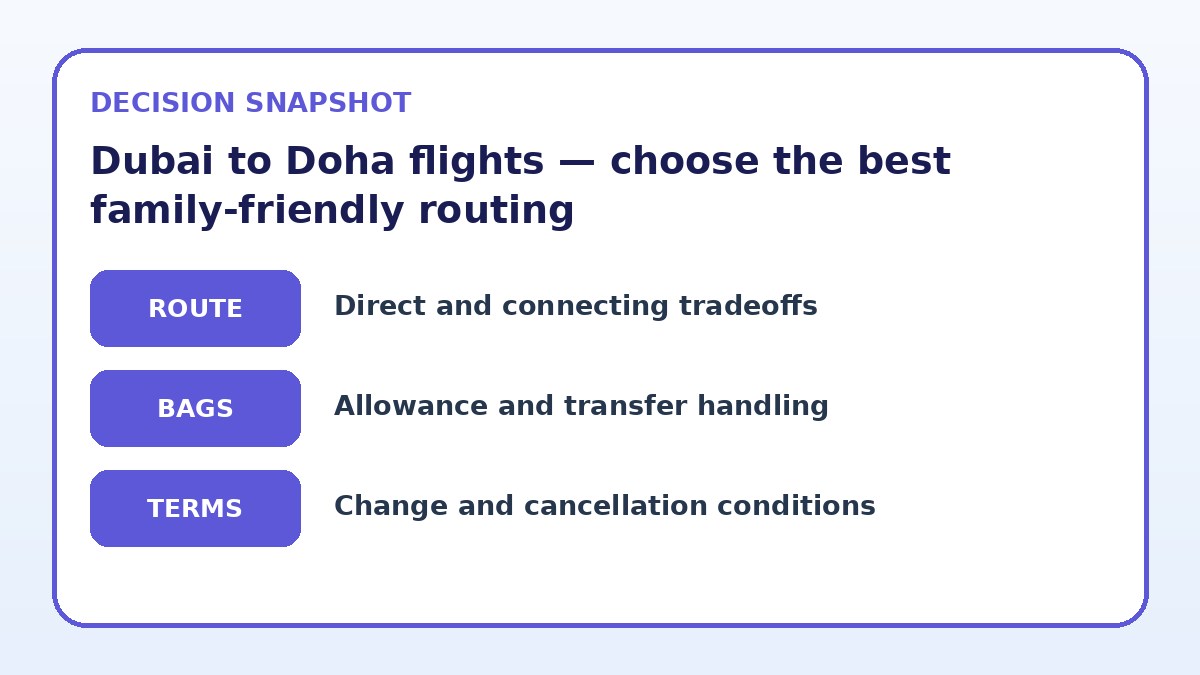
Routing: direct versus single-connection choices
Direct flights are usually the simplest family-friendly option because they eliminate transfer stress: no terminal changes, fewer opportunities for delays to cascade, and less need to worry about moving luggage and strollers. If a non-stop service is available on your dates, compare departure and arrival times against your family’s daily routine. Also check aircraft type and seat layout so you can pick seats that help keep children comfortable, such as bulkhead rows or seats near lavatories for quick access. The practical tradeoff is that direct flights sometimes cost more or have less flexible fare classes, so set a price threshold that reflects how much convenience is worth to your family’s comfort.
When a direct isn’t convenient or available, a single-connection itinerary can be viable if the connection is straightforward: same-terminal transfers, verified through-checked baggage, and a minimum connection time that fits your mobility and baggage needs. Avoid itineraries requiring separate recheck of bags or long inter-terminal transfers unless you have a long layover and plan to book ground transportation or a transit hotel. If you must accept a connection, prioritize carriers and airports known for efficient transfers and clear family assistance — but always confirm specific transfer procedures and baggage transfer assurances on the booking page before you finalize anything.
Baggage and connection risk: practical checks to reduce stress
Families should treat baggage handling as a core booking criterion. Before paying, confirm whether checked bags will be transferred automatically through the connection or require retrieval and recheck, especially when mixing carriers or fare types. If you’re traveling with prams, car seats, or a large amount of luggage, look for itineraries that explicitly list through-checked baggage on the final booking screen. Also verify size and weight allowances per individual fare — cumulative family baggage needs often require a single higher allowance or an extra paid piece that, while adding upfront cost, reduces airport hassle.
Plan for risk with a simple contingency: choose connection windows long enough to cover common minor delays but not so long that children become worn out waiting. If you must accept a tight connection, prioritize flights operated by the same alliance or carrier group because they’re likelier to protect through-checked baggage and rebook affected passengers. Still, check the carrier’s rebooking and assistance policy on the booking page: understand under what circumstances they will move your family to another flight without penalty, and whether you’ll be eligible for meals, hotels, or transfers if a disruption forces an overnight stay.
Compare flight-selection strategies
| Flight strategy | Best for | Risk to check |
|---|---|---|
| Prioritize nonstop or single-carrier itineraries | Families wanting the least transfer stress | Usually higher fares or limited schedule choices compared with mixed-carrier options |
| Choose a cheaper multi-carrier connection | Price-sensitive families willing to accept transfer hassle | Higher risk of separate baggage recheck, missed connection complications, and more time managing terminals |
| Book flexible fare bundles with change options | Families requiring the ability to alter plans without heavy fees | Higher upfront cost but easier rebooking and protection against schedule changes |
| Opt for longer layovers and transit hotels | Families needing recovery time between long flights | Longer travel day and potential extra ground costs despite reduced transfer pressure |
Recheck the complete itinerary
Confirm airports, connection handling, baggage, and change conditions before deciding.
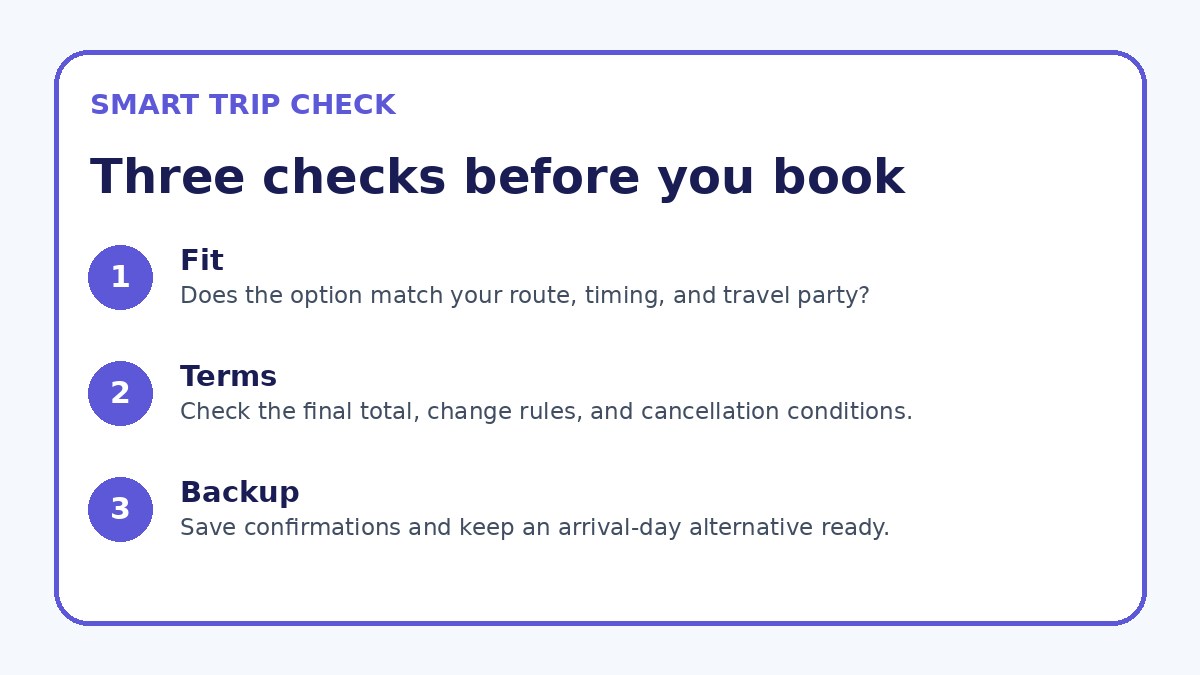
Schedule fit: align flight times with family routines
Pick flight times that align with the family’s sleep, meal, and medication schedules. For younger children, late-evening departures that coincide with bedtime can result in calmer flights if kids will sleep through much of the journey. For toddlers who resist sleeping outside their routine, an early morning departure may be preferable to avoid long stretches of active time in the airport. If you travel with school-age children, weigh school schedules and the need for a full night’s rest before important events at either end of your trip.
Also consider airport arrival and departure times for ground logistics: traffic patterns in Dubai and Doha, child-friendly facilities at the terminal, and your family’s capacity to cope with early wake-ups or late arrivals. If connections are involved, choose layovers that provide a comfortable buffer after any local disruptions like peak-hour congestion. Finally, check seat maps and meal options during booking to ensure you can reserve seats together and request child meals if needed; verify those options on the carrier’s final booking page because availability may change.
Flight details to verify
- Gather exact travel dates, full passport names, birthdates for all children, and any visa-relevant details before searching fares.
- Decide maximum acceptable connection time and whether you require same-terminal transfers or through-checked baggage.
- Confirm stroller, car seat, and infant seat policies on the carriers’ final booking page and note any gate-check procedures.
- Compare seat maps to reserve seats together; book bulkhead or extra-legroom seats only after confirming child-seat compatibility.
- Check the fare’s change and cancellation conditions, plus what is included for checked baggage and seat selection, before entering payment.
- Take screenshots or save PDF copies of fare rules and baggage transfer confirmations shown on the booking page for reference during travel.
Fare conditions: what to verify before you commit
Fare flexibility matters for families more than for solo travelers. Start by checking change and cancellation rules displayed on the booking page: look for low or waived change fees, refundable options, or the ability to buy a flexible bundle at checkout. Examine whether the fare includes seat selection and standard checked baggage — these can be costly add-ons for a family of four. Also verify whether infant fares or lap-child rules apply and whether fees for strollers and car seats are covered or charged separately.
Read the fine print about rebooking and protection for missed connections. Confirm whether the carrier guarantees onward connections when both segments are on a single ticket, and how irregular operations are handled for mixed-carrier itineraries. If you plan to buy travel insurance, confirm which fare rules the insurer requires for changeability and what documentation will be necessary for claims. Always save screenshots or PDFs of the booking terms and the carrier’s change policy during checkout, because provider language can change after purchase.
Flight Guide questions travelers ask
How do I compare direct and connecting Dubai to Doha flights for a family?
Start by listing itineraries with identical passenger details and travel dates so you can compare apples to apples. For each option, check total door-to-door time, number and type of connections, and whether baggage is through-checked. Weigh these against your family’s tolerance for airport time: a direct flight sacrifices little connection risk but may be costlier, while a single connection can work if the airport layout and transfer time meet your mobility needs. Finally, verify the fare’s change policy and the carrier’s family seating options on the booking page before buying.
What baggage rules should families verify when booking a connection?
Confirm whether checked luggage will be automatically transferred between flights or must be collected and rechecked at the connecting airport, especially when itineraries involve different carriers. Check the number, size and weight allowances per passenger and per booking, and look for explicit mentions of prams or car seats. If the booking page doesn’t clearly state through-checked baggage, contact the airline or the booking provider to get written confirmation. That prevents surprises at the gate and helps decide whether to pay for additional checked pieces upfront to avoid juggling large items during a transfer.
Which flight times generally work best for children on this route?
There’s no single best time; match flight times to your children’s individual routines. Young infants often travel best on flights that overlap with their usual naps or bedtime, reducing active periods in the airport. Toddlers may manage better with mid-morning flights after a good night’s rest, while school-age children can handle later departures if it avoids disrupting sleep before important commitments. Consider local traffic to the airport and whether early or late departures increase stress for your household — balance airport convenience with the child’s usual sleeping and eating patterns.
Final decision note
Booking Dubai to Doha flights for a family comes down to tradeoffs: save money with a cheaper, possibly multi-carrier connection, or pay more for a smoother, lower-risk itinerary. Prioritize what creates the least stress for your household—shorter transfer times, through-checked baggage, seat assignments together, and flexible fare conditions. Before finalizing any booking, gather exact passenger details and make comparisons while closely reading the carrier’s baggage transfer rules and fare-change conditions on the booking page. Keep documentation of those terms and consider a flexible fare or travel insurance if your travel dates or circumstances are uncertain. A little extra attention during booking can mean a far calmer journey for everyone.
Continue planning
Check current options and final conditions
Use the provider page to confirm live availability, the final total, cancellation terms, and every condition that matters to your trip.
This evergreen planning guide was created with AI-assisted drafting and a structured quality review. It does not display live prices, schedules, availability, visa guidance, or provider rankings. Verify current details before booking. Some links are affiliate links; we may earn a commission at no additional cost to you.