If you’re arriving to serve as a first-time visitor to Kyoto, your airport transfer decision shapes your first impression and can eat into precious sightseeing time. The two airports most likely involved are Kansai International (international arrivals) and Osaka’s Itami (domestic arrivals). The practical choices are the regional express trains that link to Kyoto, an airport limousine or shuttle bus that goes closer to city hotels, taxis or private transfers for door-to-door convenience, and renting a car if you plan to explore beyond the city. Each option balances cost, luggage hassle, number of changes, and how close you want to be dropped to your accommodation. Read the short comparisons below to match a route to your priorities, then use the checklist to confirm provider details and make a booking that fits your arrival time and luggage needs.
Trains: fast and frequent with transfers to Kyoto
Trains often provide the quickest city-bound backbone from major nearby airports. From the international airport, regional express services and a network of private and JR lines connect into the greater Osaka–Kyoto rail hub. Depending on which airport you arrive at, one or more of these rail options will require a simple station transfer. Train travel minimizes traffic uncertainty and usually drops you at Kyoto Station, where onward subway, bus, and taxi links are plentiful.
The tradeoffs are luggage and navigation: trains can be crowded at peak times, and moving between train types or platforms with large suitcases adds friction. If you need accessibility assistance, check accessibility facilities and reserve seats where possible. Before you book, confirm whether your chosen train is direct or requires changing at an intermediate station and verify luggage allowances, reservable seats, and platform information on the carrier’s official page.
Airport buses: simpler, fewer transfers
Airport limousine and shuttle buses run scheduled services between the airports and key Kyoto destinations, often stopping at major hotels and central transfer points. Buses remove the worry of carrying luggage up stairs or across platforms and can be easier to navigate after a long flight. They also tend to provide more predictable door-to-door routing for travelers who prefer a straightforward ride from terminal to hotel area without switching trains.
However, buses share road traffic with other vehicles, and journey time can vary with congestion—especially during city events or rush hours. If you choose a bus, check exact drop-off locations relative to your accommodation and whether advance seat reservation is recommended. Verify the operator’s luggage policy, how early you should arrive at the bus stop, and where buses board inside the terminal before you commit to this option.
| Approach | Best for | Tradeoff to check |
|---|---|---|
| Train (express or local) | Travelers prioritizing speed and avoiding road traffic | May require transfers and handling luggage between platforms |
| Airport bus / limousine | Those wanting a simple single vehicle to hotel area | Journey time varies with road traffic; check exact drop-off points |
| Taxi or private transfer | Groups, late arrivals, and door-to-door convenience seekers | Higher cost and still subject to road congestion |
| Rental car | Travelers planning flexible day trips outside Kyoto | Parking, tolls, and city driving add complexity and cost |
Taxis and private transfers: convenience at a premium
Taxis and pre-booked private transfers offer the simplest door-to-door service: they pick you up at the terminal curb and leave you at your accommodation. This is the easiest option for travelers with mobility needs, late-night arrivals, families with young children, or those carrying oversized luggage. Private transfers can also be timed to your flight so there’s no worry about missing the last public service of the night.
The tradeoff is cost and potential traffic delays. Taxis and private cars are typically pricier than trains and buses, and journey time still depends on road conditions. If you plan to use a private transfer, confirm exactly where the driver will meet you inside the terminal, whether parking or waiting time is included, and the total fare or cancellation terms on the booking confirmation. Use reputable booking channels and check reviews if you’re choosing an independent operator.
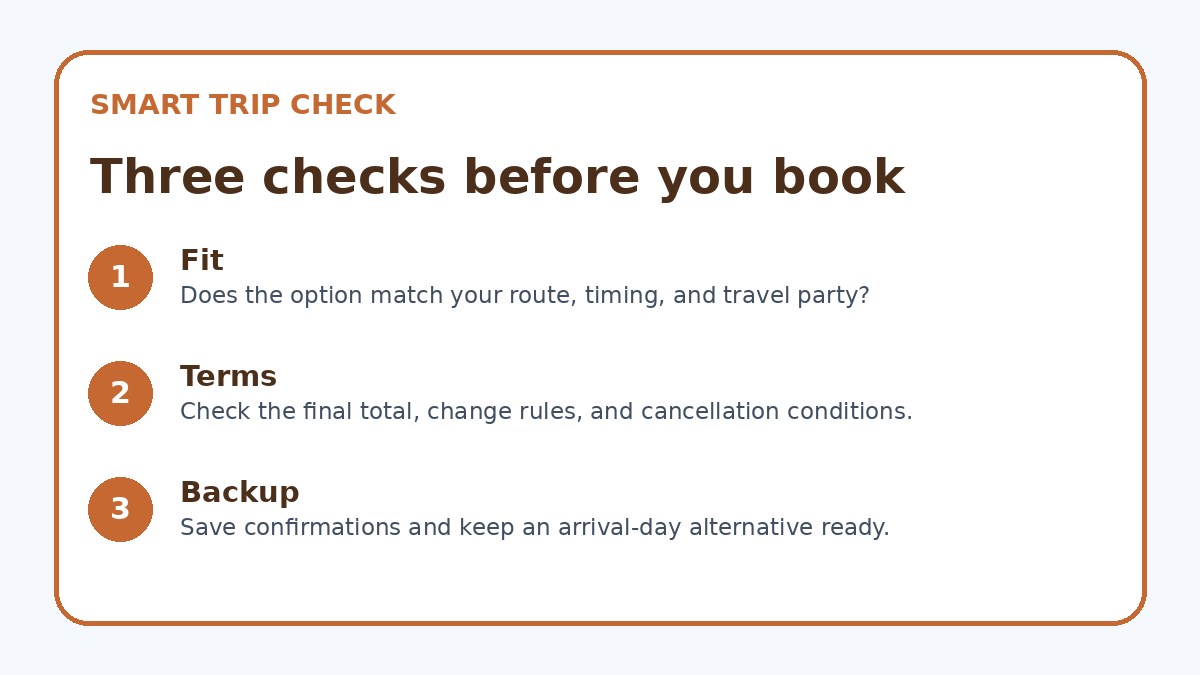
Before you book
- Check which airport you’ll arrive at (Kansai or Itami) and note the terminal for your airline or flight number.
- Compare arrival time to train and bus timetables and whether services are direct or require station changes.
- Confirm luggage rules, seat reservation options, and meeting points on the operator’s official booking page before purchasing.
- If booking a taxi or private transfer, verify the terminal pickup procedure, included waiting time, and cancellation terms.
- Look up hotel drop-off points for airport buses and the nearest train station to your accommodation on a map.
- Decide whether you need accessibility assistance or extra luggage help and arrange it with the carrier in advance.
Renting a car and mixed approaches
Renting a car can be tempting if your itinerary extends to rural or mountainous areas beyond Kyoto, where public transport isn’t as frequent. A rental gives flexibility to stop along the way and carry more luggage, but it also requires comfort driving in Japan, finding parking in Kyoto, and understanding local road rules and tolls. Many visitors find a hybrid approach — train or bus into Kyoto, then a day-rental outside the city — reduces urban parking hassles while preserving mobility for day trips.
If you do rent, confirm the pickup location at the airport, local licensing requirements (e.g., whether an international driving permit is needed), fuel policies, and insurance options on the rental company’s page. For most first-time Kyoto visitors whose plan centers on temples, shrines, and public transit-accessible neighborhoods, renting for the entire stay is usually more work than it’s worth.
Frequently asked questions
Should I plan a direct train from the airport to Kyoto?
Direct trains to Kyoto may be offered from some services, but routes and directness depend on which airport you use and the service you choose. When comparing options, check whether a chosen train is a through service to Kyoto Station or requires changing lines at an intermediate station. If you prefer fewer changes with luggage, prioritize direct services where available, and always verify platform and transfer details on the rail operator’s official timetable before you leave for the airport.
Is an airport limousine bus easier with a lot of luggage?
Yes, buses typically handle larger suitcases more conveniently than trains because they load luggage into a dedicated hold and require less walking across platforms. That ease comes with potential variability in travel time due to road traffic and sometimes farther drop-off points from smaller hotels. If luggage weight or mobility is your primary concern, check the bus operator’s luggage allowances, where buses load inside the terminal, and whether you need to reserve seats ahead of time.
What should I verify when booking a private transfer or taxi?
Ask for the precise terminal meeting point, any extra charges for flight delays or waiting time, baggage handling policies, and the cancellation or change policy before confirming. Confirm the driver’s contact or reference number and whether the price is fixed or meter-based. If arriving late at night, ensure the provider operates at your arrival hour. For peace of mind, book through a reputable platform and check recent traveler feedback—Trip.com can be used to compare availability but verify details on the operator’s booking page.
Final planning note
Choosing how to get from the airport to Kyoto comes down to priorities: speed versus convenience, luggage versus cost, and whether you value a stress-free door-to-door ride or a budget-friendly rail journey. First-time visitors often balance a train into Kyoto Station with an occasional airport bus for simpler hotel drops; taxis and private transfers add convenience when time, mobility, or late arrivals matter. Before you finalize anything, double-check whether the chosen service is direct, where pickups and drop-offs are located, and the provider’s luggage and reservation rules on their official pages. With those checks done, your arrival into Kyoto will be smooth and let you start exploring without avoidable hassles.
Continue planning
Check current options and final conditions
Use the provider page to confirm live availability, the final total, cancellation terms, and every condition that matters to your trip.
This evergreen planning guide was created with AI-assisted drafting and a structured quality review. It does not display live prices, schedules, availability, visa guidance, or provider rankings. Verify current details before booking. Some links are affiliate links; we may earn a commission at no additional cost to you.