Practical answer first: driving on Jeju can be worth it when extra luggage would make buses or taxis slow, costly, or uncomfortable, but only if you confirm insurance wording covers personal property and loading/unloading risks. Many renters assume damage coverage equals baggage coverage — that’s not always true. Before you book, ask for explicit language on personal belongings, trunk contents, roof racks, and third-party claims related to luggage. Also verify whether loss or theft requires a police report and what excess (deductible) applies to property claims. If the policy is vague, get confirmation in writing from the rental company or use an alternative mobility plan. This guide helps you decide whether to drive, what insurance phrases to watch for, how pickup and return add friction with oversized bags, and a realistic non-driving fallback for Jeju travelers.

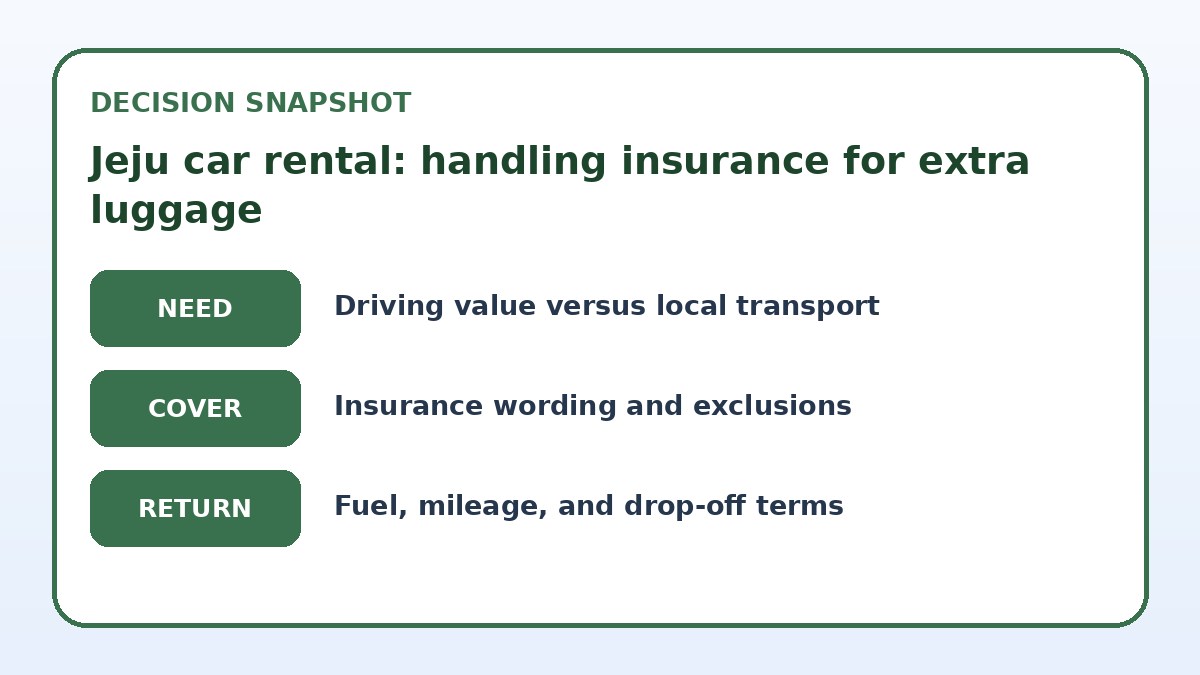
Does driving on Jeju genuinely improve your trip?
Think first about the route value: Jeju is an island with dispersed sights like coastal drives, remote beaches, and hiking trailheads that are easiest to reach by car. If your plan includes carrying multiple suitcases, musical instruments, surfboards, or camping gear, driving reduces the door-to-door effort of transferring items between buses, taxis, and accommodations. Beyond convenience, a car lets you start early and leave late, which matters if you’re timing sunrise hikes or wanting to move between distant attractions without repeating transfer steps.
Weigh that against the cost of handling extra luggage: tight parking, narrow roads near scenic viewpoints, and occasional single-lane rural stretches. Also consider how much time you’ll actually spend behind the wheel versus parked. If most of your visit is concentrated in a single town or resort, driving may add complexity instead of saving time. Decide based on where you intend to sleep, how many long drives are on your itinerary, and how much physical effort you want during transfers.
Decide whether driving earns its place
| Mobility strategy | Best for | Cost or friction to check |
|---|---|---|
| Self-drive rental with full baggage coverage add-on | Travelers who value route flexibility and can confirm explicit luggage language | Higher cost and need to verify written policy; pickup/return friction remains with heavy items |
| Self-drive basic rental without baggage coverage | Light packers or those willing to accept luggage loss risk for lower base rates | Lower price but potential out-of-pocket losses and unclear liability during theft or damage |
| Private transfer or chauffeur service | Bulky-luggage travelers who prefer door‑to‑door service and minimal handling | Less flexibility en route and potentially higher per-trip cost versus a multi-day rental |
| Public transport plus luggage courier or hotel-forwarding | Those avoiding driving entirely while moving heavy items with minimal in-person handling | Requires scheduling couriers or coordinating hotel pickup; less spontaneity for day trips |
Check live rental choices only after the route test
Use the exact driver, dates, pickup point, and return plan to compare current conditions.
Reading insurance wording: the phrases that matter
Insurance pages often mix vehicle damage and personal property coverage; for travelers with extra luggage, that distinction is crucial. Look for explicit coverage of “personal effects,” “baggage,” or “contents of the vehicle.” Check exclusions for items stored on roof racks, in unlocked trunks, or left unattended. Note whether coverage applies only while the vehicle is locked and attended, and whether theft from a parked car requires a police report to make a claim. These operational conditions determine whether minor theft or accidental loss is covered.
Also scan for limits, deductibles, and claim procedures: insurers may cap reimbursement per item or overall, and large excess amounts can make a claim impractical. See whether the rental includes a separate “baggage protection” add‑on and whether it covers damage during loading and unloading. If the wording is ambiguous, request a written policy excerpt or ask the provider to confirm coverage for your specific items — for example, musical equipment, photography gear, or sports equipment — before you finalize the booking.

Compare the full rental conditions
Confirm insurance wording, exclusions, deposit, fuel, mileage, and return terms on the final page.
Pickup and return friction when you have bulky bags
Pickup and return are the moments when extra luggage causes delays and disputes. Confirm where you’ll meet the rental agent and whether the location has elevators, wide curb space, or staff assistance for heavy items. Airport counters can be quick but crowded; remote kiosks may require a shuttle or a long walk that multiplies the effort. Ask whether staff will inspect the vehicle’s interior for pre-existing damage and how they document the condition; photographing the trunk and seats on pickup and return protects you if interior stains or tears are later claimed.
Also check return rules about fuel, cleaning, and late drop-off penalties, because bulky luggage can slow your departure and inadvertently trigger fees. If your flight departs early, verify whether outside-hours returns are available and how to lock and leave keys securely. Consider whether the rental offers roof boxes, roof-rack installation, or trailer options and how those installations affect insurance wording — some policies exclude items stored externally or attached after pickup.
Car rental terms to verify
- Ask the rental company for a written policy excerpt that explicitly mentions “personal effects,” “baggage,” or “contents of the vehicle.”
- Confirm whether coverage applies to items stored on roof racks, inside unlocked compartments, or during loading/unloading.
- Photograph and timestamp the vehicle interior and trunk at pickup and return to document pre-existing condition and protect against later claims.
- Request the exact excess (deductible) and per-item or per-claim limits for personal property and verify acceptable claim proof (police report, receipts).
- Clarify pickup/return logistics: where to park for loading, whether attendants assist with heavy items, and after‑hours drop-off procedures.
- Compare total door-to-door time and expected handling effort of driving versus private transfer or couriering bulky items ahead.
A practical non-driving fallback for luggage-heavy travelers
If insurance wording or pickup friction makes driving unattractive, plan a fallback that minimizes luggage handling. Arrange a private transfer that accommodates bulky items; many local drivers are willing to transport oversized suitcases or equipment for a single point-to-point fee. Alternatively, check whether your accommodation offers luggage assistance from the airport, or use courier services to send heavy items ahead to your hotel. These options reduce the need to interpret insurance fine print and remove the stress of loading and securing gear in confined rental trunks.
Public transport and taxis remain viable on Jeju for light luggage and simpler itineraries. Buses are economical for moving between main hubs; taxis cover short hops when trains or buses don’t connect. When choosing a non-driving approach, still compare total door-to-door time and cost against renting a car. Often the decision comes down to whether the saved effort of driving outweighs the convenience and clear liability of hiring a driver or using a transfer service.
Car Rental & Road Trip questions travelers ask
Will standard rental car insurance automatically cover my luggage on Jeju?
Not always. Standard collision damage waiver and liability policies typically focus on vehicle damage and third‑party injury. Coverage for personal property inside the car is often separate and may be labeled as baggage protection, personal effects, or contents coverage. Read the policy wording for exclusions that mention theft from unlocked vehicles, items stored externally, or losses without a police report. If the rental contract doesn’t clearly state baggage coverage, ask the provider for a written clarification or consider an add‑on specifically for personal effects.
What wording or documents should I insist on before accepting a car with heavy luggage?
Insist on language that defines covered items and the circumstances of coverage: terms like “personal effects,” “baggage,” and “contents of the rented vehicle” are important. Request the deductible amount for property claims, any per-item limits, and the required claim process (for example, filing a police report within a certain timeframe). If you’ll use roof racks or attach equipment, ask whether the policy expressly covers or excludes attached items. Get this in writing—either a policy excerpt or email confirmation—to avoid ambiguous disputes later.
If I decide not to drive, what are the best ways to move bulky luggage around Jeju?
For bulky items, private transfers or chauffeur services offer straightforward door-to-door handling with minimal transfers. Many drivers will accommodate oversized bags or sports gear for a single fare. Another option is to use a luggage courier or shipping service to send gear ahead to your hotel; this reduces airport handling and is useful for multi-leg trips. Taxis can work for short hops, but check driver willingness for very large items. Always confirm vehicle size and any extra fees before agreeing, and plan timing so your luggage arrives before you do.
Final decision note
For travelers to Jeju with extra luggage, the deciding factor is whether the rental’s written insurance terms cover your belongings and the practicalities of pickup and return. Driving offers clear route flexibility and comfort when you have many or bulky items, but only if the policy explicitly insures personal effects, roof-mounted gear, and loading incidents. If wording is vague or excesses are prohibitive, a private transfer or luggage-forwarding service can give peace of mind at the cost of some flexibility. Before booking, secure written policy language, document the vehicle condition, and weigh total door-to-door effort so your choice matches how much convenience you need versus how much risk you’re willing to accept.
Continue planning
Check current options and final conditions
Use the provider page to confirm live availability, the final total, cancellation terms, and every condition that matters to your trip.
This evergreen planning guide was created with AI-assisted drafting and a structured quality review. It does not display live prices, schedules, availability, visa guidance, or provider rankings. Verify current details before booking. Some links are affiliate links; we may earn a commission at no additional cost to you.