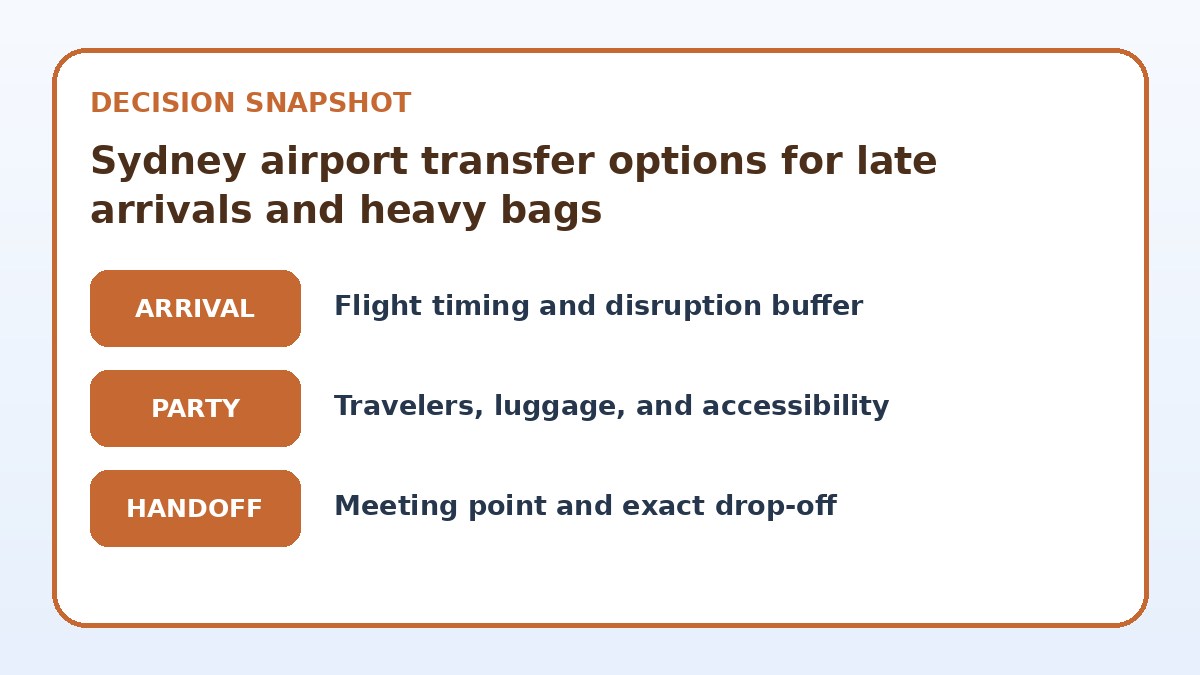
If your flight into Sydney arrives late and you have extra luggage, your first-hour decision is simple: get from the terminal to a safe, reachable drop-off with the least physical hassle and minimal waiting. That choice depends on how many bags you have, whether your party can help carry them, the time of night, and how flexible your accommodation is about late check-in or remote drop-off. Start by estimating total pieces, whether any items are oversized, and who in your party will handle them. Then pick an arrival-transfer approach that matches your tolerance for cost versus convenience. Below are clear tradeoffs and a decision path so you can compare taxis, private transfers, shuttle buses, or rideshares while you still have your flight and hotel details open.
Check options for your arrival details
Use your flight, luggage, party size, and accommodation address to compare current choices.
Luggage and party-size: pick the right vehicle
Match vehicle capacity to real-world baggage volume rather than the number of people alone. Four adults with six large suitcases needs a different solution than two travelers with backpacks. When you book, list each large suitcase, any oversized items like surfboards or musical instruments, and the number of carry-ons. That helps a driver or operator confirm whether a standard sedan, estate/wagon, SUV, people-mover, or a small van is appropriate. If booking through a company, request a clear vehicle description and ask whether they provide roof racks or trailers for oversize loads.
Also think about loading and unloading. Late-night terminals may have fewer porters, so factor in who will lift heavy bags. If someone in your party has limited mobility, choose a transfer that offers assistance at kerbside and check whether drivers can help with stairs or short carries. If you plan a multi-drop journey—dropping passengers at different addresses—confirm that the operator can handle multiple stops without extra waiting time or confusion, and map stops in the order that minimizes heavy-luggage carries.
Arrival details to have ready
- Count and list every piece of luggage, noting dimensions or oversized items; use this when selecting vehicle type on the booking page.
- Save your terminal name, arrivals level, and a clear nearby landmark or carousel number to share with the driver before landing.
- Confirm the transfer provider’s flight-tracking, wait-time policy, and how they handle delayed arrivals on their booking page or confirmation email.
- Ask your accommodation whether kerbside access is permitted and where drivers should drop passengers with heavy bags.
- Take and save photos of the terminal meeting point and the vehicle registration or app screenshot for easy identification on arrival.
- Have backup options: the local taxi rank location, authorized rideshare bay, and a map pin of your accommodation ready on your phone.
Late or disrupted arrivals: flexible planning options
Flights that land late or land with delays demand flexibility. Look for transfer choices that allow time-window changes and clear rebooking or cancellation terms. Confirm how the provider handles late flights: will they wait a set period for delays, or do they require a new booking? If you prefer to wait until touchdown, choose an option with quick on-demand availability at the terminal—keeping in mind that on-demand choices can be less predictable late at night and may involve longer waits if supply is low.
If your arrival is uncertain, consider reserving a transfer with a generous pickup buffer or a provider that tracks flight numbers. Otherwise, plan for a fallback such as the official airport taxi rank or an authorized rideshare pickup point. For very late arrivals, also verify whether airport facilities you might rely on—like baggage desks or customer-service counters—are staffed when you land, and have contact numbers for your transfer operator to confirm arrivals and coordinate meeting points in real time.
Match the transfer to your arrival
| Arrival approach | Best for | Detail to verify |
|---|---|---|
| Prebooked private transfer | Travelers with many or oversized bags who want door-to-door service and predictable pickup. | Higher cost and need to confirm vehicle size; verify wait and flight-tracking policy before booking. |
| Airport taxi rank | Immediate need after arrival and straightforward luggage loads when counters are open. | Less control over vehicle size and possible queues late at night; confirm current taxi pick-up location. |
| Rideshare app pickup | Flexible solo or light-baggage travelers who accept variable waiting times and self-loading. | May be difficult with many large suitcases; verify designated rideshare bays and walking distance from terminal. |
| Shared shuttle or coach | Budget-conscious travelers with manageable luggage who don’t mind fixed stops and potential waits. | Multiple stops and limited space for oversized items; check baggage allowance and drop-off convenience. |
Make the meeting plan clear
Check the final pickup instructions, waiting conditions, and exact drop-off coverage.
Meeting-point clarity: avoid confusion at night
Late-night terminals can be quieter but less staffed, and signage may be dimmer. Before you land, confirm an exact meeting point: terminal name (T1, T2, T3), level (arrivals or forecourt), and a landmark such as a specific exit, carousel number, or designated rideshare bay. Put this information in the booking notes and save it in your phone. If your operator offers SMS or app-based check-in, use it so the driver sees your flight status, updated arrival time, and any last-minute gate changes.
Photographs of the meeting spot are helpful—take a screenshot of terminal maps or the driver’s vehicle and registration if provided. Exchange a direct contact number rather than relying solely on a messaging platform, and confirm who is expected to carry the bags if the pickup involves a short walk from the kerb. Clear directions prevent wasted time and reduce the stress of coordinating with tired passengers after a long flight.
Drop-off fit: get to the right spot at your destination
Different accommodation types affect where a vehicle can stop. A large hotel usually allows kerbside drop-off; a narrow city townhouse or apartment building may require a short walk from the nearest legal stopping point. Before you book, check your lodging’s arrival instructions and tell your driver whether they should try to reach the door or leave you at the nearest legal bay. If you have heavy bags, prioritize a transfer that will take you as close as possible rather than saving a little on cost.
If you’re staying in a building with restricted vehicle access or timed street closures, arrange a slightly earlier or later pickup to avoid restrictions or confirm an alternate drop-off location the property can access. For short-term rentals, message your host with your expected arrival time and luggage count so they can advise the best approach. When in doubt, choose a door-to-door option that handles last-meter assistance so you don’t face unexpected carries down stairs or along long corridors.
Airport Transfer & Local Mobility questions travelers ask
How should I choose between a private transfer and a taxi if I have excess luggage?
Choose a private transfer when you need guaranteed space for many or oversized items and want door-to-door help; private operators can confirm vehicle type in advance. Taxis are practical for simpler luggage loads and immediate departure if a rank is staffed. Before you book either, check the operator’s policy on baggage dimensions and the ability to handle oversized items, and confirm pickup points and wait times so you’re not left rearranging bags at the terminal.
What meeting point details should I provide for late-night pickups at Sydney airport?
Provide terminal designation (for example, which arrivals concourse), the arrivals level or exit number, and a clear landmark such as a specific baggage carousel, airport lounge door, or rideshare bay name. Include your flight number and estimated touchdown time so the driver can monitor changes. If the operator offers an SMS or app check-in, use it and exchange a phone number to resolve any last-minute gate or arrival changes quickly.
If my arrival is delayed past midnight, which transfer type offers the most reliable fallback?
A prebooked private transfer that confirms flight tracking gives predictability for very late arrivals because the operator typically monitors your flight and adjusts pickup. If that option isn’t available, the official airport taxi rank is the usual fallback, though staffing and queue lengths vary overnight. Rideshare services can work only if designated pickup bays are accessible late; always check terminal operations and have contact numbers for your chosen service to coordinate after a delay.
Final decision note
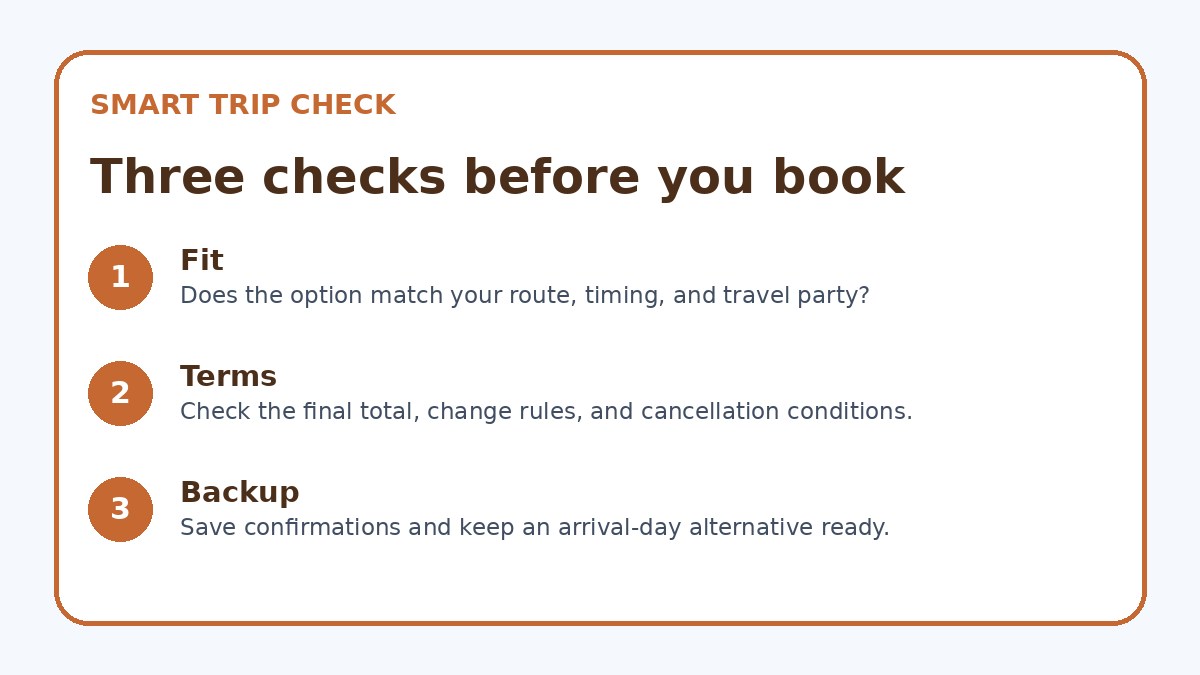
Arriving late into Sydney with extra luggage becomes manageable with a short planning checklist: count your bags, confirm a vehicle type that actually fits them, and agree a precise meeting point. Balance convenience and cost by deciding whether door-to-door assistance is worth the premium or whether a taxi or rideshare will do given your baggage volume. Always verify provider policies—flight tracking, wait times, baggage limits, and exact pickup points—on the booking page before you complete a reservation. Keep backup options ready at the terminal and communicate clearly with your accommodation so the final short walk from kerb to room doesn’t become the hardest part of your trip.
Continue planning
Check current options and final conditions
Use the provider page to confirm live availability, the final total, cancellation terms, and every condition that matters to your trip.
This evergreen planning guide was created with AI-assisted drafting and a structured quality review. It does not display live prices, schedules, availability, visa guidance, or provider rankings. Verify current details before booking. Some links are affiliate links; we may earn a commission at no additional cost to you.