Practical answer up front: choose rail if you want simpler door-to-door transfers between central terminals (Penn Station/NYC and Union Station/DC), coach if you prioritize lower-cost curbside pickups or specific terminal locations, and consider mixed-mode (train or coach plus local subway/taxi) when your start or end points are far from major terminals. Ferry option is limited for this route and mostly relevant for parts of the NYC approach. For a first-time visitor, the crucial planning steps are picking arrival/departure stations that shorten your onward transfer to accommodation, allowing extra time for luggage and security lines at big terminals, and confirming final boarding zones and connecting transit options before you buy. Later in the article I’ll walk through terminal fit, luggage friction, timing flexibility, and a disruption backup plan so you can compare practical tradeoffs and choose the best door-to-door approach.
Terminal fit: matching stations to where you actually start and end
When deciding between rail and coach, think first about where in each city you’ll start and finish. In New York City, major rail services typically use Penn Station in Midtown; coaches may load from curbside locations across Manhattan or from a bus terminal outside Midtown. In Washington, DC, most intercity trains arrive at Union Station in the Capitol Hill area, while coaches can stop at varied points, sometimes closer to hotels in other neighborhoods. Selecting the terminal that minimizes your onward transfer—walking, transit, or taxi—will reduce total travel hassle more than shaving minutes from the intercity segment itself.
Also consider how easy it is to navigate each terminal with luggage. Penn Station and Union Station are large and busy; they offer more connections but can require extra time to move between platforms and exits. Curbside bus stops can be simpler to walk to with a single bag, but they might be a longer walk to your lodging or lack covered waiting areas. For first-time travelers, plotting the walking route from the terminal exit to your first transit link or ride-hail pickup point helps avoid surprises.
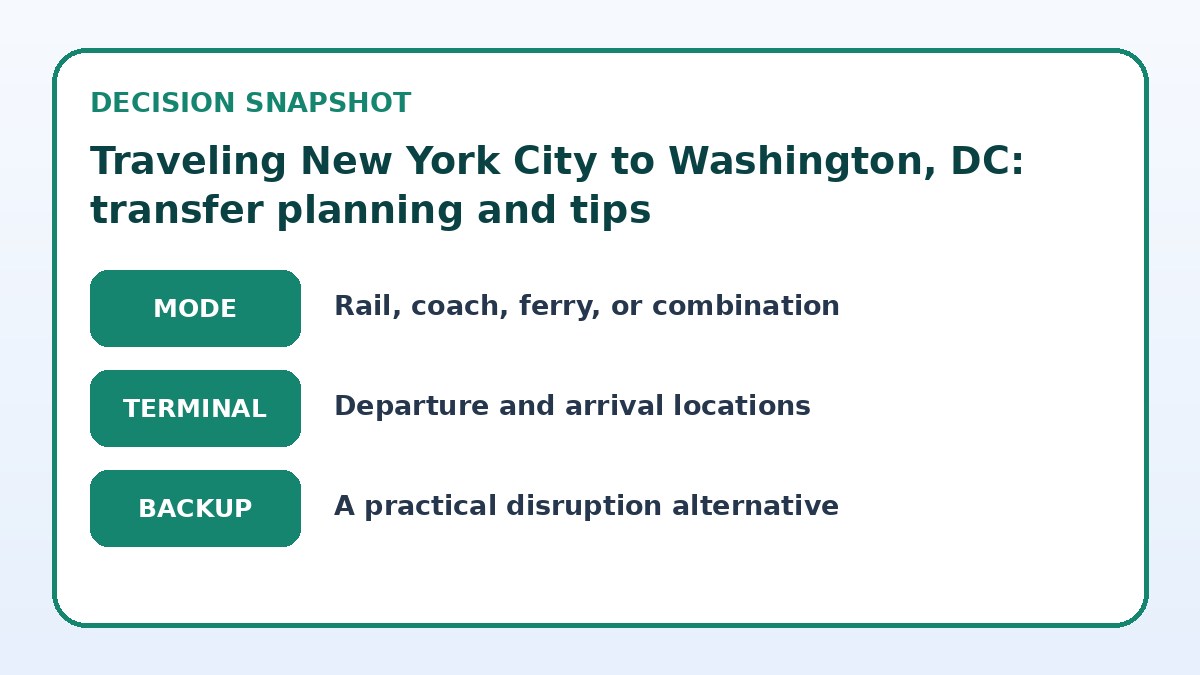
Choose the end-to-end journey plan
| Journey approach | Best for | Friction to check |
|---|---|---|
| Prioritize train arrivals/departures at major stations | Travelers wanting simpler connections to central neighborhoods and more consistent indoor platforms | Larger terminals can mean longer walks through concourses and potential elevator waits with heavy luggage. |
| Use coach/curbside services for direct curb pickups | Those who value easy street-level luggage handling and often lower-footprint boarding | Curb stops can be further from your hotel and sometimes lack sheltered waiting areas or consistent location signage. |
| Book mixed-mode (train or coach plus local transit) | Travelers starting or ending outside central terminals who need flexible last-mile solutions | Requires careful timing and extra transfers, increasing luggage handling and potential delays. |
| Choose door-to-door via taxi or ride-hail for last-mile only | Travelers prioritizing convenience, minimal walking, and quick transfers with luggage assistance | Higher cost and variable wait times; dependent on local traffic and surge pricing during peak times. |
Check live intercity options
Look beyond the ride itself and compare terminals, transfers, luggage, and arrival fit.
Luggage and transfer friction: packing and handling choices
Large terminals and mixed transfers add friction when you have multiple bags. Trains tend to have onboard luggage areas and often more flexible carry-on space; however, you may still need to carry luggage from the platform through long concourses to the exit. Buses often allow a checked bag placed under the coach and quicker curbside boarding, but passenger handling and access to the luggage bay can be slower at busy stops. Think about how many times you’ll lift or wheel your bags during transfers and whether you can manage stairs, elevators, or escalators in each terminal.
If you want minimal handling, prioritize routes that deposit you closest to your first local connection—eg, a train arriving at a station with direct subway lines to your neighborhood. When using ride-hail or taxi, secure a short walking route from the terminal to the pickup curb and factor in wait times. Bring luggage-friendly accessories (wheels in good condition, a compact lock, and a daypack) and photograph your bags before departure in case of mishandling claims or confusion at busy terminals.
Timing flexibility: when to build slack into your plan
Build extra time at the ends of your intercity ride for two reasons: terminal navigation and onward connections. In both NYC and DC, busy periods or sporadic security checks can slow exit times. If you have a tight train or coach schedule followed by a short subway connection, a taxi, or a check-in deadline at your accommodation, plan a buffer of at least 30–60 minutes beyond the advertised travel time for first-time transfers. This buffer pays off when platforms are crowded or elevator access is slow with heavy luggage.
Also consider the variability of last-mile options. Ride-hail surge pricing or driver shortages can add wait time, and local buses or subways may be delayed. If your itinerary includes a timed appointment or a meeting, opt for an earlier departure or select an arrival terminal nearer your final destination even if the intercity segment takes slightly longer. Confirm real-time transit options on the day of travel and have a backup route mapped in case your first choice is disrupted.
Compare the practical alternatives
Use the final page to confirm what is actually offered on your dates and save a workable fallback.
Intercity travel checklist
- Map the exact exit and pickup curb for your chosen terminal and save a screenshot for offline use.
- Measure walking time from the terminal exit to your first onward link (subway, taxi rank, or ride-hail pickup) with luggage in mind.
- Photograph and label your luggage, and carry a compact daypack with essentials for potential transfer delays.
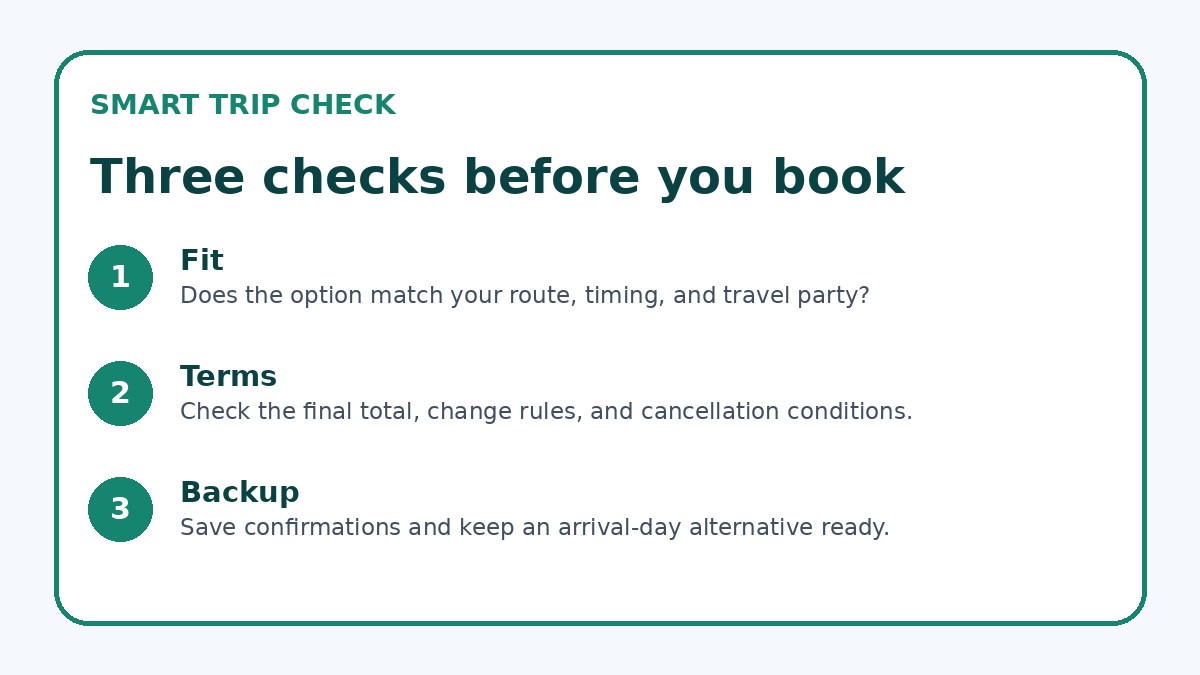
- Confirm luggage allowance and boarding/curb rules on the operator’s final booking confirmation before departure.
- Pack a small kit: charger, portable battery, local transit card or exact change, and a printed address for your accommodation.
- Identify and save one alternate departure or arrival terminal and one alternate mode (train or coach) in case of cancellation or major delay.
Disruption backup: a simple contingency plan for common problems
Create a compact backup plan before you travel: list two alternate terminals or curb stops, one secondary mode (coach if you booked a train, or vice versa), and a local contact or hotel number. If your scheduled service is cancelled or significantly delayed, you’ll be able to switch to the alternate option without starting from scratch. Keep charger power and a phone payment method ready for last-mile purchases and ride-hail requests, and screenshot or save the terminal map and local transit lines to your phone for offline use.
When provider-specific facts matter—like exact bus curb locations, terminal entrance gates, or luggage rules—verify them on the carrier’s final booking page or terminal website before you leave. Trip.com can be useful to compare current availability and conditions, but always double-check pickup points, boarding zones, and luggage allowances on the operator’s page since such details change frequently and affect door-to-door practicality.
Rail & Intercity Transport questions travelers ask
What is the easiest terminal option if my hotel is in downtown DC or near the National Mall?
If your hotel is downtown or near the National Mall, arriving at Union Station typically minimizes onward transit time because it is centrally located and connected to multiple local transit options. For many first-time visitors, this reduces the number of transfers between modes and the total walking distance with luggage. However, always map the walking or transit route from the particular station exit to your hotel entrance—Union Station has several exits and the fastest path depends on where your hotel is located. Verify the station exit, elevator availability, and any ongoing station work on the carrier or station website before you travel.
How much extra transfer time should I allow when leaving Penn Station for DC?
Allow at least 30–60 minutes beyond the intercity travel time for first-time transfers leaving Penn Station, especially during peak hours. Penn Station is sprawling and can require extra walking between platforms, ticket gates, and the street. If you need a taxi, ride-hail, or a subway connection right after arrival, add buffer time for elevator waits and passenger congestion with luggage. Check the layout and your preferred exit in advance, and plan to arrive at the terminal station with enough slack to avoid rushed connections or stressful transfers.
If my train or bus is cancelled, what is a practical on-the-ground backup?
A practical backup is to have two alternate options ready in advance: another scheduled service on a different operator (train or coach) and a different nearby terminal or curb stop. Also identify a reliable last-mile plan such as a taxi stand or a major subway line from the alternate terminal. Keep contact numbers and the operator’s rebooking instructions handy, and save your hotel address and local transit maps offline. Verify the carrier’s rebooking policy on its booking page and consider purchasing a flexible ticket if you need guaranteed change options.
Final decision note
For first-time travelers between New York City and Washington, DC, the transfer that follows the intercity ride matters more than the ride itself. Match the terminal to your actual start and end points, plan for luggage handling and station navigation, and build in time buffers for pickups and elevators. Choose the mode that reduces the total door-to-door time—urban arrivals into centrally located stations often win that comparison, while curbside coaches can simplify luggage handling. Always verify terminal pickup points, boarding zones, and luggage rules on the operator’s final booking page, and keep a simple backup plan with an alternate terminal or mode so delays don’t derail your trip.
Continue planning
Check current options and final conditions
Use the provider page to confirm live availability, the final total, cancellation terms, and every condition that matters to your trip.
This evergreen planning guide was created with AI-assisted drafting and a structured quality review. It does not display live prices, schedules, availability, visa guidance, or provider rankings. Verify current details before booking. Some links are affiliate links; we may earn a commission at no additional cost to you.