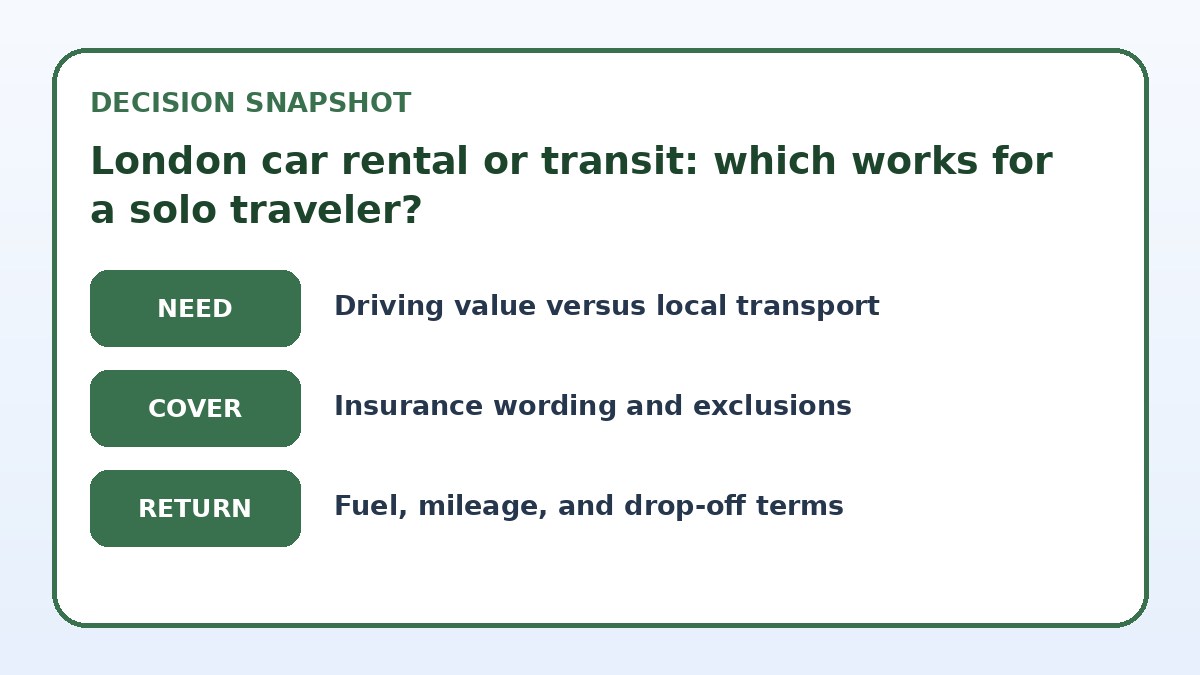
If you’re traveling solo in London, your first practical decision is whether driving actually improves your itinerary. In most central-London plans — museums, West End shows, inner-city neighborhoods — public transport is faster, cheaper to use day-to-day, and removes parking and congestion worries. Driving becomes attractive if your route prioritizes day trips beyond the city (coastal Kent, rural Cotswolds stretches, or multiple rail-remote sites) or if you need flexible timing with heavy luggage or gear. This guide gives a clear yes-or-no approach up front, then breaks down route value, insurance wording, pickup and return friction, and a firm fallback if you decide not to drive. It also lists what to verify on final booking pages so you’re not surprised by local fees, coverage details, or pickup conditions.
Route value: when a car genuinely adds time or access
Start by mapping the places you plan to visit and measuring actual door-to-door travel time rather than straight-line distance. Central London attractions are densely clustered and well served by Tube, bus and rail; a single journey that looks short on a map can become slow and expensive to park. A rental starts to pay off when an itinerary includes multiple destinations where public transport would force long, infrequent transfers, or when your days include rural or coastal sites that sit outside the main rail corridors. Also factor in early starts or late finishes when public transit frequency drops.
Consider cargo and comfort: if you’re carrying heavy sports equipment, a bicycle that won’t fold, or filming gear, a car simplifies logistics and avoids lugging items through stations and stairs. Equally, if your solo travel aims are flexible—wandering neighborhoods, hopping galleries, meeting locals—public transport’s advantage lies in simplicity and frequency. Make a short list of the longest or most complex legs; if driving shortens those legs significantly, the case for a rental strengthens. Otherwise, leave the car out of the city-centered plan.
Decide whether driving earns its place
| Mobility strategy | Best for | Cost or friction to check |
|---|---|---|
| Drive a rental for the whole trip | Solo travelers with many remote day trips, heavy gear, or multi-location rural hubs. | Higher friction from pickup, parking and insurance responsibilities; city driving and fees remain significant. |
| Use public transport only | City-focused solo itineraries in central London that emphasize museums, theatre and neighbourhood walking. | Limited flexibility for remote day trips and potential difficulty with bulky luggage or late-night routes. |
| Public transport plus occasional hire or taxi | Trip plans that are mostly urban but include a few late-night or remote legs needing door-to-door rides. | Higher per-ride cost for taxis or rideshares, but avoids full rental overhead and parking hassles. |
| Rent only for specific day trips (one-way or round-trip) | Solo travellers who want car convenience for a few rural days while using transit in the city. | Must manage pickup/return logistics and possible one-way fees; plan insurance for single-use rentals carefully. |
Check live rental choices only after the route test
Use the exact driver, dates, pickup point, and return plan to compare current conditions.
Insurance wording and liability: read the fine print
Before you commit to a London car rental, read the insurance and liability wording carefully: Collision Damage Waiver (CDW), theft protection, and the excess (the amount you’d pay after a claim) vary by provider and location. Some rates include lower-excess packages at extra cost, while others require a debit or credit card hold for the full amount of the excess when you pick up the vehicle. Confirm whether roadside assistance, glass and tire cover, and third-party liability are included or optional. If you plan to drive into other parts of the UK or cross into the Republic of Ireland, verify cross-border permissions explicitly on the rental terms.
If you intend to rely on a personal travel card or insurer for rental coverage, check the specific exclusions: many policies exclude certain vehicle types, age ranges, or drivers with recent penalty points. Rental companies sometimes require the named driver to present proof of a clean driving history or international driving permits for non-UK licences. Keep copies (digital and paper) of all insurance confirmations and the rental agreement’s main clauses to show at pickup. When in doubt about legal wording, ask the provider to point you to the exact clause on their final booking page and save a screenshot.
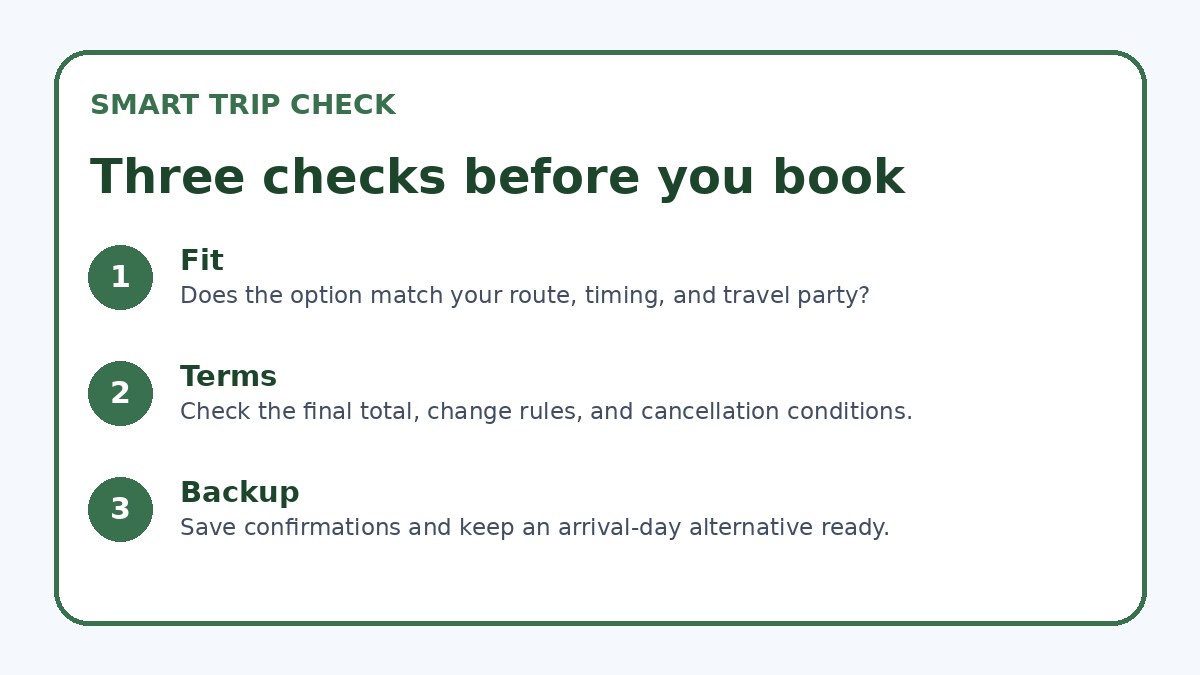
Compare the full rental conditions
Confirm insurance wording, exclusions, deposit, fuel, mileage, and return terms on the final page.
Pickup and return friction: practical time costs
Pickup and return can be surprisingly time-consuming and introduce hidden costs. Airport or railway station desks may have queues, mandatory walkthrough checks, and card holds; city-centre pick-up points can be limited to specific hours. Factor the time to get to a pickup location, the chance of additional checks, and any asymmetric opening hours for returns. If you plan one-way pick-ups or returns, confirm whether the provider charges drop-off fees between locations. Also check what happens if you run late—some providers charge after-hours return fees or may not accept returns outside staffed times.
Consider the last-mile reality: parking availability near your accommodation, residential parking restrictions, and whether your hotel or rental offers secure parking influence daily convenience. Urban parking in London often requires permit bays or paid bays with strict enforcement; failing to follow local signage can yield fines. Balance that friction against the convenience of curbside loading and full local autonomy a car provides. If pickup and return logistics look cumbersome for your dates or chosen location, that’s a strong argument for sticking with public transport and occasional taxis or rideshares.
Car rental terms to verify
- Map your full itinerary and mark legs that are poorly served by rail or bus to judge whether a car materially saves time.
- Open the rental company’s final booking page and copy the exact insurance clauses for CDW, excess, theft protection and cross-border rules.
- Check pickup and return locations and hours, note any after-hours fees, and verify whether a credit card hold is required at collection.
- Confirm parking options at your accommodation and planned stops, including permit requirements and likely nightly costs or restrictions.
- Pre-book major rail or coach journeys for non-driving days and confirm luggage allowances and station transfer logistics.
- Prepare a backup transport list: nearest Tube/rail stations, a reliable taxi/rideshare app, and two alternative public routes for each key leg.
Non-driving fallback: plan for a smooth alternative
Always design a realistic non-driving fallback for the days you would otherwise depend on a car. For central London work, a combination of Tube, bus and walking covers most needs; get an Oyster card or prepare a contactless payment method and test it on entry. For day trips, check regional trains and intercity coach connections—compare door-to-door journey times and total transfers. For legs outside regular service hours, note reliable taxi or app-based rideshare coverage. Keep a shortlist of two alternative routes for each critical leg in case of closures or strikes.
If you decide not to rent, pre-book any long-distance rail or coach segments that are important to your itinerary and determine station-to-attraction transfers. Keep one flexible paid option ready—a local taxi app or a trusted private transfer—particularly for early starts or late returns when public services reduce frequency. Save absolute contact details for station booking windows and verify luggage allowances on trains and coaches. Trip.com can be used to compare availability, but always confirm final conditions and cancellation rules on the provider’s own booking page.
Car Rental & Road Trip questions travelers ask
Can a solo traveler drive in central London without paying congestion or other fees?
Central London charges such as congestion or Low Emission Zone (LEZ) can apply to vehicles depending on zone and emissions standard; rules and boundaries change. Before booking a London car rental, verify whether your vehicle will enter charging zones and whether the rental company covers those payments. If a vehicle is subject to a daily or registration-based charge, the provider’s booking page should state responsibility for payments and penalties. Always confirm the vehicle’s emissions classification and check the final rental terms to avoid unexpected fees.
Will my personal car insurance or credit card cover a London car rental?
Some personal car insurance policies and premium credit cards offer secondary coverage for rentals, while others exclude UK rentals or certain vehicle types. Coverage usually depends on card issuer terms, the type of policy, and whether you decline the rental company’s CDW. Before relying on external coverage, request written confirmation from your insurer or card provider about the exact protections, exclusions, and the excess amount. On the rental firm’s final booking page, verify which coverages are mandatory and whether the company requires additional local insurance purchases.
If I choose not to drive, what’s the simplest way to handle late-night journeys or equipment-heavy transfers?
For late-night or equipment-heavy transfers, plan a buffer: use trains to the nearest town and then pre-book a taxi or private transfer for the last mile. Many taxi apps operate throughout London but coverage thins in rural areas, so check driver availability for your planned times. For bulky items, reserve door-to-door private transfers or consider courier services for instruments and oversized gear. Always confirm luggage policies with train or coach providers and save contact details for local taxi companies in case apps are unreliable in your destination.
Final decision note
For most solo travelers whose plans stay within central London, public transport is the pragmatic default: frequent services, easy contactless payments, and far less friction than city driving. Choose a rental only when your itinerary includes several rural or coastal day trips, bulky equipment, or complex multi-stop rural routes that public transit cannot serve efficiently. If you lean toward renting, inspect the insurance wording, pickup and return rules, and local parking realities on the provider’s final booking page. Keep a clear non-driving fallback and pre-book key rail or coach seats; that flexibility lets you enjoy London without committing to a car unless it truly improves your trip.
Continue planning
Check current options and final conditions
Use the provider page to confirm live availability, the final total, cancellation terms, and every condition that matters to your trip.
This evergreen planning guide was created with AI-assisted drafting and a structured quality review. It does not display live prices, schedules, availability, visa guidance, or provider rankings. Verify current details before booking. Some links are affiliate links; we may earn a commission at no additional cost to you.