If you’re traveling from Osaka to Kyoto with more than a carry-on, the most practical choice balances door-to-door hassle, terminal fit, and predictable transfer time. In most cases, rail will be the fastest and most frequent backbone for the journey, but coach, private transfer or a rail-plus-luggage-forwarding combination can reduce the heavy-lifting at either end. Decide first whether minimizing walking and stairs matters more than minimizing cost, because that choice determines routes, where to catch services, and whether to book a luggage delivery service. This article gives a clear practical answer up front, then walks through terminal fit, luggage and transfer friction, timing flexibility, and a simple disruption backup. Use it to choose an approach and what to check on final booking pages: seat reservations, luggage size rules, station access points, pickup/drop-off addresses and luggage delivery provider terms.

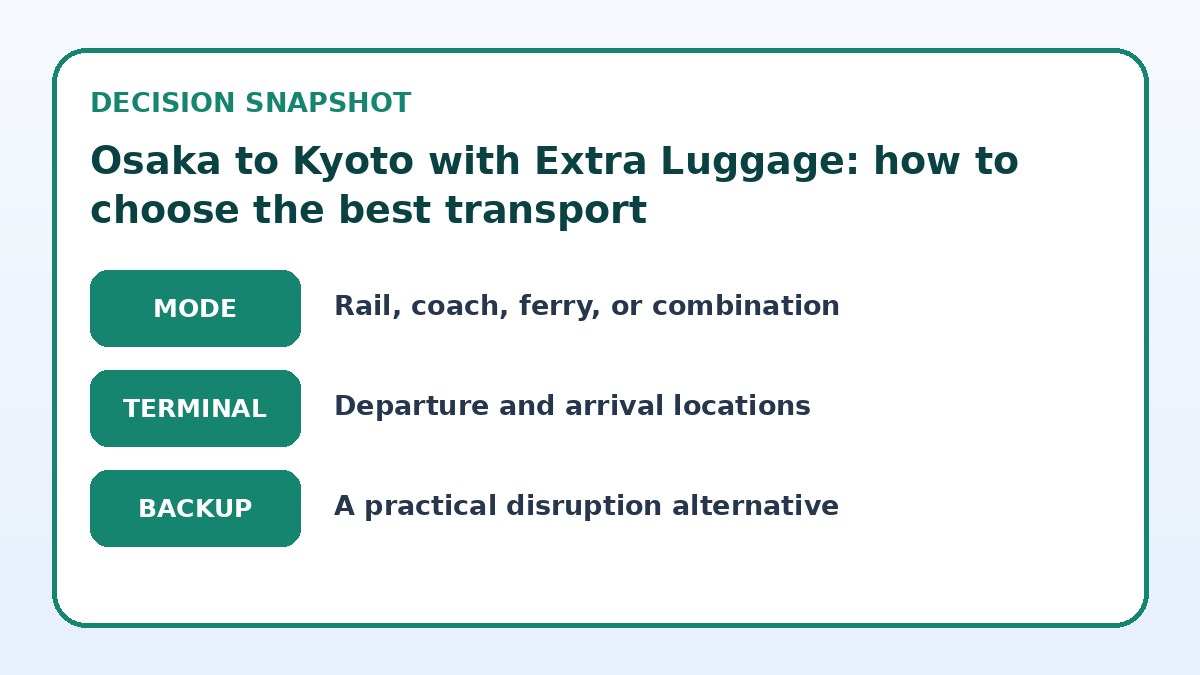
Choose a mode: rail, coach, private transfer or mixed
Start by matching your priorities to a mode. Trains usually offer the shortest in-motion time and frequent departures, which is useful if you must be flexible. Coaches can be simpler for large, oddly shaped bags if they allow curbside loading and fewer stairs to handle at destinations. Private transfers remove physical transfers entirely but cost more and depend on road conditions. A mixed approach — train for speed plus a luggage-forwarding company — can deliver the best balance: you sit on a predictable train while your suitcases move independently to your Kyoto accommodation.
When comparing these, think beyond the vehicle: check where you start in Osaka and where you need to finish in Kyoto. A mode that looks faster on paper can be worse door-to-door if it drops you at a distant station or requires an uphill walk with cases. Also weigh how much time you have between arrival and any onward commitments; some services have set pick-up windows and require you to be at the exact exit named in their instructions.
Choose the end-to-end journey plan
| Journey approach | Best for | Friction to check |
|---|---|---|
| Direct train (own luggage) | Travelers who want speed and frequent departures with full control of their bags | You’ll carry and stow luggage yourself; may face stairs or crowded platforms during peak times |
| Coach or airport-type shuttle | Luggage-heavy groups or oddly shaped items that benefit from curbside loading | Less frequent departures and potential longer door-to-door times depending on stops |
| Private door-to-door transfer | Those valuing zero handling and minimal walking between origin and destination | Higher cost and travel time can vary with traffic; must confirm exact pickup/drop addresses |
| Train plus luggage-forwarding service | Travelers who prefer fast rail travel but don’t want to carry heavy bags between stops | Requires coordination of pickup/delivery windows and verification of provider handling rules |
Check live intercity options
Look beyond the ride itself and compare terminals, transfers, luggage, and arrival fit.
Terminal fit and station access with extra luggage
Station design and which exit you use matter more than most travelers expect. Some stations are multi-level, with exits that lead to street level or underground passages; elevators and escalators are unevenly distributed. Before you commit, identify the likely arrival platform and the shortest route to a taxi rank or station exit that has lifts or level access. If you must change trains inside a station, find a route that avoids stairs; station maps and official websites usually show elevator locations, but double-check closer to travel.
If using a coach or private transfer, confirm the exact curbside set-down and pick-up point and whether the driver will assist with loading. For train travel, less walking can be achieved by reserving seats closer to the doors that lead to the correct exit. If you plan to use luggage-forwarding, verify the hotel’s preferred delivery entrance and whether the delivery company will meet you at a hotel lobby or needs you at a back entrance with limited access.
Luggage and transfer friction: packing, booking and handling
Reduce friction by thinking like a handler. Use luggage with smooth-rolling wheels and sturdy handles; attach a brightly colored ribbon or tag to quickly identify your bags among many. For each transport option, check the baggage rules on the provider’s final booking page: allowed dimensions, weight limits, and any prohibited items. If your suitcases are large or heavy, plan for additional assistance on arrival — either by booking a porter service, arranging a hotel bell staff pickup, or choosing a private transfer that includes loading.
Book seat reservations or coach spaces where allowed so you don’t worry about trunk capacity at departure. For mixed itineraries, schedule the luggage-forwarding pick-up after you’ve left your Osaka lodging and set the delivery to arrive at your Kyoto accommodation during a window when someone can receive it. Confirm the provider’s insurance and lost-item policy on their site and keep proof of booking and tracking numbers easily accessible on your phone.
Compare the practical alternatives
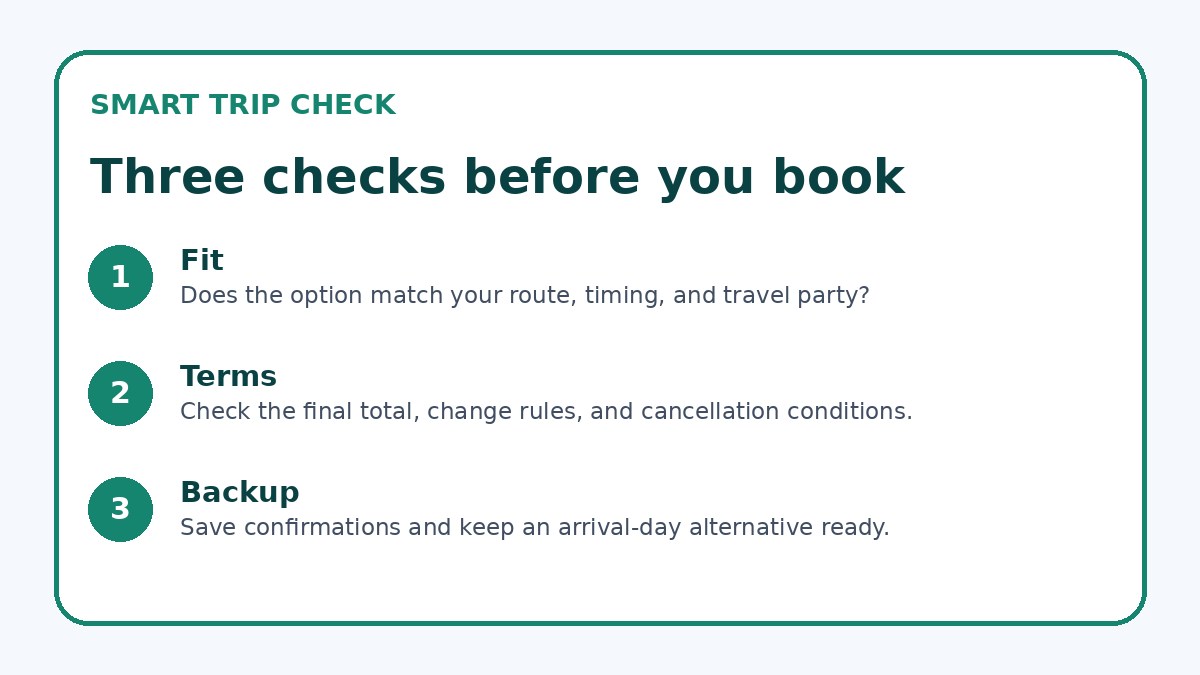
Use the final page to confirm what is actually offered on your dates and save a workable fallback.
Intercity travel checklist
- Confirm the exact station exit or address where you will be picked up or dropped off and save a screenshot of that location.
- Verify luggage size and weight limits on the chosen provider’s final booking page before you book seats or space.
- If using luggage-forwarding, schedule pickup after you leave your Osaka lodging and request a delivery window that suits your Kyoto arrival.
- Identify elevator/escalator locations on station maps and plan a step-free route between platforms and the correct exit.
- Prepare contact details for your hotel or accommodation and the transport provider, plus tracking numbers for any shipped luggage.
- Pack an essentials bag with valuables and one change of clothes to carry with you in case luggage delivery is delayed.
Timing flexibility and a simple disruption backup plan
Allow buffer time in your schedule to absorb small delays and luggage handoffs. If you’re connecting from a late arrival in Osaka or have a time-constrained check-in in Kyoto, choose the next service that leaves you at least 60–90 minutes cushion before critical appointments. When using luggage-forwarding, select options that guarantee same-day or next-day delivery windows only after you confirm those windows on the provider’s final page, and build in contingency time in case a delivery misses its slot.
Your disruption backup should be a single, executable plan: the phone number(s) you’ll call, an alternate taxi/ride-hail app installed, and the address or station exit where an alternate pickup will be easiest. If a train is canceled, changing to a coach or arranging an on-demand car from the nearest large station is often the fastest fix for heavy-luggage travelers. Keep digital copies of reservation confirmations and a paper backup of the Kyoto address and phone number of your accommodation.
Rail & Intercity Transport questions travelers ask
Can I bring oversized suitcases on regular trains between Osaka and Kyoto?
Many intercity trains accommodate typical checked-size luggage in luggage racks or space near doors, but exact size and placement rules vary by service. Before you travel, check the final booking page of the train provider or ask station staff about where large bags are stowed on the specific service you plan to use. If your bags are unusually large or you prefer not to handle them, consider a coach with curbside loading, a private transfer, or a luggage-forwarding service that moves your cases independently to your Kyoto accommodation.
Is it safer to ship luggage ahead to my Kyoto hotel than carry it on trains?
Shipping luggage ahead removes the physical burden of carrying cases through stations and reduces the risk of being stranded with heavy bags during a transfer. However, it requires confirming delivery windows and the hotel’s acceptance policy; some hotels limit the times they accept deliveries or charge storage fees. Always verify pickup and drop-off rules, tracking procedures, and insurance coverage on the forwarding provider’s booking page. Keep essentials and valuables with you, since shipped luggage can sometimes be delayed or misrouted.
What should I do if a train is canceled and I have a lot of luggage?
Immediately identify the closest large station exit or main concourse where taxis and ride-hailing services gather. Contact your accommodation to alert them, and if you’ve booked a luggage-forwarding pickup or a scheduled hotel delivery, notify that provider of the change. If possible, book a direct private transfer or coach that allows curbside loading to avoid repeated handling. Keep the transport provider’s and hotel’s phone numbers handy, and use an alternate route that minimizes carrying distance and stairs.
Final decision note
Traveling from Osaka to Kyoto with extra luggage is a practical exercise in minimizing handling and matching service design to your needs. Decide first whether you prefer to avoid carrying luggage entirely or to prioritize speed and frequent departures; that choice narrows sensible options to direct rail, coach, private transfer, or a mixed rail-plus-forwarding approach. Before you book, confirm station exit specifics, luggage size policies and any pickup/drop-off windows on provider pages, and save contact numbers and tracking details. With a clear backup plan for cancellations and a simple checklist, you can reach Kyoto with minimal stress and predictable door-to-door time.
Continue planning
Check current options and final conditions
Use the provider page to confirm live availability, the final total, cancellation terms, and every condition that matters to your trip.
This evergreen planning guide was created with AI-assisted drafting and a structured quality review. It does not display live prices, schedules, availability, visa guidance, or provider rankings. Verify current details before booking. Some links are affiliate links; we may earn a commission at no additional cost to you.