Practical answer first: if you travel light (one carry-on and a briefcase) consider flight or fast express services with simple transfers; if you have multiple checked bags or bulky equipment, trains or private car segments reduce handling friction. For mixed loads—one large suitcase plus a laptop—combine modes: rail for the long haul and a short taxi or pickup for first/last mile. Decide by weighing terminal fit (how easy is it to reach each station or airport with luggage), luggage transfer friction (how many times bags change hands), timing flexibility (fixed schedules versus on-demand), and a disruption backup (a plan that minimizes exposure to cancellations and long waits). This article lays out practical tradeoffs, transfer tips, and an end-to-end checklist so you can book a Hanoi–Da Nang trip that keeps you on schedule and your luggage secure.
Choose between rail, coach, flight or combined door-to-door
Start by matching luggage to mode. Trains typically allow larger, bulkier items to stay near your seat or in vestibules, reducing repeated loading and unloading—helpful for suitcases, duffel bags, and equipment cases. Coaches and express buses may offer underfloor storage but require gate handling and possible queuing to retrieve bags at stops. Flights are fastest point-to-point but force checked-bag processing and early airport arrival. A combined plan—rail for the long haul and a taxi at each end—can give the best balance between spacious storage and time efficiency.
Consider the operational fit: if your meeting sits close to a central rail station, the train reduces urban transfer time and taxi costs. If your schedule is tight and you travel very light, a flight may shave hours from your day despite airport overhead. For oversized or fragile cargo, private car segments or courier services for single items can be easier and reduce the risk of damage or misplacement during transfers. Map your door-to-door route before booking to avoid surprises.
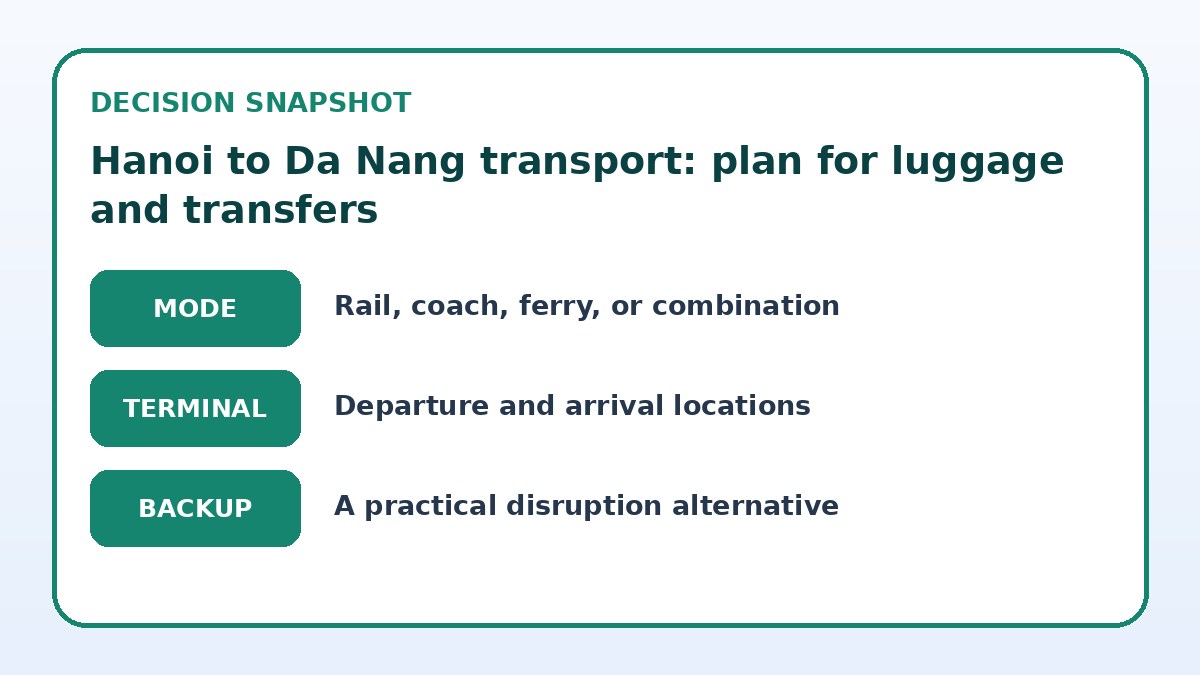
Choose the end-to-end journey plan
| Journey approach | Best for | Friction to check |
|---|---|---|
| Direct rail (single long-distance train) | Travelers with multiple checked bags or bulky items seeking fewer handoffs | Usually less frequent departures and fixed departure times; requires a good first/last-mile plan |
| Flight plus taxis | Light travellers with tight schedules prioritizing overall travel time | Adds check-in/collection steps for checked bags and more time buffer for airport processes |
| Private car or shared transfer door-to-door | Groups, equipment-heavy loads, or those needing guaranteed cabin space for luggage | Subject to road traffic and often more expensive; useful for direct pickup and drop-off flexibility |
| Hybrid (rail long-haul + taxi/ride-hail first/last mile) | Business travellers balancing spacious luggage handling with reliable schedule and city-center access | Requires coordination between services and buffer time for transfers; luggage moves one extra time |
Check live intercity options
Look beyond the ride itself and compare terminals, transfers, luggage, and arrival fit.
Terminal fit and first/last mile with luggage
Terminal fit means more than convenience: it dictates how often a suitcase changes hands. Assess the distance, typical traffic, and luggage facilities at each terminal or station. If a hotel meeting point is a short drive from one terminal but a long taxi ride from another, that difference can outweigh a marginal time saving during the main leg. Check whether the station entrance has stairs, escalators, or lifts—moving heavy cases through steps multiplies effort and time.
Plan first/last mile transfers actively. Reserve airport or station transfer services if you have bulky items; a meet-and-greet or hotel shuttle that takes luggage can save two or three handoffs. If you expect to use taxis, pick vehicles rated for luggage capacity or request an MPV/minivan. Where possible, ask your hotel to confirm luggage assistance and a late check-in option to avoid carrying bags through long waits between legs.
Luggage/transfer friction and timing flexibility
Transfer friction rises with each change of mode. Count how many times you will lift, queue, and re-tag luggage. A direct single-mode trip minimizes friction even if it takes slightly longer overall. If you must switch, schedule buffer time in your itinerary for unexpected delays—even familiar routes can stall with heavy traffic or busy check-in counters. Business travel leans toward predictable, repeatable flows; choose the option that consistently restores you to your workspace fastest after accounting for baggage handling.
Timing flexibility affects which mode is acceptable. If your meeting time is fixed, prefer options with more frequency or those you can control, like private car segments or multiple daily train departures. If your calendar allows variance, a slower train with generous onboard storage and fewer security processes may be less stressful and more reliable. When comparing services, verify operating frequency and transfer times on provider pages before booking, and consider leaving time for customs or security if your plan crosses international borders.
Compare the practical alternatives
Use the final page to confirm what is actually offered on your dates and save a workable fallback.
Intercity travel checklist
- Inventory every bag and item you’ll travel with; note dimensions and whether items need special handling.
- Choose modes by matching luggage profile to storage type—platform vestibule, underfloor coach hold, checked baggage on a flight, or car trunk.
- Map door-to-door transit times and identify the shortest, least-handling route from your office or hotel to the departure point.
- Reserve or pre-book transfers that state vehicle luggage capacity or request meet-and-greet assistance for heavy items.
- Save screenshots of luggage policies and booking confirmations and upload copies to your phone and email for quick access.
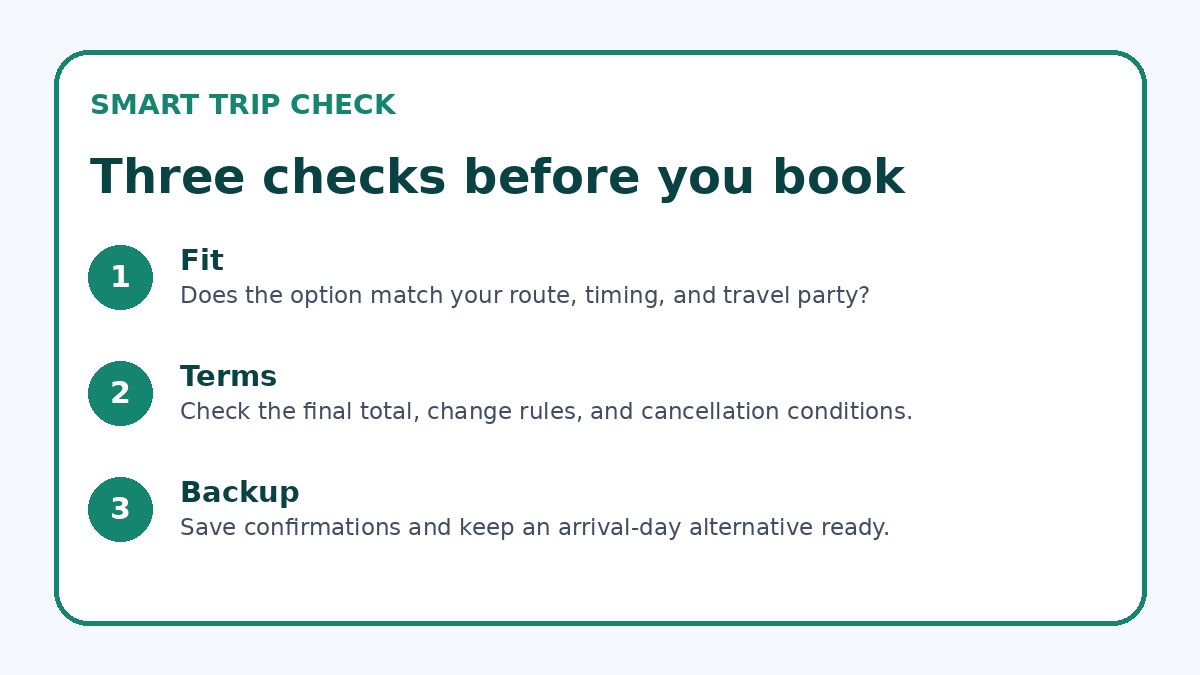
- Identify at least one disruption backup: an alternate rail departure, a trusted taxi service, or a nearby hotel that accepts early luggage.
Disruption backups and practical booking checks
Always prepare a backup that keeps luggage handling low. Identify a secondary rail or coach departure, a pre-approved taxi service, and a nearby hotel where you can store bags if a connection fails. For bulky items, arrange a courier pickup or check whether your hotel can accept early luggage delivery—this prevents repeated rehandling and keeps you ready to move at short notice. Make sure digital copies of booking confirmations, ID, and cargo photos are accessible in case of disputes.
Before you complete any booking, verify critical details on the provider’s final booking page: luggage allowances and size limits, transfer fees, terminal addresses, and change/cancellation policies. If you compare options online, note that intermediate transfer time windows and luggage rules can differ between providers and classes of service. Trip.com can be used as one place to compare availability and conditions, but always confirm luggage and transfer specifics on the operator’s own page.
Rail & Intercity Transport questions travelers ask
How much buffer time should I allow for luggage handling when traveling from Hanoi to Da Nang?
Allow more buffer than you think. For flights, add time for check-in, security, and baggage collection as well as potential taxi waits; for trains, factor in transfer time between station and city center and luggage stowing. If you must change modes, build at least 45–90 minutes between scheduled arrivals and departures to reduce stress when moving bags. The right buffer depends on the number of bags and local traffic patterns—verify station approach times and typical check-in guidance on operator pages before booking.
Can I avoid re-handling my luggage entirely on this route?
Avoiding re-handling completely is rare unless you book a single continuous door-to-door private transfer. Trains and coaches reduce handoffs compared with flights because luggage can remain with you or in a single hold, but you’ll usually need a taxi or shuttle at one or both ends. If minimizing handling is essential, arrange a private car that picks up and drops off at your exact addresses, or use a professional courier for bulky items so you travel without them.
What should I verify on the provider’s booking page regarding luggage and transfers?
Check explicit luggage allowances (number, weight, and size), whether you must label or check bags at a counter, and any extra fees for oversized items. Confirm terminal/station addresses, recommended arrival times, and whether meet-and-greet or transfer services are offered. Look at change and cancellation rules in case your meeting schedule shifts, and verify whether ticket classes affect luggage rules. Always rely on the operator’s current booking page for final details rather than third-party summaries.
Final decision note
For business travel between Hanoi and Da Nang, the smartest choice balances luggage handling, schedule reliability, and first/last mile practicality. Lightweight travellers often gain time with flights or fast road transfers, while those with larger or fragile baggage benefit from rail or private car segments that cut repeated handling. Map door-to-door logistics before booking, reserve transfers that match your luggage needs, and keep a clear disruption backup to maintain punctuality. Verify luggage allowances and transfer specifics on the provider’s booking page, and carry digital confirmations for quick resolution if plans change. With these steps you can minimize friction and arrive ready to work.
Continue planning
Check current options and final conditions
Use the provider page to confirm live availability, the final total, cancellation terms, and every condition that matters to your trip.
This evergreen planning guide was created with AI-assisted drafting and a structured quality review. It does not display live prices, schedules, availability, visa guidance, or provider rankings. Verify current details before booking. Some links are affiliate links; we may earn a commission at no additional cost to you.