Decide the neighborhood first, then hunt inventory: that’s the simplest way to make flexible booking terms actually useful on a Dubai business trip. If your schedule could change—meetings delayed, additional guests joining, or a shorter stay—pick an area with options that let you change or cancel with minimal friction. For most business travelers, proximity to a primary meeting location, predictability of daily routes, and hotel policies on changes and invoicing matter more than star ratings or extras. This guide helps you choose where to stay in Dubai by weighing neighborhood fit against the practical terms hotels typically offer. Read on to map commute friction, match room types to your party, and identify the exact booking terms to verify before you commit.

Check live stays in the areas that fit
Use your dates and party size to compare current rooms after you narrow the neighborhood fit.
Neighborhood fit: choose for meetings, not impressions
Choose the neighborhood that places you closest to the majority of your meetings and client sites. In Dubai, business addresses are clustered—some near Dubai International Financial Centre (DIFC) and Downtown Dubai, others in the Dubai Marina and Business Bay, and some near the Expo/Al Maktoum area for trade shows. Pick a single base rather than a scenic one-off; a quick taxi each morning will cost less in time and stress than daily cross-city transfers. Decide whether you need easy metro access, proximity to the airport, or a quieter street for late-night calls before filtering properties.
Assess neighborhood business infrastructure: access to meeting rooms, reliable taxis or ride-hailing, and nearby dining options for client lunches. If you anticipate colleagues joining, note where coworking spaces and short-term meeting rooms are located. For flexible booking terms, neighborhoods with a denser hotel supply give you more options to switch properties if plans change. Shortlist two adjacent neighborhoods if your meeting schedule spans multiple parts of the city—this keeps your late schedule manageable without sacrificing flexibility.
Choose an area-selection strategy
| Area approach | Best for | Tradeoff to check |
|---|---|---|
| Base near primary meeting cluster | Travelers with tightly scheduled meetings and limited tolerance for delays | Fewer scenic options and possibly higher nightly rates, but minimal commute risk and simpler booking changes. |
| Stay near a major transport hub (metro/airport) | Frequent intersite travel or uncertain arrival/departure times | Longer local trips to client sites possible; flexible policies useful but commute time may increase. |
| Book in a hotel-dense area with many options | High schedule uncertainty who may need to rebook or upgrade quickly | May be farther from specific meeting locations; switching hotels is easier but daily commutes may grow. |
| Choose a quieter neighborhood with business amenities | Travelers prioritizing reliable workspaces and low-noise evenings for late calls | Less immediate access to downtown meetings; flexible cancellation is helpful but distant travel remains a factor. |
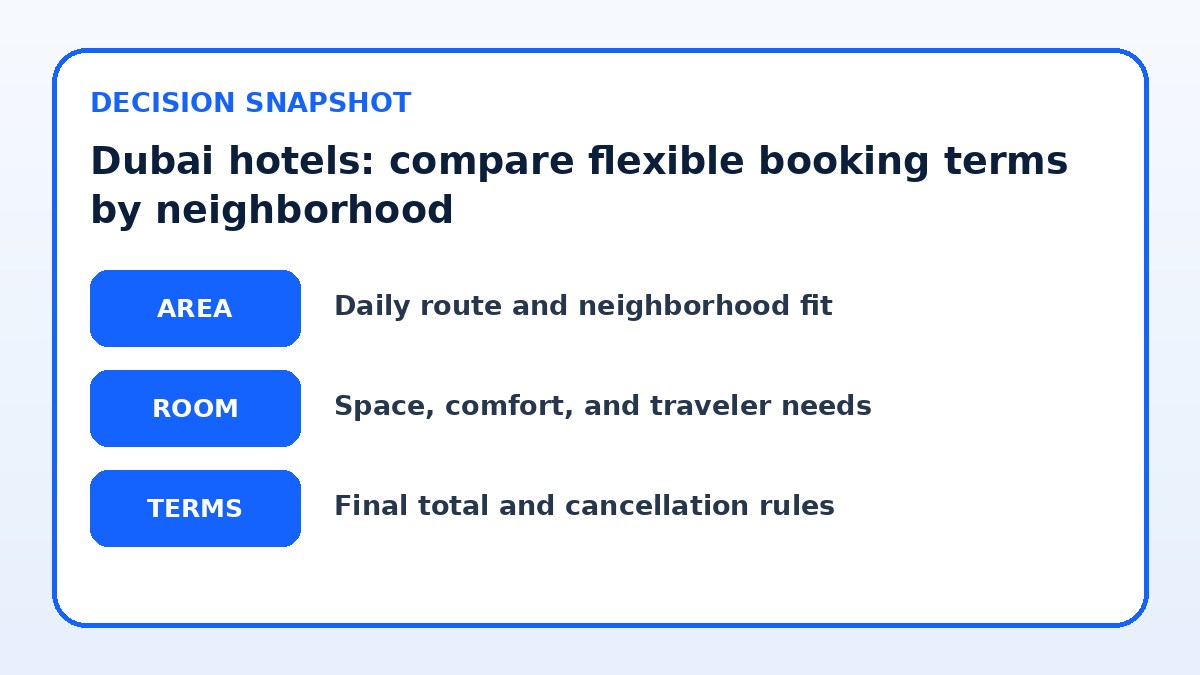
Daily-route friction: factor in commute time and reliability
Estimate commute friction by comparing straight-line distance to actual travel time during business hours. Dubai’s road network can be fast but congested at peak times; metro coverage is reliable on certain corridors but may not reach all business addresses. If punctuality is critical, prioritize hotels close to your primary venue and verify typical morning traffic patterns for that route. When you need to allow flexibility, choose hotels that publish or provide straightforward transport options—on-demand airport shuttles, guaranteed meet-and-greet, or business-arranged taxis—so you can reschedule without surprises.
When flexible booking matters because meetings shift, consider hotels that allow late check-out or day-use rooms; these reduce the need to rebook nights if a meeting runs long. For multi-meeting days across different zones, staying near a metro interchange or major road reduces variability. If you rely on ride-hailing apps, confirm in advance whether pickups are straightforward in your chosen neighborhood, and whether there are known traffic bottlenecks near major venues. That background helps you choose between a rock-solid nearby hotel or a more flexible policy farther away.
Now compare like with like
Keep the same dates, guests, room needs, and cancellation preferences while you compare the final choices.
Room and party needs: match inventory to possible changes
Define your room requirements with contingencies in mind: will you ever need an extra bed, an adjoining room, or extra guest access to the room’s desk for an associate? Business travelers should prioritize room types that explicitly list bedding configuration and maximum occupancy so you can add guests without rebooking. When comparing flexible rates, look for explicit policies about rollaway beds, child/guest charges, and whether requests are guaranteed or subject to availability; these specifics should be confirmed on the booking page before finalizing.
If you might extend a stay by a night or two, check whether the hotel allows simple in-stay modifications and whether the nightly rate can change significantly between the original and added nights. For multi-person travel, consider suites or interconnecting rooms from the start; these can be easier to adjust under a flexible booking than attempting to combine separate last-minute reservations. Also confirm whether the hotel will honor corporate rate codes or invoicing needs when changes are made, and get the precise modification and cancellation deadlines documented.
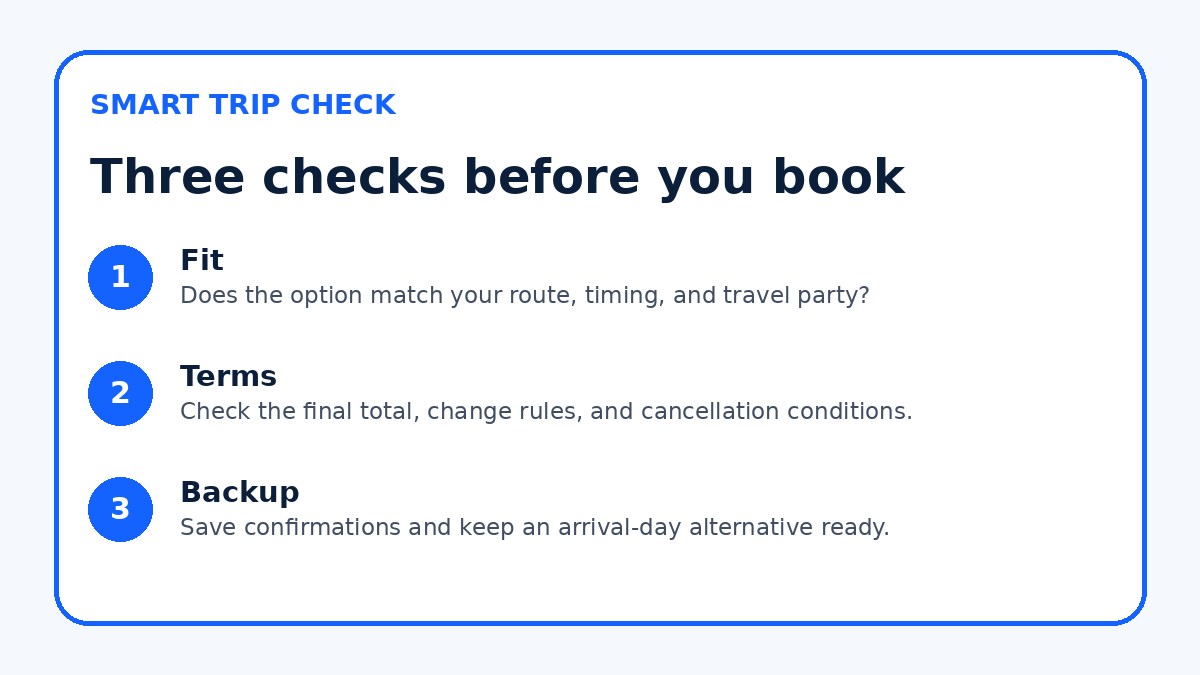
Hotel booking check before payment
- Identify the single neighborhood closest to your key meetings and note two backup areas for spillover appointments.
- On each hotel’s booking page, record the exact cancellation deadline, time zone, and penalty wording before confirming.
- Confirm whether the hotel requires a pre-authorization or deposit and how long any hold will remain on your card.
- Verify that requested room configurations (adjoining, rollaway, or suite) are guaranteed in writing for modifications.
- Ask the hotel whether corporate invoicing or separate folios will still be available if you change or extend the reservation.
- If using an OTA or Trip.com to compare availability, copy the provider’s full cancellation policy text into your trip notes.
Final booking terms: what to verify before you click Confirm
Before completing a reservation, verify three things on the hotel’s final booking page: the cancellation period (exact cut-off time and time zone), whether any deposit or pre-authorization is collected, and the penalty for changes after the cut-off. Don’t rely on marketing labels such as “flexible”; find the calendar date and hour when penalties begin and whether the refund is full, partial, or credited as hotel credit. Also check whether corporate invoicing, VAT invoices, or special payment methods are guaranteed for modified bookings.
Next, confirm how name changes, additional guests, and check-in time changes are handled. If your company policy requires invoicing or separate folios for incidental charges, ensure the hotel’s policy won’t block those options after a reservation modification. Finally, if you compare inventory on an OTA or Trip.com, use it to see availability but always click through to the hotel’s own terms or the OTA’s full policy text before committing—provider policies and processing windows are what determine whether a flexible booking will actually save you time and money.
Hotel Guide questions travelers ask
How should I weigh refundable vs. flexible non-refundable rates for a Dubai business trip?
Refundable rates generally allow full cancellation up to a defined cut-off, while flexible non-refundable rates may permit changes but limit refunds. For Dubai business trips with uncertain scheduling, prioritize refundable rates if your company reimburses cancellations; check the cut-off date and any percentage penalties. If refundable options are prohibitively costly, a flexible non-refundable rate paired with travel insurance or a clear corporate change policy can be acceptable. Always confirm whether refunds are processed back to the original payment method or issued as hotel credit and note processing timelines stated on the booking page.
What specific policy details should I confirm if I might add a colleague to my reservation?
Confirm maximum room occupancy, extra-guest fees, and whether additional guests require name registration. Some hotels allow rolled-in guests without charge up to a limit; others add a daily fee or require a different room type. Ask whether adding a guest affects breakfast entitlement, access to business lounge benefits, or invoicing. Get the hotel’s written guidance on how to make the change—online modification, phone request, or on-arrival—and whether any penalties apply if room type or occupancy needs updating mid-stay.
If my meeting location moves, when is it better to change my booking versus booking a second hotel?
If the meeting shift shortens or lengthens your stay by a night, changing the existing booking is usually simpler when the hotel’s change policy is flexible and penalties are minimal. If the venue moves to a different neighborhood, compare the cost and disruption of changing versus reserving a second close-by hotel for the relocated days. When multiple colleagues are involved, consider rebooking to keep the team together. Before changing or adding a second hotel, calculate cancellation cut-offs, compare nightly rates for the new nights, and verify whether splitting nights will affect corporate billing or loyalty benefits.
Final decision note
For business travelers to Dubai, deciding where to stay is the primary move—flexible booking terms are only valuable if they match neighborhood realities and your likely itinerary changes. Start by selecting the neighborhood closest to your meetings, then narrow down hotels that publish precise cancellation deadlines, clear policies on extra guests, and straightforward pre-authorization rules. Favor areas with multiple hotel options if you expect last-minute shifts, but don’t sacrifice punctuality for a marginally better rate. Before you finalize any booking, copy the exact policy language from the booking page, confirm invoicing and deposit details, and keep a short backup plan for switching hotels if needed. That approach leaves you ready to open inventory and choose a room with confidence.
Continue planning
Check current options and final conditions
Use the provider page to confirm live availability, the final total, cancellation terms, and every condition that matters to your trip.
This evergreen planning guide was created with AI-assisted drafting and a structured quality review. It does not display live prices, schedules, availability, visa guidance, or provider rankings. Verify current details before booking. Some links are affiliate links; we may earn a commission at no additional cost to you.