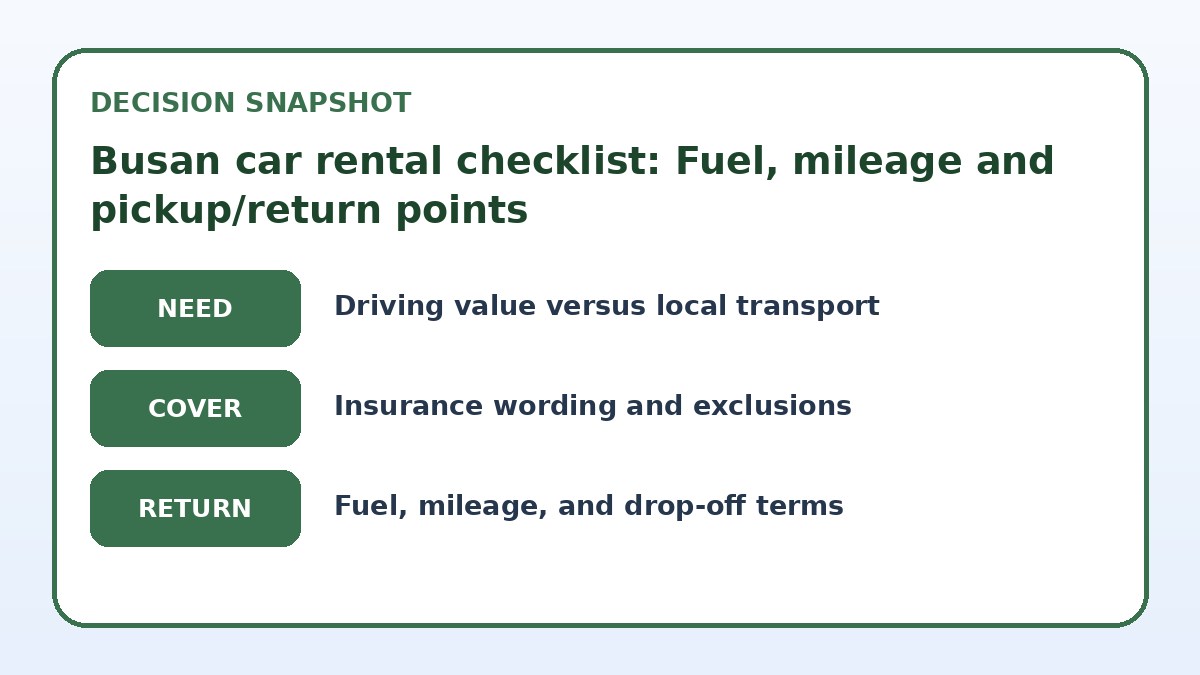
Practical answer first: driving in Busan can help if your plan includes coastal roads, day trips outside the metro area, or flexible arrival and departure logistics — but only if you understand fuel and mileage rules before you sign. Many rental contracts use differing fuel policies (full-to-full, pre-purchase, or specified refueling fees) and set mileage limits or per-kilometer charges; both affect the final cost and convenience. For first-time visitors, the key decision is whether those rules combined with insurance coverage, pickup/return friction, and local driving norms still leave driving simpler than using public transit and taxis. Read on to learn what to verify on the rental agreement, how to weigh route value, how insurance wording protects you, and what to do if you decide not to drive. If you want current availability and provider wording, compare listings on Trip.com or the rental company’s official booking page before committing.
Does driving improve your Busan trip?
Decide first whether a car materially improves your itinerary. Busan’s subway and buses cover most city attractions efficiently: Haeundae, Gwangalli, and Jagalchi Market are accessible without a car. Driving gives clear value if you plan to explore the coastal roads, Oryukdo viewpoints, or use the car for day trips outside of Busan to nearby smaller coastal towns where public transit is infrequent. Also consider luggage and group size; a small group with multiple bags or early/late arrivals may find the door-to-door convenience worth the extra work of renting.
Balance the route value against parking and traffic realities. Parking near popular beach areas can be limited and paid; downtown congestion during rush hours adds time. If your proposed routes are primarily within central Busan, transit plus occasional taxis or rideshares is often simpler. If you have flexible routes that benefit from detours or scenic drives, the car could be the better option — but only if fuel and mileage rules don’t make those detours unexpectedly costly.
Decide whether driving earns its place
| Mobility strategy | Best for | Cost or friction to check |
|---|---|---|
| Rent a car for the whole trip | Travelers with many out-of-city drives or large groups and lots of luggage | Must manage fuel policy, mileage caps, parking, and insurance; higher administrative friction |
| Daily local rental only for excursion days | Visitors who mostly use transit but want one or two flexible day trips | Requires careful timing and may incur repeated pickup/return fees or different fuel rules per rental |
| Public transit and taxis only | Short stays focused on central Busan attractions with predictable schedules | Less flexibility for remote coastal routes and early/late transfers; possible higher taxi costs for groups |
| Hybrid: public transit plus guided day tours | Visitors who want scenic drives without rental responsibilities | Loss of private flexibility and fixed departure times, but avoids fuel and mileage headaches |
Check live rental choices only after the route test
Use the exact driver, dates, pickup point, and return plan to compare current conditions.
Fuel and mileage rules: what to verify on the contract
Fuel policy language matters and is the most common source of surprise charges. Look for exact phrasing: 'full-to-full' means you pick up with a full tank and should return full; 'prepaid fuel' means you pay for a tank upfront and may not get a refund for unused fuel; 'same-to-same' requires returning with the same level shown at pickup. Also check how the company measures fuel and what refueling fees are if you fail to meet the policy. The contract should state the per-liter or flat administrative fee applied if the company refuels the vehicle for you.
Mileage caps and overage fees are equally important for day trips from Busan. The rental agreement will either offer unlimited mileage or specify a daily/total kilometer allowance plus a per-kilometer charge for overages. For itineraries that include long drives along the coast or into neighboring provinces, calculate estimated total kilometers against the allowance. If the agreement allows changing mileage packages, confirm the cost and the terms on the final booking page before accepting.
Compare the full rental conditions
Confirm insurance wording, exclusions, deposit, fuel, mileage, and return terms on the final page.
Insurance wording and pickup/return friction
Insurance summaries on booking pages can be shorthand — read the full terms. Confirm what the collision damage waiver (CDW) covers and what the excess/deductible amount is, and whether glass, tires, undercarriage, and theft protection are included or excluded. Note any requirements for filing police reports for accidents or obtaining local authority paperwork; failing to follow the required steps can void coverage. If you see optional add-ons like zero-excess packages or additional driver coverage, verify the exact protection they provide on the supplier’s final contract page.
Pickup and return friction adds time and potential extra costs. Check where the vehicle is collected (airport counters vs. off-site lots), after-hours return procedures, and whether there’s a shuttle between an off-site lot and the terminal. Also confirm the company’s fuel station locations or partner garages near the return point so you aren’t charged refueling or late return fees. If you plan to return the car outside normal hours, find the contract’s instructions and any additional charges for outside-business returns.
Car rental terms to verify
- Confirm the exact fuel policy text on the rental contract (full-to-full, prepaid, same-to-same) before finalizing the booking.
- Calculate projected kilometers for your planned routes and compare them to the rental’s mileage allowance and overage rate.
- Read the full insurance terms to find exclusions, deductible amounts, and the procedures required after an incident.
- Check pickup and return locations, after-hours procedures, and whether there are extra fees for off-site counters or late returns.
- Locate nearby fuel stations and the company’s policy on refueling receipts or proof-of-refuel requirements for returns.
- If unsure, compare provider terms on their official booking page or Trip.com listings and keep screenshots of the final agreement.
If you decide not to drive: a clear fallback
If the fuel and mileage rules, plus insurance or pickup friction, make renting unattractive, plan a robust non-driving fallback. Busan’s public transit is extensive: subways, buses, and intercity trains connect most points of interest; taxis and rideshares fill gaps for late-night or luggage-heavy transfers. For coastal excursions or day trips outside of the metro area, consider joining a small local tour or booking an intercity bus or train segment, which avoids mileage surprises and often includes local guides.
Create a hybrid plan as well: use public transit for core city days and rent a car for a single planned day for scenic drives. If you choose this hybrid, make sure the one-day rental’s mileage allowance fits the route. Book the rental with a provider whose fuel policy and insurance wording you have pre-checked, or reserve a car through a service that allows free cancellation so you can switch strategies after checking final terms on the provider’s booking page.
Car Rental & Road Trip questions travelers ask
How do I know if the rental’s fuel policy will cost me more than refilling myself?
Look for the exact refueling charge listed in the contract: some companies charge a flat administrative fee plus a per-liter or per-tank premium when they refuel the car for you. If the policy is prepaid fuel, check whether unused fuel refunds are provided and how they’re calculated. The practical test: estimate how many liters you’ll use for your itinerary and compare the cost of refilling at local stations with the total prepaid or refuel-for-you charge. If the contract language isn’t clear, request the numeric per-liter or flat fee from the rental desk before booking.
Can I extend mileage or change fuel options after pickup if my plans change?
Some companies allow upgrades to unlimited mileage or different fuel packages after pickup, but terms and costs vary. The rental contract should state whether mid-rental modifications are permitted and any associated fees. If you expect uncertain driving distances, ask at pickup about upgrading the mileage package and whether that upgrade can be done retroactively and billed proportionally. Always get confirmation in writing (email or an updated rental agreement) to avoid disputes on return.
What insurance wording should I pay special attention to as a foreign driver in Busan?
Focus on what is explicitly excluded (for example, damage to tires, windshields, undercarriage, and damage caused by off-road driving or driving under the influence). Confirm the excess/deductible amount you’d be responsible for after an incident and whether there are optional zero-excess products to reduce that amount. Also check whether the rental requires a police report or specific local paperwork for claims, and whether roadside assistance and towing are part of the standard package. If anything is unclear, request the phrasing used in claims scenarios and verify it on the provider’s final terms page.
Final decision note
For first-time visitors to Busan, the right choice is practical: rent a car only if the scenic drives or out-of-city days outweigh the administrative costs that come with fuel policies, mileage limits, and insurance wording. Begin by mapping your planned routes and estimating kilometers, then read the rental contract’s exact language about fuel (full-to-full, prepaid, or same-to-same), mileage allowances and overage rates, and insurance exclusions and deductibles. If friction at pickup/return or unclear terms remain, prefer public transit, taxis, or guided day tours, or rent for a single excursion day with a booked, verifiable contract. Always verify final terms on the supplier’s booking page (or a comparison listing such as Trip.com) before committing so there are no surprises at drop-off.
Continue planning
Check current options and final conditions
Use the provider page to confirm live availability, the final total, cancellation terms, and every condition that matters to your trip.
This evergreen planning guide was created with AI-assisted drafting and a structured quality review. It does not display live prices, schedules, availability, visa guidance, or provider rankings. Verify current details before booking. Some links are affiliate links; we may earn a commission at no additional cost to you.