Your first decision in Doha—within the first hour after landing—is whether to aim for a public option (bus or metro connection) or go straight to a private/taxi solution that handles heavy bags. If you have large suitcases, awkward gear, or a group, you’ll likely value door-to-door convenience and a clear meeting point. But public transport can work when size and timing line up and you want to reduce cost or avoid traffic bottlenecks. Read on to get a quick recommendation for typical scenarios, followed by the tradeoffs you should weigh: luggage dimensions and count, party size, late or disrupted arrivals, how clear pickup meeting points are, and where exactly you need to be dropped off in Doha. Use this as an arrival checklist while you have your flight and accommodation details open so you can book the right transfer before you land.
Check options for your arrival details
Use your flight, luggage, party size, and accommodation address to compare current choices.
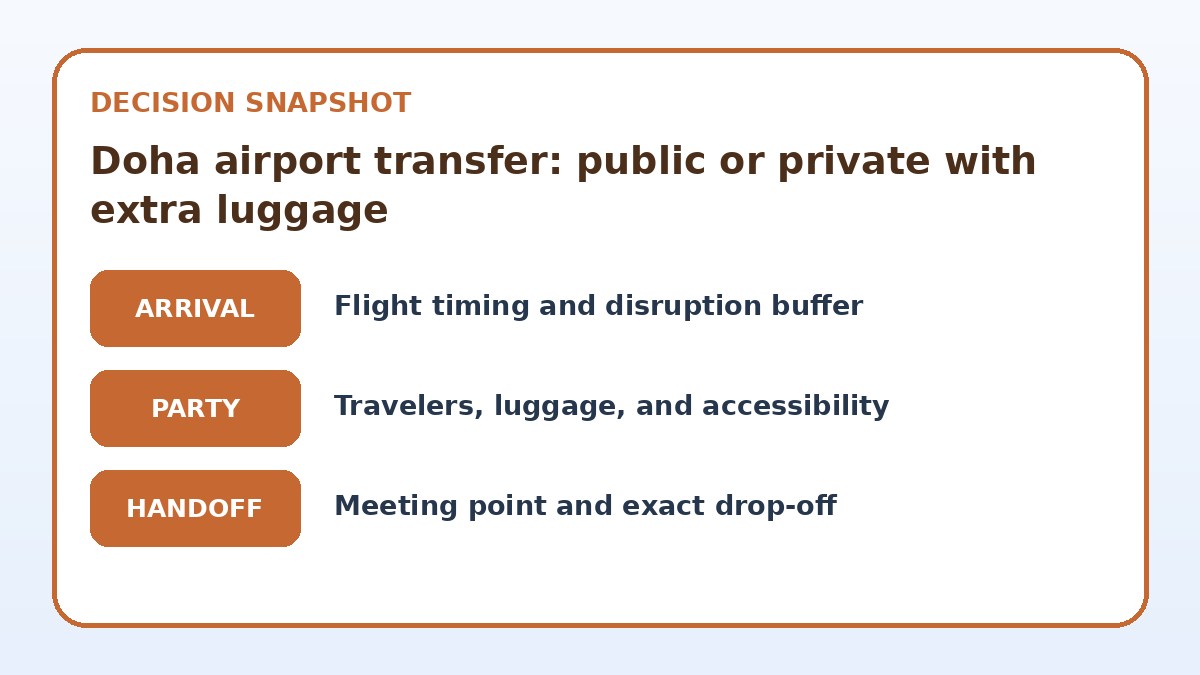
Luggage and party size: how volume changes the choice
Count every piece of luggage, including carry-ons and any special items (sports gear, instruments, or gift-wrapped boxes). A single checked suitcase plus a backpack is often manageable on buses or trains if you can lift and store your bag without assistance. Once you have two or more checked suitcases, bulky items, or a stroller and child seat, the convenience of a taxi or private vehicle usually outweighs savings from public transport. Also think about the party size: a family of four with four big suitcases will pay more for multiple taxis and will have easier handling with a single private minivan.
Beyond count, assess how you prefer to handle loading and unloading. Public options may require moving luggage across platforms, onto ramps, or up and down short stair sets; drivers at taxis and private transfers typically handle loading for you. If anyone in your party has mobility needs, a private transfer avoids the physical activity and gives you a guaranteed accessible vehicle. Before choosing, check that your pre-booked private transfer confirms the vehicle type and the number of suitcases it will accept, because capacity varies by provider.
Arrival details to have ready
- Count every checked and carry-on item, note dimensions if possible, and list any oversize or specialty gear before choosing a transfer.
- Check the terminal arrival gate and the exact arrivals hall or exit name; save a screenshot of your transfer’s pickup point.
- If booking a private transfer, confirm vehicle type, passenger and suitcase capacity, and the driver’s contact details on the booking page.
- If taking public transport, check the first and last services from the airport and the number of transfers required to reach your accommodation.
- For late arrivals, verify the transfer’s or taxi operator’s late-arrival policy and whether waiting time is included or charged extra.
- Save local emergency contacts, a map pin of your accommodation, and alternative taxi numbers in case your pre-arranged option is delayed.
Late or disrupted arrival: safety, schedules, and contingency
When flights are delayed or arrive late at night, frequency of public transport drops and options may be limited. If you expect a late arrival, prioritize options that explicitly cover after-hours pickup and include a clear late-arrival policy. A pre-booked private transfer often includes a driver waiting for a specified time and a contact point for delays, which reduces stress when plans change. If you rely on public transport, verify current evening schedules and whether buses or trains run to your neighborhood at the expected hour.
Prepare contingency steps: identify a hotline or local contact for your private transfer, keep the arrival hall meeting point descriptor handy, and have local taxi numbers saved if plans fall through. For public travel, note the terminal-to-platform route and the first and last departure times from the airport. If your airline or luggage handling is delayed, add buffer time for customs and baggage claim—this is when a flexible transfer that waits or a readily available taxi becomes far more valuable than the cheapest scheduled option.
Match the transfer to your arrival
| Arrival approach | Best for | Detail to verify |
|---|---|---|
| Airport bus or metro | Solo travelers with one medium suitcase and flexible schedules | Lower handling cost but requires lifting bags and possible transfers; fewer late-night options |
| Metered airport taxi | Travelers needing quick, on-demand door-to-door service for moderate luggage | Convenient curbside pickup but variable wait times and uncertain vehicle capacity during peak periods |
| Pre-booked private transfer (sedan or minivan) | Groups, families, or travelers with multiple/oversized bags seeking guaranteed capacity | Most convenient for handling and meeting-point clarity; requires booking in advance and vehicle confirmation |
| Shared shuttle or ridepool | Budget-conscious travelers with manageable luggage willing to share rides | Lower cost per person but potential for multiple stops and limited luggage space per passenger |
Make the meeting plan clear
Check the final pickup instructions, waiting conditions, and exact drop-off coverage.
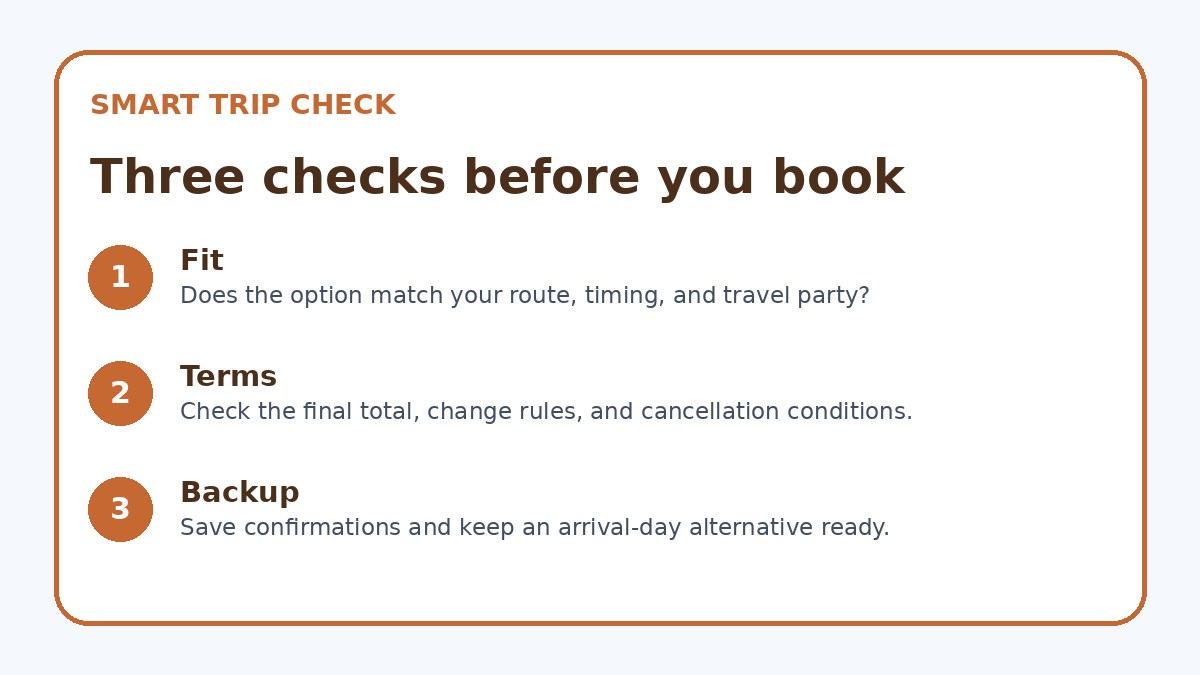
Meeting-point clarity: avoid confusion in Doha’s terminals
Meeting-point clarity matters much more when you have extra luggage. Public transport access points are usually marked, but they can still require walking between terminals or using shuttle corridors. For taxis and private transfers, insist on a named, easily reachable meeting point inside the arrivals hall, a phone contact for the driver, and a vehicle description. If you book online, save the confirmation message and screenshot the driver’s contact details; if a transfer company lists a terminal exit or desk as the pickup point, verify that it’s accessible from international arrivals without additional security checks.
If you’re using a metered taxi from a taxi rank, plan for the time it takes to get to that rank with heavy bags. Some travelers prefer to pay for curbside drop-off and pickup to minimize walking. For public transit, check whether you’ll need to transfer lines carrying luggage; each transfer increases the handling burden. When using a shared shuttle, confirm whether the driver will load and unload your luggage at intermediate stops and whether there are any size restrictions that could require a second vehicle.
Destination-side fit: where you need to be dropped off matters
Think about the exact drop-off point at your accommodation. A private transfer or taxi can usually stop at the building entrance, drop you at a lobby or side gate, and wait while you check in with heavy bags. Public transport might deliver you to the nearest station, a few blocks away, or a bus stop that still requires carrying luggage to your door. If your hotel or rental has restricted vehicle access, verify whether drivers can approach closely or must use a designated drop zone; this will affect whether a private vehicle truly saves effort.
If your destination is in a dense urban area or a pedestrianized district, study the final approach: narrow streets, one-way systems, or limited curbside space can make taxis slower. A small group with moderate luggage might accept a short walk from a nearby station, whereas travelers with large suitcases or seniors will usually prefer door-to-door service. Before booking, ask the private transfer company where they will stop and check local directions from the nearest public transit stop to your accommodation so you can compare total door-to-door effort honestly.
Airport Transfer & Local Mobility questions travelers ask
Can I bring very large or heavy luggage on Doha’s public transport?
Public buses and trains typically accept standard suitcases carried by passengers, but very large or awkward items can be difficult to handle during transfers and peak hours. If your luggage needs special handling or exceeds typical size limits, a private transfer or taxi avoids repeated lifting and reduces the risk of damage. Before you rely on public transport, check the operator’s baggage rules on their official site and consider whether you can stow your items securely during the journey without blocking aisles or seats.
How should I handle a long layover and multiple bags when I arrive in Doha?
With a long layover you have more flexibility: you can consider short-term luggage storage or sending excess bags ahead if that service is available. If you plan to leave the airport, factor in time for immigration, baggage claim, and re-entry screening. For multiple bags the convenience of a private transfer becomes more valuable, saving time wasted moving between terminals or stations. If you prefer public transport, choose off-peak times and plan routes that minimize transfers and walking distance with your bags.
What should I verify on a private transfer booking page before I pay?
On the provider’s booking page confirm the exact pickup location inside the arrivals area, the vehicle model or class, passenger and suitcase capacity, driver contact details, wait-time allowances for delayed flights, and any extra charges for stops or late arrivals. Also check the cancellation and modification policy in case your flight schedule changes. If the booking platform allows, read recent user notes about vehicle suitability for luggage—but always treat those as anecdotal and verify the provider’s stated capacity first.
Final decision note
If you arrive in Doha with extra luggage, the simplest rule is this: prioritize door-to-door service when you have multiple large suitcases, special items, mobility needs, or a late arrival. Public transport and shared options work well for light packers who value lower cost and can handle transfers. Before you book, verify vehicle capacity, pickup instructions, and any late-arrival policy on the provider’s page. Keep your flight and accommodation details handy and use the checklist above to compare total door-to-door time, handling effort, and contingency options. For live availability checks, you can compare options on Trip.com or directly on provider websites, but always confirm the final booking terms before you travel.
Continue planning
Check current options and final conditions
Use the provider page to confirm live availability, the final total, cancellation terms, and every condition that matters to your trip.
This evergreen planning guide was created with AI-assisted drafting and a structured quality review. It does not display live prices, schedules, availability, visa guidance, or provider rankings. Verify current details before booking. Some links are affiliate links; we may earn a commission at no additional cost to you.