If you and your partner are deciding how to travel from Seoul to Jeonju, the practical choice comes down to how you value comfort, schedule certainty, luggage ease and door-to-door time. Trains generally offer the smoothest ride and simpler transfers for couples, while coaches can be cheaper and more direct from certain terminals. Ferry options are limited on this inland route but can be part of a mixed itinerary if you want a coastal detour. This guide gives the quick, usable answer up front: weigh train for comfort and fewer transfers, coach for simple city-to-city routing, and mixed options when you plan scenic stops. Read on for terminal fit, luggage and transfer friction, timing flexibility, and a ready disruption backup so you can pick, book and relax.
Terminal fit and door-to-door practicality
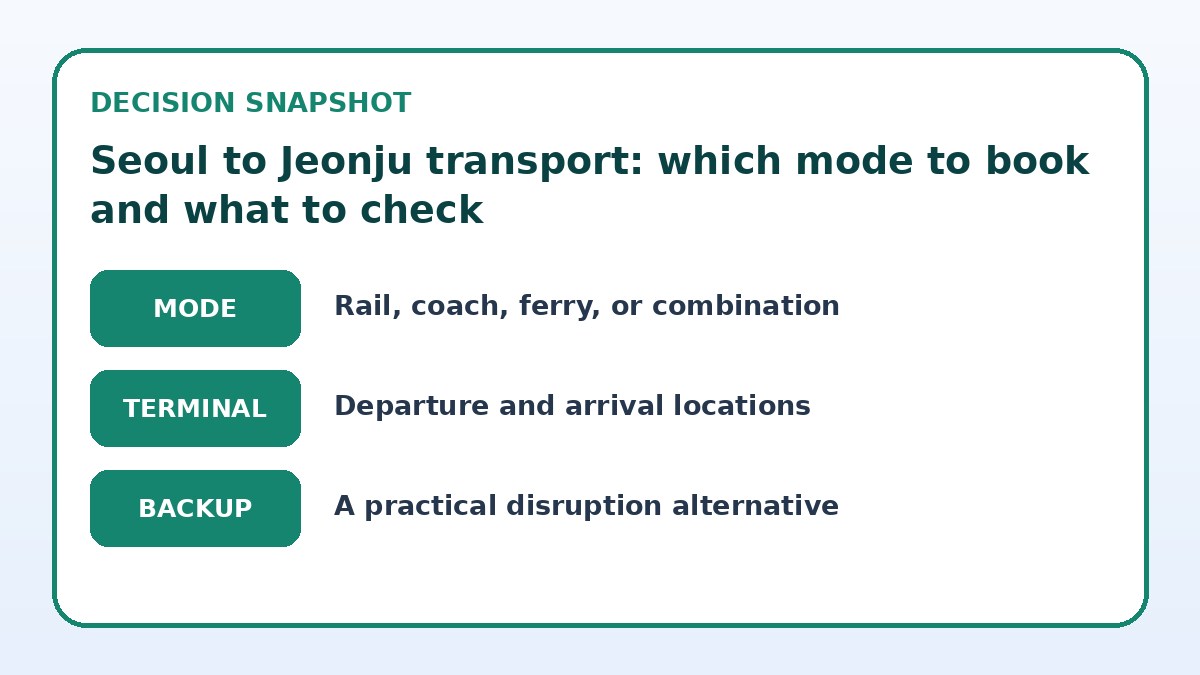
Start by mapping where you are in Seoul and where you need to end up in Jeonju. Major train stations often sit closer to subway lines and taxi ranks, which makes first- and last-mile transfers shorter and easier for couples carrying shared luggage. Coaches tend to board at bus terminals that may be farther from your accommodation or require a local subway change; factor in transfer time and the effort of moving luggage between modes. If your Jeonju lodging is in the old city centre, check which arrival point drops you closest to your hotel entrance to avoid extra taxis or long walks.
When considering mixed itineraries—such as a coastal ferry plus a bus or train leg—tally cumulative transfer times and the number of times you’ll handle luggage. Couples who prefer staying together and minimizing physical strain should prioritize single-transfer journeys. Also account for late-night or early-morning accessibility of terminals; some bus terminals and smaller ports have reduced services or fewer taxis, which affects how practical an arrival or departure time will be for a two-person trip.
Choose the end-to-end journey plan
| Journey approach | Best for | Friction to check |
|---|---|---|
| Train-only itinerary | Couples wanting the fewest transfers, more onboard space, and predictable station access. | May require a subway or taxi to reach stations; less flexibility for scenic detours. |
| Coach-only itinerary | Couples prioritizing direct city-to-city hops from a specific terminal near their lodging. | Comfort and luggage handling can be tighter; road traffic affects arrival time predictability. |
| Mixed-mode (train + coach or ferry) | Couples who want scenic stops or to combine different regions into one trip. | More transfers, extra handling of luggage, and greater need for buffer time between segments. |
| Flexible day-of travel (open return/standby) | Couples with uncertain plans who want maximum scheduling freedom. | Higher risk of no seats at preferred times and more time spent arranging alternatives on the day. |
Check live intercity options
Look beyond the ride itself and compare terminals, transfers, luggage, and arrival fit.
Luggage, comfort and on-board experience
Think through how much luggage you’ll bring and how mobile you want to be during the trip. Trains generally provide more space to spread out, roomier seating and predictable places to stow suitcases, which helps couples relax and enjoy the journey. Coaches are improving for comfort but can be narrower and involve lifting baggage into cargo holds; if one partner prefers to avoid heavy lifting, a train with accessible luggage racks or boarding assistance will be more convenient.
If you plan a scenic route or a mixed-mode trip, consider seating together and whether food or beverage options matter. Some coaches and trains have refreshments or vending, while ferry legs may include promenades and walking space that change the experience. For couples wanting to linger with a view, a route with longer on-deck or observation time adds value—but adds transfer complexity too. Decide which aspect—comfort, view, or convenience—matters most and let that steer your mode choice.
Timing flexibility and planning windows
Timing matters when traveling as a pair: do you want a fixed departure or flexible options? Trains frequently run on predictable schedules and usually allow you to check multiple departures with clear seat availability. Coaches can have frequent departures from major terminals but may be subject to road conditions that create variability. For couples who prefer to stick to a tight itinerary—museum entry times, restaurant reservations, or evening plans—prioritize modes and departure times that minimize risk of late arrival.
If your schedule allows wandering or scenic detours, mixed options can turn travel time into part of the trip. But mixed itineraries require padding for connections, potential waits at transfer points and the chance of missed legs. Build buffer time between segments and prefer arrival times that leave daylight for finding your accommodation. When booking, verify the provider’s final booking page for transfer instructions, boarding gates and luggage rules so you aren’t surprised at departure.
Compare the practical alternatives
Use the final page to confirm what is actually offered on your dates and save a workable fallback.
Intercity travel checklist
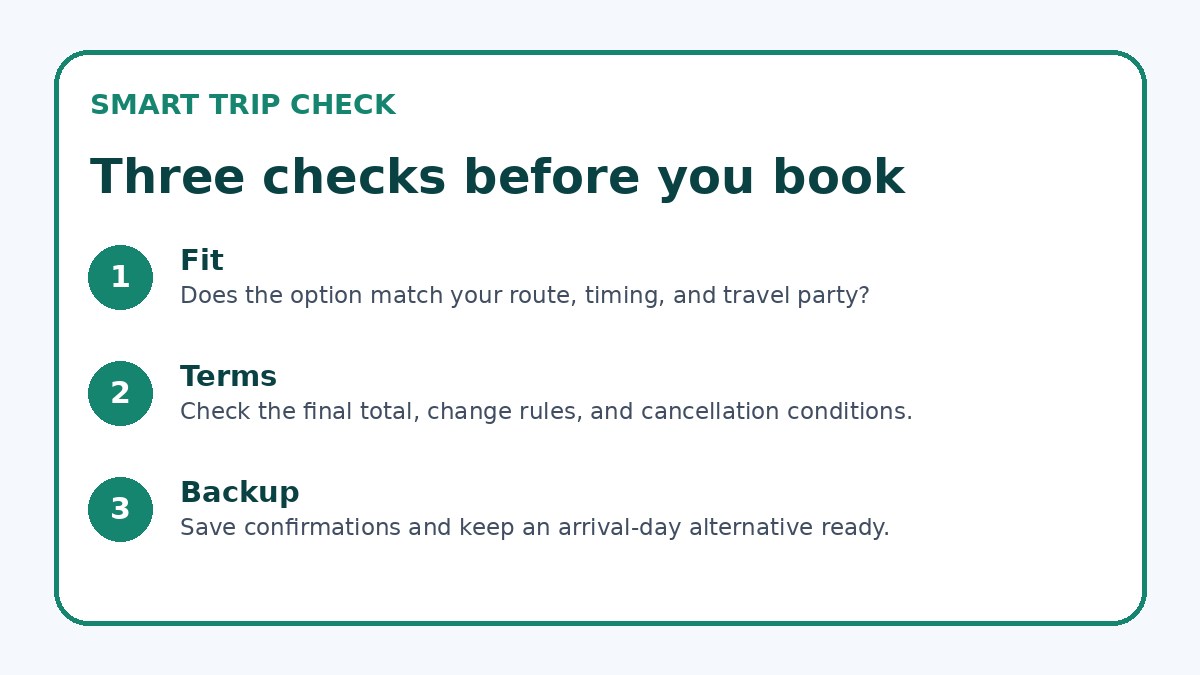
- Map your door-to-door route and time each transfer, including subway, taxi and walking legs before you book.
- Confirm luggage allowances and where to stow bags on the chosen mode; note any special assistance options if needed.
- Screenshot or save departure and ticket pages for all legs, plus contact details for carriers in case of changes.
- Build at least 30–60 minutes buffer between connecting legs for unexpected delays and walking between terminals.
- Decide in advance how much extra you’ll spend on a taxi or ride-share as a disruption backup.
- Verify last-mile arrival options in Jeonju—taxi ranks, bus stops, or hotel pick-up—and factor them into total travel time.
Disruption backup and faster alternatives
Couples should agree on a simple disruption plan before departure: choose an alternate train or coach time, decide the maximum extra taxi spend you’re willing to use, and know where to get live schedule updates. Identify at least one later departure and one earlier one on paper or screenshots so you can switch if the plan changes. If you both carry phone chargers and saved screenshots of tickets, rebooking or rerouting becomes much less stressful.
If a connection fails, a practical fallback is a direct taxi or ride-share for a final short hop, even though it costs more—this avoids splitting up or carrying luggage across multiple transfers at night. When provider-specific facts could change, check the operator’s final booking page for refund and change rules, boarding gates and luggage allowances. For price and availability comparisons before you book, you can check Trip.com as one of several tools, but always confirm details with the carrier you select.
Rail & Intercity Transport questions travelers ask
Is the train faster than the coach from Seoul to Jeonju?
Speed depends on the specific service chosen and how you measure door-to-door time. A train can be faster on the rail leg and tend to be more predictable because it avoids road congestion, but if your origin or final address is far from the rail station, additional subway or taxi time may offset that advantage. Compare total transfer time, not just the in-vehicle duration, and check provider pages for exact schedules and station locations before booking.
Can couples bring large suitcases on coaches and trains without extra fees?
Luggage policies vary by carrier and ticket type; many trains and coaches allow standard suitcases but handle larger items differently. Before booking, check the carrier’s final booking page for luggage size, quantity limits and any required pre-declaration or additional charges. If you prefer not to lift heavy bags, choose a service with accessible storage or request assistance at the station; this is especially useful for couples managing shared luggage.
Should we book tickets in advance or buy on the day when traveling as a couple?
Booking in advance secures seats together and reduces stress, particularly for popular departure times or weekend travel. Day-of purchases work if you value flexibility and there are frequent departures, but they carry the risk of limited seating and possibly having to split across seats. If you need to compare real-time availability, Trip.com is one tool to check, but always confirm final seat selection and change/cancellation terms on the carrier’s official booking page.
Final decision note
For most couples traveling from Seoul to Jeonju, the decision comes down to the balance between comfort and door-to-door simplicity. Trains offer fewer transfers and more onboard space, making them the practical default for two people with moderate luggage. Coaches can be sensible for couples based near bus terminals or seeking a direct city–city link, while mixed routes work for those who value scenic detours despite extra handling. Whatever you choose, plan transfers, verify luggage rules on the carrier’s final booking page, save ticket screenshots, and set a straightforward disruption backup to keep the trip relaxed.
Continue planning
Check current options and final conditions
Use the provider page to confirm live availability, the final total, cancellation terms, and every condition that matters to your trip.
This evergreen planning guide was created with AI-assisted drafting and a structured quality review. It does not display live prices, schedules, availability, visa guidance, or provider rankings. Verify current details before booking. Some links are affiliate links; we may earn a commission at no additional cost to you.