In the first hour after landing in Tokyo you’ll face a practical decision: use the city’s public network (trains and airport buses) or book a private option (taxi, shuttle, or prearranged car). Your answer depends on four fast checks you can make while taxiing to the gate: how much luggage you have, how many people are in your party, whether your arrival is late or delayed, and where exactly you need to be dropped off. For most solo travelers with light bags and clear onward directions, public transit is often straightforward and economical. For groups, late-night arrivals, heavy gear, or door-to-door convenience, private transfers remove uncertainty. Below you’ll find clear tradeoffs, decision criteria, a four-row comparison of common arrival approaches, and an actionable checklist you can use while you have your flight and accommodation details open.
Check options for your arrival details
Use your flight, luggage, party size, and accommodation address to compare current choices.
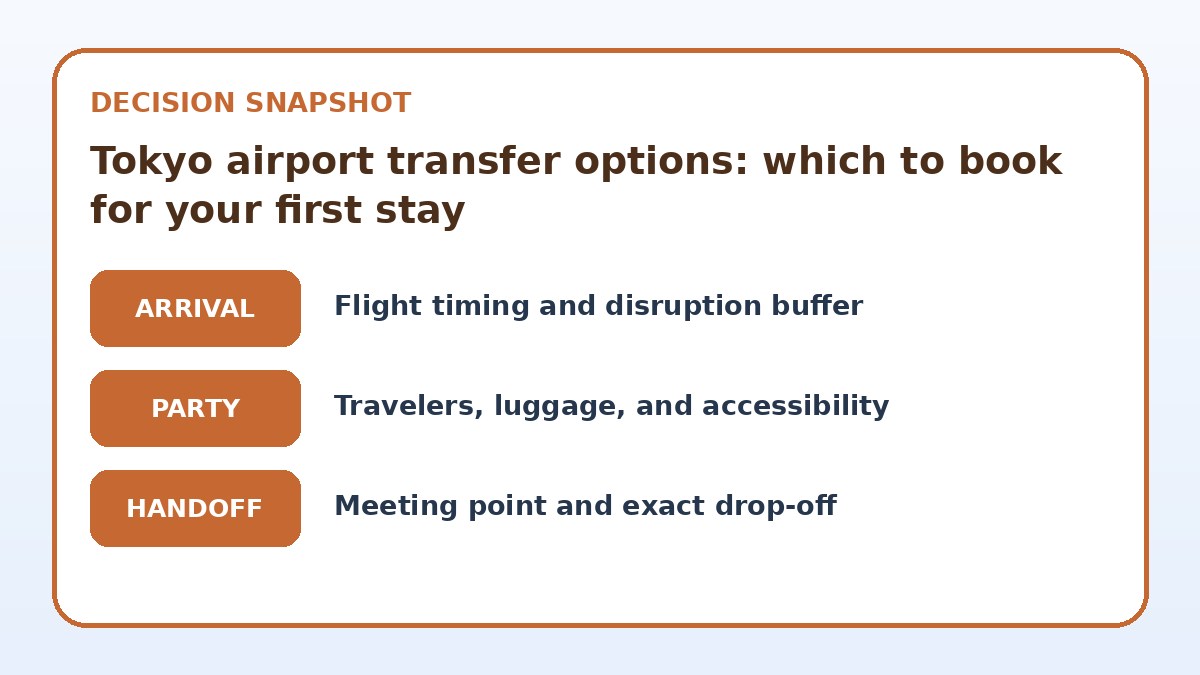
Luggage and party size: match vehicle capacity to comfort
Before choosing public or private transfer, count your carry-ons, checked bags, and any bulky items like sports equipment or strollers. Trains and airport buses have space for luggage but require you to handle bags on stairs, platforms and sometimes down streets to your hotel. If your party is two with one medium suitcase each, public transit is often practical. If you are a family of four with several large cases, a prebooked vehicle or airport taxi reduces transfers and physical strain.
Also consider how much room you need to sit comfortably. Private vehicles give assured space for passengers and luggage and avoid the unfamiliar logistics of transferring between lines or buses. On public services you’ll need to evaluate whether you can manage the final walk from the station to your accommodation—some hotels are station-adjacent while others involve a longer, luggage-unfriendly approach. Use the airline seat map and luggage allowances to estimate final bag count before you choose.
Arrival details to have ready
- Count all passengers and suitcases—include carry-ons, checked bags and any oversized items before choosing vehicle size.
- Check your flight’s scheduled arrival terminal and note the official arrival exit letter or number to share with drivers.
- Confirm whether your hotel address has a vehicle entrance or requires a short walk from the nearest station.
- If arrival is late or could be delayed, write down a backup private transfer or taxi desk number to avoid being stranded.
- When booking private service, verify pickup instructions, wait-time allowances, and the provider’s contact details on their booking page.
- If using public transit, map the final station-to-hotel walking route and estimate luggage handling difficulty before you leave the airport.
Late or disrupted arrivals: plan for reduced public options
If your flight arrives late at night or after a delay, the availability of trains and buses may be limited. Nighttime last trains or bus services vary by route and day of the week; if you’re pushing into those hours, a private transfer avoids the risk of standing on cold platforms or paying for an unexpected overnight stay. Keep in mind that airport terminals remain open but connections slow down, so the convenience and predictability of a booked car can be worth the premium when schedules are uncertain.
When disruptions happen—long immigration lines, baggage delays, or missed connections—private providers can sometimes adapt pickup times more flexibly than fixed-schedule public services. If you rely on public transport, build an extra buffer into your arrival plans and confirm alternative options ahead of time. Whether you pick public or private, save the contact info for a taxi desk at the airport and a backup car service so you can switch quickly if your plans change.
Match the transfer to your arrival
| Arrival approach | Best for | Detail to verify |
|---|---|---|
| Airport train (or express rail) | Solo or duo travelers with light baggage heading to major stations | Requires carrying bags across platforms and possibly one final walk to the hotel |
| Airport bus or coach | Passengers with medium luggage or direct-stop hotels along the bus route | Slower in traffic; stops are fixed so you may still need a short transfer |
| Taxi or app-based private ride | Small groups needing door-to-door service, especially at night | More expensive and can be affected by city traffic and narrow streets |
| Prebooked private transfer or van | Families, larger groups, or travellers with bulky gear wanting predictable pickup | Higher cost and requires exact meeting arrangements; verify cancellation and wait-time policies |
Make the meeting plan clear
Check the final pickup instructions, waiting conditions, and exact drop-off coverage.
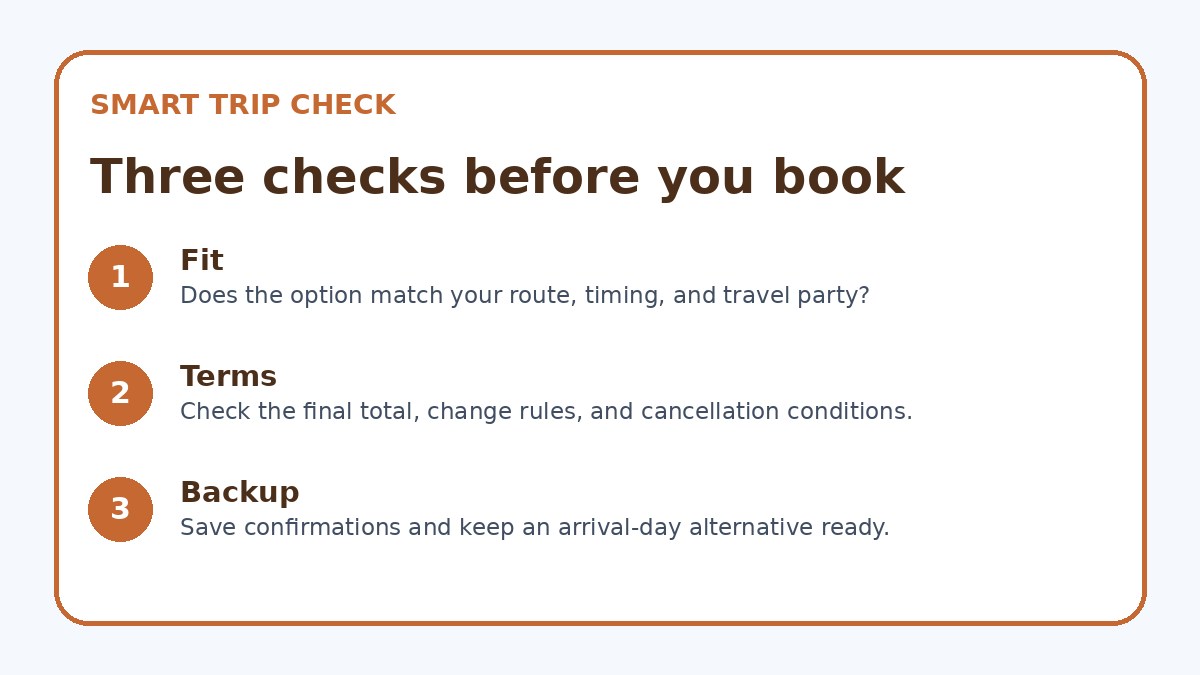
Meeting-point clarity: avoid confusion at busy terminals
Large Japanese airports have multiple terminals, arrival exits, and official taxi ranks; meeting points matter. For public options, the platform or bus stop name is usually sufficient, but for private pickups you will need a precise exit letter, curb number, or a recognizable landmark. If your booking confirmation gives an unclear meeting point, contact the provider before you depart. Include terminal, airline, and estimated arrival time in messages so the driver can adjust if your flight is early or late.
If meeting a private driver, exchange a recent phone number and, if useful, a live location pin from your phone once you have landed and cleared immigration. For arrivals where language could be a barrier, take a screenshot of your hotel name written in Japanese to show a driver or ask an airport information desk to help. A clear plan for where you will meet reduces waiting stress and keeps the transfer smooth for both parties.
Destination-side drop-off: drop close to your door when it matters
Think about how close the transfer can drop you to your accommodation. Public transport typically leaves you at the nearest main station or bus stop; many hotels are a short walk from those points, but some ryokans and private apartments sit on narrow streets or uphill areas where taxis and larger vehicles may not reach. Check your accommodation’s directions and entry instructions so you know whether you should expect a final walk with luggage.
If your accommodation has a dedicated vehicle entrance or concierge who can meet you curbside, a private transfer gives true door-to-door convenience. Conversely, if your lodging is well connected to a major station, taking public transit saves both money and traffic-related delays. When in doubt, contact the property before you travel to confirm the best drop-off option and any arrival instructions you should share with your driver or use when planning a public route.
Airport Transfer & Local Mobility questions travelers ask
How do I decide between Tokyo airport transfer by train and by bus?
Consider where your accommodation is located and how much luggage you have. Trains generally connect rapidly to central stations and can be faster during peak traffic, while airport buses stop closer to some hotels and reduce transfers if your property is on the route. If you expect heavy traffic or want guaranteed seating with luggage stowage, compare the bus route and final stop to your hotel’s address. Always check schedules and any last-service times for both modes before you travel.
Is it better to prebook a private transfer to avoid language or logistics problems?
Prebooking a private transfer reduces the guesswork of negotiating with drivers after a long flight and offers door-to-door service, which is helpful with lots of luggage or when arriving late. However, private transfers require precise meeting details and clear cancellation or wait-time policies, so verify those on the provider’s booking page. For many first-time visitors who are comfortable using signs and ticket machines, public transport remains a reliable and straightforward alternative.
What should I confirm with my hotel when planning an airport transfer?
Ask whether the hotel has a recommended entrance for vehicle drop-off, any restrictions for large vehicles, and the preferred nearby station or bus stop name. If you plan to arrive late, check whether the property offers a late check-in process or a staff contact for arrivals. If the hotel provides an in-house shuttle or recommends a specific transfer partner, request clear pickup instructions and compare those against other private or public options before booking.
Final decision note
For first-time arrivals in Tokyo, make a quick decision by balancing luggage, party size, arrival time and your accommodation’s access. Public trains and buses work very well for light travellers heading to major stations, offering frequent service and clear signage. Private taxis or prebooked vehicles offer comfort, door-to-door convenience and simpler logistics for groups, late arrivals, or heavy gear, but require precise meeting details and higher cost. Use the checklist while you still have flight and hotel details open, confirm meeting points and provider rules on their booking pages, and keep a backup transfer contact ready—Trip.com can be used to compare live availability if you want a quick second opinion.
Continue planning
Check current options and final conditions
Use the provider page to confirm live availability, the final total, cancellation terms, and every condition that matters to your trip.
This evergreen planning guide was created with AI-assisted drafting and a structured quality review. It does not display live prices, schedules, availability, visa guidance, or provider rankings. Verify current details before booking. Some links are affiliate links; we may earn a commission at no additional cost to you.