If you’re booking Sydney to Auckland flights for the first time, the most practical question is this: which tradeoffs are you willing to accept between direct routing, price, baggage flexibility and schedule convenience? The right answer depends less on a single low fare and more on the combination of travel dates, how much luggage you’ll carry, transfer risk tolerance and whether schedule timing impacts your plans in Auckland. Start by locking your exact travel dates, the number and ages of travelers, and any tight onward connections or fixed activities at your destination. With those details in hand you can compare nonstop versus one-stop options, check baggage allowances and change/cancellation conditions, and assess connection cushion and airport transfer time. Below is a focused pre-booking checklist and decision framework to help you choose the flight strategy that fits your priorities and reduces surprises at check-in and arrival.
See live routes for your exact travel day
Compare direct and connecting choices with the same baggage and traveler details.
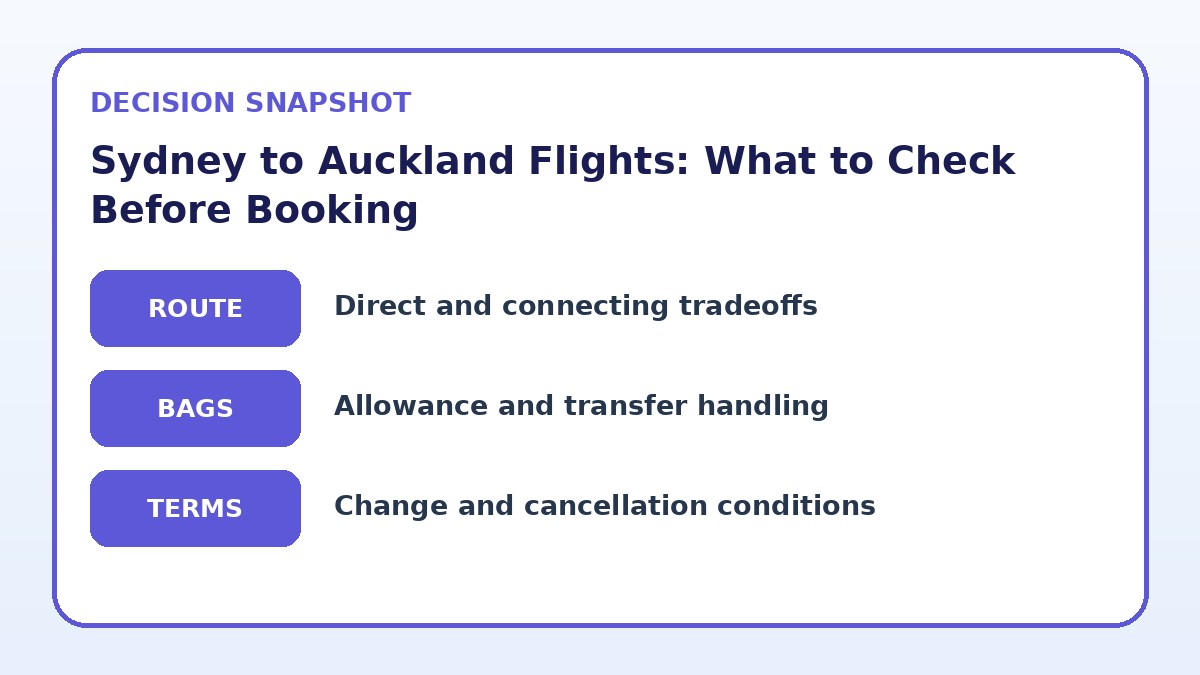
Routing: direct vs connecting choices
On the Sydney to Auckland corridor you’ll commonly find both nonstop and connecting options. For first-time visitors, the main decision is whether saving time with a nonstop justifies a higher base fare or whether a connecting itinerary is acceptable if it significantly lowers out-of-pocket cost. When comparing routes, look beyond flight duration: factor in the time to clear departure airport security, any domestic transfers in Sydney if you’re not starting at the same terminal, and how arrival timing aligns with your hotel check-in or activities in Auckland.
If you consider a connecting flight, check where the connection occurs and whether it requires you to re-check baggage or change terminals. That adds complexity and potential delay. Also verify minimum connection times on the carrier’s booking page and read recent passenger reports or airport guides for the transfer experience. If you have tight onward arrangements in Auckland, favor itineraries with more buffer between scheduled landing and your first commitment at the destination.
Baggage and connection risk: read the full rules
Baggage allowances and whether your bag is checked through to Auckland differ across fares and between direct and connecting bookings. A low initial fare may exclude checked bags or assign different seat types; the cumulative cost after adding one or two checked items can change which option is cheaper. For connections, confirm whether all legs are on one ticket. If not, you may need to collect and re-check luggage at the intermediate airport, which increases transfer time and risk of missing the next flight.
Before booking, inspect the carrier’s fare rules on the final booking page for explicit baggage weights, dimensions, and fees, and for special items such as sports equipment. If you’re traveling with fragile or oversized gear, ask the airline what documentation or extra handling is required. When someone in your party has mobility needs or travels with a child and stroller, verify assistance procedures and how those are handled during connections so you can plan realistic transfer windows.
Compare flight-selection strategies
| Flight strategy | Best for | Risk to check |
|---|---|---|
| Pick a nonstop flight at a higher base fare | Travelers prioritizing speed and simple transfers with minimal connection risk. | You pay more upfront and may get less price flexibility or fewer included extras depending on fare class. |
| Choose a one-stop itinerary for a lower base fare | Budget-conscious travelers willing to accept longer travel time and connection complexity. | Greater risk of missed connections, possible baggage re-checks, and tighter schedules if delays occur. |
| Buy the cheapest fare and add extras à la carte | Passengers who are sure of their dates and travel light without needing flexibility. | When you add baggage, seat selection and change fees the final cost can approach or exceed flexible fares. |
| Select a flexible/refundable fare | Travelers with uncertain plans or those who might need date changes without penalties. | Higher initial cost, but reduces stress and potential large fees if plans change—verify exact change rules. |
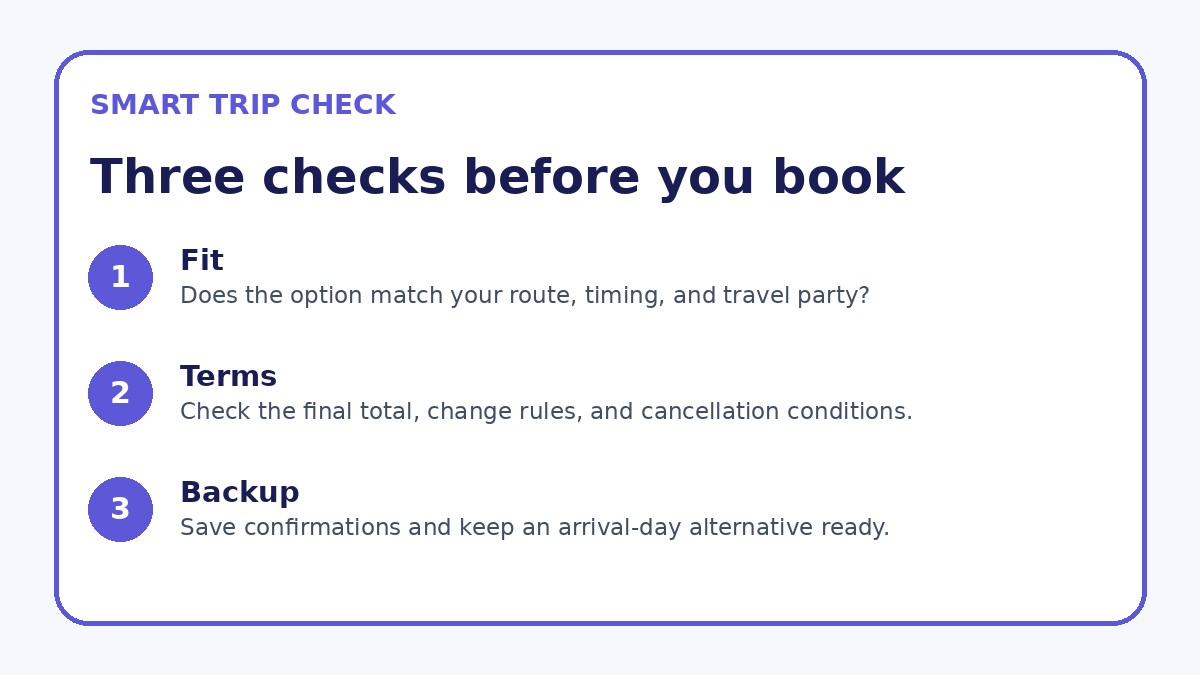
Recheck the complete itinerary
Confirm airports, connection handling, baggage, and change conditions before deciding.
Schedule fit and daily rhythm
Flight times affect how much of your arrival or departure day you get to use. Early-morning departures may require a pre-dawn transfer to Sydney Airport, while late arrivals in Auckland can make first-night logistics harder. Consider your energy levels and whether you prefer arriving with an afternoon to check into accommodation and adjust to local time. Also weigh the risk of travel-day disruptions—if a tight schedule would ruin a prepaid activity, choose a more forgiving itinerary.
If you have fixed commitments—meetings, tours that start at a specific hour, or inter-island connections from Auckland—build a conservative buffer into your arrival time. Two small delays can cascade on a same-day connection or a booked tour. Use realistic door-to-door estimates, including travel time from your Sydney neighborhood to the outbound terminal and from Auckland Airport to your first stop, to ensure the selected flight aligns with your ground plans.
Flight details to verify
- Confirm your exact travel dates, full legal names as on passports, birthdates for infants/children, and passport numbers before starting bookings.
- Decide on your baggage needs (carry-on only or checked) and calculate the total fare plus predictable add-on fees on the airline’s final booking page.
- Compare nonstop and connecting itineraries using door-to-door travel time, not just scheduled flight time, including transfers to/from airports.
- Read the fare conditions for change, cancellation, and refund rules on the carrier’s payment page and screenshot or save the policy text.
- Verify minimum connection times, whether bags are checked through, and terminal transfer logistics when evaluating one-stop options.
- Prepare credit card details, contact phone number, and emergency contact, and note what ID you’ll need at check-in and for arrival in Auckland.
Fare conditions and the fine print to verify
Fare conditions determine change and cancellation flexibility, seat selection costs, and whether you can earn frequent flyer credit. Before committing, click through the carrier’s final booking page to read the specific terms for the fare class you’re considering. Look for fees for date or name changes, refundability, and any restrictions on combining fares. If you anticipate possible date shifts, a fare with a modest change fee may cost less overall than the cheapest non-changeable ticket plus a penalty later.
Also confirm how taxes and surcharges are displayed and whether the fare shown includes all mandatory government or airport charges. If you plan to add extras—checked bags, premium seats, meals—estimate their total cost and add it to the fare when comparing options. Finally, verify exactly what personal data the booking requires and whether the provider’s final payment page lists the total charge and the cancellation/alteration policy in plain terms before you enter payment details.
Flight Guide questions travelers ask
Should I always pick a nonstop when flying from Sydney to Auckland?
Not necessarily. Nonstops reduce travel time and simplify transfers, which helps if you want to maximize time in Auckland or avoid connection stress. However, nonstop fares can be higher and sometimes include fewer perks in economy fares. If you travel very light and are flexible on timing, a well-timed one-stop could save money. Evaluate total door-to-door time, baggage handling, and the fare conditions for both options before deciding.
How far ahead should I book Sydney to Auckland flights for the best choice of schedules?
There’s no single ideal booking window for every traveler. Booking earlier can improve your choice of preferred departure times and seat availability, especially for groups or families who need adjacent seats. If you have fixed travel plans or require specific seats, start searching once your dates are set. If flexibility matters more, monitor fares and schedules but be prepared to lock in when a suitable combination of routing, baggage policy and fare conditions appears.
What exact fare details must I verify on the airline’s final booking page?
Always verify total price including taxes and surcharges, baggage allowances and fees for the fare class, change and cancellation fees or refundability, and whether seats or meals are included or cost extra. Also check whether the itinerary is on a single ticket (which affects baggage through-checking and protection for missed connections) and any country-specific requirements that the airline lists at checkout. Keep screenshots of the final terms for future reference.
Final decision note
Booking Sydney to Auckland flights for a first-time visit is a practical exercise in matching priorities: speed, price, baggage needs and schedule resilience. Start by locking the travel dates and traveler details, then compare nonstop and connecting options using total door-to-door time. Add predictable extras—checked bags, seats and change protection—into your cost comparison and read the fare conditions on the final booking page before you pay. If you still want to shop options quickly, Trip.com is one place to compare current availability, but always verify baggage, connection rules and change fees on the carrier’s own booking confirmation page before finalizing your purchase.
Continue planning
Check current options and final conditions
Use the provider page to confirm live availability, the final total, cancellation terms, and every condition that matters to your trip.
This evergreen planning guide was created with AI-assisted drafting and a structured quality review. It does not display live prices, schedules, availability, visa guidance, or provider rankings. Verify current details before booking. Some links are affiliate links; we may earn a commission at no additional cost to you.