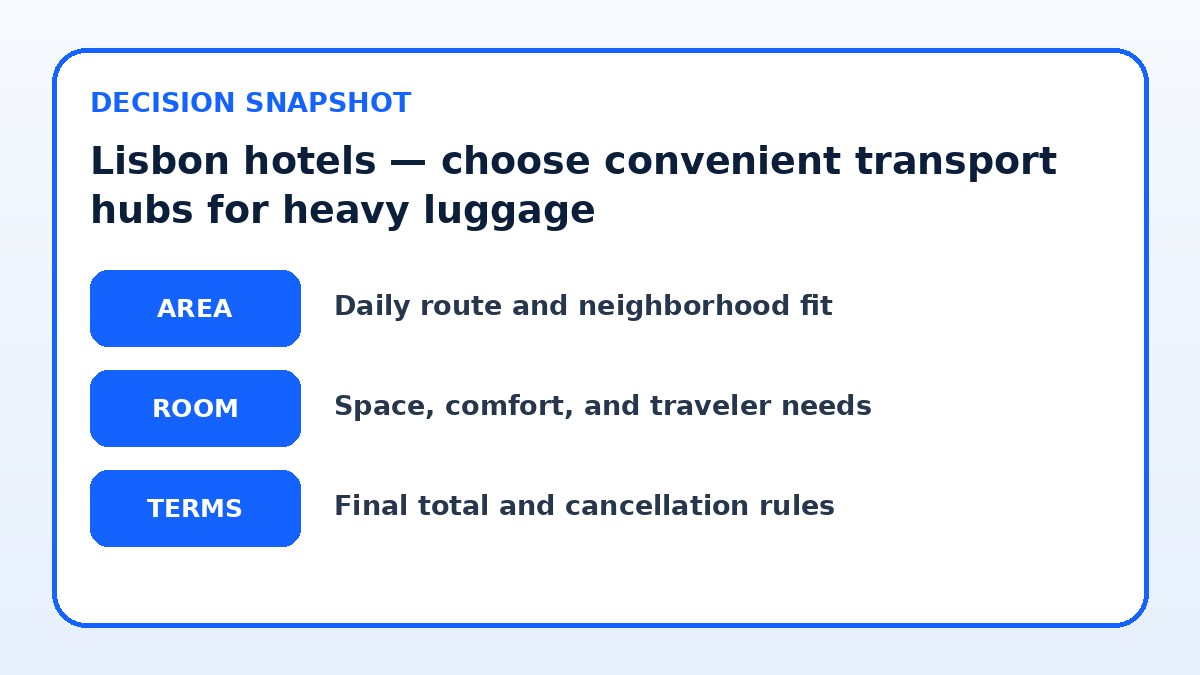
If you’re traveling to Lisbon with bulky suitcases, sports equipment, a stroller, or lots of shopping, your top hotel decision is which neighborhood minimizes daily friction between transport and your room. Choose an area with a short, mostly level walk from the nearest metro, commuter train station, or easy taxi drop-off; if you’ll use public transit often, prioritize direct metro lines and interchange stations with elevators and escalators. This article gives the practical short answer up front — neighborhoods that work well for heavy luggage, what daily-route pain points to expect, how to size a room for your party and bags, and which booking terms to confirm before you reserve. Read the short comparisons to pick one area to shortlist, then use the checklist to verify elevator access, luggage storage, arrival logistics, and free cancellation before opening live inventory.

Check live stays in the areas that fit
Use your dates and party size to compare current rooms after you narrow the neighborhood fit.
Which Lisbon neighborhoods save you effort with luggage
For travelers with extra luggage, think in terms of transport nodes rather than sightseeing icons. Baixa-Chiado, Avenida da Liberdade, and the area around Rossio train station put you within a short, mostly flat walk to metro lines and intercity trains, reducing the number of curb-to-room transfers. Belém and Parque das Nações are good if you arrive by longer-distance trains or expect to use commuter services—both offer wider pavements and easier vehicle access, though they sit farther from the historic center.
Alfama and Bairro Alto are classic Lisbon but present tradeoffs: narrow, hilly streets and lots of stairs that make repeated luggage moves tiring. If you want those neighborhoods’ atmosphere, book a hotel explicitly advertising step-free access or arrange a transfer that can unload as close as possible to the property. For a balance of charm and convenience, look at hotels along the tram lines that have nearby metro interchanges so you can avoid carrying bags up steep alleys.
Choose an area-selection strategy
| Area approach | Best for | Tradeoff to check |
|---|---|---|
| Stay near a major metro interchange (e.g., Baixa-Chiado, Marquês de Pombal) | Frequent transit use and short, flat walks to lines that connect most of the city. | Busy central districts can have limited private drop-off space and occasional pedestrian-only areas near hotel doors. |
| Stay by a main train or commuter hub (Rossio, Entrecampos, Cais do Sodré) | Arrivals by intercity train and day trips where avoiding extra transfers is a priority. | Stations are practical but can be noisier; hotels may be more functional and offer less historic character. |
| Stay in riverside / flat districts (Parque das Nações, Belém) | Easy vehicle access, roomier pavements, and lower-stepping terrain for heavy cases. | These areas sit further from the historic hilltop attractions and evening dining scenes. |
| Stay in historic neighborhoods (Alfama, Bairro Alto) | If you prioritize neighborhood atmosphere and are prepared to arrange help for luggage. | Narrow, steep streets and stairs mean more time spent carrying or arranging special drop-offs. |
Daily-route friction: what to map before you book
Map the route between your planned arrival point—airport, train station or ferry quay—and the hotel door. Look for stairs, cobblestone sections, pedestrian-only zones, short but steep inclines, and where you’ll need to lift bags into taxis or onto trams. If your hotel’s address sits on a pedestrian square, verify how close a vehicle can legally and practically stop for drop-off; some central Lisbon squares restrict vehicle access and require a short carry.
Also check the nearest metro station layout: does it have elevators or only escalators and stairs? Which lines are served and whether they provide direct rides to the airport’s metro/transfer point or require a connection. If you plan to take the train to Sintra or Cascais, being near Rossio or Cais do Sodré can be a huge time and effort saver because you minimize transfers and extra handling of luggage.
Now compare like with like
Keep the same dates, guests, room needs, and cancellation preferences while you compare the final choices.
Room and party needs: sizing your booking for luggage
When evaluating room types, look beyond bed configuration. Seek rooms that explicitly show floor space, a wardrobe or closet, and luggage racks in photos. For two adults and oversized cases, a standard double can be cramped; consider booking a superior or family room for the extra clearance to open suitcases without blocking corridors. If you travel with bulky sports gear or musical instruments, verify dimensions with the hotel and ask whether they offer a secure storage room.
If you’re traveling with a baby or mobility-impaired companion, confirm cot or accessible-room availability and the path from hotel entrance to room for step-free movement. For groups or multi-stop itineraries, a hotel that offers short-term luggage storage on arrival and departure days reduces the need to carry bags through last-day sightseeing. Always ask whether in-house porters are available and whether they charge a fee—policies vary and should be confirmed on the booking page or by email.
Hotel booking check before payment
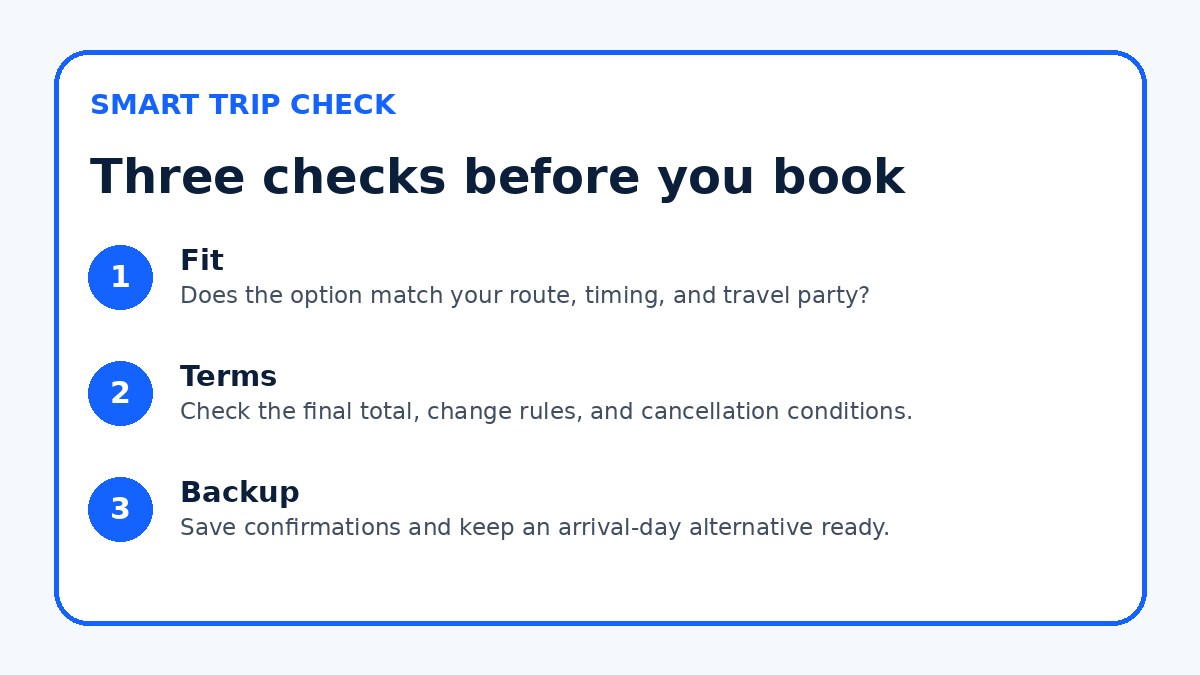
- Check the hotel description and photos for elevator presence and confirm step-free access from street to room in writing.
- Ask the property whether they offer luggage storage on arrival and departure days, whether it is free, and where the storage is located.
- Map the walking route from your arrival point (airport/train/ferry/taxi drop-off) to the hotel door and note any stairs, cobbles, or pedestrian-only stretches.
- Request vehicle drop-off instructions from the hotel and confirm the closest legal stopping point for a taxi or rideshare.
- Choose a room type with extra floor space or a separate sitting area if you need to open and store large suitcases.
- If mobility or oversized gear is involved, ask for photos of the exact corridor and doorway dimensions and confirm porter assistance availability.
Booking terms and final checks to remove surprises
Before you click reserve, verify a few concrete items on the hotel’s final booking page or in direct communications: elevator availability, exact check-in and check-out windows, luggage storage policies and any applicable fees, and vehicle drop-off instructions. If accessible rooms are required, request confirmation in writing and ask for photos of the route to your room if that matters. If arrival is late at night, confirm late-check-in procedures so you don’t get stuck outside with luggage.
If you’ll arrive by public transport, check transfer alternatives and compare door-to-door taxis or pre-arranged transfers vs. public options for how many steps and lifts each involves. Use the hotel’s contact to ask whether they recommend a particular entrance or approach for luggage to avoid narrow alleys. If comparing live inventory, you can use Trip.com once to see availability and policies, but always verify provider-specific facts such as elevator availability and storage rules directly with the hotel.
Hotel Guide questions travelers ask
Is it better to pick a hotel near the metro or near a train station when I have heavy luggage?
Both options can reduce lifting, but the right choice depends on your itinerary. A hotel near a metro interchange shortens daily trips around the city and usually gives more frequent, level access points; check whether the metro stations on your route have elevators. A hotel near a main train station (Rossio, Entrecampos, Cais do Sodré) is better if you’re arriving or departing by intercity rail or taking day trips to Sintra or Cascais because it minimizes transfers and the need to haul bags between services. Compare the specific station layouts and step-free routes before deciding.
Can trams or buses in Lisbon handle oversized luggage, and should I plan to use them?
Trams and buses can be crowded and often require stepping up from the street, so they are less convenient for large suitcases. Short tram rides through narrow streets can be charming but involve boarding and standing room rather than luggage storage. If you expect to use public transit with big bags, prioritize hotels near metro stations with elevators or arrange a taxi/rideshare for arrival and departure legs. For predictable handling, a direct taxi from the airport or station to your hotel’s recommended drop-off point is usually simpler.
What hotel policies or fees should I confirm when booking if I have extra baggage?
Ask about luggage storage availability and whether there’s a charge or size restriction, porter service and any fee, and late-check-in/early-check-out procedures that might affect drop-off or pick-up of bags. Also confirm whether the hotel requires a credit card pre-authorization for incidental charges and whether there are time limits on stored items. For accessibility or special equipment, request written confirmation of the room’s suitability and the path to it. Always verify these details on the hotel’s booking page or by direct message so you have an official record.
Final decision note
For travelers with extra luggage, the most practical Lisbon hotel choice is the one that minimizes awkward transfers and stair carries: close to a metro interchange with elevators, a main train hub for onward rail journeys, or a riverside district with easy vehicle access. Balance that against how much you value historic streets versus daily convenience. Use the comparison rows to shortlist the one area that matches your arrival mode and daily plans, then run through the checklist and ask the hotel specific questions about elevators, drop-off points, luggage storage, and porter services before booking. Once those logistics are confirmed, you’ll be able to reserve with confidence and focus on your Lisbon itinerary, not the suitcase.
Continue planning
Check current options and final conditions
Use the provider page to confirm live availability, the final total, cancellation terms, and every condition that matters to your trip.
This evergreen planning guide was created with AI-assisted drafting and a structured quality review. It does not display live prices, schedules, availability, visa guidance, or provider rankings. Verify current details before booking. Some links are affiliate links; we may earn a commission at no additional cost to you.