If you’re traveling from San Francisco to Vancouver with extra luggage, the primary tradeoff is often route convenience versus fare flexibility. A nonstop or single-connection routing may cost more but reduces the chance of lost or delayed bags; lower fares with connections can save money but increase baggage-handling risk and timing pressure. Before you start searching live inventory, be ready with exact travel dates, full traveler names, baggage counts and dimensions, and whether any items need special handling (sports equipment, oversized bags, or fragile items). Have contact-phone numbers and a backup arrival plan in Vancouver in case a connection is missed. Use the checklist below to compare direct and connecting options, confirm checked and carry-on allowances, examine fare change and cancellation conditions, and evaluate schedule buffers that protect both your bags and your plans.
See live routes for your exact travel day
Compare direct and connecting choices with the same baggage and traveler details.
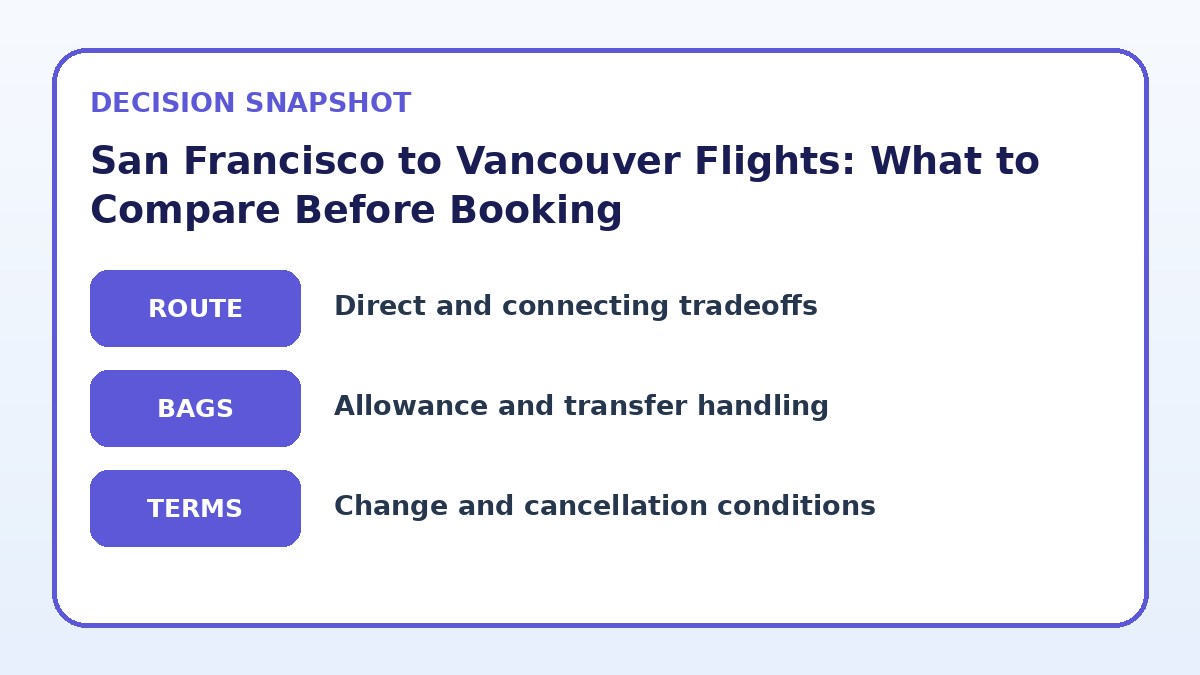
Routing: direct flights versus connections
When you plan San Francisco to Vancouver flights with extra luggage, routing is the first practical choice. Nonstop flights (if offered) minimize the number of times your bags are handled and reduce the complexity of transfers, which lowers the risk of misdirected or delayed luggage. Connecting itineraries can open more schedule or price options, but each connection adds a transfer event where bags move between aircraft and ground crews. For travelers with bulky or valuable luggage, fewer connections are a strong operational benefit to prioritize.
Comparing options means looking beyond advertised flight time: factor in the time needed to collect and recheck checked bags at a connection, any customs/immigration processes if a routing requires an international transit procedure, and the minimum connection time recommended by the airline. When multiple carriers are involved in a single ticket, through-checked bags are common but not guaranteed—confirm whether you’ll stay on one ticket or need separate bookings, because separate tickets often require you to claim and recheck baggage.
Baggage rules and connection risk
Baggage allowances and fees vary widely by fare class, route, and airline; the number of bags allowed, weight limits, and size restrictions can change between carriers on a connecting itinerary. For each candidate flight, check the exact baggage policy displayed on the airline’s final booking page: confirm permitted pieces, excess weight charges per kilogram or pound, and the fees for oversized or special items like skis or musical instruments. Make a list of all items you plan to check, with weights and measurements, so you can quickly compare costs across options.
Connection risk is a practical consideration when you travel with extra luggage. Short layovers increase the chance that a delayed inbound flight will leave insufficient time to transfer checked bags; longer layovers make loss of time at your destination more likely if your luggage is delayed. If your itinerary involves two separate tickets or self-transfer between carriers, plan for mandatory baggage pickup and recheck—this step adds time and complexity. Prioritize itineraries that either offer through-checked baggage on the same ticket or provide ample connection windows.
Compare flight-selection strategies
| Flight strategy | Best for | Risk to check |
|---|---|---|
| Book a nonstop or single-connection itinerary | Minimizing baggage transfers and risk of delayed or lost luggage | Typically fewer schedule options and possibly higher fares or less flexible ticket classes |
| Choose the lowest-fare option with connections | Maximizing savings when baggage risk and tight schedules are less important | Higher chance of missed transfers, extra baggage fees, and more time spent handling luggage |
| Pay for a flexible fare with included checked bags | Travelers who value changeability and want predictable baggage costs | Higher upfront cost but fewer surprises; may be unnecessary if plans are fixed |
| Mix-and-match separate tickets for lower-cost legs | Those needing very specific timing or route combinations not offered on a single ticket | You assume responsibility for missed connections and must handle baggage recheck yourself |
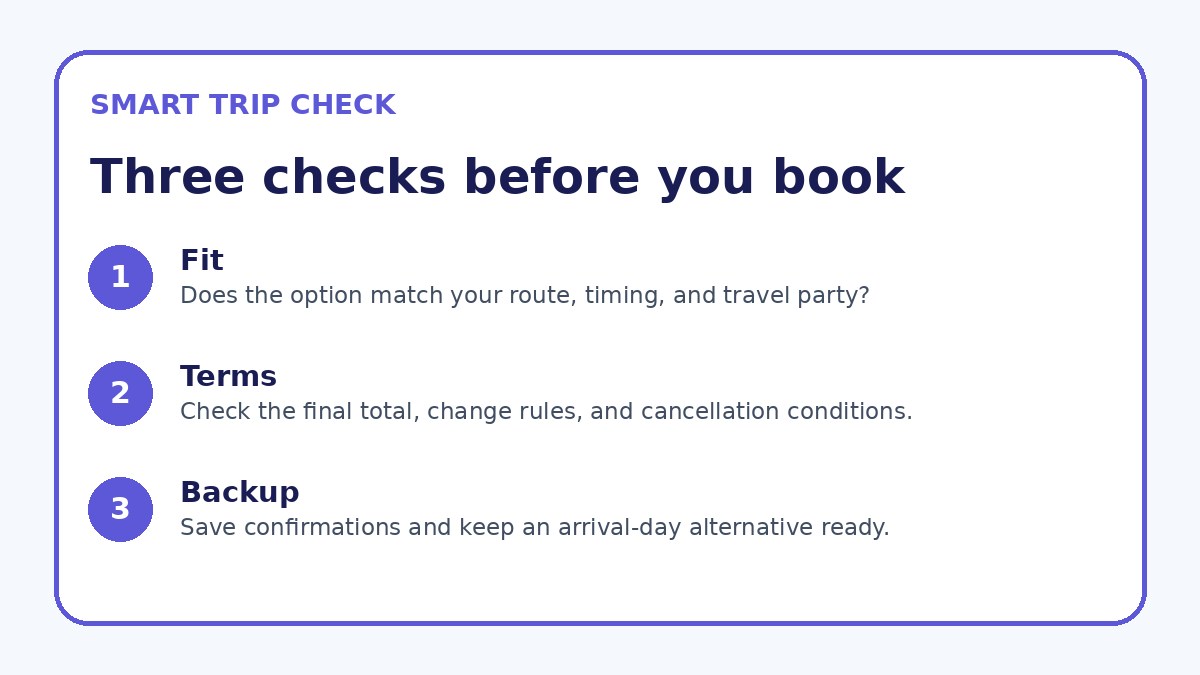
Recheck the complete itinerary
Confirm airports, connection handling, baggage, and change conditions before deciding.
Schedule fit and contingency planning
Choose flights that align with your broader schedule and tolerance for risk. If you’re on a tight timeline—attending an event or starting a rental—the safer choice is a routing with more buffer time or a nonstop option if available. Consider arrival time in Vancouver relative to ground transportation schedules; late arrivals may limit transport choices or increase taxi and rideshare wait times. Conversely, early departures from San Francisco can be harder to reach if you need to ferry oversized luggage to the airport or rely on morning traffic patterns.
Build contingency plans: if a connection is delayed, know whether subsequent flights on the same ticket are protected by the airline and whether rebooking is allowed without penalty. Have the contact details for your airline and travel insurance policy ready, and make a backup plan for immediate needs at destination—where you can store or temporarily offload extra baggage, and whom to call if an item is lost or damaged. Record your most important documents and high-value items in carry-on bags to protect them independently of checked luggage.
Flight details to verify
- Confirm exact travel dates, full traveler names, contact numbers, and the number and weights of checked bags before you search live fares.
- Check whether potential itineraries are sold on a single ticket with through-checked baggage or as separate tickets requiring bag pickup and recheck.
- On each airline’s final booking page, verify baggage allowances (pieces, weight, and size), fees for extra or overweight items, and special-item rules.
- Compare total door-to-door time including recommended minimum connection times, likely transfer procedures, and how many times bags will be handled.
- Read the fare conditions on the booking page: change/cancellation rules, refundability, and whether baggage is included or must be added as an extra.
- Plan contingencies: collect airline contact info, take photos of packed bags and contents list, and note local options in Vancouver for temporary storage or repairs.
Fare conditions and what to verify on booking pages
Fare conditions determine your flexibility with changes, cancellations, and baggage—key when you travel with extra luggage. Before you click purchase, read the airline’s fare rules on the final booking page: check change and cancellation fees, whether the fare is refundable, and whether the fare class includes checked bags or only allows carry-on. If baggage is not included, compute the total cost by adding the expected fees for each checked piece and any potential overweight charges for your actual bag weights.
Also verify whether the displayed itinerary is sold as a single ticket or as separate segments; if separate, confirm who is responsible for missed connections and baggage transfers. Look for any small-print restrictions, such as non-transferable tickets or specific rules for oversized items. If you’re comparing multiple booking channels, note that baggage allowances and add-on options sometimes differ—always confirm final baggage totals and extra-item policies on the airline’s own booking page before paying. For a quick check of live availability and conditions, you can compare options on Trip.com, but treat the airline’s page as authoritative.
Flight Guide questions travelers ask
Should I always choose a nonstop flight if I have extra luggage?
Nonstop flights reduce the number of times checked bags move between aircraft and ground crews, which lowers the chance of delays or misrouting. However, nonstop options may be fewer, less flexible, or more expensive. If the nonstop schedule works with your timing and budget, it’s often the simplest choice with extra luggage. If not, prioritize itineraries with a single, protected connection on one ticket and a comfortable connection window to reduce transfer risk.
How can I estimate total baggage cost before booking?
Start by listing each checked item's weight and dimensions. On each candidate itinerary, open the airline’s final booking page and add the exact number of checked bags to the booking flow to see real fees; fare-class pages often show inclusive allowances. Don’t forget potential overweight and oversized charges, plus fees for special items. Add those baggage fees to the base fare to compare total outlay across flights rather than comparing base fares alone.
What should I do if my itinerary involves separate tickets with different carriers?
If you buy separate tickets, assume you must claim and recheck checked luggage between flights unless you confirm otherwise. Build longer connection windows to allow for baggage pickup and recheck, and ensure you have any necessary visas or transit documents. Consider travel insurance that covers missed connections or baggage delays, and prepare to pay separate baggage fees on each carrier. If minimizing risk is a priority, buy a single-ticket itinerary that protects connections and lets your bags be through-checked.
Final decision note
When planning San Francisco to Vancouver flights with extra luggage, the practical choice starts with routing versus fare flexibility. Prioritize itineraries that reduce baggage transfers—nonstop or single-ticket connections—if minimizing risk is important. Always gather exact traveler and baggage details before you check live options so you can compare total costs and real policies on airline booking pages. Carefully read fare conditions and baggage rules, and plan contingencies for missed connections or delayed bags. With the checklist above and deliberate comparison of scheduling, baggage rules, and fare conditions, you’ll be able to pick the flight that best balances convenience, cost, and peace of mind.
Continue planning
Check current options and final conditions
Use the provider page to confirm live availability, the final total, cancellation terms, and every condition that matters to your trip.
This evergreen planning guide was created with AI-assisted drafting and a structured quality review. It does not display live prices, schedules, availability, visa guidance, or provider rankings. Verify current details before booking. Some links are affiliate links; we may earn a commission at no additional cost to you.