Short practical answer: choose the mode that minimizes door-to-door friction for your priorities. If you value simplicity and low transfer stress, a single-seat sleeper train or a point-to-point long-distance coach that picks up near your accommodation will often be the most practical. If time-flexibility and comfort matter more than transfers, layering a domestic flight with a short city transfer can work, but that adds airport handling. For budget-driven solo travelers willing to manage a few transfers, combining cheap bus legs or a train plus a short bus can save money but increases luggage and transfer complexity. This guide breaks down terminal fit, luggage and transfers, timing flexibility, and disruption backups so you can match the route plan to your energy level, schedule, and comfort needs. Where provider specifics matter, check the operator’s final booking page and local maps; Trip.com can be used to compare current availability but verify pick-up and drop-off locations directly with providers.
Terminal fit: start and end points matter
When choosing between rail, coach, flight, or a mixed itinerary, start by mapping each option’s actual terminals relative to your origin and destination addresses. A central station or coach terminal that’s a short taxi ride from your Hanoi accommodation and drops you near Da Nang’s city center can be easier than a flight that lands at an airport farther from your hotel. Solo travelers should tally the number and difficulty of short trips needed before and after the main ride: taxi to station, baggage handling at a platform, and the last-mile transfer in Da Nang. These small movements often determine whether the journey feels straightforward or exhausting.
Also check what each terminal offers solo travelers: safe waiting areas, luggage storage, and simple ticket counters or mobile check-in. If a station requires climbing stairs with bags or has confusing platform layouts, that increases friction. For airports, consider the length of walk between gates, security lines, and transit time to the city. When comparing options, draw a simple door-to-door map showing every transfer and approximate time; the plan with fewer uncertain steps usually wins for a solo traveler who prefers predictable logistics.
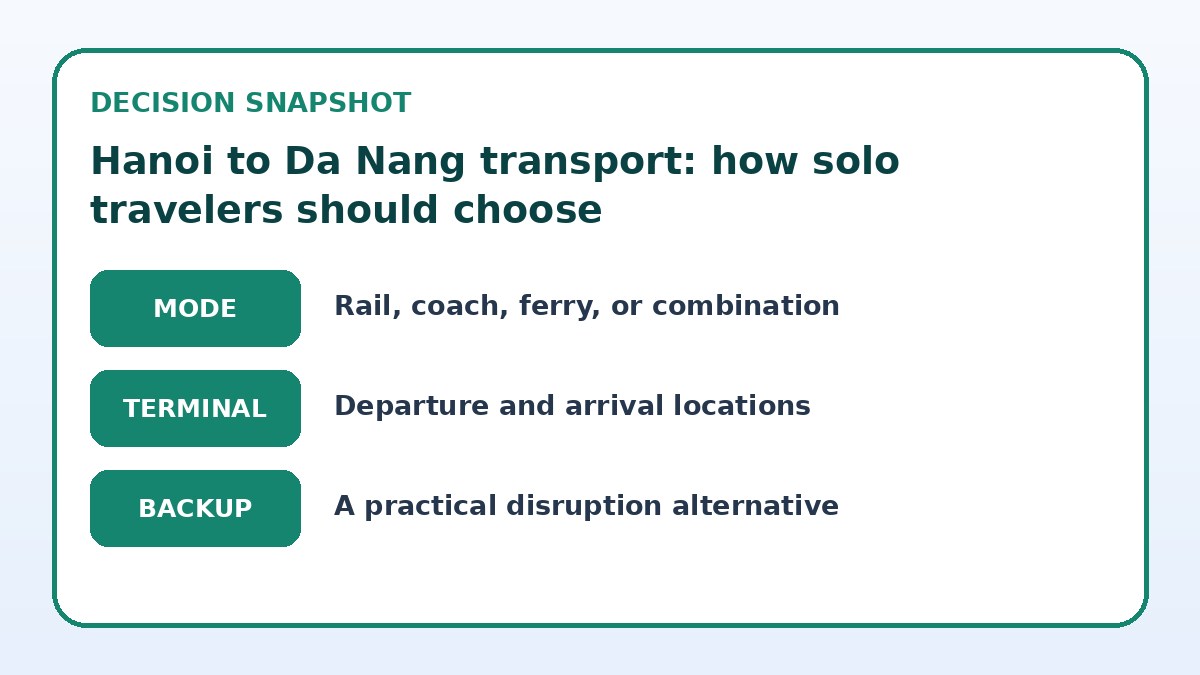
Choose the end-to-end journey plan
| Journey approach | Best for | Friction to check |
|---|---|---|
| Single long-distance train (direct where available) | Solo travelers who value fewer transfers and consistent, predictable terminal handling. | Often slower than flying; check final booking pages for exact station locations and onboard facilities. |
| Point-to-point coach with centralized pickup | Those prioritizing low transfer steps and frequent daytime departures to match flexible plans. | Comfort and space vary; verify luggage policies and drop-off proximity to your Da Nang address before booking. |
| Flight plus simple taxi or ride-hail transfer | Travelers needing speed over distance with willingness to handle airport procedures. | Adds airport check-in and last-mile time; confirm terminal-to-city transfer options and allow buffers for delays. |
| Mixed itinerary (train or coach plus short local bus/taxi) | Budget-conscious solo travelers prepared to manage more handoffs to reduce fares. | More transfers increase luggage handling and coordination; plan extra time and clear pickup locations. |
Check live intercity options
Look beyond the ride itself and compare terminals, transfers, luggage, and arrival fit.
Luggage and transfer friction: manage what you carry
Luggage handling changes the whole trip feel. If you travel light with a carry-on, you can tolerate more transfers and public-transport legs. If you have a larger bag, favor services that minimize handling: a single train or coach that loads your luggage onto a reserved storage area or a flight that lets you check a bag can be more practical. Think about how many times you will shoulder your bag, lift it onto racks, or keep it in sight. Solo travelers should avoid itineraries that require repeated short walks across busy stations with heavy bags or multiple stair climbs without lifts.
Also evaluate transfer friction in real terms: is the connecting point a cramped bus station or a modern terminal with marked pickup zones? Are taxis or ride-hailing reliable there, and how easy is it to communicate pickup details? If language or connectivity might be an issue, prioritize options that leave you at well-signposted, staffed terminals where you can ask for help. If you must combine modes, build extra time for slow baggage transitions and choose daytime departures to avoid stressful late-night transfers.
Timing flexibility: schedules, comfort, and solo needs
Decide whether departure flexibility or fixed arrival windows are more important. Trains and frequent coaches usually offer multiple daily departures, which helps if you want to shift plans day-of or recover from a late morning. Flights may be faster but typically require arrival at the airport earlier, plus security and potential delays; that can complicate same-day tight schedules. Solo travelers who prefer to travel at night to save daytime hours should check whether an overnight train provides a safe, comfortable sleeping option and whether the terminal environment at both ends feels secure for solo arrival after dark.
Also consider in-journey comfort: a longer daytime rail ride with a window seat and space to stretch might be mentally easier than a short flight with cramped boarding and longer check-in procedures. Check the typical frequency of each mode (not specific schedules here) and plan a buffer for local traffic, especially for airport transfers. Build your day assuming a delay in the first leg so you don’t miss a strict connection; choosing a single-leg option where possible eliminates that hazard entirely.
Compare the practical alternatives
Use the final page to confirm what is actually offered on your dates and save a workable fallback.
Intercity travel checklist
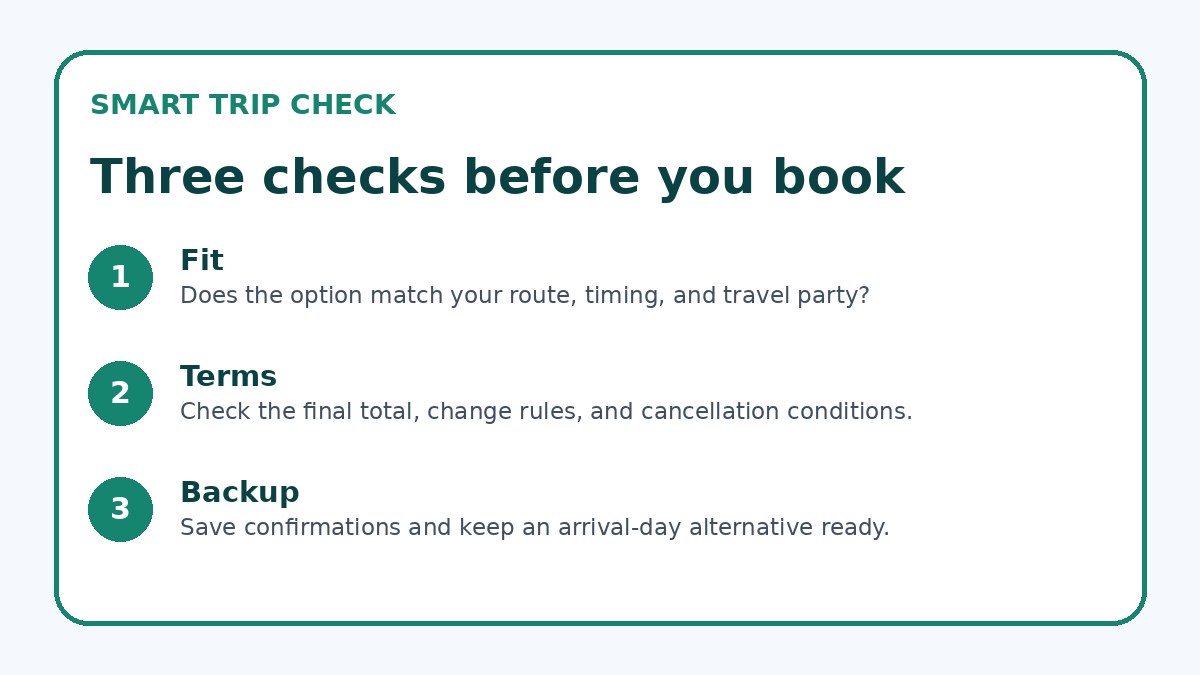
- Map door-to-door transfers before booking: list taxi, station walk, and final pickup points with approximate travel times.
- Confirm where luggage is stored or carried on each option and whether staff assistance is available at terminals.
- Block extra buffer time for connections and local traffic when combining modes, especially involving airports.
- Save key addresses and directions in the local language and keep a screenshot of your booking with pickup details.
- Identify one realistic backup option reachable within two to four hours from your origin and note how to buy a ticket quickly.
- Charge devices, set up mobile payment or local SIM, and carry a small emergency cash reserve for unexpected transfers.
Disruption backup: simple fallbacks that keep you moving
Every realistic plan needs a backup you can implement solo. Identify one or two concrete alternatives reachable from your origin: the next train, a regular coach line, or a later flight. Know where to buy an immediate replacement ticket, whether at a central station counter, through an agent, or via an app. Make sure your phone, payment method, and local SIM or roaming are set up so you can contact providers quickly. If language could be a barrier, save key phrases or directions in the local language and keep an address card for your Da Nang destination to show drivers or staff.
Also prepare a simple financial buffer and a place to stay in case the backup isn’t immediate. For example, if you miss the intended evening service, have a reliable hotel option near the terminal and a plan for getting there safely. For higher-risk transfers—tight flight-to-train connections, or remote bus pickup points—choose alternatives that are easy to reach by taxi. The goal is not to eliminate risk but to have backups that are straightforward to arrange solo, minimizing the need for long waits or complex coordination.
Rail & Intercity Transport questions travelers ask
How do I compare total door-to-door time between train, coach, and flights?
Estimate each leg: time to reach the departure terminal from your accommodation, recommended check-in or boarding buffer, in-journey time, and transfer time on arrival to your final address. Add typical traffic allowances for taxi rides in Hanoi and Da Nang. For flights include airport security and luggage reclaim time; for trains and coaches include platform access and luggage loading. Because schedules change, use the operator’s booking page to confirm terminal addresses and recommended arrival windows, then run the full door-to-door sum to see which option actually gets you to your door fastest.
Is it safer for a solo traveler to pick a night train or a daytime coach?
Safety depends on specifics: a staffed, well-lit night train that stops at a major station can feel safer and more predictable than an isolated late-night coach pickup. Daytime coaches reduce exposure to late-night transfers and make navigation easier on arrival. Consider your comfort with night travel, the terminal environment, and whether you prefer to sleep on the move. If you worry about security, choose options that leave you at busy, staffed terminals and avoid remote drop-off points; verify terminal facilities on the operator’s booking page before committing.
What practical checks should I make on the provider’s booking page before purchasing?
Confirm exact pickup and drop-off addresses, baggage rules, and whether the ticket is changeable or refundable under typical disruption scenarios. Look for clear instructions about check-in or boarding windows and any required identification. Check contact options for the provider—phone, email, or office location—and read recent passenger instructions about terminal access. If using third-party platforms like Trip.com to compare options, always follow through to the operator or final booking page to verify pickup zones and luggage allowances before you pay.
Final decision note
For most solo travelers the most practical Hanoi to Da Nang plan minimizes transfers and unpredictable last-mile steps. A direct train or a coach that picks up near your accommodation usually reduces door-to-door friction; a flight can save time but adds airport handling and potential stress. Match the choice to how much luggage you have, whether you need a strict arrival time, and how comfortable you are managing transfers at night. Always map the full door-to-door sequence, confirm terminal and baggage details on the provider’s booking page, and identify a simple backup you can implement solo. These steps will keep the trip manageable and let you focus on enjoying Da Nang when you arrive.
Continue planning
Check current options and final conditions
Use the provider page to confirm live availability, the final total, cancellation terms, and every condition that matters to your trip.
This evergreen planning guide was created with AI-assisted drafting and a structured quality review. It does not display live prices, schedules, availability, visa guidance, or provider rankings. Verify current details before booking. Some links are affiliate links; we may earn a commission at no additional cost to you.