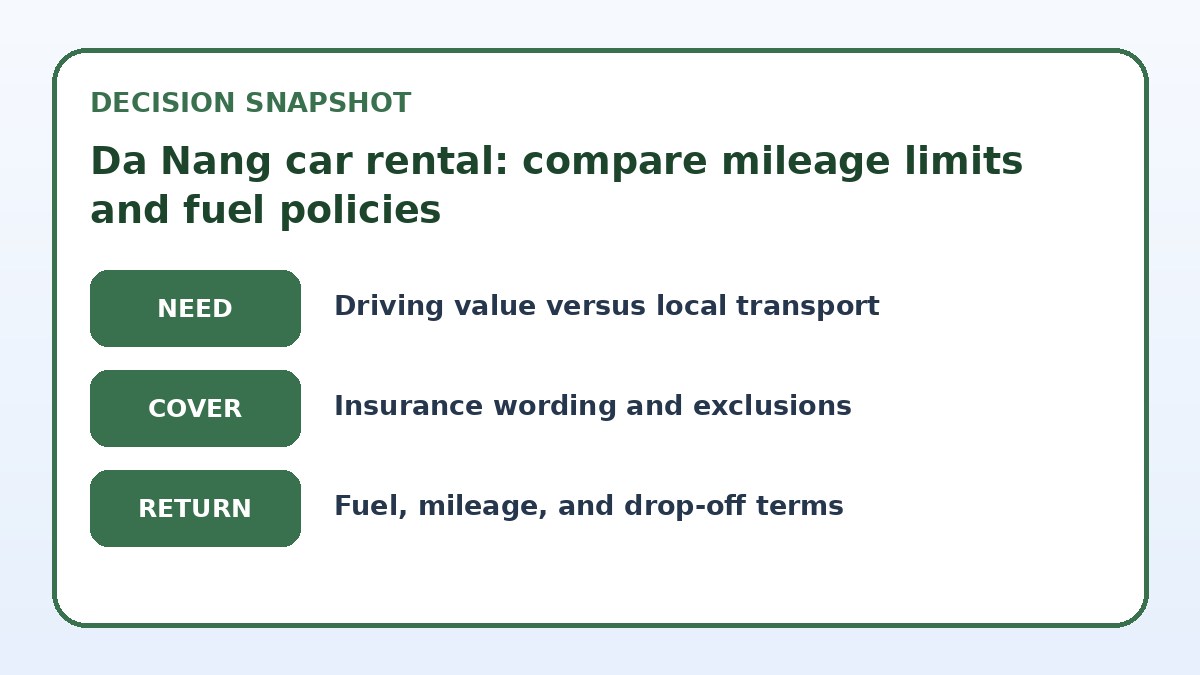
If you’re in Da Nang on business, driving can save time between meetings and give access to coastal or inland appointments that public transport doesn’t serve well. The practical answer: drive only if the trip itinerary includes multiple suburban or intercity stops where on-demand taxis or ride-hail would fragment travel time and increase cost. Before you commit, check two primary contract items on the booking page: the fuel policy and any mileage limit or per-kilometre surcharge. Those two clauses determine your likely out-of-pocket costs more than the headline daily rate. Also read the insurance and deposit terms so damage, theft, and third-party coverage are clear. If fuel or mileage terms look restrictive, choose a different transport strategy or a supplier with a transparent unlimited-mileage option. This guide walks through route value, insurance wording, pickup/return friction, and a practical non-driving fallback for business travelers in Da Nang.
Decide whether driving improves your business itinerary
Start by mapping your appointments and accommodation: if all meetings are within central Da Nang and clustered near a team or client hub, the time savings from a rental will be small. Rideshare and taxis are plentiful in the city center and often simpler for single short trips because you avoid parking, refueling logistics, and local driving stress. Conversely, if your schedule includes several meetings outside the center—industrial parks, beaches, conference venues, or day trips to nearby provinces—a rental car can cut door-to-door time and make multi-stop days feasible.
When evaluating route value, estimate mileage and frequency: a single round-trip of 50–150 km can be economical with an unlimited or high-mileage allowance, but multiple medium-length runs can trigger per-kilometre fees if the contract has a cap. Consider meeting times and hotel location versus traffic patterns; driving gives control over departure and route but adds duties like returning with the agreed fuel level and documenting vehicle condition. If the hassle of managing those details outweighs saved time, prefer a non-driving option.
Decide whether driving earns its place
| Mobility strategy | Best for | Cost or friction to check |
|---|---|---|
| Self-drive rental with unlimited mileage | Multi-stop regional days where you need schedule control | Higher upfront responsibility for fuel, refuelling, and damage documentation |
| Self-drive with mileage cap | Short, predictable in-city trips to avoid overspending on long distances | Risk of per-kilometre charges if you misestimate travel; careful tracking required |
| Pre-booked car-and-driver (half/full day) | Busy executives who must work en route and need punctual door-to-door service | Less flexibility for ad-hoc stops; typically higher hourly cost than self-drive |
| Ride-hail and taxis for point-to-point trips | Single or occasional in-city meetings where parking and fuel are inconvenient | Costs can add up for multiple stops and journeys outside the city centre |
Check live rental choices only after the route test
Use the exact driver, dates, pickup point, and return plan to compare current conditions.
Insurance wording and what to verify on the booking page
Insurance language in rental contracts is where many business travelers see surprises. On the booking page, look for explicit statements about collision damage waiver (CDW), theft protection, third-party liability, and whether these are included in the base price. Important specifics to verify: the insurance excess (the amount you’d pay before coverage applies), exclusions for certain types of damage (glass, tyres, interior), whether roadside assistance is provided, and whether corporate or personal credit-card insurance is accepted by the supplier.
Also confirm whether optional top-up coverage is offered and whether the supplier requires you to pay for damage and claim reimbursement later, or if they accept the insurer directly. If your company has a rental policy, check whether the supplier’s wording meets corporate requirements and whether additional drivers or young-driver surcharges are allowed under the policy. Always save or screenshot the final buy page where insurance inclusions and exclusions are shown; that is the wording to present if a dispute arises.
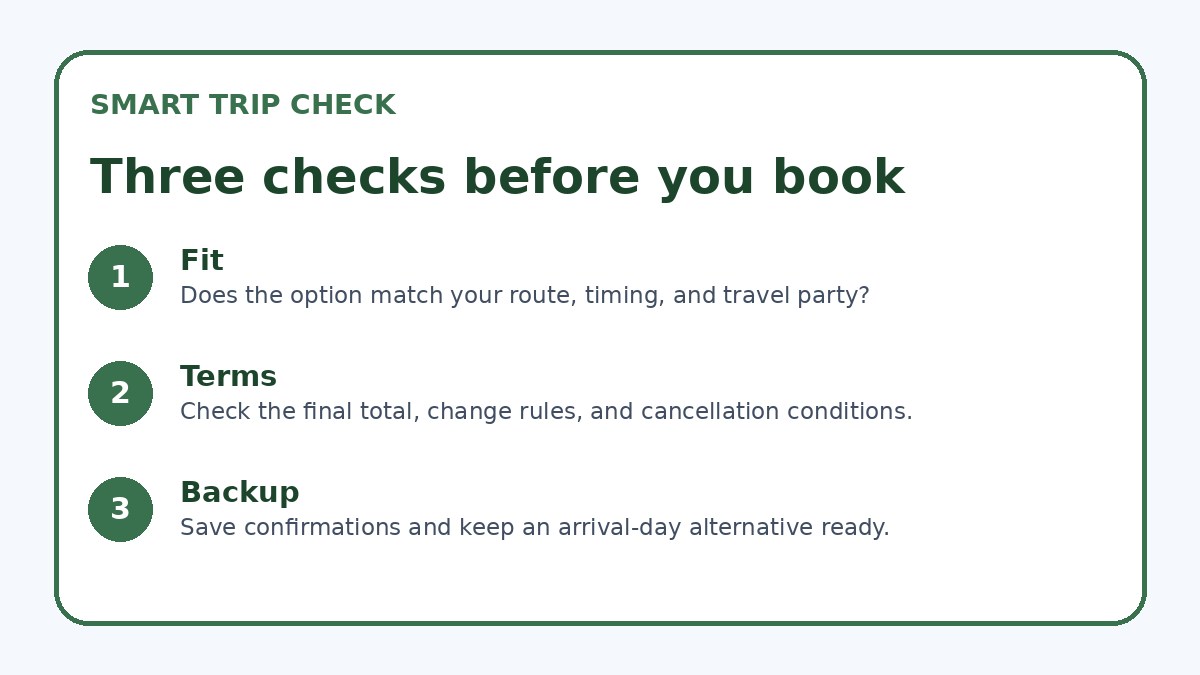
Compare the full rental conditions
Confirm insurance wording, exclusions, deposit, fuel, mileage, and return terms on the final page.
Pickup, return friction, and fuel policy pitfalls
Pickup and return logistics create small frictions that compound on a business trip. The booking page should state where you collect and drop the car, hours of operation, and any after-hours return fee. Airport collection may be quicker between flights, but curbside costs or waiting times at counters can add minutes. Equally important is the fuel policy: common variants are full-to-full (you return with a full tank), pre-purchase (you’re charged fuel upfront), and charged-at-return (supplier tops up at a potentially premium rate). Each has trade-offs for convenience and cost.
Before you book, check the supplier’s method for calculating refueling charges and whether they round fuel amounts or add service fees. If the policy is full-to-full, note where the nearest reliable petrol stations are relative to your return route. If pre-purchase is the only option, calculate likely fuel needs for your itinerary and compare whether pre-purchase covers the expected distance without overpaying. Document the fuel gauge photo at pickup and return to reduce disputes, and confirm whether the supplier will accept a fuel receipt if you refuel yourself before returning the car.
Car rental terms to verify
- Before booking, screenshot the supplier’s fuel policy text and confirm whether it is full-to-full, pre-purchase, or charged-at-return.
- Calculate estimated total kilometres for your itinerary and compare that to any stated mileage cap and per-kilometre fee on the booking page.
- Verify insurance details on the final booking page: excess amounts, included coverages, exclusions, roadside assistance, and whether corporate insurance is accepted.
- Note pickup and return locations and hours; if after-hours return is possible, check the fee and photographic return checklist requirements.
- If choosing full-to-full, plan a practical refuelling stop near your return route and keep fuel receipts in case the supplier requests proof.
- If you decline a rental, pre-book a chauffeur service or confirm ride-hail app availability for peak meeting times and get an invoice policy acceptable to your expense procedures.
Non-driving fallbacks and how to compare them fairly
If you decide not to drive, prepare a fall-back plan that matches your itinerary’s complexity. For city-centre meetings, a combination of ride-hail apps and local taxis gives flexibility without parking or fuel worries. For scheduled multi-stop days, arrange pre-booked car-and-driver services or a dedicated chauffeur for half- or full-day hires; these can be more predictable for tight agendas and leave you free to work during transfers. Public transport options—buses or intercity coaches—are typically slower and less reliable for tightly timed business meetings but can be cost-effective for single-seat transfers.
When comparing non-driving options, measure total door-to-door time, cost per hour or trip, and the ability to rearrange appointments at short notice. Also confirm whether a chauffeur service provides invoices and receipts that meet your company’s expense reporting rules. If availability or supplier terms are uncertain, search comparison sites—Trip.com can be used to check current availability and supplier conditions—but always verify refund, cancellation, and insurance details on the provider’s final booking page before confirming.
Car Rental & Road Trip questions travelers ask
What fuel policy should a busy business traveler pick in Da Nang?
Choose the fuel policy that matches your tolerance for logistics and uncertainty. Full-to-full is transparent: you refuel to the same level you received and avoid supplier top-up fees, but it requires you to find a petrol station before return. Pre-purchase can save time if your trip uses exactly the fuel allowance and you dislike last-minute refueling, but it often results in paying for unused fuel. If the booking page does not clearly state the refuelling calculation or fees, ask for the exact wording and compare the estimated fuel use for your planned kilometres before committing.
How do I avoid surprise mileage charges on a Da Nang rental?
Start by estimating the total distance for your planned meetings and transfer routes, including return to the airport or hotel. On the booking page, find any stated daily or total mileage cap and the per-kilometre surcharge for exceeding it. If a cap exists and your itinerary brushes that threshold, either select a rental marked as unlimited-mileage or choose a supplier whose cap comfortably exceeds your estimate. Keep a log of kilometres during the trip and retain meter photos at pickup and return; that evidence helps contest unexpected billing if you believe a supplier misapplied charges.
What should my company expense policy require when authorizing a rental in Da Nang?
Your company policy should require clear documentation: the supplier’s final booking page screenshot showing fuel and mileage terms, the rental contract with insurance and excess amounts, and all receipts—fuel, tolls, and supplier invoices. Specify whether corporate or personal credit-card insurance is acceptable and whether optional top-up insurance can be charged to the company card. Require drivers to photograph the vehicle condition at pickup and return and to log kilometres and fuel levels; these items protect both traveler and employer in the event of damage claims or billing disputes.
Final decision note
Driving in Da Nang can be a practical choice for business travelers when multiple off-centre meetings or day-long regional trips are on the agenda. The deciding factors are straightforward: how much control and time savings you need versus the administrative burden of fuel and mileage rules, insurance excess, and pickup/return logistics. Before you book, verify the supplier’s fuel policy wording, mileage limits, insurance inclusions and exclusions, and any after-hours or location fees on the final booking page and keep screenshots. If the terms look restrictive or unclear, a car-and-driver service or a mix of ride-hail for intra-city workdays will usually remove the fuel-and-mileage headaches while preserving schedule reliability. Plan with documented evidence and your company’s expense rules to avoid surprises.
Continue planning
Check current options and final conditions
Use the provider page to confirm live availability, the final total, cancellation terms, and every condition that matters to your trip.
This evergreen planning guide was created with AI-assisted drafting and a structured quality review. It does not display live prices, schedules, availability, visa guidance, or provider rankings. Verify current details before booking. Some links are affiliate links; we may earn a commission at no additional cost to you.