If you’re traveling from Dubai to Abu Dhabi with extra luggage, the practical decision isn’t just a cheapest-ticket choice — it’s how you move your bags smoothly between doors. Start by comparing rail (where available), intercity coach, private car transfer, or a mixed plan combining coach and private pickup. Your priorities — minimal lifts, few transfers, and predictable walk distances — will point you to different options. Consider where your journey begins in Dubai and ends in Abu Dhabi: airport terminals, city hotels or a specific address each change the luggage friction. This guide focuses on end-to-end practicality: terminal fit, how luggage is handled at each step, timing flexibility for a staggered itinerary, and straightforward disruption backups so your bags don’t become the trip’s weakest link.
Choosing between rail, coach, private car, or a mixed plan
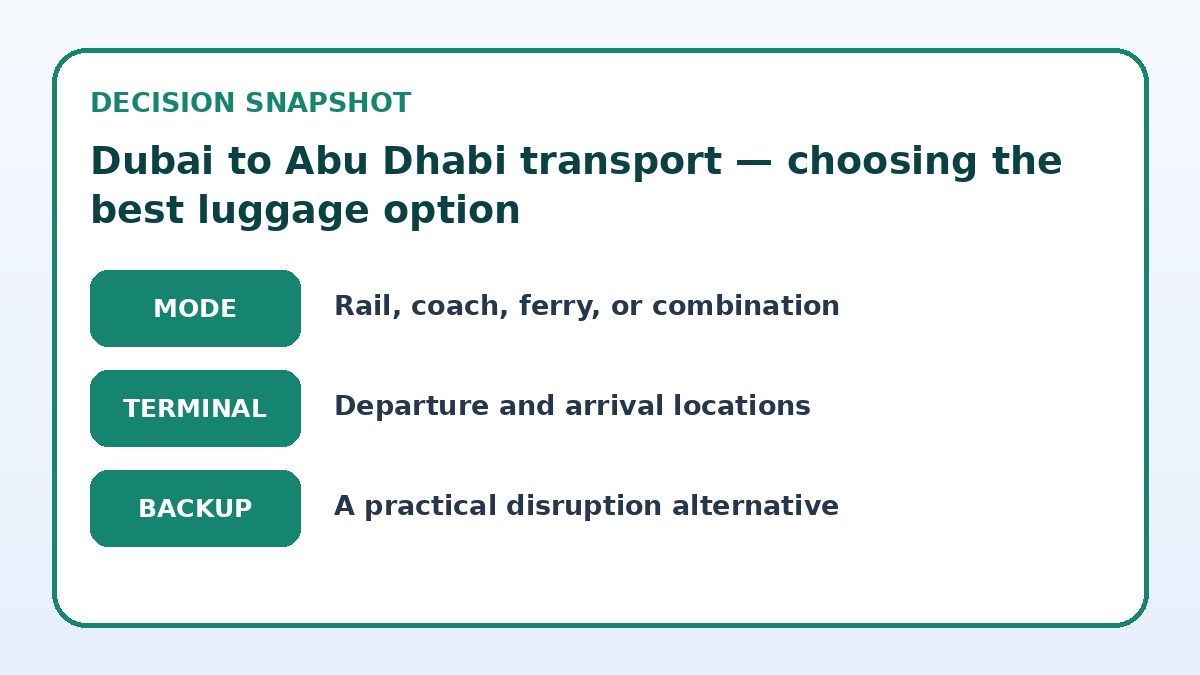
Begin by comparing the kinds of services available: rail (if offered), scheduled intercity coach, private car transfer, and combinations where you ride a coach or rail for the main leg and use a taxi or private pickup for the first or last mile. For travelers with extra luggage, a private car removes handling steps but may be costlier; coaches usually have luggage bays but require loading and unloading; rail can offer spacious storage but may require stairs, elevators or platform transfers. Think beyond the ride time: count how many times your bags will be moved, how long you’ll be walking with them, and whether each transfer point has staff to help.
A mixed plan can give the best balance: use a coach or rail for the main highway distance to reduce driving stress, then switch to a private vehicle for door-to-door convenience. That minimizes highway driving while keeping the number of manual bag lifts low. When comparing options, verify on the operator’s final booking page where luggage is stored, maximum case sizes accepted, and whether assistance is offered at boarding and disembarkation. If you consult Trip.com or operators’ sites, confirm luggage rules directly before booking.
Choose the end-to-end journey plan
| Journey approach | Best for | Friction to check |
|---|---|---|
| Private door-to-door car transfer | Single-stop journeys with heavy or awkward luggage | Higher per-trip cost but minimal transfers and low handling effort |
| Scheduled intercity coach with luggage bay | Cost-conscious travelers with standard wheeled suitcases | Requires loading/unloading at stations and potential curbside handling |
| Rail for the main leg plus local taxi for first/last mile | Long straight-line distance travelers who want a stable ride and space | May involve platform transfers, stairs or elevators—check station accessibility |
| Mixed plan: coach or rail plus courier or short private pickup | Those wanting to reduce driving while avoiding multiple manual lifts | Two bookings increase coordination; verify transfer timing and luggage handoff rules |
Check live intercity options
Look beyond the ride itself and compare terminals, transfers, luggage, and arrival fit.
Terminal fit and luggage transfer friction
Terminal fit is about how well your bags physically move through each point: hotel driveway, coach station, rail platform, or airport curb. Evaluate typical door layouts: tight hotel lobbies with stairs create friction, while coach stations with level loading make handling easier. For big or heavy trunks, look for options that load directly into a vehicle’s trunk or a coach bay rather than requiring several short carries through crowded concourses. If your ending point is an airport terminal, plan for check-in or transfer counters that accept or store oversized items, and always verify those services on the provider’s booking pages.
At transfer points, prioritize services that minimize carrying distance and vertical movement. Examples include meet-and-greet drivers who load your bags, sheltered bays that reduce exposure to weather, and elevators that connect platforms to concourses. If you anticipate limited mobility or very heavy luggage, request assistance when you book — many coaches and private transfer services list ancillary help as an option. Where rail or coach stations lack lifts, factor in extra time or choose an alternate pickup/drop-off closer to ground level to avoid awkward manual transfers.
Timing flexibility and scheduling to avoid congestion
Timing affects how easily you move luggage. Peak hours, weekends or major events can increase vehicle congestion and make curbside access slow, turning a short transfer into a long, bumpy ordeal. Build buffers into your schedule: allow additional time for parking, queueing, luggage loading and security checks. If using scheduled coach or rail services, select an earlier departure than strictly required; arriving at least 30–60 minutes before departure helps with oversized bags and avoids last-minute scrambles. For private transfers, include contingency time so drivers can find accessible drop-off points if the most convenient curb is crowded.
Flexibility also helps if you must change plans mid-journey. If your route includes multiple segments, leave spare time between connections to accommodate delays, luggage check-in procedures, or a brief rest stop. When you must be at a specific Abu Dhabi hotel or terminal by a set time, choose a plan whose variance is known — for instance, private cars typically offer predictable door-to-door times, while scheduled services can be subject to traffic and boarding queues. Always verify estimated journey durations and recommended arrival times on booking pages rather than relying on general expectations.
Compare the practical alternatives
Use the final page to confirm what is actually offered on your dates and save a workable fallback.
Intercity travel checklist
- Count and photograph all bags; note dimensions and approximate weights for booking verification.
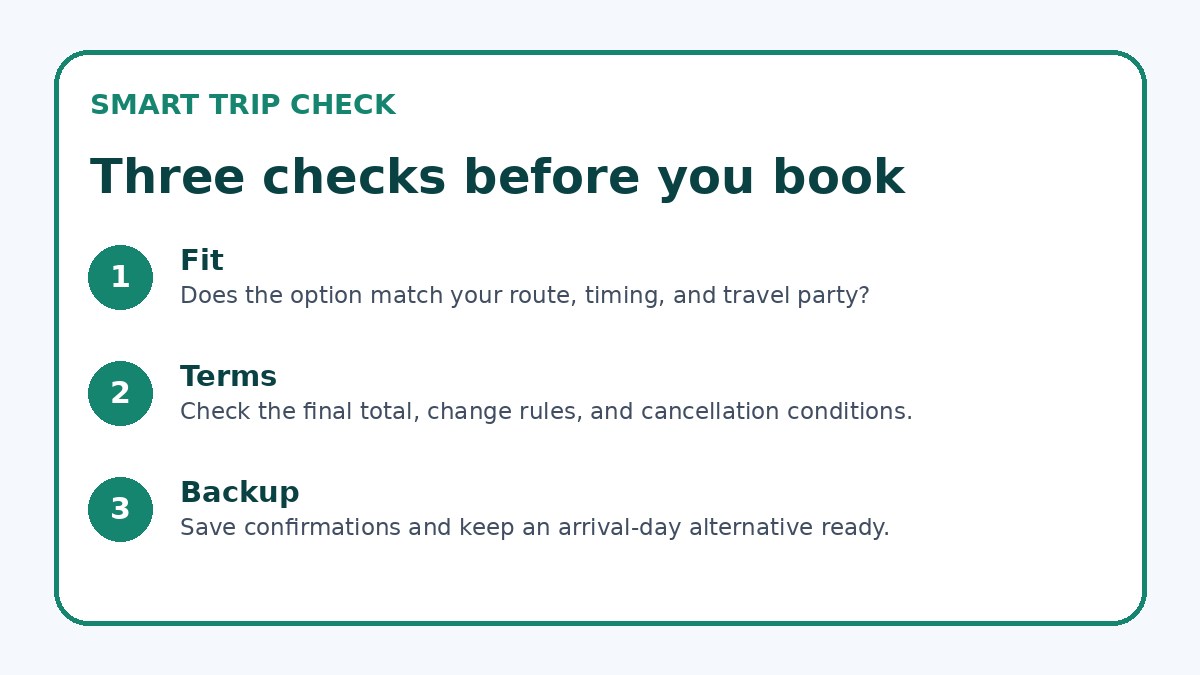
- Confirm luggage allowances, size limits and any extra-item fees on the provider’s final booking page.
- Book a meet-and-greet or assisted loading service for heavy or bulky pieces when available.
- Reserve arrival windows with hotels or arrange a secure local drop-off in Abu Dhabi beforehand.
- Pack essentials and valuables in a small carry-on that remains with you at all times.
- Save contact numbers for alternative transfer providers and your booking references for rapid changes.
Disruption backups and pragmatic contingency planning
A practical disruption backup prevents your luggage from becoming stranded if the primary plan fails. Have a secondary option ready: a local taxi company that can handle large bags, a hotel concierge willing to hold or transfer items, or a luggage courier service that moves baggage securely between cities. Before you travel, photograph your luggage and contents list so replacement or insurance claims are simpler if items are damaged or delayed. Keep essentials — medication, documents, a change of clothes — in a carry-on that stays with you, so immediate needs are met if checked luggage goes astray.
Confirm cancellation and rebooking rules for your chosen services and know the contact numbers for rapid changes. If you rely on a coach or rail segment, note nearby private transfer providers who can be called at short notice. When traveling between cities, identify a nearby luggage-friendly drop-off point in Abu Dhabi — a hotel with luggage storage or a secure facility — where you can leave bags if your arrival time changes. Always check the final provider pages for their contingency policies and any available emergency assistance options.
Rail & Intercity Transport questions travelers ask
Can I rely on coach luggage bays for oversized suitcases?
Many intercity coaches have underfloor luggage bays suited to standard checked suitcases, but dimensions and accepted items vary by operator. Before you book, check the provider’s booking page for maximum case sizes, any restrictions on fragile or high-value items, and whether assistance will be available at boarding and disembarkation. If your bags are unusually large or heavy, consider a private car transfer or a courier for the long leg, and keep a small carry-on with essentials in case loading takes extra time.
Is a private transfer worth the extra cost when I have many bags?
A private transfer often reduces handling because one driver loads, secures and delivers your bags directly to your door, eliminating station lifts and waiting times. For travelers with many cases, awkward items or tight schedules, the reduced physical effort and simpler logistics typically justify the premium. Weigh that against budget and the number of passengers: if several people share the transfer cost, it becomes more economical. Always verify vehicle size and luggage capacity on the booking page so the chosen car or van can accommodate your load.
How should I plan transfers if I arrive in Dubai by air with checked luggage?
If you arrive by air, factor in passport control, baggage reclaim, and any visa or entry steps before planning the Dubai-to-Abu Dhabi leg. Choose a transfer option that leaves sufficient buffer time after your flight for delayed baggage or inspections. If you expect tight connections or heavy bags, a pre-booked private transfer reduces the stress of finding suitable transport on arrival. For coach or rail connections, confirm where the service departs relative to airport terminals and whether there’s dedicated luggage assistance so you don’t have to carry cases across long distances.
Final decision note
For travelers moving between Dubai and Abu Dhabi with extra luggage, prioritize door-to-door practicality over marginal savings. A private car transfer minimizes handoffs and walking, while coaches or rail can be efficient if you confirm luggage policies and station accessibility in advance. Mixed plans give flexibility but require careful timing and coordination. Whatever you choose, verify luggage dimensions and assistance options on the provider’s final booking page and have a simple disruption backup: a taxi company, hotel storage, or a local courier. With those checks in place, your bags will be one manageable part of a well-planned trip.
Continue planning
Check current options and final conditions
Use the provider page to confirm live availability, the final total, cancellation terms, and every condition that matters to your trip.
This evergreen planning guide was created with AI-assisted drafting and a structured quality review. It does not display live prices, schedules, availability, visa guidance, or provider rankings. Verify current details before booking. Some links are affiliate links; we may earn a commission at no additional cost to you.