If you’re booking Los Angeles to Honolulu flights for business, the practical first question is: how flexible must your ticket be? For many travelers the right decision balances schedule fit and connection risk against the fare’s change and cancellation conditions. Start by deciding how likely your dates will shift, whether you need guaranteed same-day return options, and how tolerant you are of longer connections or multi-carrier itineraries. This article gives the quick answer up front—pick the most flexible fare you can reasonably afford if your schedule is uncertain; prefer direct routings for one-stop reliability when timing is tight—and then walks through the tradeoffs of routing, baggage and connection risk, schedule fit, and fare conditions so you can compare options and make a confident booking.
See live routes for your exact travel day
Compare direct and connecting choices with the same baggage and traveler details.
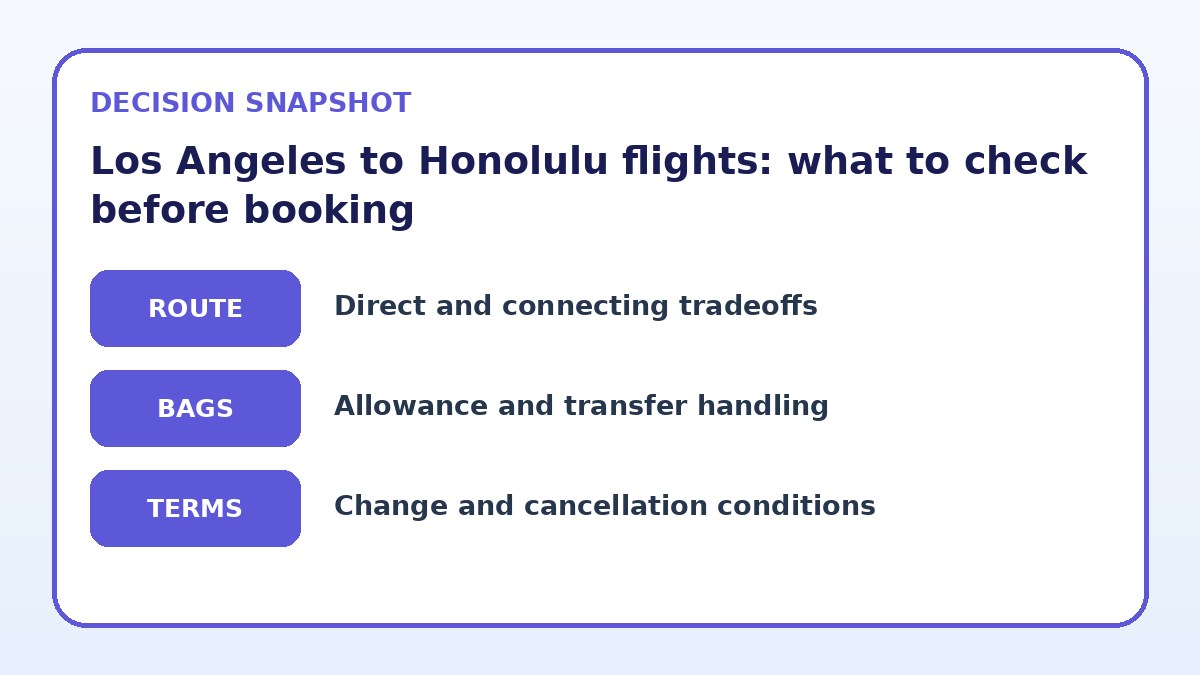
Routing: direct versus connecting itineraries
Los Angeles (LAX) to Honolulu (HNL) is frequently offered both as nonstop service and with connections through mainland hubs. For business travel the key tradeoff is straightforward: nonstops minimize travel time and the number of moving parts, while connecting options can widen departure windows and sometimes lower fares. When comparing itineraries, look beyond total elapsed time—check the number and length of segments, whether the same airline operates all legs, and whether the itinerary is ticketed on a single booking reference. Single-ticket itineraries give you stronger protection for missed connections and easier rebooking through the operating carrier.
If flexibility is essential, consider how easy it is to change segments on your ticket. Nonstop flights often have fewer rebooking permutations but may have stricter premium-class rules; connecting itineraries can complicate change fees if different carriers are involved. When different airlines are used, changes may require contacting multiple providers and could mean separate rules for refunds, standby, or reissue. Always verify on the final booking screen which carrier is the ticketing carrier and how changes are handled across the itinerary.
Baggage and connection risk for business travelers
Checked baggage can be a decisive factor for business trips that include materials or suits. Direct nonstop flights remove the need for interline baggage transfers and reduce the chance of mishandled luggage. For connections—especially across different carriers—confirm whether bags are checked through to the final destination on a single ticket; if not, you may need to claim and recheck baggage during a connection, which requires longer layovers and increases the odds of delay.
Connection risk also affects meeting reliability. Build buffer time between flights based on whether you have bags to collect, whether terminals require a shuttle or security reentry, and the historical on-time reliability of the carriers involved. If a missed connection would cause serious professional consequences, opt for longer minimum connections or a different itinerary that keeps you on a single carrier or a nonstop flight, even at higher cost.
Compare flight-selection strategies
| Flight strategy | Best for | Risk to check |
|---|---|---|
| Nonstop premium flexible fare | Business travelers needing guaranteed arrival times and simple rebooking | Higher upfront fare but minimal connection and baggage risk, with generally clearer change rules |
| Single-carrier connecting fare | Travelers wanting lower cost with some protection under one ticketing carrier | Lower price than premium nonstop, but still subject to single carrier’s complex reissue rules if schedule changes |
| Multi-carrier cheapest fare | Cost-focused travelers willing to manage separate segments and risks | Lowest up-front cost but separate change/cancellation rules per segment and higher connection risk |
| Flexible corporate or refundable ticket | High-uncertainty trips requiring free or low-cost changes and refunds | Most expensive option; choose only when change probability and business impact justify the premium |
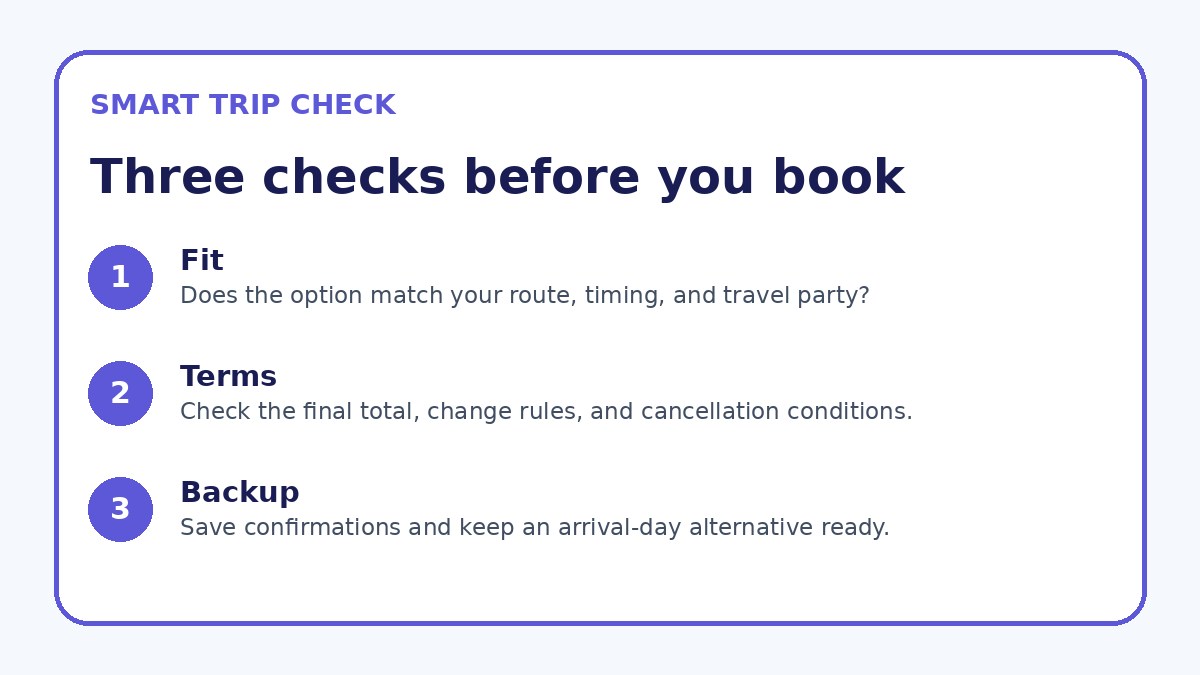
Recheck the complete itinerary
Confirm airports, connection handling, baggage, and change conditions before deciding.
Schedule fit and same-day business needs
When your travel purpose includes same-day meetings or tight arrival windows, schedule fit becomes the priority metric. Look at both departure and arrival times relative to your commitments, then map worst-case scenarios: delayed arrival plus baggage claim, transit to a meeting location, and check-in at your office or hotel. For early-morning meetings in Honolulu, overnight departures from Los Angeles that arrive in the morning can be convenient—but ensure the itinerary isn’t an overnight connection that risks missed sleep and more delay exposure.
Also consider aircraft and frequency. Multiple daily nonstops give you backup options later in the day; a single daily nonstop or limited frequencies increase the stakes of any disruption. When flights are infrequent, flexible change policies and the ability to rebook same-day on another flight without steep penalties are valuable. Confirm on the booking page what same-day change or standby options, if any, are available and whether corporate policy fares alter rebooking rules.
Flight details to verify
- Assemble exact traveler names, frequent flyer numbers, and corporate fare codes before searching to avoid name-change complications.
- Confirm whether the itinerary is on a single ticket and which airline is the ticketing carrier to know whose rules apply for changes and reissues.
- Read the full fare rules on the carrier’s final booking page, including any clauses about same-day changes, rebooking windows, and vouchers versus refunds.
- When booking connections, allow at least 90–120 minutes for checked-bag transfers or terminal changes; factor in local airport layout and likely security re-entry.
- If keeping a strict schedule, purchase a fare with explicit free-change or low-fee reissue options, and document the carrier’s change policy screenshot or confirmation email.
- If booking through an agent or corporate tool, confirm whether the agent’s change process differs and save contact details for urgent rebooking support.
Fare conditions and what to confirm before booking
Fare conditions determine your financial and operational flexibility. Business travelers should parse the airline’s published rules for changes, cancellations, reissuance fees, and refundability before confirming payment. Look for explicit language on whether the fare allows free changes, a credit toward future travel, or only a fee-waived reissue under certain circumstances. If a corporate fare code or negotiated rate applies, verify whether it overrides standard public rules.
On the final booking screen and the fare rules section, check for blackout dates, same-day change restrictions, and the process for involuntary rebooking if a schedule is cancelled. If you purchase through an online travel agency or a corporate booking tool, verify whether the agency’s change process differs from direct-book policies. Trip.com can be an option to compare current availability and conditions, but always confirm the airline’s final rule text on the carrier’s booking page before relying on flexibility promises.
Flight Guide questions travelers ask
How do I decide whether a nonstop or connecting Los Angeles to Honolulu flight is worth the higher fare?
Decide by mapping the cost of a higher fare against the potential cost of a delay or missed meeting. If missing a Honolulu appointment would have significant operational or reputational consequences, the time savings and lower connection complexity of a nonstop usually justify a higher fare. If your schedule is flexible or you can absorb a delay without major fallout, a connecting itinerary on a single ticket can be a reasonable tradeoff. Always verify on the booking page whether the nonstop versus connecting options have different change or cancellation rules that could influence the overall value.
What specific fare-rule language should business travelers look for before buying?
Look for explicit terms on change fees, reissue procedures, refundability, and whether airline-issued travel credits are offered instead of cash refunds. Confirm whether free changes are permitted within a certain window and whether changes require paying a fare difference. Check clauses about involuntary rebooking and whether the carrier will rebook you without fees on disrupted flights. If you rely on corporate fares, verify any override of public rules and whether the corporate agreement covers same-day changes or standby. Always save the fare rule screenshot or confirmation email for later reference.
If I have checked baggage and a tight schedule, how much connection time should I plan for?
For checked baggage and inter-terminal transfers, plan for at least 90–120 minutes on a single-ticket connection; allow more time if the itinerary uses different carriers that don’t interline baggage. This buffer helps absorb small delays and provides time to claim and recheck bags or move between terminals. If you have carry-on only and no terminal changes, 60–75 minutes may suffice depending on the airport layout and carriers involved. When consequences are severe, choose nonstop service to eliminate this risk.
Final decision note
For business travelers booking Los Angeles to Honolulu flights, the most practical rule is simple: prioritize the level of flexibility you actually need, then choose the routing that matches it. If schedule certainty is paramount, pay for a flexible fare on a nonstop or single-carrier itinerary to reduce connection and baggage risk. If you can tolerate some uncertainty for a lower fare, select a single-ticket connecting option and build buffer time into your schedule. Before you book, gather exact traveler details, confirm ticketing carrier and fare rules on the final booking screen, and save documentation of the change and cancellation terms so you can act quickly if plans shift.
Continue planning
Check current options and final conditions
Use the provider page to confirm live availability, the final total, cancellation terms, and every condition that matters to your trip.
This evergreen planning guide was created with AI-assisted drafting and a structured quality review. It does not display live prices, schedules, availability, visa guidance, or provider rankings. Verify current details before booking. Some links are affiliate links; we may earn a commission at no additional cost to you.