For most business travelers moving between Tokyo and Kyoto, the practical choice hinges less on speed alone and more on door-to-door friction: how easily you reach terminals, handle luggage, and arrive ready for meetings. Rail — including Shinkansen and conventional services — usually wins for reliability and downtown-to-downtown access, but coaches or a blended itinerary can be worthwhile when cost, late-night connections, or specific hotel locations matter. This guide gives the plain answer up front, then walks you through terminal fit, luggage and transfers, schedule flexibility, and a compact backup plan for disruptions. Read on to weigh convenience versus flexibility and to get the specific checks to run on operator booking pages before you finalize a business trip.
Terminal fit: where you start and where you need to end
Begin by mapping door-to-door time, not just the journey duration. Stations and bus terminals sit in different parts of Tokyo and Kyoto; a seemingly faster ride can be slower overall if you must cross a city to reach your hotel or meeting. For example, some train services arrive at central Kyoto stations with multiple onward transit options, while certain coach terminals may require a short taxi or local bus trip. Plot your meeting address, preferred hotels, and the terminal locations on a map to see which mode minimizes ground transfers.
If your company books ground transport for you, coordinate terminal choice with the driver’s pickup point and expected traffic windows. Confirm whether the terminal has covered walkways, elevators, or escalators to ease moving luggage from platform or bus bay to taxi stand. When planning, note that walking distances and transfer complexity at large stations can add unpredictable minutes; prioritize terminals that put you closest to your first appointment or that offer reliable, direct taxi access.
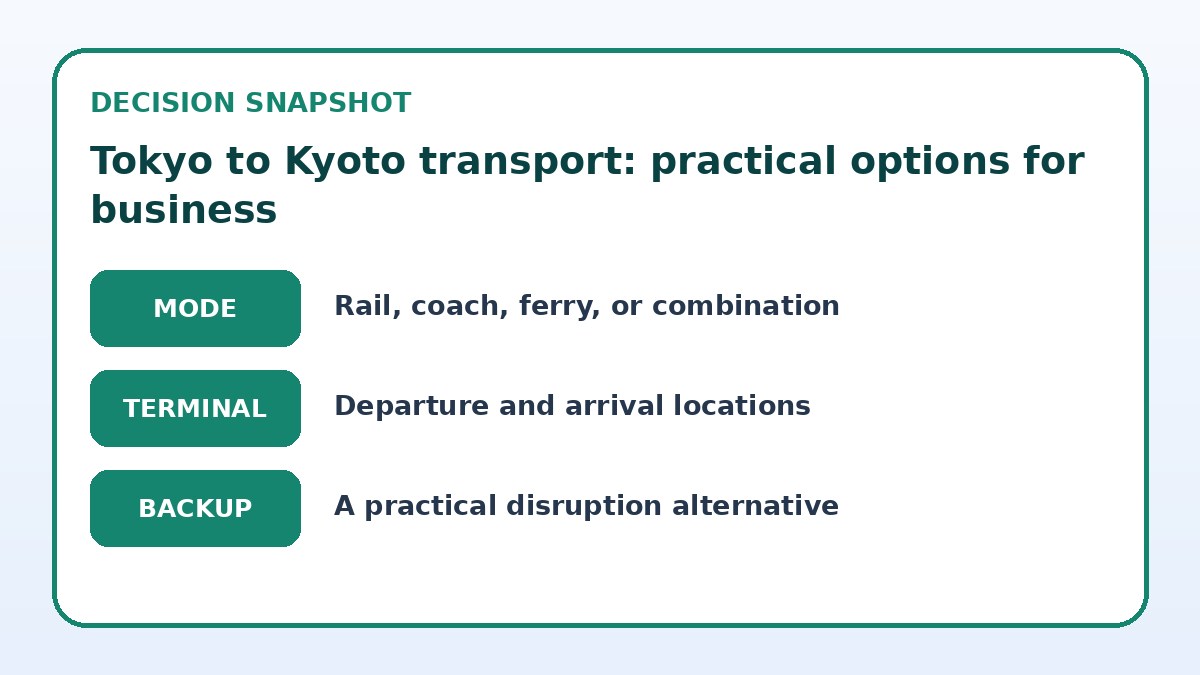
Choose the end-to-end journey plan
| Journey approach | Best for | Friction to check |
|---|---|---|
| Priority rail (reserved seats on fast trains) | Arriving downtown quickly with minimal transfers and predictable schedules | May involve walking inside large stations and requires checking luggage rules and seat-change policies |
| Standard rail with flexible ticketing | Travelers who value schedule flexibility and simpler rebooking options | Longer total door-to-door time if your hotel is farther from the chosen station |
| Coach or overnight bus | Those trying to preserve a full business day or reduce overnight hotel needs | Often fewer departure times and potential terminal-to-hotel transfer complexity |
| Mixed itinerary (rail plus coach or taxi segments) | Complex schedules or hotel locations not well served by a single terminal | More handoffs increase luggage handling and require careful contingency planning |
Check live intercity options
Look beyond the ride itself and compare terminals, transfers, luggage, and arrival fit.
Luggage and transfer friction: practical handling matters
Business travelers often carry a rolling suitcase plus a laptop bag and briefcase. Check how each mode handles multiple items, door-to-door delivery, and storage during peak times. Trains typically allow racks and luggage tags, but you should verify whether a reserved seat, a separate luggage service, or priority storage is needed for oversized cases. Coaches may restrict the number of checked bags or require gate handling; if you depend on quick exits, a coach’s baggage bay can either be a time saver or a bottleneck depending on loading practices.
Don’t forget the last-mile: transferring between terminal and meeting by taxi or local transit adds handling steps. If a hotel offers luggage pickup or storage during the day, that can reduce rush-hour friction. Also confirm elevator and escalator availability at the terminal for moving heavy suitcases. Where available, consider services that let you ship a case ahead to a hotel or collection point; verify those provider details on the provider’s website before booking.
Timing flexibility: schedules, windows, and the business day
Assess how rigid your meeting times are and whether you need a departure window that gives buffer for delays or an earlier arrival to prep. Trains can offer frequent departures and clear published timetables, which helps when you need a narrow arrival slot. Coaches or night travel can free up a daytime schedule but may be less frequent; they can work well for an overnight trip that saves a hotel night or that aims to preserve a full business day in the origin city. Consider whether a slightly longer travel time with a predictable schedule is preferable to a faster but infrequent departure.
Also plan for variability across weekdays and weekends: commuter patterns, holiday timetables, and event days change capacity and transfer times. When timing matters, pick options with mid-trip slack—an earlier service or an arrival buffer—and lock in changeable tickets only after confirming your meeting schedule. Before booking, review the operator’s last available departures and any time-of-day restrictions on ticket changes so you can pivot without heavy penalties if your meeting shifts.
Compare the practical alternatives
Use the final page to confirm what is actually offered on your dates and save a workable fallback.
Intercity travel checklist
- Map door-to-door route time from your office or hotel to each terminal and pick the option with the shortest practical transfer time.
- Confirm luggage allowances, storage options, and any oversized-item policies on the operator’s final booking page.
- Choose a departure that leaves a buffer before your first meeting; book a second, later backup if tickets allow free or low-cost changes.
- Verify the terminal’s taxi rank location and estimated taxi travel time to your meeting address during expected traffic conditions.
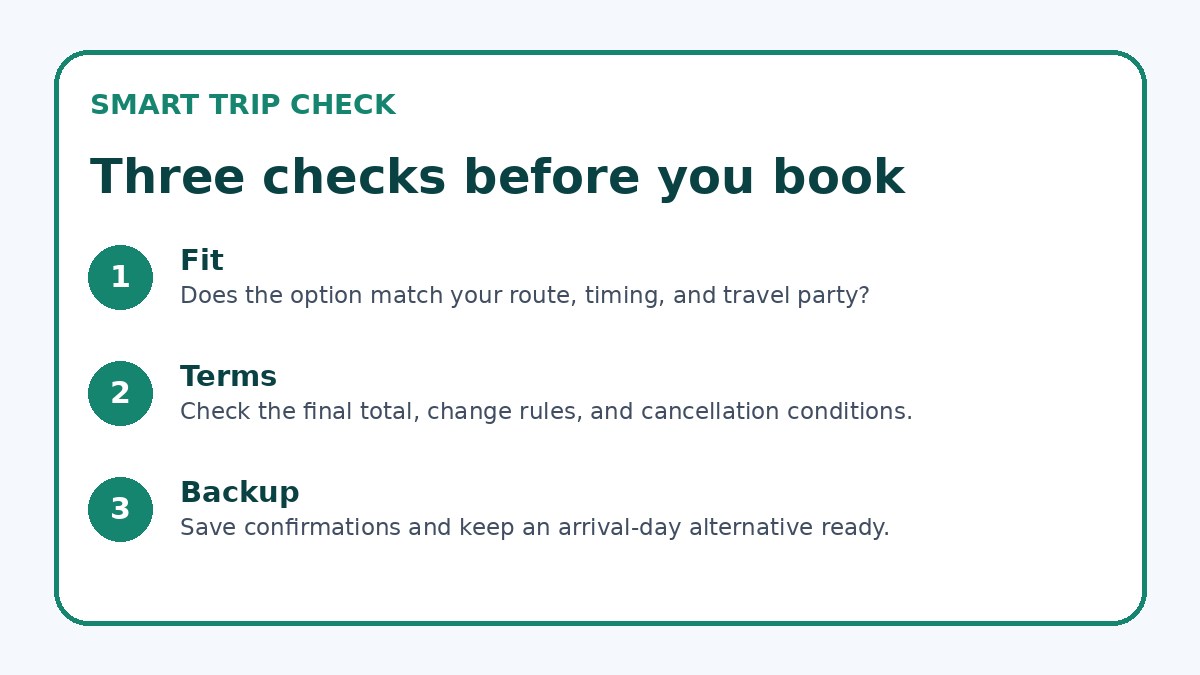
- Save screenshots of your booking, change/cancellation rules, and the operator contact number for day-of-travel problem solving.
- If you need extra reliability, arrange a local taxi company or hotel shuttle as a fallback and confirm pickup terms in writing.
A compact disruption backup: practical alternatives and verification steps
Build a simple backup that keeps you moving: choose an alternate departure an hour earlier or later on the same operator or pick a different nearby terminal you could reach by taxi. If train service is disrupted, know whether coaches run that same corridor, and where those bus terminals are relative to your hotel. Keep contacts for your travel manager and a local taxi service, and save a screenshot of the operator’s refund/transfer policy and the booking reference to present quickly if you need a change at a ticket window.
When you finalize plans, verify a handful of facts on the provider’s booking page: allowed luggage count and sizes, boarding location and recommended arrival time, change and refund rules, and accessible contact channels for day-of-travel help. If you want a single place to compare availability, you may check Trip.com along with operator sites, but always confirm the primary provider’s terms directly before you rely on that booking for business commitments.
Rail & Intercity Transport questions travelers ask
Is the Shinkansen always the most practical choice for business travelers between Tokyo and Kyoto?
Shinkansen-style high-speed rail often wins for downtown-to-downtown convenience and predictable timetables, but it isn’t automatically the most practical for every business trip. Practicality depends on where your meetings or hotels are located relative to stations, how much luggage you carry, and how flexible your schedule must be. Also factor in transfer times, walking distances within large stations, and whether you need an arrival buffer. Before booking, compare door-to-door times for train versus coach or mixed routes and confirm luggage and seat-reservation options on the provider’s booking page.
How should I handle luggage when traveling between Tokyo and Kyoto for work?
Start by inventorying what you will carry: checked case, carry-on, laptop bag, and any presentation materials. Check the operator’s baggage rules for number, size limits, and whether early arrival at the terminal is recommended for larger items. If transferring between modes, plan for elevator and escalator availability at both terminals and consider a hotel-to-hotel luggage transfer service when timing is tight. Always verify the specific baggage policy and any extra- handling fees on the booking page before you finalize travel.
What’s a simple day-of-travel disruption plan that won’t overcomplicate a business trip?
Choose one realistic alternate: either a later departure on the same route or a different nearby terminal with a similar timetable. Save contact details for the operator, your travel manager, and a local taxi company. Keep a screenshot of your booking and the operator’s change/refund terms so you can present them quickly at a service counter. If you rely on a single tight connection to reach a meeting, buy a ticket with flexible change terms or arrange a taxi standby to cover short-notice gaps; verify the taxi company’s pickup window in advance.
Final decision note
Deciding how to travel between Tokyo and Kyoto for business comes down to minimizing door-to-door friction rather than chasing the fastest headline speed. Start by mapping terminals against your meeting or hotel, account for luggage and transfers, and pick a service that gives the timing flexibility you need. Before you finalize anything, verify luggage allowances, boarding locations, and change/refund rules on the provider’s booking page; keep a simple backup departure and local taxi contact for day-of-travel disruption. With these checks you’ll make a choice that keeps the focus on the meeting, not the commute.
Continue planning
Check current options and final conditions
Use the provider page to confirm live availability, the final total, cancellation terms, and every condition that matters to your trip.
This evergreen planning guide was created with AI-assisted drafting and a structured quality review. It does not display live prices, schedules, availability, visa guidance, or provider rankings. Verify current details before booking. Some links are affiliate links; we may earn a commission at no additional cost to you.