Practical answer first: for most first-time visitors to Hong Kong, a rental car is unnecessary and often more hassle than help. The city’s public transport — MTR, buses, trams, ferries and taxis — covers central areas, major attractions and airports efficiently; driving adds time for parking, navigation, and dealing with restricted zones. That said, a rental car can make sense if your plan focuses on the New Territories, remote outlying islands where car access improves flexibility, or if you travel with a lot of gear or a multi-generational family that values private mobility. Use this guide to weigh the tradeoffs, match rental choices to realistic itineraries, and create a checklist of what to verify before you book so you choose the right approach for your Hong Kong visit.
When a rental car makes practical sense
A rental car becomes useful when your itinerary includes areas poorly served by frequent public transit or when you must transport bulky gear. Examples include long countryside drives into the New Territories, photography or hiking expeditions with equipment, or trips where you plan to visit several spread-out rural spots in a single day. A private vehicle offers door-to-door access and schedule control that buses and trains can’t match; it also simplifies travel for groups with children or older travelers who prefer minimal walking and easy rest stops.
Another valid reason to rent is time-sensitive travel that public transport cannot accommodate—early or late departures, direct airport transfers for large parties, or connecting multiple remote meetings in one day. If you choose to rent, plan realistic driving legs and check where you can legally park near destinations. Also verify whether any parts of your intended route require special permits or have vehicle size limits. Finally, consider whether hiring a driver or private transfer yields similar convenience without the need to navigate local roads yourself.
When to skip a car and use public transport
For most first-time visitors staying in Kowloon, Central, Wan Chai, or Tsim Sha Tsui, public transport is faster, simpler, and cheaper than driving. Hong Kong’s MTR network and surface transport reach museums, markets, shopping districts, and many viewpoints with short transfers or direct lines. Traffic congestion, limited parking, narrow streets in older districts, and one-way systems can add unpredictable delays; combined with the city’s pedestrian-friendly layout, these factors often make transit the smart, low-stress choice.
Taxis and ride-hailing services provide flexible point-to-point travel without the need to park, and ferries are often the most scenic way to reach islands and waterfront neighborhoods. If your schedule includes popular central attractions, expect to walk and use stairways or elevators; plan accommodations close to an MTR station if you want maximum convenience. Evaluate public options by mapping your daily route and timing transfers—you may find transit covers your needs with less friction than handling a rental car.
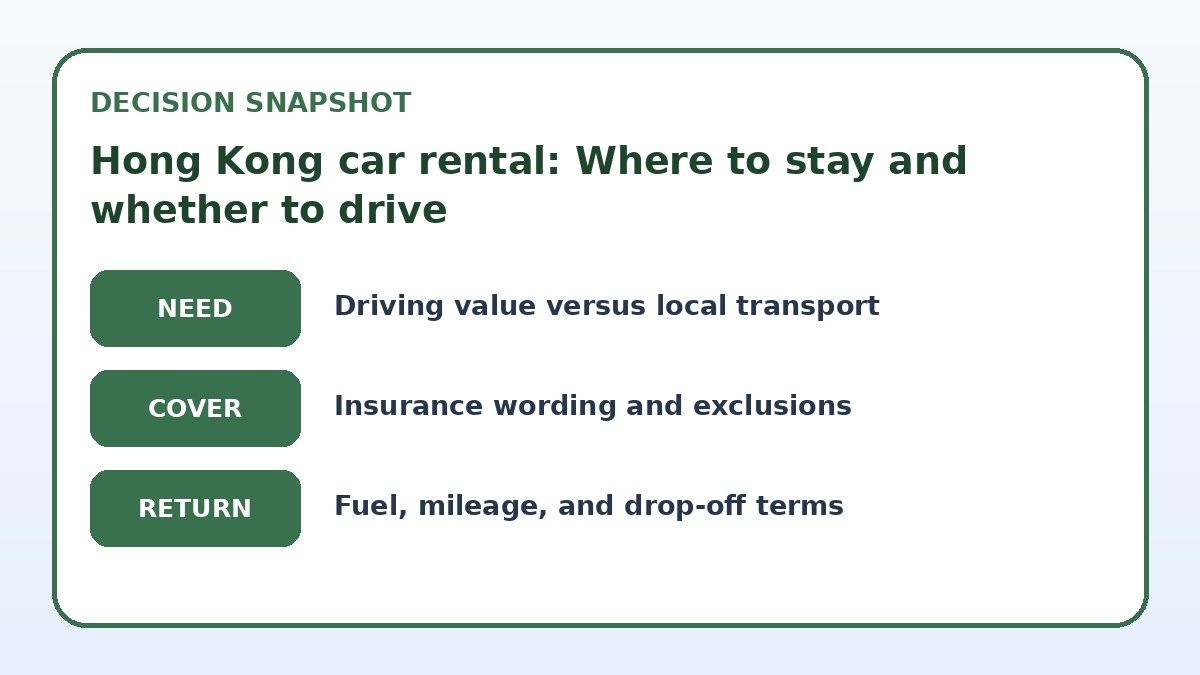
| Approach | Best for | Tradeoff to check |
|---|---|---|
| Rent a car for full trip | Multi-stop rural itineraries or large groups with heavy luggage | Higher costs, parking challenges, and urban traffic stress |
| Use public transport only | Sightseeing in Hong Kong Island and Kowloon cores | Less flexibility for remote destinations or late-night travel |
| Public transport + occasional taxi or hire | City-centered trips that need occasional doorstep convenience | Higher short-trip taxi costs, but avoids parking and driving stress |
| Rent for part of the trip (pick-up/drop-off) | Combining city sightseeing with a few remote day trips | More complex logistics and potential extra drop-off fees |
Key tradeoffs: cost, time, and convenience
Compare direct costs like the rental rate, fuel, parking fees, and tolls against transit expenses, including group taxi fares or occasional private transfers. Non-monetary costs matter too: time spent searching for parking, waiting for payment or change at parking kiosks, and the mental load of urban driving in a dense, unfamiliar city. Conversely, transit can add walking time between stations and final destinations, and services that are frequent in the urban core thin out at night and in rural areas.
Convenience depends on trip style. If you prioritize spontaneity and private storage for equipment, a car offers more control. If you prefer avoiding driving stress, want to maximize sightseeing time in central neighborhoods, or have a compact itinerary centered around museums, markets and waterfronts, public transit or targeted point-to-point hires will likely be superior. Quantify the value of saved walking or transfer time to decide whether the car’s convenience justifies its extra costs and complexity.
Before you book
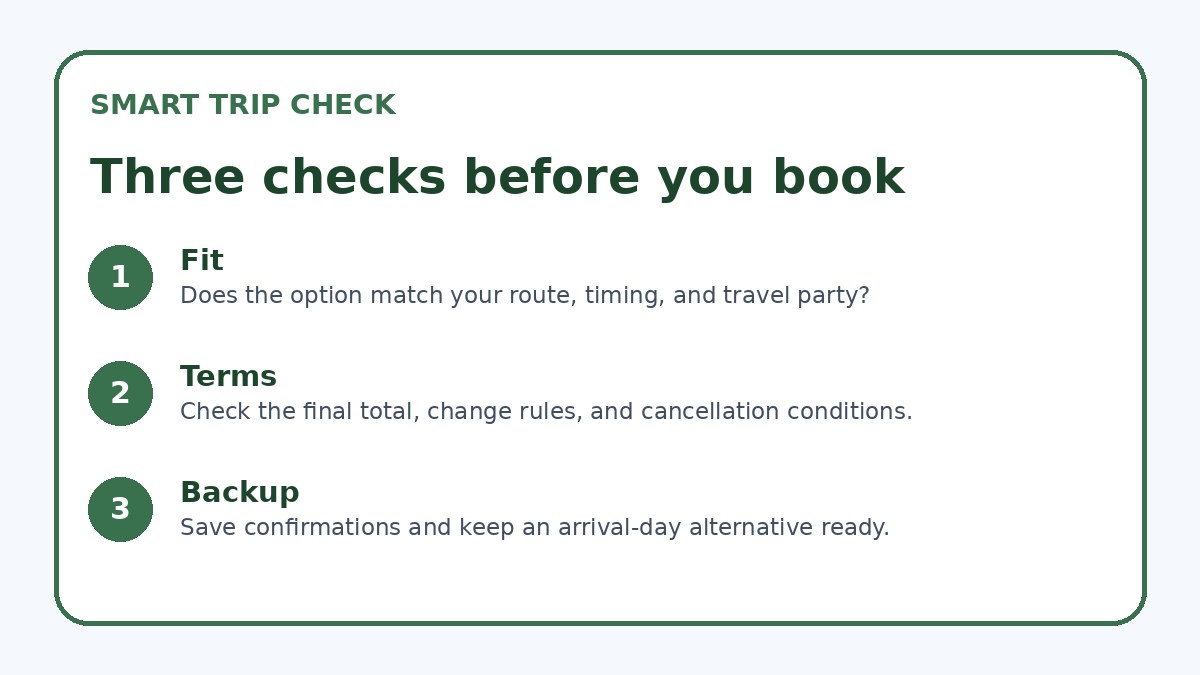
- Map each day of your itinerary and mark which stops lack frequent public transport to identify genuine driving needs.
- Confirm the rental company’s driver age, license and ID requirements on their final booking page before reserving.
- Verify clearly what the insurance covers, the size of the deductible, and how to obtain roadside assistance if needed.
- Check parking availability and estimated costs at each overnight stay and key daytime stop.
- Decide whether to add an extra driver, child seat, or GPS on the booking page and check their fees.
- Compare transit travel times and fares for your itinerary to the estimated driving time, including expected parking search time.
Practical checks before you book a car
Always verify the rental provider’s full terms before payment: driver age and license requirements, insurance coverage levels, fuel policy, permitted cross-border travel, and any penalties for late returns or vehicle damage. If you plan to drive in restricted areas or across border checkpoints, check official rules and whether the rental company explicitly permits those journeys. Use the provider’s final booking page to confirm pick-up and drop-off locations, opening hours, included mileage, and whether additional drivers or child seats incur extra fees.
Check parking options near your hotels and main stops—some areas have scarce on-street parking or require booking a lot or garage space in advance. Confirm the car size fits narrow streets or steep ramps you may encounter, especially if visiting rural villages or island piers. If you want to compare current availability and terms quickly, Trip.com is one place to view options, but always return to the rental company’s own pages to read the definitive rental agreement before committing.
Frequently asked questions
Do I need an international driving permit to rent a car in Hong Kong?
Requirements vary by country and rental company. Many local providers accept a full, valid foreign driving license if it is in English or accompanied by an authorized translation. Some jurisdictions require an international driving permit (IDP) in addition to your national license. Always check the rental company’s specific license policy and present any documents they list on the provider’s final booking page to avoid pickup refusals.
How easy is parking in Hong Kong and should I pre-book parking?
Parking availability depends on neighborhood and time of day. Downtown areas and tourist hotspots have limited on-street parking and higher rates; private garages are available but can be expensive. If you plan to stay overnight in a popular district or need guaranteed space near a rural trailhead, contact your hotel or the destination’s parking operator to reserve a spot where possible. Pre-booking is not always offered, so factor time for locating and paying for parking into your daily plans.
Can I drive a rental car between Hong Kong and nearby mainland China or Macau?
Cross-border driving involves additional permits, insurance, and often specific vehicle preparations; many standard rentals do not permit leaving Hong Kong. If you plan to cross into Macau or mainland China by car, confirm with the rental company whether cross-border travel is allowed, what paperwork is required, and what extra fees apply. Always read the provider’s cross-border policy on their final booking page and check government border rules independently before arranging the trip.
Final planning note
For most first-time visitors, Hong Kong’s dense urban core and excellent public transport network make a rental car unnecessary. Use transit, taxis and ferries for city-centered sightseeing to save time and avoid parking hassles. Choose a rental if your plans prioritize rural New Territories exploration, island access with limited services, or if you travel with a large group or heavy equipment that benefits from private cargo space. Whatever you decide, map your daily needs, check the rental provider’s full terms on the booking page, and compare transit alternatives; that practical verification is the most reliable way to pick the right option for your trip.
Continue planning
Check current options and final conditions
Use the provider page to confirm live availability, the final total, cancellation terms, and every condition that matters to your trip.
This evergreen planning guide was created with AI-assisted drafting and a structured quality review. It does not display live prices, schedules, availability, visa guidance, or provider rankings. Verify current details before booking. Some links are affiliate links; we may earn a commission at no additional cost to you.