If your family trip to Seoul includes day trips outside the city or you'll be juggling small children and strollers, deciding whether to rent a car hinges on a few specific checks: fuel policy, mileage limits, and how insurance and pickup/return work. Driving inside central Seoul is often slower than public transport, but a car can unlock suburbs, nearby mountains, and child-friendly attractions on a flexible schedule. The right decision balances route value against pickup friction, unexpected charges, and safety coverage. This guide gives the practical answer up front, then walks you through the tradeoffs, the exact policy language to confirm before you book, and a clear non-driving fallback so your family has a workable plan even if renting isn’t the best choice.

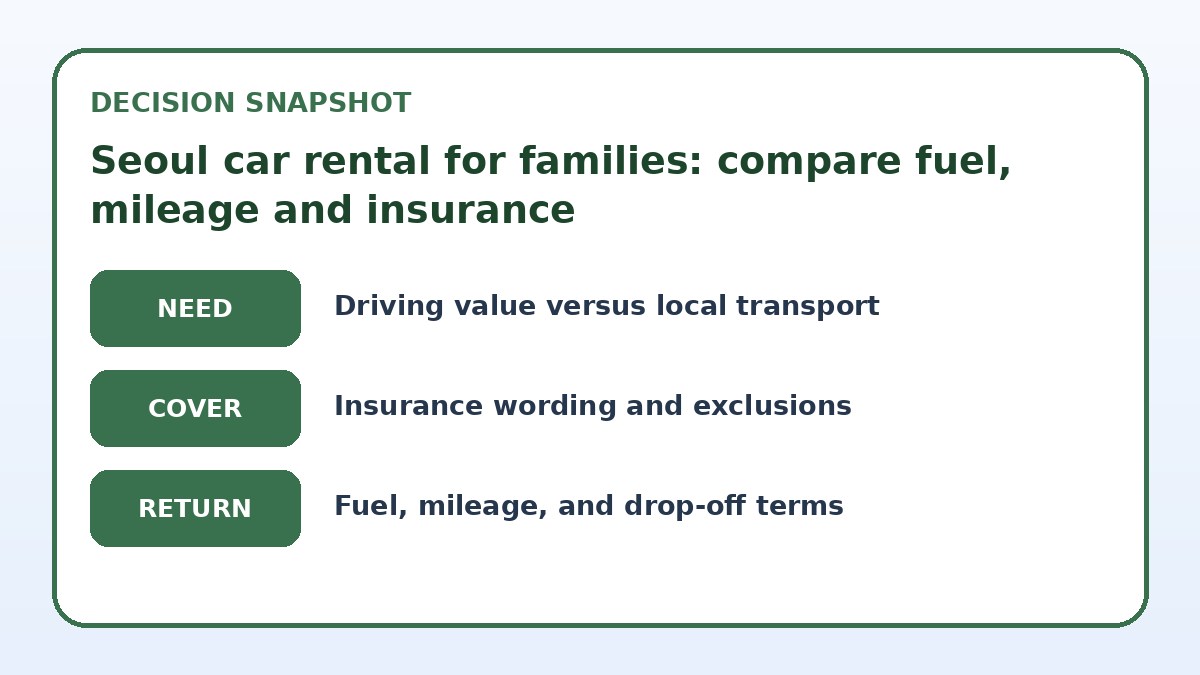
Decide whether driving truly improves your family itinerary
Start by mapping the places you want to visit and estimating time on the road. Central Seoul’s public transport—subway and buses—is fast, frequent, and generally better than driving for downtown sightseeing, museums, and many indoor kid activities. A rental becomes more useful if you plan multiple day trips to places like the countryside, small coastal towns, or mountain parks where public transit routes are infrequent or require several transfers. Also weigh the convenience of door-to-door travel with children, luggage, and strollers against parking hassles and slow traffic during peak hours.
Consider practical family factors: needing a child seat, carrying a stroller, and having flexible arrival/departure times. If your days start early or end late, a car can save waiting time and offer safer shortcuts between scattered attractions. But remember that parking near major Seoul attractions can be limited and costly, and unfamiliar driving in dense traffic can be tiring. If most activities are inside Seoul and near subway lines, public transit plus occasional taxis may be simpler and cheaper.
Decide whether driving earns its place
| Mobility strategy | Best for | Cost or friction to check |
|---|---|---|
| Rent a car for the whole trip | Families with multiple suburban day trips and lots of luggage or children | Higher parking and fuel complexity plus pickup/return friction; check fuel policy and mileage limits carefully |
| Use public transit and taxis | Families staying mainly in central Seoul with easy subway access | Less flexibility for remote day trips and more carrying of luggage or strollers between stations |
| Rent just for specific days (hybrid) | Families who want city convenience and occasional countryside excursions | Requires additional bookings and coordination; confirm child-seat availability and refueling rules for short rentals |
| Prebook private transfers or guided day tours | Families who prefer door-to-door service without driving logistics | Often more expensive per day and less flexible, so compare exact pickup, drop-off, and cancellation terms |
Check live rental choices only after the route test
Use the exact driver, dates, pickup point, and return plan to compare current conditions.
What to verify in fuel and mileage wording before booking
Fuel policy language is critical. The cleanest option for families is full-to-full: you pick up the tank full and return it full, paying only for what you use; keep the fuel receipt where possible. Some rental agreements instead offer pre-purchase fuel or charge a refueling fee; these can be convenient but less economical and can create disputes about tank levels. On the final booking page, confirm which policy is listed, whether a fuel deposit or prepayment is taken, and how refueling charges are calculated and documented.
Mileage limits matter for day trips. Some contracts include unlimited mileage; others impose daily or total limits with per-kilometer fees for excess. When driving from Seoul to nearby provinces or multiple destinations in a single day, add anticipated kilometers and compare with the stated allowance. Also check if there are geographic restrictions—some agreements restrict cross-border travel or use in certain regions—and read exactly how excess mileage is measured and billed on the provider’s final terms page.
Compare the full rental conditions
Confirm insurance wording, exclusions, deposit, fuel, mileage, and return terms on the final page.
Insurance wording and pickup/return friction you must check
Insurance language can hide essential family protections. Verify what the basic rate covers, where deductibles apply, and which add-ons you can buy. Look specifically for liability coverage, collision damage waiver (CDW), and whether child seats or third-party damage are included or optional. If renting at an airport, note whether insurers limit coverage for airport pickups, and always check the deductible amount and the process to report and document damage. On the booking page, locate the exact insurance clauses and any mandatory local protection you can’t opt out of.
Pickup and return logistics affect whether a rental is family-friendly. Confirm counter hours, whether after-hours drop-off is allowed and if it requires an extra fee, and whether the company offers bilingual support. Ask about child-seat availability and fit for different aged children, and whether delivery to hotels or specific pickup locations is offered. Note that airport pickups often have extra fees and longer queues; the booking page should list counter location, required documents, and any shuttle procedures you must follow.
Car rental terms to verify
- On the provider’s final booking page, confirm the fuel policy (full-to-full, pre-purchase, or refueling fee) and save the wording or a screenshot.
- Verify mileage limits and fees: note daily or total kilometer allowances and the per-km excess charge shown in the contract.
- Read insurance details: deductible amount, what CDW covers, liability limits, and what optional extras are available to reduce your out-of-pocket risk.
- Confirm pickup/return logistics: counter hours, after-hours procedures, airport shuttle steps, and whether delivery to your hotel is offered.
- Arrange child seats in advance and check fit and certification; document the provider’s child-seat policy and any extra fees before you book.
- Keep a non-driving fallback: download Seoul transit apps, list taxi/ride-share options, and identify nearby subway stations for each planned attraction.
Non-driving fallback and how to structure a hybrid plan
Always plan a non-driving option so your family is not stranded if rental terms don’t suit you. In Seoul, this means pairing public transport with point-to-point taxis or app ride services for short hops, and using day tours or private transfers for destinations outside the city. Identify a few reachable alternatives for each day: which subway stations, bus lines, and taxi ranks serve the planned attractions. Keep transit apps, an offline map, and a list of reliable taxi phone numbers or ride-app accounts ready to share among adults.
A hybrid approach often delivers the best balance: use Seoul’s transit for city days and rent a car only for specific day trips where it creates clear time savings or comfort improvements. If you choose this, book a small, fuel-efficient car with a simple fuel policy and unlimited mileage if possible. Reserve child seats or plan to bring a portable seat that meets Korean regulations. Finally, confirm the cancellation and modification terms so you can switch between car and transit without losing money if plans change.
Car Rental & Road Trip questions travelers ask
Do I need to worry about different fuel types or filling stations near Seoul?
Yes—verify the required fuel type (regular gasoline, diesel, or premium) listed on the rental page and check whether local gas stations accept credit cards and English labels. Many cars in Korea use regular gasoline, but the wrong fuel can cause expensive damage. If the booking page mentions pre-purchased fuel or refueling fees, compare those terms to local pump prices and plan where you will refill before returning the car. Keep receipts when you refuel; they can be required if a dispute arises.
How do mileage limits affect day trips from Seoul?
Mileage limits can make seemingly modest day trips costly if your route is long or includes multiple stops. When planning, total the kilometers of your full itinerary—Seoul to the destination and back plus local driving—and compare with the stated allowance. If the rental contract has daily limits, multiply by rental days and factor in distances between sites. If the booking page shows per-kilometer overage rates, calculate a worst-case excess cost and decide whether unlimited mileage or a higher allowance is worth a larger base rate.
What should I do at pickup and return to avoid disputes with a family in tow?
At pickup, inspect the car together and photograph all sides, interior, and the fuel gauge; have a staff member initial any existing damage on the contract. Confirm the agreed fuel level and child-seat condition if provided. Keep copies of all documents and receipts in a safe place. At return, refuel according to the stated policy, take photos of the tank level and odometer, and request a final inspection paper or digital receipt before leaving. If problems arise, note the agent’s name and the time and request written confirmation of any charges.
Final decision note
For families visiting Seoul, renting a car can be liberating when your plans include multiple out-of-city destinations or require flexibility with children and gear. But the practical decision rests on details: fuel policy, mileage caps, insurance deductibles, and pickup/return logistics. Start by listing each day’s likely kilometers and whether transit alternatives are practical; then use the provider’s final booking page to confirm the exact fuel wording, excess-mile charges, insurance limits, and child-seat policies. If any of those terms feel risky or unclear, choose a hybrid plan or reliable transfers to keep the trip smooth. With the right checks, your family can enjoy both Seoul’s convenience and the freedom of the road when it truly adds value.
Continue planning
Check current options and final conditions
Use the provider page to confirm live availability, the final total, cancellation terms, and every condition that matters to your trip.
This evergreen planning guide was created with AI-assisted drafting and a structured quality review. It does not display live prices, schedules, availability, visa guidance, or provider rankings. Verify current details before booking. Some links are affiliate links; we may earn a commission at no additional cost to you.