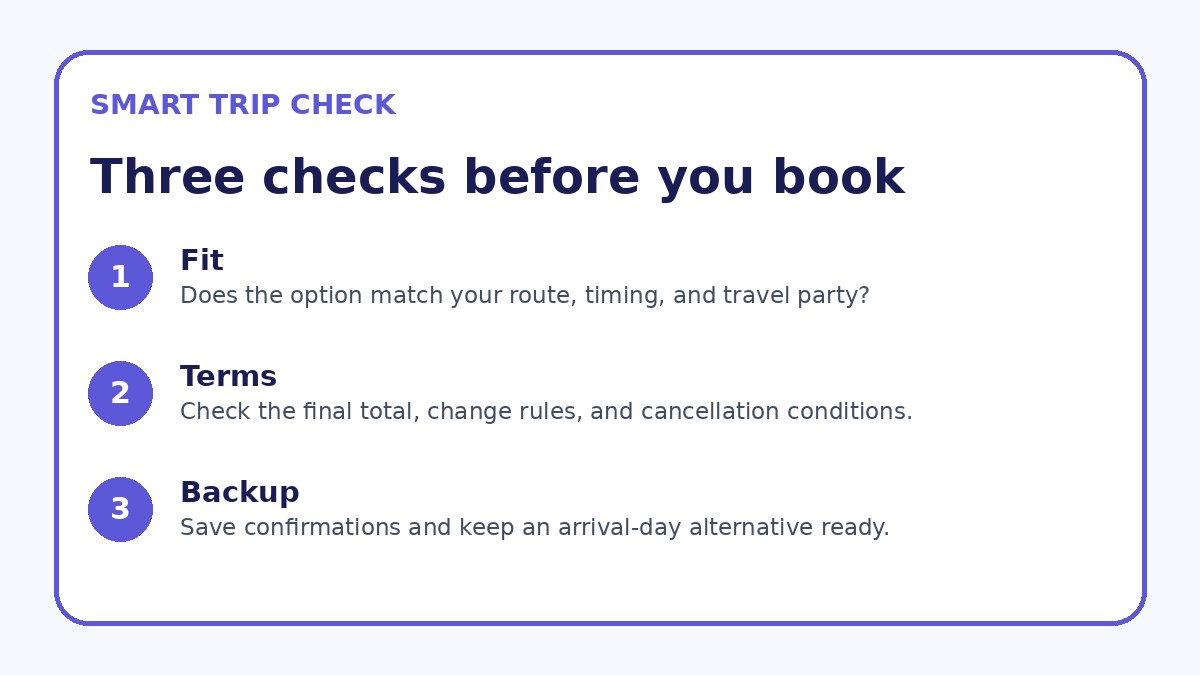
Practical answer up front: for most couples the best approach is to identify one or two daily time windows that match your plans, then compare a convenient nonstop (if available) against a slightly cheaper connecting flight that grants better flexibility on cancellation or change fees. Focus first on departure and arrival times that suit mornings, evenings, or hotel check-in, then layer in baggage allowances and the fare-change rules that matter most to both of you. The route-versus-fare tradeoff is simple: pay more for fewer hassles and a tighter schedule, or accept connection risk and stricter baggage rules in exchange for a lower base fare and flexible dates. Below you’ll find a practical framework—routing, baggage/connection risk, schedule fit, and fare conditions—to help couples agree on what to prioritize and what to verify on the airline’s final booking page.
See live routes for your exact travel day
Compare direct and connecting choices with the same baggage and traveler details.
Routing: direct versus connecting balance
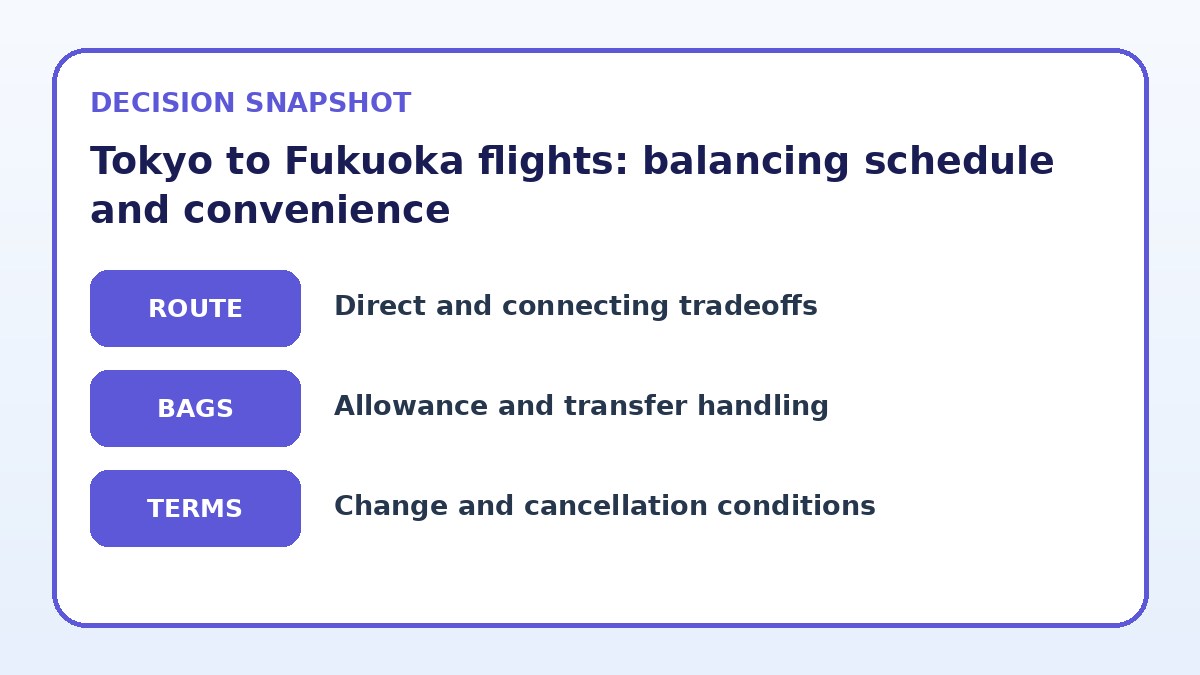
When planning Tokyo to Fukuoka flights, start by listing the routing options available for your exact dates—direct (nonstop) flights if they operate on your day, or itineraries with one connection. Direct routes are typically more convenient: fewer airports, less time spent changing gates, and lower chance of missed connections. Connecting itineraries can widen your schedule options and sometimes lower the ticket cost, but they add layers of timing risk. For couples, think about whether you want to spend extra time together in transit or maximize time at your destination.
To choose between these, compare total door-to-door travel time rather than flight hours alone. Consider the extra time needed at each airport for security, transfers, and the possibility of delays. If you both prefer a relaxed rhythm—early check-in, lounge access, and predictable arrival—lean toward a direct option or a connecting itinerary with a healthy buffer between flights. If you need more date flexibility or lower base fares, include well-timed connections in your comparison set and verify the minimum connection times shown by the airline.
Baggage and connection risk: split responsibilities
Baggage rules vary by fare class and carrier; for couples this matters because one checked bag fee can change the economics of a choice quickly. Before booking, decide whether you’ll travel light with carry-on only or need at least one checked bag. If either traveler requires a checked bag, compare the baggage allowance included with each fare. Remember to verify whether connecting itineraries transfer bags automatically or require recheck during self-transfer; that affects stress, time, and the possibility of missed luggage.
Connection risk also includes the chance of delays cascading between flights. For couples traveling on sentimental or time-sensitive trips (weddings, anniversaries, events), avoid tight connections or itineraries spanning multiple carriers with separate tickets. If you accept a connection to save money, build in a buffer—especially when transferring between terminals or airports. Check the carrier’s official guidance about misconnect protection and where to confirm baggage transfer rules on the final booking page.
Compare flight-selection strategies
| Flight strategy | Best for | Risk to check |
|---|---|---|
| Pay more for a nonstop or single-carrier itinerary | Couples prioritizing convenience, minimal transit time, and lower connection risk | Higher base fare and less flexibility to change dates at a cheap rate |
| Book a cheaper connecting itinerary with flexible-change fare | Couples who want date flexibility without accepting tight connections | Longer travel time and possibly more time in airports |
| Choose a low-cost fare with strict rules and add-ons only as needed | Price-sensitive couples traveling with light carry-on luggage | Extra fees for baggage, seat selection, and limited or costly changes |
| Use a higher-fare flexible ticket and mix services (lounge, seat) for comfort | Couples willing to pay for peace of mind and extra onboard or airport comfort | Higher upfront cost, which may not be economical for short stays |
Recheck the complete itinerary
Confirm airports, connection handling, baggage, and change conditions before deciding.
Schedule fit: syncing with your plans as a pair
Couples should plan around shared priorities: morning sightseeing, an afternoon arrival for hotel check-in, or evening dinners. Identify two to three acceptable arrival windows that keep the day’s key plans intact, then filter available flights to those windows. If one partner prefers earlier departures and the other dislikes airport mornings, aim for mid-day options or pick an itinerary that minimizes the total time in transit and waiting. Compromise is easier if you both list what would make the trip enjoyable on arrival day.
Also consider downstream logistics at the destination—train or taxi availability from the airport, expected hotel check-in time, and activity schedules. If your stay depends on an evening reservation, prioritize arriving with enough margin to freshen up. When comparing flights, couples should check the airline’s published arrival and departure times and confirm any connection length or overnight layover before booking. Always verify on the airline’s final booking page whether the displayed times and connection details apply to your specific fare.
Flight details to verify
- Agree on two acceptable arrival windows and one fallback date before searching fares together.
- Collect each traveler’s passport name, birthdate, and frequent flyer numbers to enter exactly when checking options.
- Compare baggage allowances and add any needed checked bags before finalizing to see true trip cost.
- Check connection minimums and whether bags transfer automatically on the airline’s final booking page.
- Review the ticket’s change and cancellation terms, plus any name-correction rules, and screenshot them.
- Confirm seat selection options and note whether seats are included or sold as an add-on for each traveler.
Fare conditions: flexibility, change fees, and what to verify
Fare conditions determine how easy it is to change plans. Low-fare tickets can be restrictive, with limited or costly change and cancellation options, while higher-fare buckets often include more generous modifications. For couples, balance the cost-saving of a restrictive fare against the peace of mind a flexible fare provides—especially when travel dates might shift because of work, health, or family obligations. Decide together how likely your dates are to change; if there’s any doubt, prioritize a fare class with clearer, lower-cost change policies.
Before confirming a booking, verify four points on the airline’s final booking page: the exact change and cancellation terms, whether the fare includes seat selection, the baggage allowance per traveler, and any differences for name corrections or voluntary refunds. If you use a third-party site to compare options (Trip.com can be one such place to check availability), always complete your purchase on or after confirming the final fare rules with the carrier or seller. Document the fare conditions or take screenshots in case you need them later.
Flight Guide questions travelers ask
How should couples decide between a slightly cheaper connecting flight and a more convenient nonstop?
Start by listing what you value: fewer airport hassles, guaranteed arrival windows, or a lower base fare. If your itinerary contains time-sensitive plans at destination, prioritize convenience and direct routing. If you need flexibility in dates and are comfortable with longer travel time, a connecting itinerary with better change terms can save money while providing date flexibility. Also calculate add-on costs—checked bags, seat fees, and the potential need for transfers—so your decision weighs total trip cost and not just the headline fare.
What are the most important fare rules to verify for couples booking together?
Look for change and cancellation conditions, baggage allowance per passenger, seat assignment policies, and rules on name corrections. Make sure you understand whether the fare allows free or low-cost date changes and under what circumstances refunds are available. If your booking combines segments on multiple tickets or carriers, verify misconnect protection and baggage transfer on the airline’s booking page. Save or screenshot the fare rules at purchase to avoid disputes later.
How can couples reduce stress if a connection is required on the Tokyo to Fukuoka route?
Choose connections with comfortable buffer times and avoid terminal-hopping when possible. Favor itineraries on a single carrier or within the same alliance so baggage is more likely to transfer automatically and staff can assist with rebooking if delays happen. Pack essentials in carry-on items for both travelers, share contact numbers, and set a realistic minimum connection time you’re both comfortable with. Finally, allow extra time in your schedule for unexpected delays rather than squeezing activities tightly around arrival time.
Final decision note
Balancing schedule flexibility and convenience for Tokyo to Fukuoka flights comes down to honest priorities and shared tradeoffs. Couples who value predictability should lean toward direct or single-carrier itineraries with clearer baggage handling and change protections. Those who need date flexibility can consider connecting options but must budget for baggage fees and build buffers for transfers. Before booking, finalize exact dates and traveler details, compare total trip costs including add-ons, and verify fare rules on the airline’s booking page. Doing this together reduces surprises and helps you pick an option that fits both your schedule and your peace of mind.
Continue planning
Check current options and final conditions
Use the provider page to confirm live availability, the final total, cancellation terms, and every condition that matters to your trip.
This evergreen planning guide was created with AI-assisted drafting and a structured quality review. It does not display live prices, schedules, availability, visa guidance, or provider rankings. Verify current details before booking. Some links are affiliate links; we may earn a commission at no additional cost to you.