Practical answer up front: for most couples who value flexibility, take a refundable or changeable overnight or daytime train where possible, or book a coach with a lenient change policy; reserve a private car transfer only if you need absolute door-to-door control or tight timing. That balances fewer transfers, easier luggage handling and predictable sleeping or working time together. If you prefer lower cost and don’t mind stricter rules, non-refundable coach or mixed train+bus options cut fares but reduce rebooking options. This article explains the tradeoffs—terminal fit, luggage and transfers, timing flexibility, and what to do if something goes wrong—so you can pick the approach that matches your priorities as a couple.
Terminal fit and door-to-door practicality
Start by mapping where you start in Bangkok and where you want to arrive in Chiang Mai. Stations and bus terminals are not always central to hotels or short-term rentals, so factor local transfer time and taxi or rideshare convenience into the total journey. A couple carrying medium-to-large luggage will find a single pickup to a train station preferable to multiple short transfers between terminals. Private transfers go straight from door to door, which is convenient for coordinating arrival times with check-in or planned activities, but they are usually the least flexible and most expensive in dollar-per-kilometre terms.
When comparing options, think beyond the scheduled ride: add the estimated taxi or rideshare to reach departure terminals, plus the onward transfer in Chiang Mai. Some trains depart from a central station that’s easier to reach than long-distance bus terminals, while some coach operators use different terminals depending on the service level. Couples should also consider late-night arrivals—arriving downtown late by train may be safer and easier to reach a booked hotel than arriving at an out-of-town bus depot.
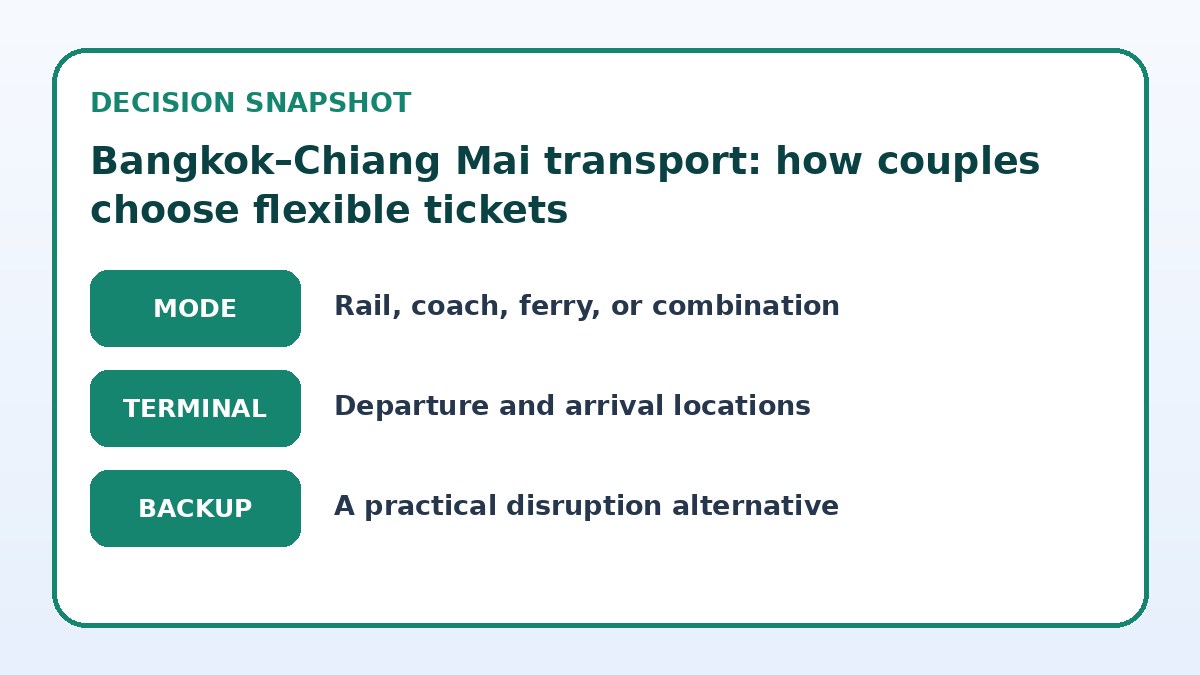
Choose the end-to-end journey plan
| Journey approach | Best for | Friction to check |
|---|---|---|
| Flexible train tickets (refundable or changeable) | Couples wanting comfortable overnight travel with easier luggage handling and predictable rest together | Usually higher upfront cost and limited daily departures on some services |
| Coach services with lenient change policies | Couples who value multiple departure times and lower cost but still want reasonable rebooking options | More transfers and less onboard space versus trains; check strictness of hold baggage rules |
| Mixed routes (train + local bus/minivan) | Couples balancing budget and experience, willing to handle transfers for scenic or timing advantages | Added transfer friction and luggage handling; each segment can have different change rules |
| Private car door-to-door transfer | Couples prioritizing privacy, exact timing, and minimal handling of luggage | Higher cost and variable cancellation/change terms; less economical for budget-conscious travellers |
Check live intercity options
Look beyond the ride itself and compare terminals, transfers, luggage, and arrival fit.
Luggage, transfers and friction for two
Luggage matters more when travelling as a couple because you jointly manage weight, fee rules and carrying. Trains usually provide more onboard storage and room to stand and rearrange bags during the journey, which reduces the stress of handling two backpacks or a suitcase plus a daypack. Coaches often have hold baggage allowances and help loading, but multiple transfers—switching from a bus to a local minivan, for example—mean repeated bag movement and higher risk of delay. Decide how much physical effort or porter service you want to buy: paying extra for a private transfer or a premium rail service can spare you repeated lifts.
If your route includes a segment with a connection, such as a scenic daytime train followed by a local bus for the final leg, build time cushions into your plan. Couples should avoid back-to-back tight connections unless both travellers are comfortable carrying or guarding bags and can move quickly between platforms or terminals. Also check what happens to unclaimed or delayed luggage: verify the provider’s written policy on the booking page before you commit, and consider travel insurance that covers missed connections and baggage issues for extra peace of mind.
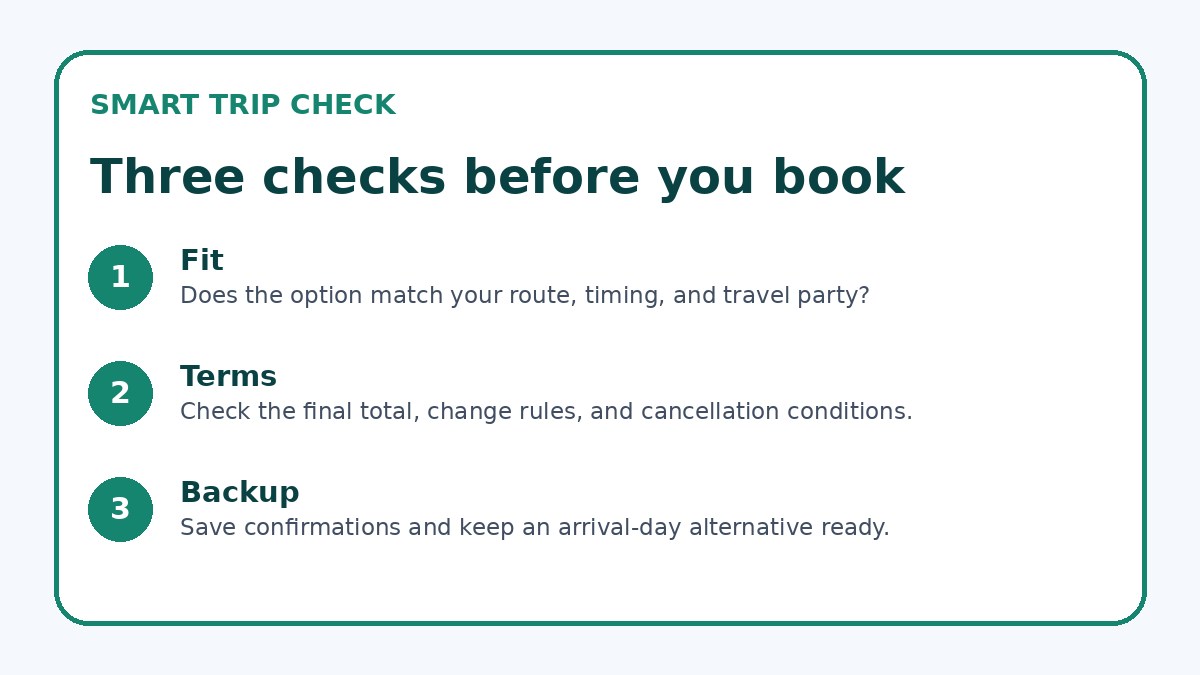
Timing flexibility: change, cancel and rebook
Look closely at the fare rules for changing or cancelling—this is the core of ticket flexibility. Fully refundable tickets or ones that allow free changes up to a set time before departure are worth the premium for couples who need adaptable plans. If you must travel on specific days, check for multiple departures per day so a simple same-day rebook is feasible. When comparing trains, coaches and private transfers, verify the exact change fees, the time window for free modifications and whether changes can be done online or must be processed at a physical counter.
A practical couple will create a flexibility hierarchy: acceptable change fee, minimum notice for free alterations, and whether partial refunds are provided. For multi-leg itineraries, ensure each segment’s policy aligns—flexibility on the first leg but strict rules on the connecting service can leave you stuck. When in doubt, document refund/change conditions via screenshots of the booking page or confirmation emails, and check whether customer service supports joint bookings (two names under one reservation) to ease communication when rebooking.
Compare the practical alternatives
Use the final page to confirm what is actually offered on your dates and save a workable fallback.
Intercity travel checklist
- Compare change and cancellation terms on the provider’s final booking page before you commit to any fare.
- Estimate door-to-door travel time by adding local transfers and check rideshare or taxi availability at both terminals.
- Decide acceptable change fees and document them—take screenshots of booking pages and confirmation emails.
- Pack a day bag with essentials so you can wait comfortably together if bags are stored or delayed.
- Agree in advance on a disruption decision rule (save money vs. pay to keep schedule) to avoid arguments under stress.
- Keep emergency contact numbers and a small contingency fund for last-minute private transfers or hotel holds.
Disruption backup: plans if delays or cancellations happen
Create at least two backup plans: one simple and inexpensive, the other more expensive but fast. The simple plan might be a later same-day departure on a different operator or mode, while the fast plan could be a private transfer or charter if you’re on a fixed schedule. For couples, agree ahead how you’ll choose between the backups—one partner might prefer to conserve money while the other prioritizes arriving early. Also identify where you’ll wait together if a connection is missed: a station lounge, a nearby café or a booked cheap room for a few hours can make a stressful disruption manageable.
Before travel, save contact details and the exact refund/change terms from your provider’s final booking page—if you use online marketplaces to compare, verify policies on the supplier’s page too. Keep electronic and printed copies of tickets and a photo of each luggage tag. If your itinerary includes tight onward commitments (tours, events or flights), communicate flexibility needs when booking to see if providers will note your reservation as requiring easier rebooking options. Finally, carry a small emergency fund separate from your daily cash to pay for a change when timing is critical.
Rail & Intercity Transport questions travelers ask
Can couples get connected seats or private sleepers on trains between Bangkok and Chiang Mai?
Many trains offer seating classes and sleeper berths that let couples sit or sleep together, but configurations and availability vary by service. If a private cabin or adjacent berths matter, check the seat layout and booking options on the operator’s official pages before paying. When booking through a third-party site, verify the exact berth assignment and cancellation/change terms on the supplier’s final confirmation. Also ask whether the reservation will name both travellers on one record or require separate tickets; that affects rebooking and checking in together.
If our first-leg is delayed, how do we protect a connecting coach or train in Chiang Mai?
Aligning protection starts with choosing refundable or changeable tickets for one or both legs, or selecting operators that explicitly rebook missed connections. If that’s not available, build buffer time between connections—preferably several hours—so you can transfer without stress. Keep contact information for both operators handy and document booking terms that mention missed-connection policies. Travel insurance that includes missed connections can help cover costs, but you should confirm coverage details ahead of time and know the claims process in case you need compensation.
Is it better for couples to book tickets separately or under one reservation?
Booking under one reservation simplifies communication with the operator and makes it easier to request adjacent seats or linked berths, but some budget fares restrict name changes or individual refunds. If you prioritize coordinated changes or shared seating, a single joint booking is often preferable—confirm with the provider whether both names appear on the record and how changes are handled for multi-person reservations. If you need maximum flexibility for each traveller, separate tickets may make sense, but be prepared for the risk of split seating and separate change fees.
Final decision note
Choosing between trains, coaches, mixed routes and private transfers for Bangkok to Chiang Mai travel comes down to how you prioritise comfort, flexibility and door-to-door simplicity as a couple. Trains tend to offer the best balance for two people who want room to relax and easier luggage handling, while coaches and mixed routes can lower costs or increase schedule options at the price of extra transfers. Private transfers remove transfer friction and give the most predictable arrival time, though at higher cost and variable rebooking rules. Verify fare rules on the provider’s booking page, factor in local transfers, and plan simple backups so you and your partner can focus on the trip rather than last-minute logistics.
Continue planning
Check current options and final conditions
Use the provider page to confirm live availability, the final total, cancellation terms, and every condition that matters to your trip.
This evergreen planning guide was created with AI-assisted drafting and a structured quality review. It does not display live prices, schedules, availability, visa guidance, or provider rankings. Verify current details before booking. Some links are affiliate links; we may earn a commission at no additional cost to you.