Decide where to stay in Rome by matching your family’s daily rhythm to one of four neighborhood profiles: historic-center proximity for half-day sightseeing, family-friendly residential areas for longer rests and playground access, transport-hub neighborhoods for easy airport or day-trip connections, and quieter villa zones if you want more space and green time. Start by naming the one or two priorities that matter most each day—short museum walks, midday naps, easy train links, or larger rooms with kitchenettes—and use that to eliminate half the city in minutes. This article compares those neighborhood approaches, explains likely daily-route friction with kids, maps common room and party needs, and ends with the practical booking terms to verify before you reserve. By the time you finish, you’ll have a clear shortlist of neighborhoods to open in a live search tool like Trip.com or your preferred booking site.

Check live stays in the areas that fit
Use your dates and party size to compare current rooms after you narrow the neighborhood fit.
Neighborhood fit: choose by daily priorities
Start by listing the practical priorities for each travel day: short walks between sights, afternoon rest, easy train or airport links, or outdoor playtime. If museum-heavy mornings and short walks are top priorities, the historic center (Centro Storico, Navona, Pantheon) puts you close to many attractions so you can return easily for naps. Families who prefer morning leisure and long siestas might favor residential zones where larger apartments and quieter streets make relaxing between activities realistic and pleasant.
Deciding on the single most frequent pattern (sightseeing loop, day trip, or downtime-heavy schedule) narrows your choices quickly. For example, if more than half your days include a day trip to the coast or Tivoli, prioritize proximity to main train stations. Conversely, if you expect to dine out often and wander at night, staying centrally reduces evening transfers. Make each family member’s comfort part of the priority list—stroller needs, sleep schedules, and appetite for walking will quickly show which neighborhood fits best.
Choose an area-selection strategy
| Area approach | Best for | Tradeoff to check |
|---|---|---|
| Historic center (Pantheon/Navona/Colosseum edges) | Families focused on short walks between major sights and shorter midday returns. | Higher crowd density, narrow streets, and often limited elevator access in older buildings. |
| Near train hubs (Termini, Tiburtina) | Families planning day trips, early departures, or quick airport/train connections. | Busier, more functional neighborhoods with fewer playgrounds and less evening atmosphere. |
| Residential neighborhoods (Monteverde, Prati, Trastevere residential parts) | Families wanting larger apartments, parks, and quieter streets for downtime. | Longer daily commutes to central monuments and some sightseeing musts may require public transit. |
| Green or villa zones (Villa Borghese edges, Parioli) | Families prioritizing outdoor space, safer streets, and spacious accommodation options. | Further from many major sights on foot; expect more transit or taxi use to reach museums. |
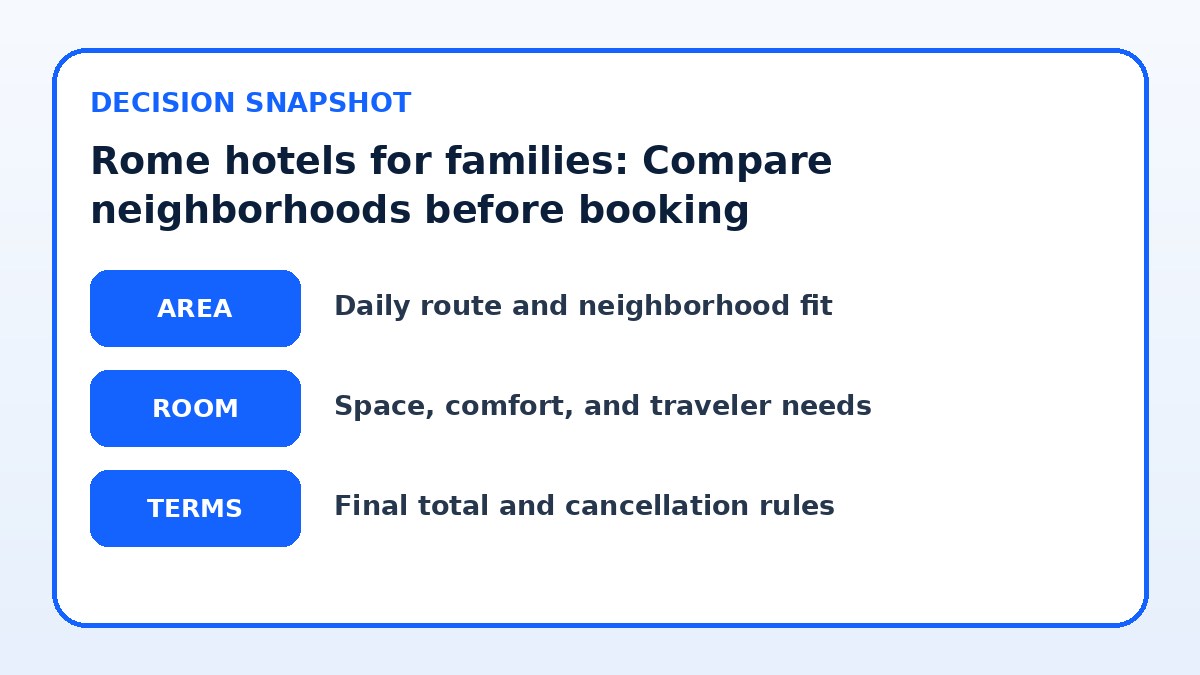
Daily-route friction: how neighborhood choice affects movement
Travel fatigue in Rome often comes from repeated short transfers: walking between sights with a stroller, queuing for buses, and navigating cobblestones. The historic center minimizes transit time but maximizes crowds and limited elevator access in older buildings. If your family relies on a stroller or has mobility constraints, look for hotels or apartments that explicitly list elevator availability and ground-floor rooms. Also review whether the property has immediate nearby bus or metro stops to break up long walks.
Stations like Termini reduce friction when you have early train departures or long luggage transfers, but the surrounding areas can feel busy and less atmospheric for relaxed evenings. Residential neighborhoods reduce daily movement stress by offering parks and playgrounds within walking distance, which is great for pre- or post-sightseeing decompression. Balance daily-route friction by plotting one typical day from your proposed neighborhood: morning activity, midday return or rest, late afternoon outing, and evening meal—then measure the walking and transit legs for realism.
Now compare like with like
Keep the same dates, guests, room needs, and cancellation preferences while you compare the final choices.
Room and party needs: what to check before booking
When choosing a property, prioritize room configuration first: two-bedroom apartments or family suites with separate sleeping areas reduce evening noise and keep young children’s routines intact. Look for properties that list cot availability, extra beds, and kitchenette or minibar options if you plan to prepare snacks or simple meals. Verify elevator access and the number of stairs: many Roman buildings have charming staircases but few elevators, which can be a deal-breaker with heavy luggage or a stroller.
Also consider bathroom layout and privacy—an en-suite bathroom reduces night-time disturbance—and air conditioning, which matters in summer months. If your family prefers self-catering, check the size of the kitchen and the presence of a full oven or just a kitchenette. Communicate specific needs directly with the property or booking platform before confirming: ask about bed sizes, sofa bed quality, safety features, and noise from nearby streets so you know exactly what to expect on arrival.

Hotel booking check before payment
- List your family’s three non-negotiable daily needs (short walks, cot/crib, kitchenette) before searching neighborhoods.
- Check the property listing for elevator access, number of stairs, and whether the advertised room type fits your party size.
- Confirm cot, extra bed, and high-chair availability directly with the property before booking and ask about any fees.
- Plot one representative day from the property: morning attraction, midday return, afternoon activity, and evening meal to test travel legs.
- Verify cancellation, check-in/out times, and whether late arrival or luggage storage is possible on the property’s live booking page.
- Compare at least two neighborhoods on your shortlist in the same price band and room configuration to see the real tradeoffs.
Booking terms and final checks before you reserve
Before you press ‘book,’ read the property’s cancellation policy, check-in and check-out times, and any extra fees for cots or additional guests. These terms change frequently, so verify them on the property’s live booking page or the booking platform you plan to use. If your travel involves tight arrivals or late flights, confirm whether late check-in is possible and whether the property holds luggage if you arrive early. Do not assume flexible arrival unless the property states this clearly.
Also verify what identification and payment methods the property requires at check-in, and whether any city tourist taxes are collected on-site. If you’re booking a room described as ‘family’ or ‘suite,’ ask whether the listed maximum occupancy includes small children in cots, and whether extra beds are foldout sofas or proper beds. Finally, consider contacting the host or hotel with an explicit list of family needs—crib, high chair, and elevator—to avoid surprises and secure a comfortable stay.
Hotel Guide questions travelers ask
Is the historic center the best choice for families who want to see Rome’s main sights?
The historic center is excellent when your top priority is walking between major sights and returning for midday rests. It reduces time spent on transit and is ideal for shorter sightseeing loops. But weigh this against crowd density, narrow cobblestone streets, and many older buildings lacking elevators—these can be challenging with strollers or heavy luggage. If your children need more space or quieter nights, consider a nearby residential neighborhood that offers quick transit links to the center so you retain convenience without constant crowd exposure.
Should families always aim to stay near Termini station for convenience?
Staying near Termini is convenient when you have multiple train or airport transfers because it minimizes luggage movement and simplifies early departures. However, station-adjacent neighborhoods tend to be busier and more functional, with fewer playgrounds and a different evening atmosphere than quieter districts. If you value peaceful evenings and park time, weigh the convenience of Termini against the benefits of a residential area; check local transit connections and the time it takes to reach your main sightseeing priorities before deciding.
What room features are most important to verify for a family booking in Rome?
Verify configuration-first: number of bedrooms, whether sofa beds are full-size, and the presence of a cot if needed. Check elevator availability and the number of stairs, especially in older buildings, and ask about bathroom arrangements (en-suite vs. shared). If you plan to prepare food, confirm the kitchen’s equipment—full oven, stovetop, or just a kettle. Finally, ask about air conditioning, noise insulation, and any city tax collected at check-in so you have a clear expected experience and final cost.
Final decision note
Choosing where to stay in Rome for a family trip comes down to matching daily rhythms to neighborhood strengths. Pick the historic center to minimize sightseeing transfers and maximize walkable museum access; choose station areas for transit-heavy itineraries; favor residential neighborhoods for space, parks, and calm evenings; or choose villa-edge neighborhoods if outdoor play and larger accommodations matter most. Use the checklist to verify elevators, room layout, and host policies before booking, and plot a typical day from any shortlisted area to see realistic travel legs. Once you narrow to one or two neighborhoods, open live inventory—Trip.com or other platforms—to compare specific properties, confirming cancellation, check-in rules, and child-specific provisions on the provider’s final booking page.
Continue planning
Check current options and final conditions
Use the provider page to confirm live availability, the final total, cancellation terms, and every condition that matters to your trip.
This evergreen planning guide was created with AI-assisted drafting and a structured quality review. It does not display live prices, schedules, availability, visa guidance, or provider rankings. Verify current details before booking. Some links are affiliate links; we may earn a commission at no additional cost to you.