Practical answer first: if you’re traveling London to Barcelona with more or heavier bags than usual, prioritize routing that minimizes transfers and airport changeovers, choose fares that include the exact checked weight/quantity you need, and confirm connection minimums and recheck rules before booking. The core tradeoff is route versus fare: direct flights or one-stop itineraries that keep you in the same aircraft or terminal often cost more but reduce baggage handling risk and stress. Cheaper fares may split baggage allowances, require paid extras, or force inconvenient connections. Before you search live fares, gather exact travel dates, total pieces and weights, traveler ages, and whether any items need special handling. This checklist helps you turn those details into quick, comparable booking choices so you can pick a flight that balances cost and luggage confidence.

See live routes for your exact travel day
Compare direct and connecting choices with the same baggage and traveler details.
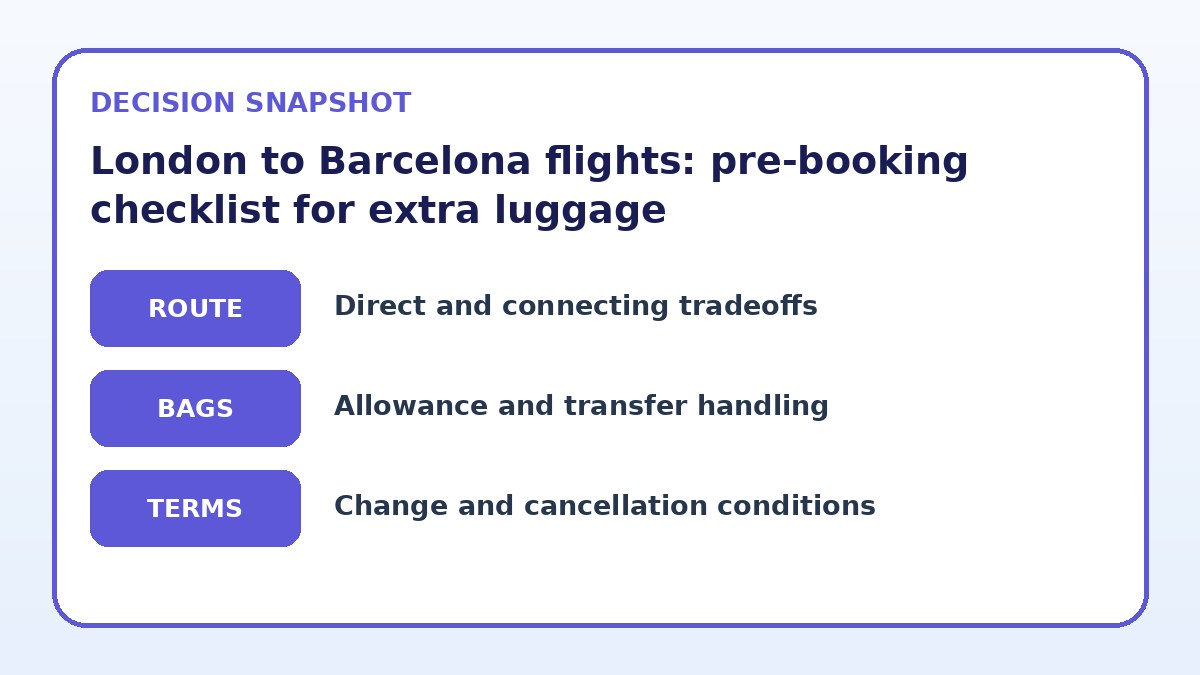
Routing: direct versus connecting options and the baggage tradeoff
When you have extra luggage the simplest routing decision is whether to prioritize a direct flight or accept a connection to save money. Direct service cuts the number of times bags must be unloaded, transferred and rechecked, so it reduces the chance of mishandled items or missed transfers. Connecting itineraries can be attractive on fare grounds, but every connection adds a transfer event and sometimes requires you to collect and recheck bags if you change airlines or terminals, erasing any nominal savings.
How to evaluate routes: on the search screen, filter for non‑stop and then for single‑connection options. For each result, open the fare details and the itinerary notes and look specifically for phrases about interline baggage transfer or self-transfer requirements. If an itinerary says you must claim and recheck baggage, treat that like a negative for extra-luggage travelers unless the connection is long and you’re comfortable handling your bags through security and check-in again.
Baggage and connection risk: reading allowances and special-item rules
Baggage rules are the most important variable when you travel with bulky or multiple items. Before you book, check the exact number of included checked pieces, allowed weight per piece, and whether cabin baggage limits are independent of checked allowances. Some fares include one checked bag but cap it at 20 kg; others allow two bags at 23 kg. If you need odd-sized pieces (sporting gear, instruments, boxes), review the carrier’s special‑item policy and note whether advance booking is required or whether those pieces are quoted as a separate fee at the airport.
Connection risk compounds baggage complexity. If your itinerary has a short connection, verify minimum connection times and whether baggage is transferred automatically between the carriers listed. When two different carriers operate an itinerary, confirm on their booking pages whether they have an interline agreement that covers baggage through-checking. If they do not, plan to collect and recheck baggage at the connecting point and factor in extra time and possible costs for oversized items.
Compare flight-selection strategies
| Flight strategy | Best for | Risk to check |
|---|---|---|
| Book a nonstop flight with generous included allowance | Travelers willing to pay more for lower baggage handling risk | Higher base fare but fewer transfer events and little or no rechecking of luggage |
| Choose one-stop itineraries on a single ticket with through-checked bags | Cost-conscious travelers who accept one connection but want baggage handled | Saves money versus nonstop but depends on interline baggage agreements and tight connection reliability |
| Buy the cheapest fare and add baggage à la carte | Travelers who know exact baggage needs and can add measured allowances | Lower headline fare but potential high add-on fees, variable rules by leg, and airport surcharge risk |
| Split tickets or separate carriers to save on base fare | Experienced travelers comfortable managing self-transfer and rechecking baggage | Lowest fares possible but high operational risk for lost bags and no protection for missed connections |
Recheck the complete itinerary
Confirm airports, connection handling, baggage, and change conditions before deciding.
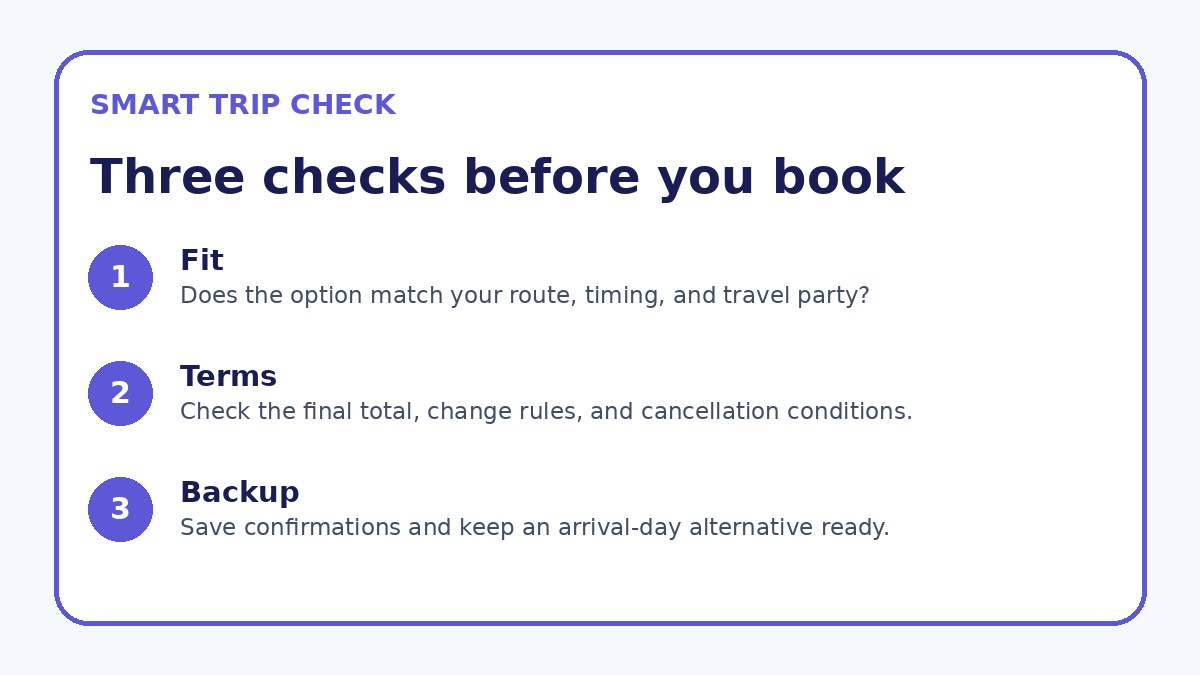
Schedule fit and operational considerations for luggage-heavy travelers
Choose flight times not only for convenience but for operational robustness. Early-morning flights are sometimes less tolerant of delays caused by overnight turnarounds, while later flights can be affected by cumulative day-of-service delays. For travelers with extra bags, a slightly later departure that provides a longer connection buffer or clearer transfer terminal may be a better choice than the earliest low-fare option. Also consider airport layout: some London airports require longer transfers between check-in and departure or between terminals, which matters when you’re managing carts, trolleys, or oversized items.
Check the carrier’s recommended check-in and baggage-drop deadlines for oversized or special items, and add extra time into your schedule. If an itinerary requires arriving extra-early to process special items or pay oversize fees, that erodes any fare savings. When comparing times, write down arrival and departure terminals so you can judge whether a connection involves an inter-terminal bus, train, or long walk—each adds friction for heavy luggage and increases the chance of missing a connection.
Flight details to verify
- Decide total pieces and exact weight per piece for every traveler and record dimensions; use these numbers when comparing fare baggage tables.
- Note preferred travel dates and at least one alternate date; check nonstop and single-connection options for each date before finalizing.
- On each candidate itinerary, open the fare rules and save a screenshot or PDF of the baggage inclusions and change/cancellation terms.
- Verify whether each itinerary requires baggage collection/recheck at connections and add minimum extra transfer time if it does.
- If you have special items, contact the carrier(s) listed on the itinerary to confirm advance booking requirements, costs, and drop-off procedures.
- Before payment, confirm the final total including any pre-booked baggage fees and print or save the booking confirmation showing allowance per segment.
Fare conditions: cancellations, changes and baggage inclusions to verify
Fare rules determine how flexible your ticket is if plans change, and they also state what baggage is or isn’t included. Before you commit, open the full fare conditions and find the sections on refunds, date changes, and baggage inclusions. Note whether the fare allows paid upgrades at booking, whether baggage can be added at a lower online price than at the airport, and whether changes are permitted without an excessive penalty. For extra luggage, an otherwise nonrefundable low fare that allows inexpensive baggage add-ons might still work—but you need to confirm the add-on price and whether it applies per leg.
On provider booking pages, explicitly verify the billed baggage allowance for each passenger on each flight segment: weight-based or piece-based systems behave differently across carriers. If you plan to split the trip across carriers or tickets, check whether baggage is protected for missed connections or covered only to the first stopping point. Always print or save the baggage breakdown shown on the final booking page and the confirmation email; that is what airport staff will use if there’s a dispute.
Flight Guide questions travelers ask
Should I always choose a direct London to Barcelona flight if I have a lot of luggage?
Not always. Direct flights reduce baggage transfer events and generally lower the risk of mishandled items, which is valuable for heavy or multiple pieces. However, direct service can be substantially more expensive. If a one-stop itinerary is on a single ticket with through‑checked baggage and a comfortable connection time, it can be an acceptable compromise. Compare the fare difference against the cost and hassle of extra baggage fees, and ensure the connection does not require you to collect and recheck bags—if it does, treat it like two separate journeys.
How can I tell whether my baggage will be automatically transferred on a connecting itinerary?
Look for explicit language in the itinerary and fare conditions about through-checked baggage or interline baggage agreements. On the airline or booking page, examine the segment details: if the itinerary lists both flights under one booking reference and mentions through-checking, baggage transfer is likely automatic. If the itinerary shows separate tickets or different carriers without an interline note, assume you may need to claim and recheck baggage. When in doubt, phone the carrier(s) to confirm and get written confirmation if you have oversized or unusual items.
What documentation should I bring when traveling with unusual or oversized luggage?
Bring any product documentation, purchase receipts, or permits for restricted or high-value items, plus a clear list of dimensions and weights for each piece. If the item is an instrument, sporting gear or contains batteries, check the carrier’s special-article policies in advance and bring any required inspection or battery documentation. Also carry a copy of the booking confirmation showing the pre-booked special-item allowance or paid fee. Keep photos of the packed items and fragile-label instructions to help in case of a dispute or damage claim.
Final decision note
Booking London to Barcelona flights with extra luggage is mostly about turning details into verifiable choices: exact piece counts, routing that minimizes transfers, and fare rules that actually include the allowance you need. Start by collecting traveler names, precise luggage specs and preferred dates; then compare nonstop and single-connection itineraries side by side, reading the fine print on baggage transfer and change rules. Keep screenshots or PDFs of the final baggage breakdown shown on the carrier’s booking page and call the airline if anything is unclear. With those steps you’ll choose a ticket that balances cost and the reduced risk and stress of moving extra bags across borders.
Continue planning
Check current options and final conditions
Use the provider page to confirm live availability, the final total, cancellation terms, and every condition that matters to your trip.
This evergreen planning guide was created with AI-assisted drafting and a structured quality review. It does not display live prices, schedules, availability, visa guidance, or provider rankings. Verify current details before booking. Some links are affiliate links; we may earn a commission at no additional cost to you.