For many business travelers, the question isn’t whether Busan has transit — it’s whether driving will actually make your day more efficient. If your schedule clusters meetings around Haeundae, Centum City or the port area, a rented car can cut cross-city transfers and give you flexible timing. But Busan’s subway and bus network, plus reliable taxis, often outpace driving when traffic, parking and unfamiliar rules add friction. This guide gives a clear recommendation first, then walks you through how to assess route value, insurance wording, pickup and return friction, and a practical non-driving fallback that keeps your schedule on track without a car.
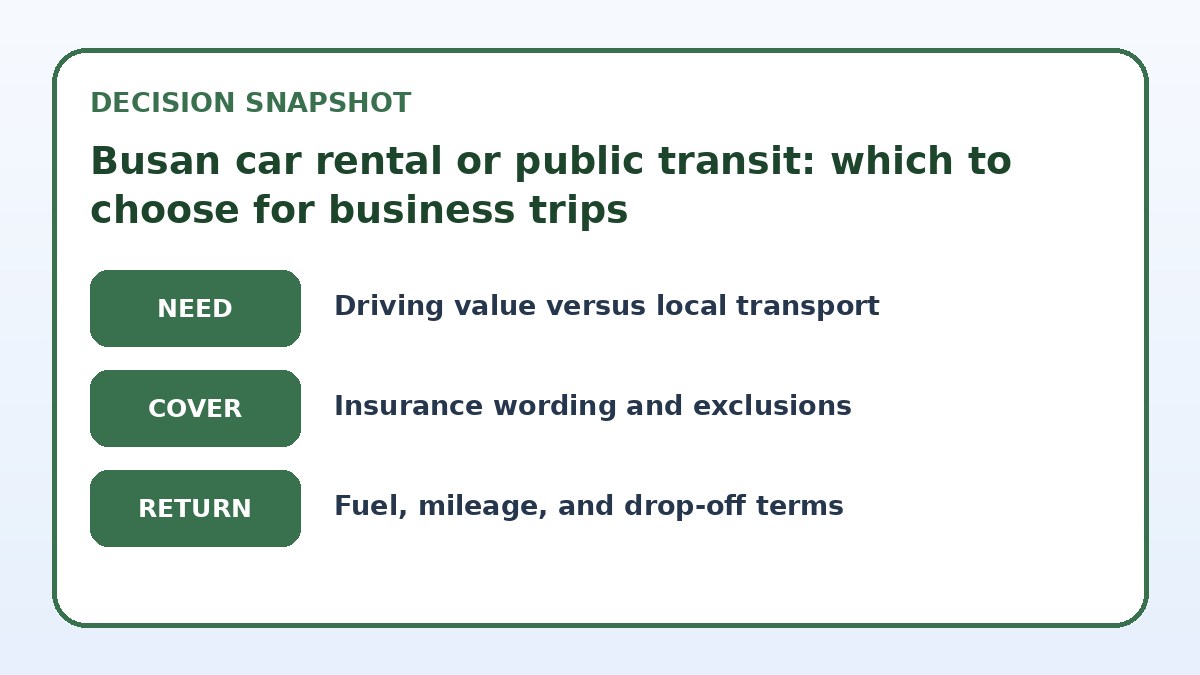
Decide whether driving genuinely improves your itinerary
Start by mapping every appointment, hotel and meeting address on a single map layer and add realistic time windows, including buffer for running late. Compare the direct travel time door-to-door by car with the fastest transit combination (subway, bus, short taxi). Driving helps when you repeatedly need off-network stops—suppliers, factories, or port terminals—that would otherwise force long taxi rides. Conversely, if most addresses fall within 1–2 subway stops of major stations, the subway’s predictability through rush hours usually beats driving.
Also weigh parking and brief stops. Business trips often require quick exits for meetings or mail runs; factor in time to find and pay for parking, walking from lot to office, and the risk of congested feeder roads. If your schedule leaves little slack and you don’t want to handle parking behavior in a foreign city, public transport plus short taxi segments can provide steadier, stress-free timing. Use this assessment to decide if you should pursue Busan car rental or a transit-first plan.
Decide whether driving earns its place
| Mobility strategy | Best for | Cost or friction to check |
|---|---|---|
| Public transport (subway + buses) | Dense-city schedules with meetings near stations and predictable arrival windows. | Less flexible for off-network stops; requires awareness of last-train times and minor walking between stops. |
| Rental car (self-drive) | Multiple off-network meetings, early starts or late finishes, and routes with poor transit coverage. | Parking, unfamiliar roads, and pickup/return logistics can add time and hidden costs; insurance wording must be checked. |
| Taxis and chauffeur services | Last-mile speed, unpredictable schedules, or when you need point-to-point reliability without driving. | Can be costly for many stops; availability fluctuates in peak times and expense policies must be planned. |
| Mixed approach (transit plus occasional rental or taxi) | Hybrid itineraries combining dense urban meetings with an occasional off-network visit. | Requires planning and quick switching between modes; you may pay for both transit and short rentals or taxis. |
Check live rental choices only after the route test
Use the exact driver, dates, pickup point, and return plan to compare current conditions.
Insurance wording: what to check before you book
Rental contracts use specific legal terms that determine what is and isn’t covered. On the rental page or contract, verify liability limits (third-party damage), collision damage waiver (CDW) scope, and the size of the deductible or excess you would pay after an incident. Check whether the quoted price includes roadside assistance and whether glass, tire and undercarriage damage are excluded or extra. If your company card offers primary rental coverage, confirm it matches the local rules and ask for written confirmation to present at pickup.
Also confirm driver eligibility and permit rules. In Korea, you may need an International Driving Permit (IDP) plus your home license—check the rental provider’s stated requirements. Look for wording about additional drivers, cross-border travel restrictions (if you plan to cross into neighboring regions), and fuel policy. If any term is ambiguous, get a definitive answer from the rental provider’s booking page or customer service; ambiguous insurance wording is a common source of unexpected costs.
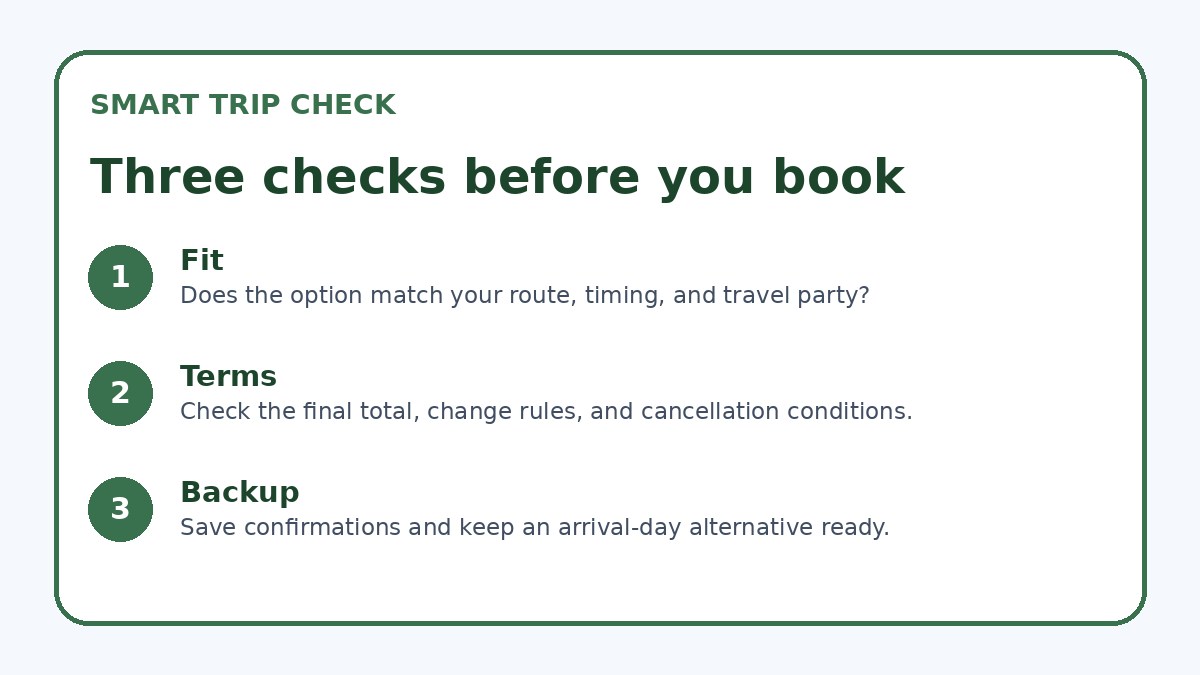
Compare the full rental conditions
Confirm insurance wording, exclusions, deposit, fuel, mileage, and return terms on the final page.
Pickup, return friction and operational realities
Pickup and return logistics can make or break a rental decision. Airport counters may offer convenient hours but can involve lines and local transfer time; city-center kiosks are often quicker but may have limited hours. Confirm the provider’s documented pickup and drop-off window, whether after-hours returns are accepted, and how they handle vehicle checks to avoid disputes over damage. One-way rentals are sometimes allowed but frequently carry sizable drop fees—verify the exact terms on the provider’s booking page before committing.
Also plan the first and last-mile to and from your meeting locations. If pickup requires a shuttle from the airport or a long walk from public transit, the apparent time savings of renting can evaporate. Similarly, returning a car after a late meeting may be difficult if counters close; ask about key-drop procedures. These operational frictions are often the deciding factor when comparing Busan car rental to a transit-focused itinerary.
Car rental terms to verify
- Map every meeting, hotel and important address and mark the nearest subway station, bus stop and typical taxi pickup point.
- Compare door-to-door travel times for driving versus subway-plus-taxi during your meeting windows, including parking search time.
- Review the rental contract’s insurance wording: liability limits, collision waiver scope, deductible size, and roadside assistance inclusions.
- Confirm pickup and return hours, after-hours procedures, airport counter location, and one-way drop fees on the provider’s final booking page.
- If not renting, pre-save local taxi apps, hotel concierge number, and reserve timed taxi transfers for critical early or late trips.
- Log company travel policy limits and confirm whether your corporate card supplies rental coverage; secure written confirmation if required.
A practical non-driving fallback for business travelers
If you opt against renting, build a robust fallback that replicates flexibility without a car. Identify the nearest subway stations to each meeting, note the first and last train times that day, and mark reliable taxi stands or app-based taxi options for late runs. Keep a list of local taxi apps, your hotel concierge’s contact, and a few trusted routes pre-checked for real-time transit disruptions so you can switch modes quickly. This redundancy prevents a stuck schedule if trains are delayed or a meeting runs overtime.
You should also pre-book short taxi transfers for critical legs where time matters—airport to hotel, a late-night client drop-off, or a multi-stop day when transit would create risky tight connections. Pre-booking minimizes wait uncertainty and gives you a clear fallback cost to compare against the incremental cost of renting a car. If you want to compare live options side-by-side, Trip.com can be used to view current availability, but always verify operational and insurance details on each provider’s final booking page.
Car Rental & Road Trip questions travelers ask
Do I need an International Driving Permit to rent a car in Busan?
Many rental companies and local laws require an International Driving Permit (IDP) in addition to your home license; requirements can vary by provider. Before booking a Busan car rental, check the provider’s official eligibility criteria on the booking page for the exact documents needed. Also verify age restrictions and whether your home country license is accepted without an IDP. If your company supplies insurance or driver authorizations, obtain those confirmations in writing and carry them to the pickup counter.
How should I handle insurance excess and damage disputes at pickup or return?
Read the rental agreement’s damage and excess sections and request written clarification for any exclusions such as glass, tires or undercarriage. At pickup, inspect and photograph the vehicle with timestamps, noting existing damage on the provider’s check sheet and getting a signed copy. On return, repeat the inspection and request documentation showing no new charges. If a dispute arises later, having the signed check sheet and dated photos makes claims easier to resolve; save all receipts and communications for your company expense process.
When is a taxi or chauffeur a better choice than renting a car for business?
Taxis or chauffeur services are often superior when you need predictable, door-to-door service for a few high-priority legs or when parking and driving would add significant stress. They remove the responsibility for navigation, local regulations and parking fees, and are useful for late-night returns when rental counters may be closed. For sequences of short meetings within transit corridors, taxis can fill gaps without the operational and insurance overhead of a rental car.
Final decision note
For most Busan business trips, public transport plus selective taxi use is the default efficient choice: the subway moves reliably through congested corridors and short taxis cover first/last-mile needs. Choose Busan car rental when your schedule includes multiple off-network stops, early departures or late finishes, or when predictable door-to-door control is essential. Before booking, map routes, verify insurance wording and driver requirements on the rental provider’s booking page, and check pickup/return procedures to avoid unexpected friction. If you stay transit-first, prepare a non-driving fallback with pre-saved taxi apps and reserved transfers for critical legs so your schedule remains under control.
Continue planning
Check current options and final conditions
Use the provider page to confirm live availability, the final total, cancellation terms, and every condition that matters to your trip.
This evergreen planning guide was created with AI-assisted drafting and a structured quality review. It does not display live prices, schedules, availability, visa guidance, or provider rankings. Verify current details before booking. Some links are affiliate links; we may earn a commission at no additional cost to you.