Practical decision first: for most families, choose the option that minimizes transfers and walking with luggage while matching your comfort and budget priorities. That usually means prioritizing fewer station changes, child-friendly seating, and a pickup/dropoff location close to your accommodation. Start by listing the family’s must-haves—stroller space, luggage capacity, on-board restrooms, seat reservations, and door-to-door transfers. Next, map where you’re staying in both Osaka and Kyoto and note nearby stations, bus stops, or parking/ride-share points. Use that map to eliminate options that add lengthy walks or extra connections. Finally, compare total travel time, number of transfers, and how easy arrival and departure will be for kids. The following sections explain how to build a multi-city ground-transport plan step by step, the tradeoffs to weigh, and a checklist to confirm before you book.
See current options before you compare the details
Availability and final conditions change. Open Trip.com now or keep reading for the practical comparison.
Map your start, stop, and family needs
Begin by plotting your Osaka accommodation, Kyoto accommodations, and the nearest transport hubs on a single map. For families, proximity matters more than theoretical speed: a station or bus stop five minutes from your hotel often beats a faster service that requires a 20-minute walk, multiple escalators, or a confusing transfer. Note practical details such as whether the route requires changing lines inside large stations, moving between separate terminals, or crossing streets. Mark where you would rather begin and end each day—close to a playground, your hotel entrance, or a favorite restaurant—to reduce stress when travel days are tight.
Next, list family-specific needs clearly: stroller or wheelchair access, number of checked bags, children’s ages for fare and seating rules, potential nap times, and whether you need on-board toilets or food options. Assign a priority to each need (essential, useful, nice-to-have) so you can trade off speed for convenience when comparing options. This upfront mapping transforms vague preferences into measurable criteria you can use when reading schedules and booking pages.
Compare trains, highway buses, and private transfer lines
When building a multi-city plan, treat trains, intercity buses, and private transfers as different templates rather than direct competitors. Trains often offer frequent departures and straightforward station-to-station journeys, but stations can be large and require stairs or long corridors. Highway buses might deliver you closer to hotel districts and reduce station navigation, though they can involve fixed pickup points and less guaranteed legroom. Private transfers or taxis give the most door-to-door convenience with minimal transfers, which is useful with small children and heavy luggage, but consider how much of your daily budget you are willing to allocate to that convenience.
To compare, create a simple matrix for each route option showing total door-to-door time estimate, number of transfers, walking distance at each end, luggage handling, and child-friendly features. For each row, add notes on what you must verify on the provider’s booking page—seat reservation policies, exact pickup address, stroller storage rules, and cancellation/change penalties. This method lets you see which transport template best aligns with your family’s priorities and allows mixing modes across multiple cities while keeping the plan coherent.
| Approach | Best for | Tradeoff to check |
|---|---|---|
| Direct train between central stations | Families who want predictable schedules and easy ticketing | May require navigating busy stations and carrying luggage to platforms |
| Highway or shuttle bus to hotel-district stops | Groups prioritizing minimal walking and direct hotel-area drop-offs | Fixed pickup points and less frequent departures than trains |
| Private transfer or taxi door-to-door | Families with small children, lots of luggage, or tight schedules | Higher per-trip cost and traffic variability on busy routes |
| Mixed plan: train plus short taxi or bus at either end | Families balancing cost with convenience by minimizing long transfers | Requires coordination and buffer time between different providers |
Ready to check the option that fits your plan?
Use your exact dates and traveler details so the provider page can show the current total and conditions.
Design a multi-city day plan with buffer time
Families should design the day with generous buffers for bathroom breaks, souvenir detours, and unexpected delays. When planning connections, add at least one extra transfer buffer beyond the provider’s recommended minimum—this reduces nerves when a train is delayed or a child needs a long restroom stop. If you intend to visit attractions near transit hubs, slot those into your schedule so travel legs and sightseeing alternate comfortably. Avoid stacking multiple tight transfers on a single day; spread longer travel chunks across several lighter days whenever possible.
If you plan to mix transport modes—say, train to Kyoto and a bus to a nearby town—confirm how each segment’s arrival point connects with the next pickup. Pay attention to last-mile issues like whether the stop is curbside, requires a short walk through a market, or sits on the far side of a large station complex. Map walking routes between segments using clear landmarks and estimate times with children’s pace in mind. That pre-planning will make the day flow and make it easier to stick to nap windows or meal breaks.
Before you book
- Plot both accommodations and nearby transport hubs on one map to compare door-to-door distances.
- Confirm seat-reservation and stroller policies on the carrier’s official booking page before purchasing.
- Estimate total door-to-door time including walking, transfers, and a 20–30 minute buffer per connection.
- Save screenshots of station exits, elevator locations, and the walking route from platform to street.
- Pack a compact family go-bag with snacks, medicines, wipes, chargers, and printed booking confirmations.
- Note an alternate same-day option (next train or local taxi) and the provider’s change/cancellation terms.
What to verify before booking and on travel day
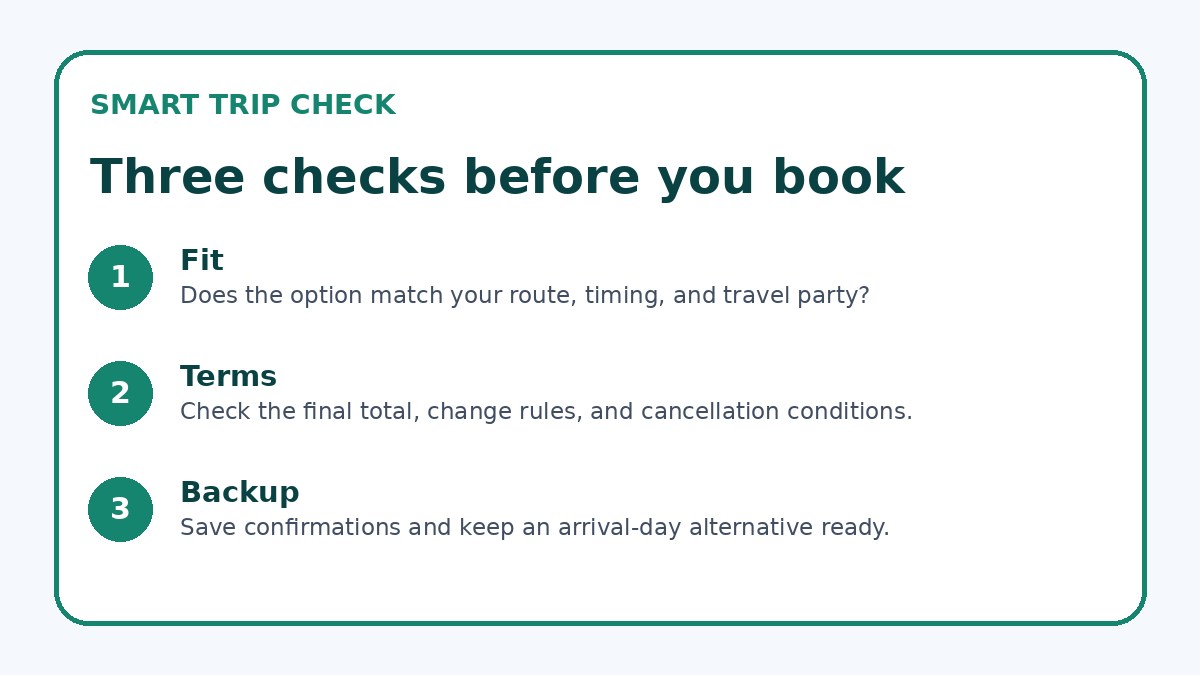
Before committing, verify five specific facts on the provider’s official booking page: exact departure and arrival locations, seat reservation rules and whether seats together are possible, luggage allowance and stroller policies, child fare and age-based seating rules, and cancellation/change terms. If you use a third-party site to compare options, confirm the same details on the carrier’s site or booking confirmation because small print often changes. For private transfers and taxis, check where drivers will meet you, how they display your name, and whether child seats are available or required by local regulations.
On the travel day, arrive earlier than the provider suggests if you are traveling with kids and luggage—this reduces last-minute stress. Keep a compact go-bag with snacks, wipes, a compact first-aid kit, and any necessary documents. If your plan involves station transfers, identify elevator routes and ticket gate locations ahead of time and download offline maps or take screenshots of key station layouts. Finally, have a simple backup option—an alternate train or a local taxi number—so you can pivot if your primary plan becomes impractical.
Frequently asked questions
Should my family take the train or a private transfer between Osaka and Kyoto?
Choose based on priorities: trains are often frequent and simple to book, making them a good balance of reliability and cost, while private transfers eliminate station navigation and give true door-to-door service. If your children need naps or you have heavy luggage, a private transfer reduces handling but costs more; if you prefer predictability and multiple departure times, a train-based plan usually works better. Compare total door-to-door time, number of transfers, and how each option affects moving between your specific accommodations.
How much buffer time should we build when planning connections with kids?
Build larger buffers than you would when traveling alone—plan at least one additional transfer margin beyond minimum suggested connection times. Factor in restroom breaks, snack stops, and slower walking pace with strollers. For mixed-mode plans, add extra time to reach pickup points that may be outside the station complex. These larger buffers make delays easier to handle and keep the day flexible if a child needs an unexpected break or rest.
What are the most important things to check on booking pages before finalizing tickets?
Verify exact departure and arrival locations, seat-reservation rules (and whether seats together are guaranteed), stroller and luggage allowances, child fare age cutoffs, and cancellation/change policies. If using a third-party comparison site, cross-check these details with the operator’s official page because policies can differ. Also confirm pickup/drop-off meeting points for transfers so you aren’t surprised by curbside versus station-concourse directions on travel day.
Final planning note
Building a family-friendly ground-transport plan between Osaka and Kyoto is less about choosing a single “best” mode and more about matching practical needs to the right mix of services. Start with a clear map of where you’re staying, list essential family needs, and compare options by door-to-door time, number of transfers, and luggage or stroller handling. Use the checklist to verify critical booking details, allow generous buffers for connections, and keep a simple contingency plan. By prioritizing convenience and predictable logistics over theoretical speed, you’ll reduce stress and make travel days more enjoyable for everyone.
Continue planning
Check current options and final conditions
Use the provider page to confirm live availability, the final total, cancellation terms, and every condition that matters to your trip.
This evergreen planning guide was created with AI-assisted drafting and a structured quality review. It does not display live prices, schedules, availability, visa guidance, or provider rankings. Verify current details before booking. Some links are affiliate links; we may earn a commission at no additional cost to you.