
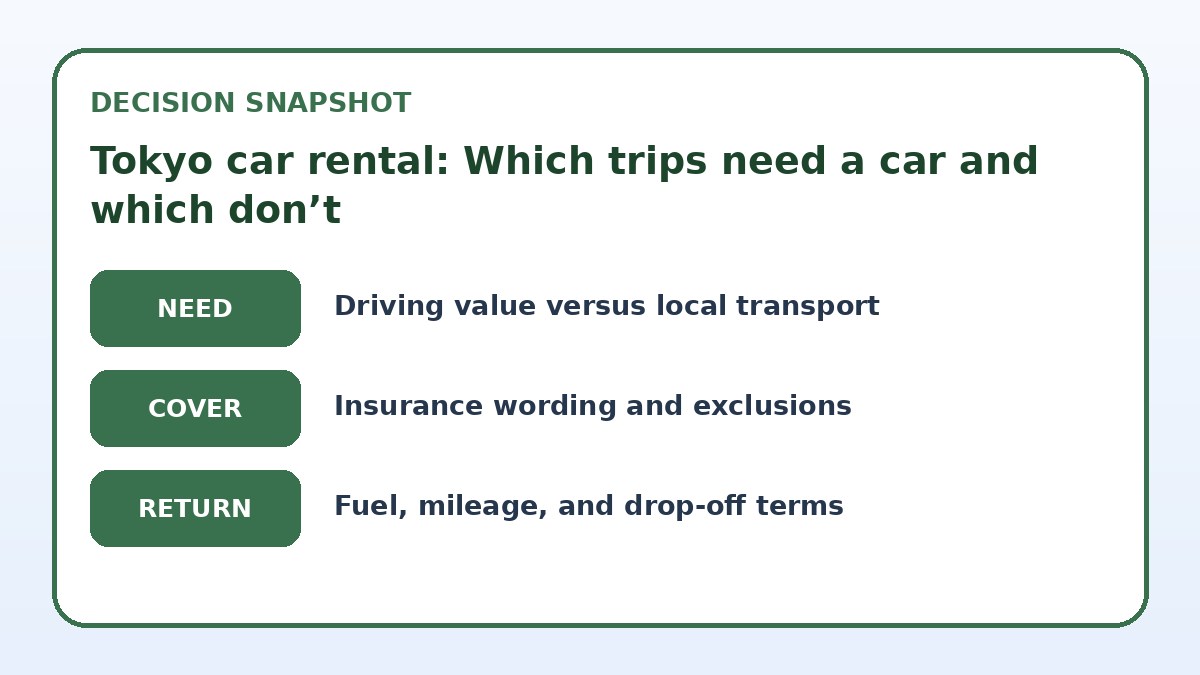
Short answer: for most first-time visitors to central Tokyo, a rental car is more hassle than help; exceptions include day trips to far-flung parks, remote temples, or highly flexible itineraries that include several rural legs. Tokyo’s urban core is dense, exceptionally well served by trains and subways, and walking plus public transit usually beats driving for sightseeing, restaurants and museums. However, if your plan emphasizes off-the-beaten-path regional routes, late-night departures, or traveling with a lot of luggage or young children, a car can unlock places that trains don’t reach easily. This guide helps you weigh the tradeoffs—traffic, parking, lodging location, language and map navigation, and the types of side trips that justify the cost and effort of renting in Japan.
Why driving in central Tokyo is usually unnecessary
Tokyo’s rail network is dense and frequent: subways and private lines connect most tourist neighborhoods, and stations are often closer to sights than parking areas. Many attractions sit within comfortable walking distance of transit hubs, letting you avoid the time and uncertainty of finding and paying for parking. Streets in central wards are busy, signage can be visually cluttered for first-time drivers, and intersections are optimized for pedestrian flows rather than leisurely sightseeing by car. For short hops inside the city, taxis or ride-hailing (where available) solve occasional door-to-door needs without the burdens of a rental car.
Public transit also reduces the friction of driving: no need to worry about narrow one-way streets or unfamiliar toll systems, and train schedules simplify day planning. If your itinerary is focused on museums, shopping districts, and concentrated dining neighborhoods, you’ll likely save time and money by buying a day pass or using IC transit cards. Factor in the effort of adjusting to local driving norms and potential language barriers on rental paperwork and signage; these small frictions accumulate and can turn a flexible day into a stressful one.
When a Tokyo car rental can make sense
A car pays off when your route includes destinations poorly served by rail—mountain passes, coastal drives, rural shrines, or multiple towns across prefectural borders where buses are infrequent. If your group carries significant luggage, travels with young children or mobility limitations, or plans late-night arrivals and departures outside train hours, the convenience and privacy of a car are real advantages. Roadside parking at rural attractions is often easier and cheaper than city lots, and driving lets you stop at viewpoints or small towns that have no convenient train station.
For multi-day loops—such as heading from Tokyo to Chichibu, the Kanto highlands, or coastal Hakone-type routes while avoiding repeated train transfers—a car speeds connections and opens flexible overnight choices. Still, check whether major roads in your planned regions are seasonal or subject to closures, and plan fuel and rest stops carefully. A rental can transform your reach, but the decision should follow a clear map of where you want to go, instead of a generic assumption that cars equal freedom.
| Approach | Best for | Tradeoff to check |
|---|---|---|
| Rely on Tokyo transit and occasional taxis | Sightseeing in central wards, short stays, single-city itineraries | Less flexibility for remote day trips and late-night departures |
| Rent a car just for rural day trips | Targeted excursions outside metro area with complex last-mile needs | Extra cost and logistics for pick-up/drop-off; city driving still impractical |
| Full trip by rental car | Multi-day regional loops, travelers with bulky gear or mobility needs | Higher parking and toll costs plus driving stress in urban sections |
| Mixed approach: transit in city, rental for outbound legs | Balanced itineraries combining city sightseeing and countryside exploration | Requires careful scheduling and possibly multiple rental transactions |
Costs, parking and practical hurdles to factor in
Don’t assume a rental rate equals your total cost: factor in parking, expressway tolls, fuel, potential congestion surcharges, and time spent searching for spaces in city centers. In Tokyo, short-term parking near central attractions is limited and often expensive; some hotels do not offer parking for guests, or they reserve limited spaces for advance reservation only. Additionally, navigating narrow lanes, one-way rules and unfamiliar GPS systems adds cognitive load. If you’re uncomfortable reading maps in Japanese, check that the car’s navigation supports English and confirm whether the rental provides maps or mobile Wi‑Fi for route planning.
Insurance coverage and driving rules also require attention. Understand what the rental includes and what optional protections you might want—verify policy details on the provider’s final booking page, including liability limits, excess amounts, and cross-prefecture rules. If you plan cross-border trips (for example, to islands or other jurisdictions), confirm whether the contract allows such travel. Finally, factor time for fuel stops and possible traffic delays when comparing driving to rail travel durations so your schedule remains realistic.
Before you book
- Map each planned stop and mark whether it’s within a 10–30 minute walk of a rail station.
- If considering a rental, confirm hotel parking availability and whether reservations are required.
- Verify on the rental provider’s final booking page which insurance covers you and the excess amount.
- Check that the vehicle’s navigation supports English and arrange mobile Wi‑Fi if you need live maps.
- Estimate total road costs: rental, fuel, tolls and likely parking fees for the days you plan to drive.
- If driving overnight or late, confirm local road conditions and whether your rental allows cross-prefecture travel.
How to decide: a quick decision checklist and booking tips
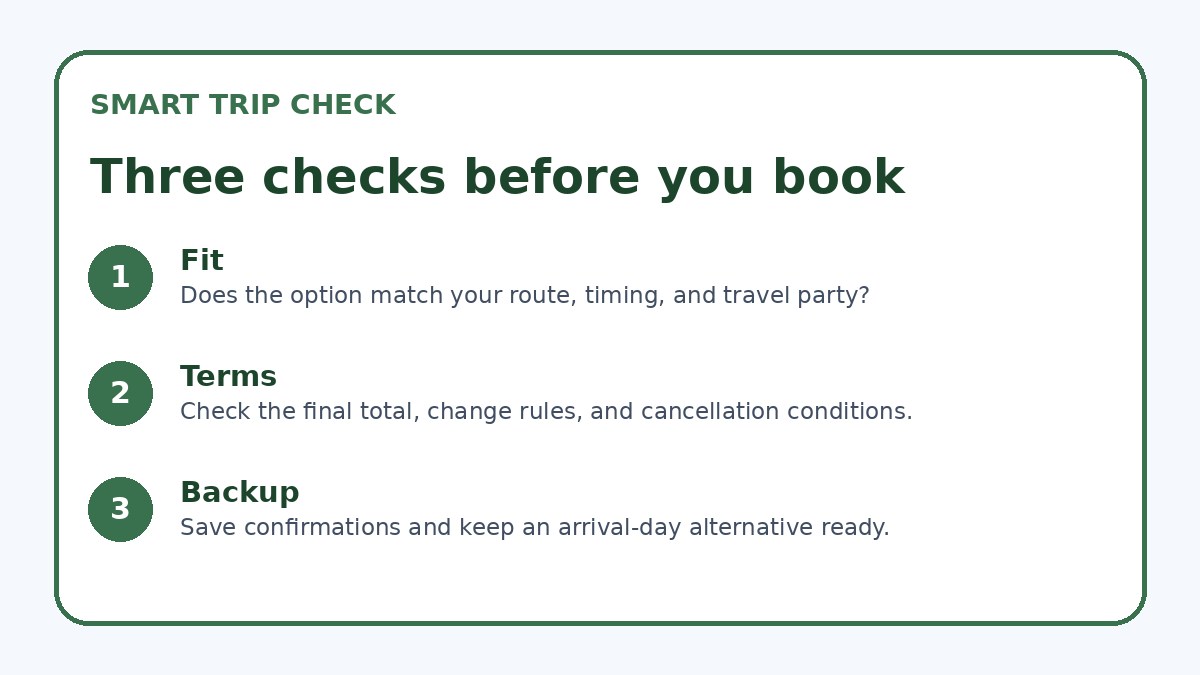
Start by mapping your itinerary: pinpoint each destination and mark whether it sits within a 10–30 minute walk of a major rail station. If most stops are transit-accessible, favor trains. If several key points are rural, require late-night access, or you’ll carry bulky gear, a rental is more likely to be worthwhile. Also weigh group size—more passengers spread fixed rental costs, and family travel often shifts the value toward a car. Balance the expected door-to-door time savings against parking searches, tolls and unfamiliar driving conditions.
When you move forward with booking, compare vehicle sizes (compact cars for narrow roads, or larger vehicles for comfort), confirm pick-up and drop-off locations, and verify what languages the rental agent or navigation system supports. Check the provider’s cancellation, fuel, and mileage policies on the final booking page before committing. You can compare offers on sites such as Trip.com, but always verify the rental terms directly with the supplier to ensure the contract reflects your needs and planned routes.
Frequently asked questions
Can I use an international driver’s license to rent a car in Tokyo?
Driver licensing rules vary by nationality and are set by Japanese authorities and rental companies. Many visitors use an International Driving Permit (IDP) based on the 1949 Geneva convention along with their valid home-country license. Some countries require an official Japanese translation of the license instead. Because provider policies differ, check the rental company’s accepted documents and any age or license-duration restrictions on the final booking page before you travel; bring original documents to the pick-up counter.
Is driving in Tokyo hard for foreign visitors?
Driving itself follows familiar traffic rules, but Tokyo presents specific challenges: heavy traffic at peak times, narrow streets in older districts, frequent one-way systems, and dense signage. Parking can be expensive and limited in tourist areas. If you’re comfortable with urban driving in crowded cities and confident using the car’s navigation, you can manage; if not, relying on trains and taxis reduces stress. Consider practicing on quieter roads first or renting for only the rural portion of your trip rather than the entire stay.
How do I decide between renting a compact car or a larger vehicle for a regional trip from Tokyo?
Choose a compact car for narrow roads, urban parking and better fuel efficiency; pick a larger vehicle if you prioritize passenger comfort, have three or more adult travelers, or carry bulky gear like bikes or skis. Also consider luggage capacity and road types—some rural routes are steep or winding, where a stable, well-powered car improves safety. Confirm the vehicle dimensions and luggage space on the rental page, and verify whether automatic or manual transmissions are available to match your driving experience.
Final planning note
For most first-time visitors focused on central Tokyo, a rental car is an unnecessary complication: trains and walking deliver faster, cheaper, and less stressful sightseeing. A car becomes a good choice only when your itinerary includes multiple rural or remote stops, late-night travel, bulky gear, or specific mobility needs that public transit cannot meet. Decide by mapping every stop, comparing door-to-door times, and totaling expected costs for parking, tolls and fuel. If you opt to rent, confirm insurance, navigation language, hotel parking, and pick-up/drop-off terms on the rental provider’s final booking page before you commit. Consider renting only for the outbound legs and using transit inside the city to get the best of both approaches.
Continue planning
Check current options and final conditions
Use the provider page to confirm live availability, the final total, cancellation terms, and every condition that matters to your trip.
This evergreen planning guide was created with AI-assisted drafting and a structured quality review. It does not display live prices, schedules, availability, visa guidance, or provider rankings. Verify current details before booking. Some links are affiliate links; we may earn a commission at no additional cost to you.