
If you’re traveling from Paris to Rome with more or heavier bags than usual, the practical decision is to complete a focused pre-booking checklist before you buy a ticket. Start by comparing the baggage allowances and fees on the flights you’re considering, then check airport transfer logistics and connection minimums if your itinerary includes a change. Also verify seat type and carry-on rules so you don’t get surprised at boarding. Planning ahead saves time at the airport and can prevent large fees or missed connections. Below you’ll find a compact but thorough checklist, criteria to weigh between direct and connecting options, and clear next steps to finalize a booking that suits extra-luggage needs.
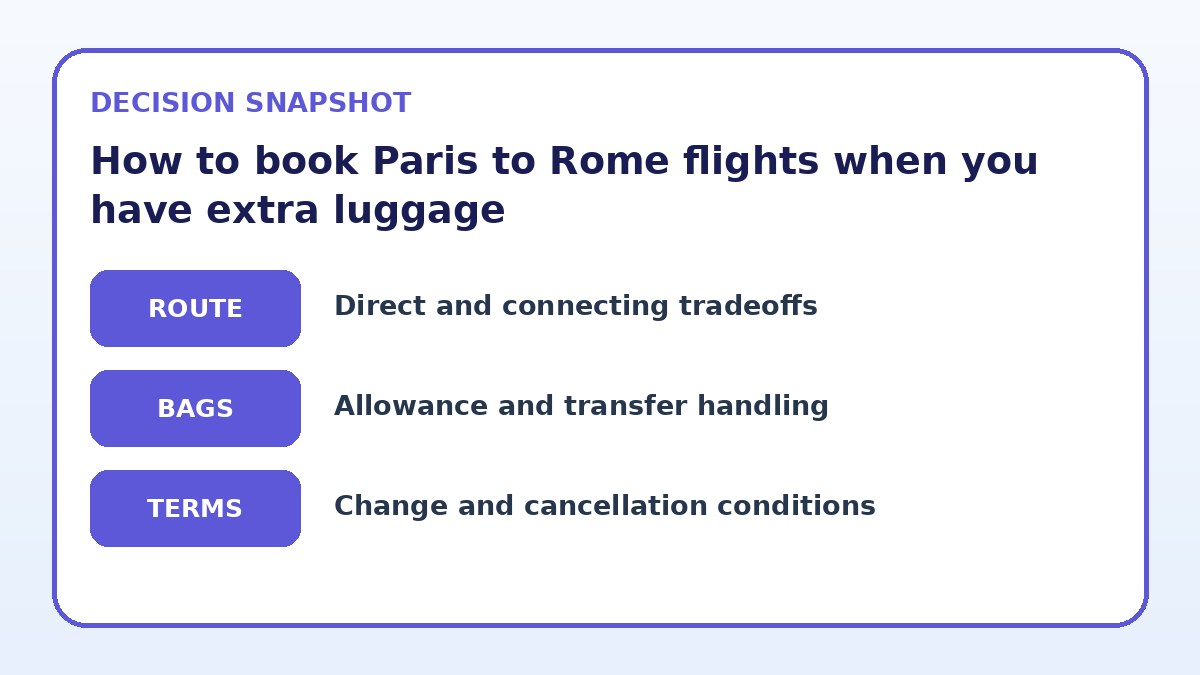
See current options before you compare the details
Availability and final conditions change. Open Trip.com now or keep reading for the practical comparison.
Know exactly what counts as extra luggage
Start by cataloguing your bags: count checked pieces, carry-ons, and special items such as skis, musical instruments, or bulky souvenirs. For most European carriers the difference between a standard carry-on and an oversized item can be the decisive factor in fees. Don’t rely on general assumptions: airlines define size and weight limits differently, and some low-cost carriers include only a small personal item in the base fare. Write down each bag’s weight and linear dimensions (length + width + height) and label any fragile or oddly shaped items—this list becomes the basis for comparing options across carriers and fare classes.
Next, separate what can be reduced or consolidated. Can you move items from checked to a firm carry-on that meets cabin size limits? Could compressible items go into vacuum bags to reduce volume? For specialty equipment, check whether the airline treats it as sporting goods, a bulky checked bag, or a separate excess-charge item. Knowing what you have and how flexible those items are lets you target fares and add-on baggage options that minimize cost and handling complexity on your Paris to Rome trip.
Direct vs connecting flights: baggage handling tradeoffs
Direct flights minimize luggage handling: one check-in, one claim. That often reduces the chance of misrouting or additional fees linked to re-checking through a connection. However, direct options may be less flexible in schedule or price. When comparing itineraries, look at how each carrier handles interline baggage if a connection is required—some airlines automatically transfer checked bags between partners, others require you to collect and re-check at the layover airport. Verify this on the carrier’s final booking page and the airport’s transfer procedures to understand whether your bags will remain with you during a connection.
If a connection is unavoidable, prioritize longer minimum connection times when you have extra luggage, especially if you might need to collect and drop bags between flights. Short connections increase the risk of missing a flight if baggage drop queues are long or if terminals require shuttle transfers. Also check if you need to pass through security or immigration during the connection; that changes how quickly you can move between gates with large suitcases. Weigh the possible cost savings of a connecting itinerary against these operational risks and the emotional cost of rushing through an unfamiliar airport.
| Approach | Best for | Tradeoff to check |
|---|---|---|
| Book a direct flight with included checked bags | Travelers prioritizing simplicity and minimal luggage handling | May be more expensive or have fewer daily schedules |
| Book a lower-fare connecting itinerary and add baggage | Travelers aiming to reduce fare while accepting extra planning | Risk of re-checking luggage and tighter connection times |
| Buy a basic fare and add single-piece overweight coverage | Travelers with one heavy item but otherwise light packing | Can be costly per kilogram vs a multi-piece allowance |
| Reserve a higher fare class that includes multiple pieces | Families or long-stay travelers with many checked bags | Higher upfront cost but fewer surprise fees at the airport |
Ready to check the option that fits your plan?
Use your exact dates and traveler details so the provider page can show the current total and conditions.
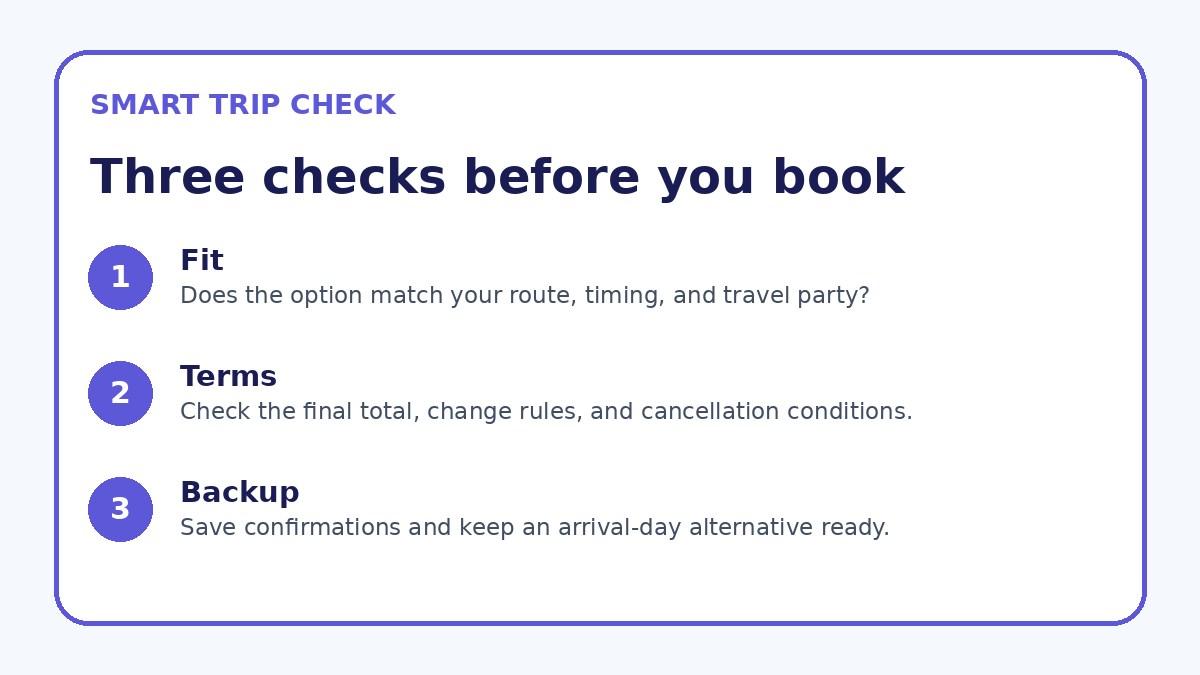
Fare classes, add-ons, and what to verify before payment
When you’ve narrowed choices, examine fare class baggage inclusions for each option and identify the exact add-on you would purchase. Some fares include one checked bag and only a small cabin item; others require buying baggage allowance separately at booking or at the gate. Check the carrier’s final booking page for the precise terms: permitted weight per piece, linear dimensions, how many pieces are allowed, and whether fees change if paid later at the airport. Also confirm whether the fare permits online check-in and seat selection—both can simplify boarding when you have large carry-ons or need a bulkhead seat for extra space.
Don’t forget ancillary rules that affect luggage handling: excess weight charges, per-piece versus per-kilogram pricing, and whether the airline allows combining allowances across passengers on the same reservation. For example, some carriers let you pool checked-bag allowances; others do not. If you plan to travel with a companion, compare booking separately versus on one reservation. Always print or save the baggage allowance screenshots or PDFs shown at checkout so you have the exact terms while traveling, and consider checking Trip.com or the carrier’s site to confirm current availability and conditions before final payment.
Before you book
- List each bag with precise weight and linear dimensions (L+W+H) and note any oversized or fragile items.
- Compare baggage allowances and fees for every flight option at the carrier’s final booking page before purchase.
- Decide whether a direct flight is worth any premium to avoid re-checking or transferring luggage.
- Confirm the minimum connection time and whether checked bags transfer automatically on connecting itineraries.
- Plan ground transfer logistics in Paris and Rome for large suitcases—check elevator access, trolleys, and vehicle trunk space.
- Save screenshots or PDFs of the baggage allowance, paid add-ons, and any confirmation showing the purchased baggage options.
Airport logistics in Paris and Rome with larger bags
Pick airports and arrival/departure terminals with practical luggage infrastructure. In Paris there are multiple airports and terminals with different transfer options; Rome likewise has choices for arrivals. Before booking, list your likely arrival and departure terminals and check whether they offer elevators, escalators with luggage lanes, baggage trolleys, and convenient ground transport with luggage space. If you’ll use public transit, research whether trains and metro lines between the airport and city center allow large suitcases—some connections require stairs or long walks which are harder with heavy bags.
Also plan last-mile logistics: does your hotel or rental accept early luggage drop? Will you need a taxi or a private transfer that can hold oversized trunks? If you plan rail connections beyond Rome, verify station layout and luggage handling rules. For any transfer company or train provider you consider, look for explicit baggage dimensions and luggage carriage policies on the provider’s booking page. Practical choices made before booking—like choosing an airport with a straightforward shuttle or a hotel with porter service—often save far more hassle than a small fare saving.
Frequently asked questions
Is it cheaper to pay for extra baggage at booking or at the airport?
Policies vary by carrier, but paying for baggage during booking is often cheaper or at least more predictable than paying at the airport. Some airlines increase fees for baggage purchased at check-in or at the gate, and low-cost carriers can be strict about enforcing size and weight. Always check the carrier’s final booking page for exact prepayment discounts and whether the fee changes with time. If cost is sensitive, compare the fee shown at checkout with the carrier’s airport fee notes and factor booking convenience into your decision.
Can I combine baggage allowances across passengers on the same reservation?
Combining allowances depends on the airline’s rules and the fare type. Some carriers allow pooling or transferring allowances within one reservation, but many do not—each passenger’s checked bag limit is treated separately. If you plan to share allowances, verify the policy on the carrier’s booking page or contact the airline directly. When pooling is not permitted, consider buying an extra checked bag on one passenger’s record only if the airline allows it and if the total checked pieces meet your needs without overweight charges.
How much connection time should I allow when traveling with bulky luggage?
Allow more buffer than a typical passenger: if the itinerary requires re-checking bags or changing terminals, plan at least 90–120 minutes between flights to account for baggage retrieval, security, and transit between gates. For simple transfers where checked bags are through-checked by the carrier, 60–90 minutes may suffice depending on airport layout. Always check the minimum connection times published by the airline and factor in time for immigration, customs, or shuttle transfers—these operational details are best confirmed on the carrier’s or airport’s official pages before booking.
Final planning note
Booking Paris to Rome flights when you have extra luggage is primarily an exercise in comparison and verification. Start with an accurate inventory of your bags and then compare how each itinerary treats checked and carry-on items, including precise size, weight, and per-piece rules shown at checkout. Favor direct flights when avoiding baggage handling is most important, but don’t ignore cost and schedule tradeoffs—sometimes a carefully chosen connection with longer layover time is acceptable. Before you finalize the purchase, confirm transfer rules, terminal logistics, and any add-ons on the carrier’s final booking page. If you want a quick availability check, Trip.com can show current options, but always depend on the airline’s official terms for baggage details.
Continue planning
Check current options and final conditions
Use the provider page to confirm live availability, the final total, cancellation terms, and every condition that matters to your trip.
This evergreen planning guide was created with AI-assisted drafting and a structured quality review. It does not display live prices, schedules, availability, visa guidance, or provider rankings. Verify current details before booking. Some links are affiliate links; we may earn a commission at no additional cost to you.