
If you’re planning New York City to Toronto flights with kids, start by deciding whether a direct flight or a connecting itinerary best fits your family’s priorities. Direct flights reduce time spent in transit, lower the number of takeoffs and landings, and simplify logistics with young children or heavy carry-on gear. Connecting itineraries can open up more schedules, airport choices, and sometimes lower fares or better seat availability—but they add complexity: additional security lines, possible gate changes, and the chance of a missed connection. Before you book, think about total door-to-door time, the ages and needs of your kids, and how tolerant your family is of unknown delays. Below you’ll find concrete trade-offs, decision criteria, and a checklist to run through before confirming any reservation.
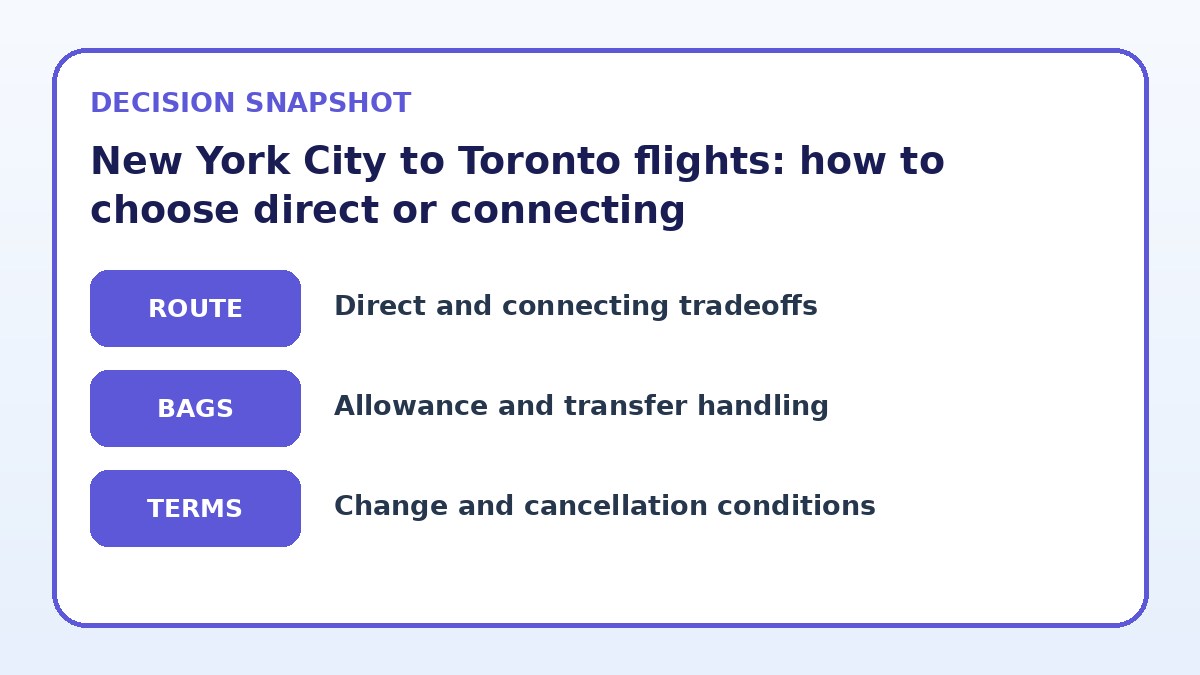
See current options before you compare the details
Availability and final conditions change. Open Trip.com now or keep reading for the practical comparison.
Why direct flights matter for family travel
Families frequently choose direct flights because fewer segments mean fewer opportunities for things to go wrong. With infants or small children, the reduced complexity of a single takeoff and landing, no mid-journey re-clearing of security, and fewer gate changes simplifies feeding, napping, and bathroom routines. Direct service also makes it easier to bring a stroller and other essential gear through one set of security checks and claim checked bags only once on arrival. If one parent is traveling alone with children or if someone has mobility needs, the predictability of a direct trip is often decisive.
That said, a direct flight’s convenience must be balanced against schedule and cost. Direct options may depart at less convenient times from either New York or Toronto airports, or they may be more expensive during peak family travel windows. For multi-stop households who value evening flexibility or need to match school schedules, a slightly longer but same-day connecting itinerary might be workable. Always compare the total hassle—including airport transfer time and waiting—rather than focusing solely on airborne minutes.
When a connecting itinerary can make sense
Connecting itineraries unlock more departure times, airport pairings, and sometimes more favorable seating or fare classes for families traveling with multiple children. If your preferred direct flight is fully booked for family seating together, a connection that lets you book seats in a single row may be superior. Connections can also help when you want to fly from a different New York-area airport (for example, using a carrier with a hub that doesn’t serve the nonstop route) or when carrier loyalty benefits or award availability make a routed ticket more attractive.
However, choosing a connection means planning for an extra airport stop: you’ll need to budget for transfer time, the possibility of secondary security screening, and the logistics of managing carry-on baggage and kids in a busy terminal. Aim for realistic minimum connection times (what the airline lists as minimums are different from what feels safe with children). When selecting a connecting option, prefer longer layovers that allow time for bathroom breaks, snacks, and a buffer against delays—especially if your family includes very young children or if you’re traveling with bulky equipment.
| Approach | Best for | Tradeoff to check |
|---|---|---|
| Direct flight | Families prioritizing simplicity, fewer transitions, and shorter total travel time. | Often fewer schedule options and potentially higher fares or limited seat availability. |
| Short single connection | Families wanting more schedule flexibility without too much added complexity. | Requires confident timing and can feel rushed if delays occur or with young children. |
| Longer connection with airport break | Families needing time to feed, nap, or change children between flights. | Increases total journey time and may require extra transit or waiting comforts. |
| Separate tickets/low-cost carriers | Price-sensitive families able to manage baggage and recheck logistics independently. | No protected connection; missed legs likely mean extra expense and stress. |
Ready to check the option that fits your plan?
Use your exact dates and traveler details so the provider page can show the current total and conditions.
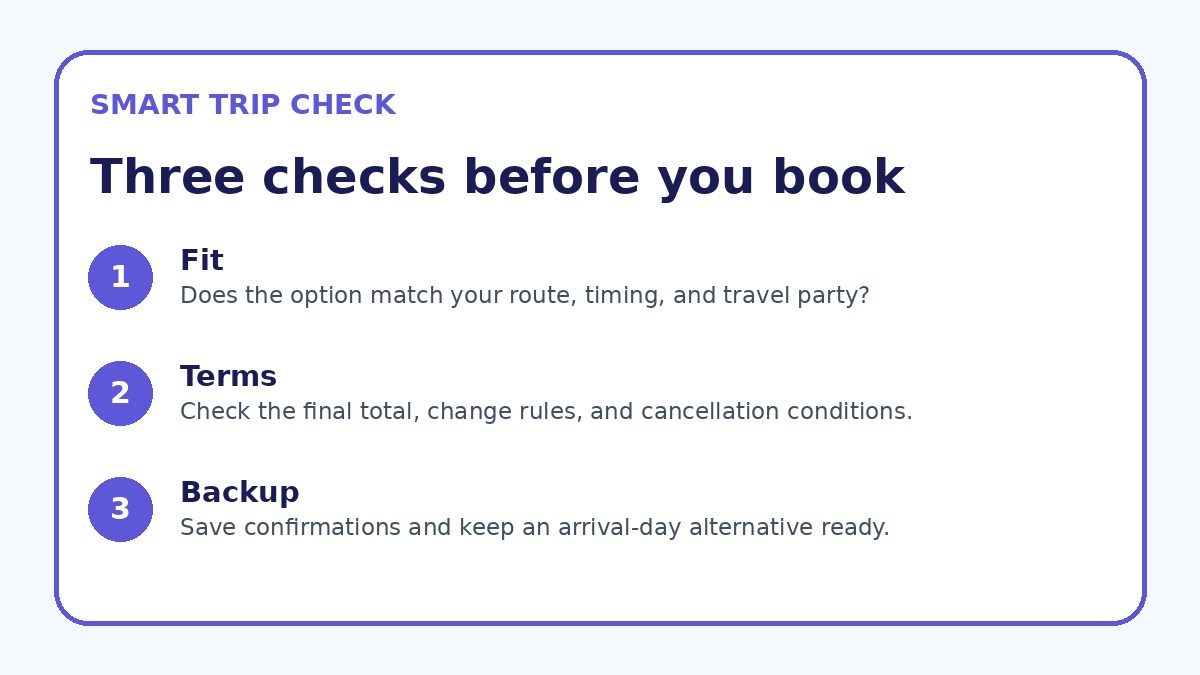
Practical comparison criteria to use before booking
Treat comparison like a decision checklist: total door-to-door travel time, number of takeoffs/landings, number and length of connections, airport transfer time at each end, and crew/service reliability you’ve experienced before. Also consider the ages of the kids—infants under two, toddlers who require naps, or school-age kids with specific routines change the value you place on speed versus price. Look at seat maps and the ability to reserve adjacent seats; a cheap ticket that leaves seats scattered across the cabin is usually worse for families than a slightly higher-fare direct option that lets you sit together.
Don’t forget ground logistics: which New York airport is easiest from your home, and which Toronto airport is most convenient to your destination? Ground time and taxi or transit complexity can erase the airborne time advantage of a direct flight. Check airline family services such as early boarding, bassinets (if applicable), and whether checked strollers are handled gate-to-gate or require curbside check-in. When in doubt, call the carrier to confirm family-specific services that the online booking page may not detail fully.
Before you book
- Compare total door-to-door time (including airport transfers) for each itinerary before selecting a flight.
- Verify seat assignments on the carrier’s final booking page to ensure your family sits together.
- Confirm baggage allowances and stroller/car-seat handling rules for every segment on the airline website.
- Allow a realistic minimum connection buffer—prefer longer layovers with small children or tight transfers.
- Check the airline’s change and cancellation policy for your exact fare class in case plans shift.
- Look up family amenities at departure and arrival airports, like nursing rooms, family lanes, or play areas.
How to shop and what to verify on booking
Start by searching for itineraries that show total travel time and number of stops; filter for family-friendly options like exit-row restrictions and seat assignment availability. Use tools that allow you to view seat maps before purchase and to compare itineraries side-by-side—Trip.com can be used as one place to compare current availability and conditions, but always confirm critical details on the airline’s booking page. On the carrier’s final page, verify baggage allowances for each segment, whether seats are guaranteed together, and what happens to strollers and car seats at each transfer point.
Before you click purchase, confirm cancellation, change, and rebooking policies for the exact fare class you’re buying—these rules vary even on the same flight number depending on fare bucket. Check minimum connection times and whether a single reservation protects you in case of missed connections; if you book separate tickets, you may have no airline protection. Finally, note the airports’ family amenities: nursing rooms, family security lanes, and play areas can make connections far less stressful, so factor these into your layover planning.
Frequently asked questions
How much extra layover time should I plan when traveling with toddlers?
Plan more than the airline’s minimum connection time when you have toddlers—aim for at least 90–120 minutes for a single connection in a major U.S. airport if you need to re-clear security or handle stroller check-in. This buffer allows time for diaper or snack breaks, a quick walk to relieve restless kids, and a margin for minor delays. If you’re connecting through a smaller hub where gates are close and no re-clearing is needed, a shorter layover can work—but still factor in the children’s pace rather than the bare minimum.
Is it better to fly from JFK, LaGuardia, or Newark for Toronto trips with family?
Choose the airport that minimizes overall hassle for your household: consider travel time from home, parking or transit options, and the airport experience with children. One airport might offer more direct flights while another has better ground access or family facilities, which can influence whether a direct or connecting itinerary is preferable. Compare both airborne options and ground transfer times; find which combination yields the shortest realistic door-to-door journey, not just the fastest flight time.
What should I do if my connecting flight is delayed and I’m traveling with young children?
If a connection is delayed, first check whether you’re on a single reservation; airlines will typically rebook you on their next available flight. Contact airline agents at the desk or via the carrier’s app for rebooking and ask about family priority if you have young children. If you booked separate tickets, you may be responsible for rebooking and additional costs—keep emergency funds and a flexible plan. Meanwhile, use the delay time to find a quieter gate area, secure snacks and water, and keep children comfortable with familiar routines and activities.
Final planning note
For families traveling from New York City to Toronto, the right choice between direct and connecting flights depends on how you balance simplicity, time, cost, and the ages of your children. Direct flights reduce transitions and unpredictability, which often matters most with infants and toddlers. Connecting itineraries can provide schedule flexibility, more seat options, or lower fares, but they require realistic layover buffers and careful attention to baggage and recheck rules. Use the practical checklist above, verify seat, baggage and change policies on the airline’s booking page, and factor in airport transfer times to make the best choice for your household.
Continue planning
Check current options and final conditions
Use the provider page to confirm live availability, the final total, cancellation terms, and every condition that matters to your trip.
This evergreen planning guide was created with AI-assisted drafting and a structured quality review. It does not display live prices, schedules, availability, visa guidance, or provider rankings. Verify current details before booking. Some links are affiliate links; we may earn a commission at no additional cost to you.