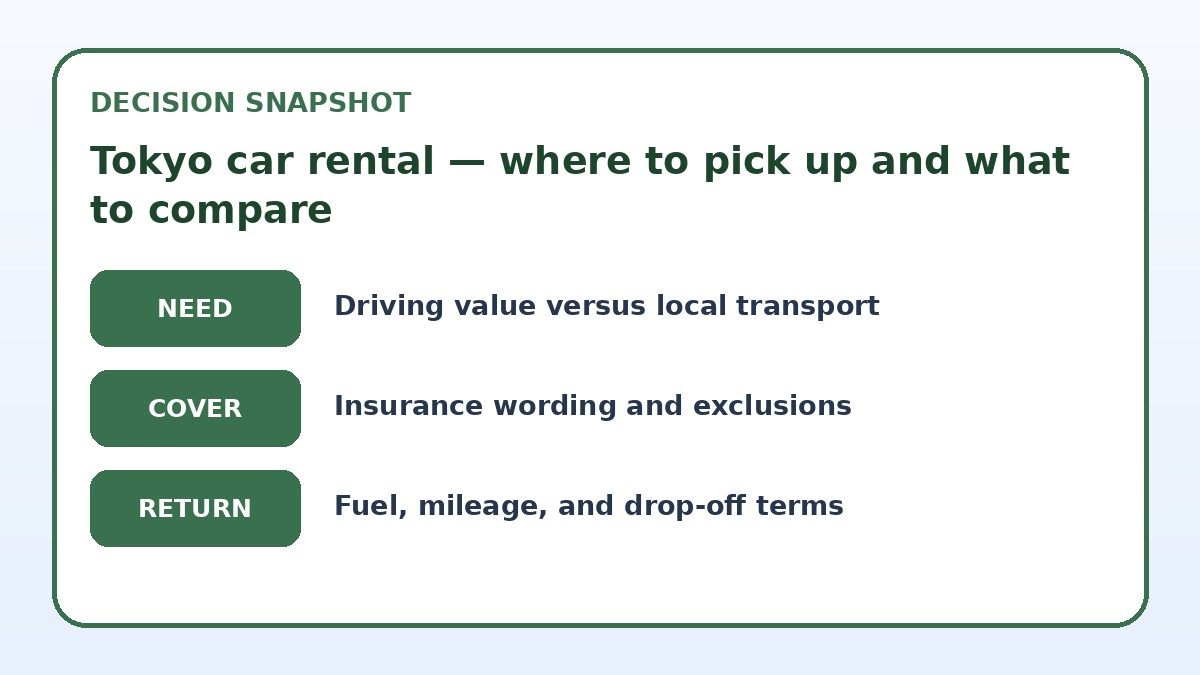
For most first-time visitors to Tokyo, driving rarely transforms the core city itinerary — Tokyo's trains, subways and walkable neighborhoods usually deliver faster, cheaper, and less stressful travel than a rental car. Choose a rental only if your plans include day trips that public transit would make long or inflexible: coastal drives, Hakone, Nikko, the Izu Peninsula, or a multi-stop route outside metropolitan Tokyo. If you do decide a car adds value, your next practical choice is where to pick it up: at the airport (Narita or Haneda) or at a city location (near major stations or your hotel). Airport pickup can be convenient for immediate departures and long rural legs; city pickup tends to reduce urban driving and parking time but may add train or taxi transfers. Below I give the short answer, the tradeoffs to weigh, what insurance words to check, pickup/return friction, and an organized non-driving fallback.
Decide whether driving truly improves your Tokyo trip
Start by mapping your must-see places and the realistic travel time between them. If all must-sees sit inside Greater Tokyo — museums, shrines, shopping districts, and neighborhoods — the city's rail network is usually faster and more convenient than driving. Factor in time looking for parking, queueing for toll booths, and weekday congestion that can add significant minutes to short distances. Conversely, if your plan includes extended day trips beyond the commuter network, a car can turn complicated multi-leg train-and-bus combinations into a single flexible route, especially where rural transit is sparse.
Consider the type of experience you want: do you value the freedom of spontaneous stops and scenic detours, or do you prefer the efficiency of trains and avoiding the stress of unfamiliar driving rules and narrow streets? Also weigh passengers and luggage: families with young children or heavy gear sometimes find a rental more practical than juggling station transfers. Make the decision on route value first — only then compare pickup points and the extra costs and frictions each choice brings.
Decide whether driving earns its place
| Mobility strategy | Best for | Cost or friction to check |
|---|---|---|
| Airport pickup (Narita/Haneda) | Trips that start or end with long drives outside Tokyo or routes with early departures. | Saves inner-city driving but can add queue and shuttle time; verify desk hours and toll/ETC arrangements. |
| City pickup (station or hotel area) | Stays centered in Tokyo with a short rental window for a day trip or two. | Reduces urban driving and airport transfers but watch for limited fleet, shorter hours, and central parking costs. |
| Public transit plus day rentals or car-share | Hybrid plans where most travel is by rail but occasional driving is needed nearby. | High flexibility and less insurance complexity, but may have availability limits and require advance booking for specific days. |
| No-rental alternative (rail, highway buses, taxis) | Visitors focused on Tokyo and short regional trips who prefer low stress and predictable costs. | Less scenic control and flexibility for remote rural routes; may be slower or require more transfers than a car. |
Check live rental choices only after the route test
Use the exact driver, dates, pickup point, and return plan to compare current conditions.
Insurance wording to verify before you book
Insurance descriptions can sound similar while covering very different risks. On the booking page, look for the exact terms: third-party liability limits (confirm the currency and cap), whether a collision damage waiver (CDW) or loss/damage coverage is included or optional, the amount of the excess (deductible) and whether an additional zero-excess option exists. Also confirm whether roadside assistance and theft protection are included, and whether they apply to rental use across prefectures. If a rental agreement mentions 'limited use' locations or vehicle restrictions, clarify those before signing.
Ask specifically about cross-prefecture travel, expressway toll liability, and any exclusions for unpaved roads or mountain routes—these can appear in fine print. If your booking channel offers insurance add-ons, compare the exact contract language on the provider’s final booking page. Keep a digital and printed copy of the insurance summary and the rental agreement contact details in the car; these are the documents you will need if you must make a claim or require roadside assistance.
Compare the full rental conditions
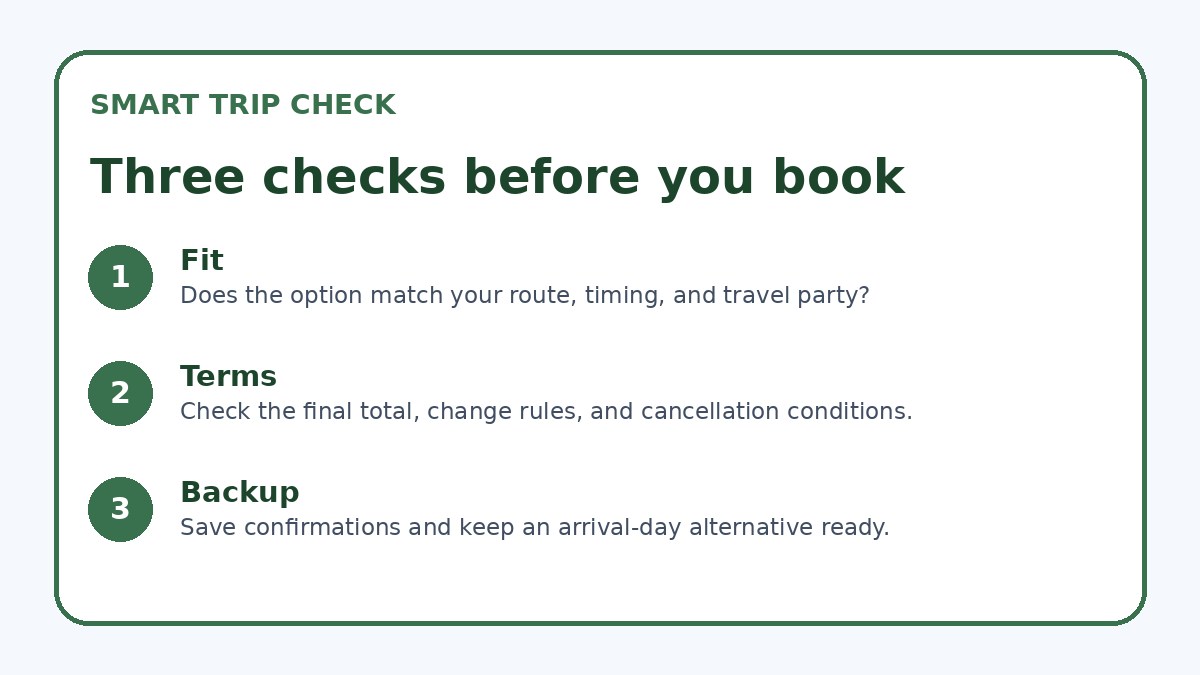
Confirm insurance wording, exclusions, deposit, fuel, mileage, and return terms on the final page.
Pickup and return friction: airport versus city
Airport pickup: Pros include immediate access to highways, consolidated rental desks, and clear signage for departures from Narita or Haneda. But airports can be busy, and queues or shuttle transfers to off-site lots can add time. When returning at an airport, you must plan for fuel policies, vehicle inspection times, and shuttle waits; missing a scheduled flight because you underestimated return procedures is an avoidable risk. Check whether the airport desk closes overnight and whether late returns incur fees. Verify where toll cards and ETC (electronic toll collection) devices are provided and how they are billed.
City pickup: Picking up in Tokyo often places you closer to your hotel, avoids inner-city driving and airport shuttles, and can simplify immediate exploration. City locations, however, might be smaller with limited vehicle availability and more constrained operating hours. Returning in the city can save time if you plan to continue using trains, but central parking fees and one-way drop-off surcharges (if returning elsewhere) can offset those gains. Confirm exact pickup address, opening hours, what documentation is required at the desk, and any one-way return fees on the booking page.
Car rental terms to verify
- Map your route and mark segments where public transit would be slow or infrequent to justify renting a car.
- On the provider’s final booking page, confirm liability limits, collision damage waiver wording, excess amounts, and roadside assistance coverage.
- Check pickup and return hours, exact desk address, shuttle requirements, and late-return penalties for both airport and city locations.
- Estimate tolls, expressway passes, parking fees, and whether ETC devices are provided and how charges are billed.
- Decide on a one-way drop-off plan and verify any additional fees or restrictions for returning the vehicle in a different location.
- Have a non-driving fallback: note train timetables, bus options, and a taxi service contact for any day you choose not to drive.
Non-driving fallback and alternative mobility strategies
Always plan a realistic fallback before booking a rental. If trains cover your main itinerary, keep local rail passes, an IC transit card (Suica/Pasmo), and a list of highway bus services handy. Long-distance buses and regional train lines frequently serve day-trip routes at lower cost than fuel and tolls. For point-to-point convenience, reserve a taxi or a private transfer for the start or end of a rural day trip if schedules don’t align with public transit.
If you want limited car time without full rental responsibilities, consider hourly car-share services or short-term leases near major stations — these let you avoid long pickup queues and insurance complexity while still allowing brief drives. When comparing options, include the time to reach rental locations, parking and toll costs, insurance coverage levels, and the friction of returning a car under tight schedules. Keep Trip.com in mind as a place to compare current availability, but always verify provider terms directly on their final booking page.
Car Rental & Road Trip questions travelers ask
Will renting a car in Tokyo save me time compared with trains?
It depends on your route. Within central Tokyo, trains and subways are almost always faster because they bypass traffic and stop near major sites. A car can save time for multi-stop excursions to distant sights where regional rail is infrequent or requires multiple transfers—examples include remote coastal or mountain areas. When deciding, compare door-to-door travel time including parking and tolls versus scheduled rail times. If tight timing matters, plan both options and prioritize the one with the more reliable arrival window.
What should I look for in rental insurance language?
Look for explicit terms: third-party liability caps, whether collision damage waiver (CDW) reduces or eliminates your deductible, and precise excess amounts. Confirm if theft protection and roadside assistance are included, and whether the policy allows travel across prefectures and on expressways. Avoid vague wording; if the booking page references 'full coverage' or similar, open the provider’s detailed policy or contact customer support for the contract language. Keep proof of cover and emergency contact numbers accessible during your rental.
Are there common pickup/return pitfalls I can avoid?
Yes. Common issues include underestimating desk queues at airports, not allowing time for off-site shuttle transfers, assuming 24/7 desk hours, and overlooking fuel or cleaning return requirements. For city pickups, small lots can have limited availability or strict opening times. Always confirm where the vehicle will be inspected on return, how minor damage claims are handled, and whether you need a printed inspection form. Arrive with the required documents, plan buffer time before flights or train departures, and photograph any pre-existing damage at pickup.
Final decision note
If your itinerary stays inside central Tokyo, skip the rental: trains, subways and short taxis give speed and predictability. Choose a rental only when your priority is flexible access to outlying scenic routes or when multiple rural stops make public transit impractical. If you decide to rent, select airport pickup for straightforward highway exits and early departures, or city pickup to avoid initial urban driving and airport queues. Before booking, verify insurance contract language, pickup/return hours and addresses, toll and ETC arrangements, and any one-way fees on the provider’s final booking page. Always keep a non-driving fallback planned so unexpected traffic, weather, or timing changes won’t derail your trip.
Continue planning
Check current options and final conditions
Use the provider page to confirm live availability, the final total, cancellation terms, and every condition that matters to your trip.
This evergreen planning guide was created with AI-assisted drafting and a structured quality review. It does not display live prices, schedules, availability, visa guidance, or provider rankings. Verify current details before booking. Some links are affiliate links; we may earn a commission at no additional cost to you.