If you’re a solo traveler planning Seoul to Osaka flights, the practical choice is to prioritize fare flexibility that matches how likely your plans are to shift. Start by picking the fare class and ticket channel that let you change or cancel with the least hassle for your situation — whether that means a higher refundable fare, a flexible nonrefundable fare with low change fees, or a cheaper ticket you accept as fixed. Once you spot options, stop and verify the exact change and cancellation wording on the final booking page: look for fees, time windows, whether refunds are credit or cash, and how rebooking price differences are handled. For international routes like Seoul–Osaka, also confirm which airports and connections a fare covers. This article explains the tradeoffs, shows how to compare direct versus connecting options, and gives a practical checklist so you leave with confidence rather than surprises.
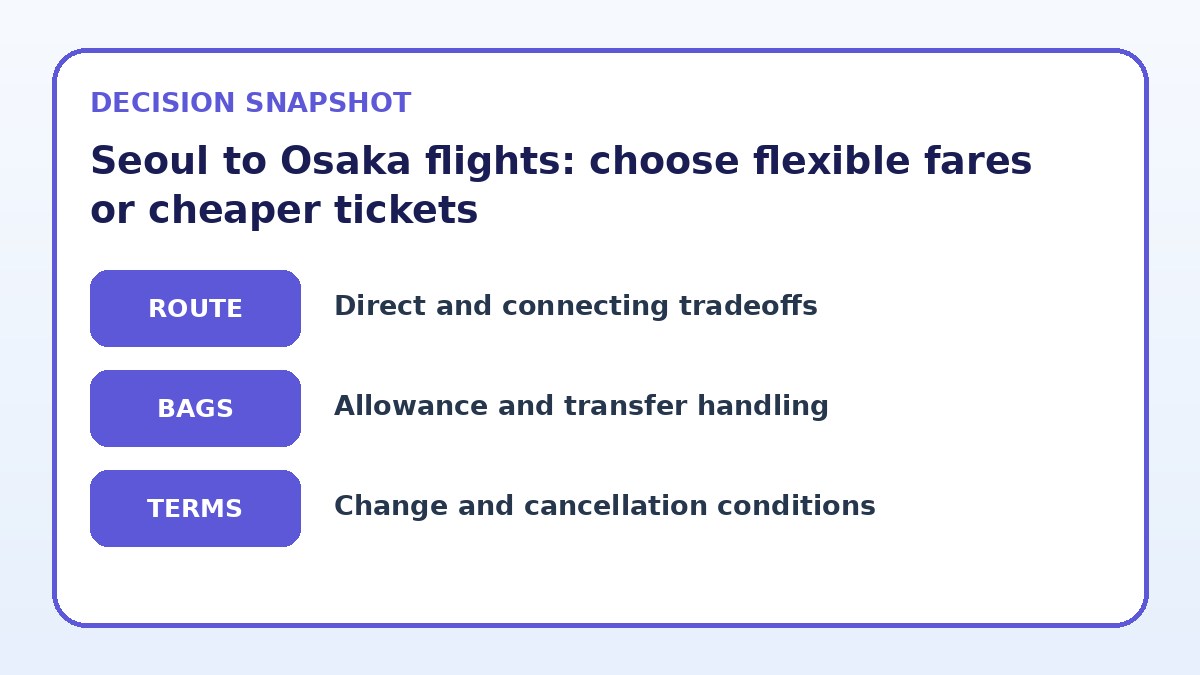
See current options before you compare the details
Availability and final conditions change. Open Trip.com now or keep reading for the practical comparison.
Understand core fare types and what flexibility really means
Airlines typically sell multiple fare families: basic or economy light, standard economy, and more flexible economy or refundable fares. For solo travelers, the practical differences are not just the headline price but the contract terms: whether changes are allowed, whether cancellations get a cash refund or credit, and which parts of the itinerary (segments, baggage, seat) trigger extra fees. Read the fine print for phrases like "nonrefundable," "credit only," and "change fee applies". Those short labels hide distinctions: some nonrefundable fares will allow changes for a fee but no cash refund; others permit same-day changes at a lower cost.
When comparing fares, put the total expected cost of a potential change into your head, not just the one-way ticket price. Add a hypothetical scenario—delaying your return by a week—and see how much the airline would charge: the change fee plus current fare difference. Also note whether taxes and government fees are refundable separately. Always check the provider's final booking page and the ticketing rules PDF when available, because those official documents contain the precise policy that governs your purchase.
Compare direct and connecting options with flexibility in mind
Some Seoul to Osaka itineraries are direct while others route via a connector. Direct flights reduce complexity when changing dates: you usually adjust one segment and pay the airline’s fare change terms for that single flight. Connecting itineraries can be attractive if cheaper, but they multiply the number of ticketed segments and potentially complicate refunds and schedule-change rules. For codeshares or multi-carrier itineraries, different segments might be operated by different airlines with different change policies—verify which carrier issues and is responsible for the ticket.
When a connection is offered, ask how changes are handled across carriers: will the operating carrier allow changes without penalty or will the marketing carrier control the rules? If you value flexibility, prefer a single-carrier ticket or an alliance fare that explicitly offers unified change and cancellation terms. If you see a lower-priced connecting option from an online marketplace, check the ticketing carrier and read its policy on the booking page. Trip.com can be used as a place to compare current availability and conditions, but always confirm the official airline ticketing rules before purchase.
| Approach | Best for | Tradeoff to check |
|---|---|---|
| Cheapest nonrefundable fare | Sole travelers with fixed, certain plans | Lowest upfront cost but little or no cash refund and higher rebooking risk |
| Standard refundable or flexible fare | Travelers wanting cash refunds or easy cancellations | Higher ticket price but predictable refunds and low change hassle |
| Low-cost fare plus travel insurance | Budget-conscious travelers who accept a claims process | Lower fare with potential insurance claim delays and covered reasons only |
| Higher-cost flexible fare with free changes | Solo travelers who may change plans frequently | Pay more up front to avoid significant rebooking fees later |
Ready to check the option that fits your plan?
Use your exact dates and traveler details so the provider page can show the current total and conditions.
How to interpret fees, refunds, and vouchers when traveling alone
Change fees are only part of the financial story. When you cancel, some tickets return money to your original payment method, some issue an airline credit or voucher, and others are nonrefundable entirely. If a refund is issued as credit, check its validity period and whether it covers the full amount or only the base fare. For solo travelers who value liquidity and unpredictability, accepting a slightly more expensive refundable ticket may be worth the cost compared with a cheap nonrefundable ticket that yields only airline credit.
Also check administrative details: who pays the refund processing fee, whether third-party taxes are refundable, and what documentation you must submit. If you booked through a travel agent or marketplace, the intermediary may have separate cancellation terms and service fees. Before clicking purchase, look for explicit language on the final booking page about how refunds are processed, whether the airline or the seller makes the reimbursement, and any deadlines to file a refund request after cancellation.
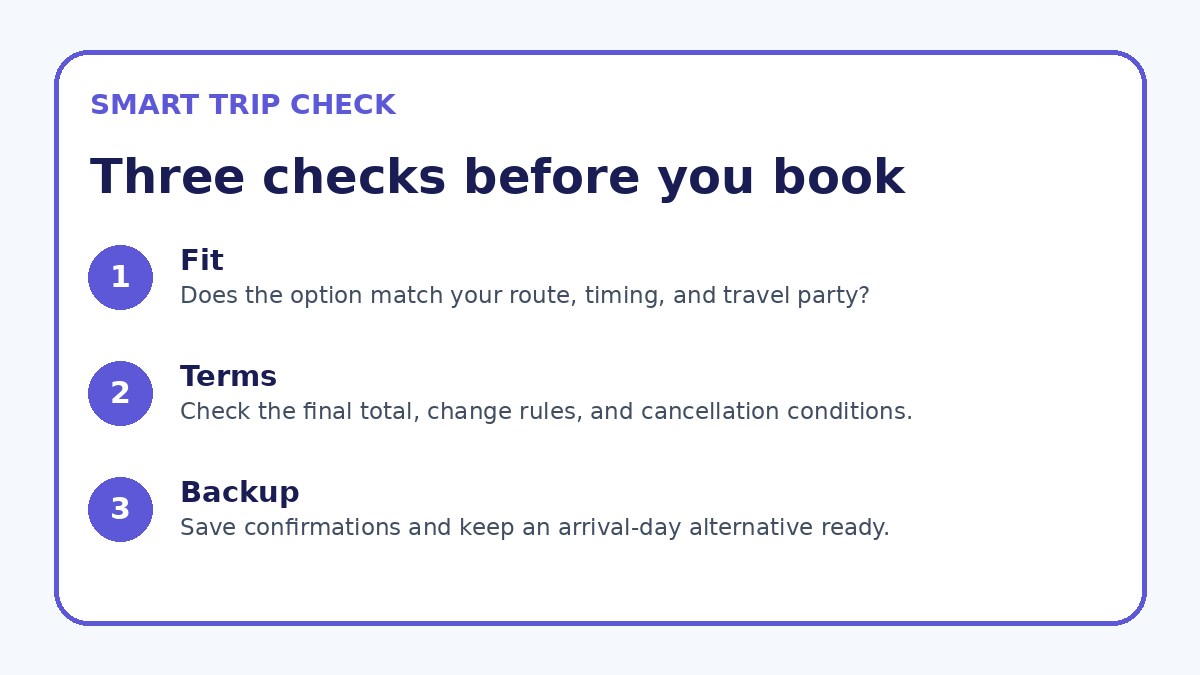
Before you book
- On the airline’s final booking page, open the detailed ticket rules or fare conditions PDF and read change and cancellation sections.
- Confirm whether changes within 24 hours of booking are free and whether that policy applies to your purchase channel.
- Check how refunds are issued (credit card refund, airline credit, or voucher), and note any expiry dates for credits.
- Identify the ticketing carrier and verify whether connecting or codeshare segments are governed by a different airline.
- Calculate a worst-case change: current change fee plus the current fare difference for likely alternative dates.
- If booking through a third party, read their cancellation policy and check whether they add service fees to refunds.
Practical decision criteria: what to prioritize for your solo trip
Decide what level of flexibility matches your risk tolerance. If your plan is firm—fixed dates, no likely changes—lower-cost, less flexible fares can make sense. If your trip is uncertain, pick a refund-friendly or low-change-fee option. Consider non-ticket flexibility too: can you change hotels or trains without penalty? If you expect a high chance of flight changes, price the worst-case change scenario: fee plus fare difference. That number tells you whether the upgrade to a flexible fare is a rational purchase.
Also account for travel day risks: early-morning flights often have fewer same-day change options; late cancellations or missed connections can be treated differently depending on whether you bought protection (like refundable fares or travel insurance). If you want peace of mind, choose a fare that explicitly allows free or low-cost changes within a defined window, and verify those terms on the airline’s final booking summary and ticket rules before you pay.
Frequently asked questions
Can I change my Seoul to Osaka flight without losing the ticket value?
Possibly, but it depends on the fare class. Some fares allow changes for a fee plus any fare difference; others are nonrefundable and only offer airline credit. If you want to preserve ticket value, choose a fare labeled refundable or explicitly offering free or low-cost changes. Always confirm the exact wording on the final booking page, and check whether the policy is applied by the airline or the seller if you booked through an agent or marketplace.
If my connecting flight is delayed, how do change and cancellation rules apply?
If your itinerary is issued on a single ticket, the operating carrier usually has responsibility for rebooking and may offer protections. For separate tickets, each segment’s rules apply independently, which can leave you exposed. Verify at booking whether you have a single ticket for all segments and check the airline’s missed-connection or schedule-change policy on the booking page. If protection matters, prefer a single-carrier ticket or a documented protection policy rather than separate low-cost legs.
Should I buy travel insurance or a flexible fare for my Seoul–Osaka trip?
It depends on what risks you need covered. Flexible fares simplify changes and refunds directly through the airline, while travel insurance can reimburse nonrefundable costs for covered reasons like illness or certain travel interruptions. Compare the flexible-fare premium to the insurance cost and read the insurance policy exclusions carefully. If your main concern is last-minute airline changes, a flexible fare is often the simpler route; for broader risk coverage, consider insurance combined with the best available fare you can afford.
Final planning note
For solo travelers on Seoul to Osaka flights, the best practical step is to match fare flexibility to how likely your plans are to change. Read the full fare conditions on the final booking page before you pay: verify change fees, whether refunds are cash or credit, the ticketing carrier, and any time windows for free changes. Balance the upfront cost of flexible fares against the potential rebooking expenses you might face. Use the checklist to verify critical items, and compare direct versus connecting options with an eye toward single-ticket coverage. If you want a quick place to compare options, Trip.com can show current availability, but always confirm the airline’s official ticket rules before completing your booking.
Continue planning
Check current options and final conditions
Use the provider page to confirm live availability, the final total, cancellation terms, and every condition that matters to your trip.
This evergreen planning guide was created with AI-assisted drafting and a structured quality review. It does not display live prices, schedules, availability, visa guidance, or provider rankings. Verify current details before booking. Some links are affiliate links; we may earn a commission at no additional cost to you.