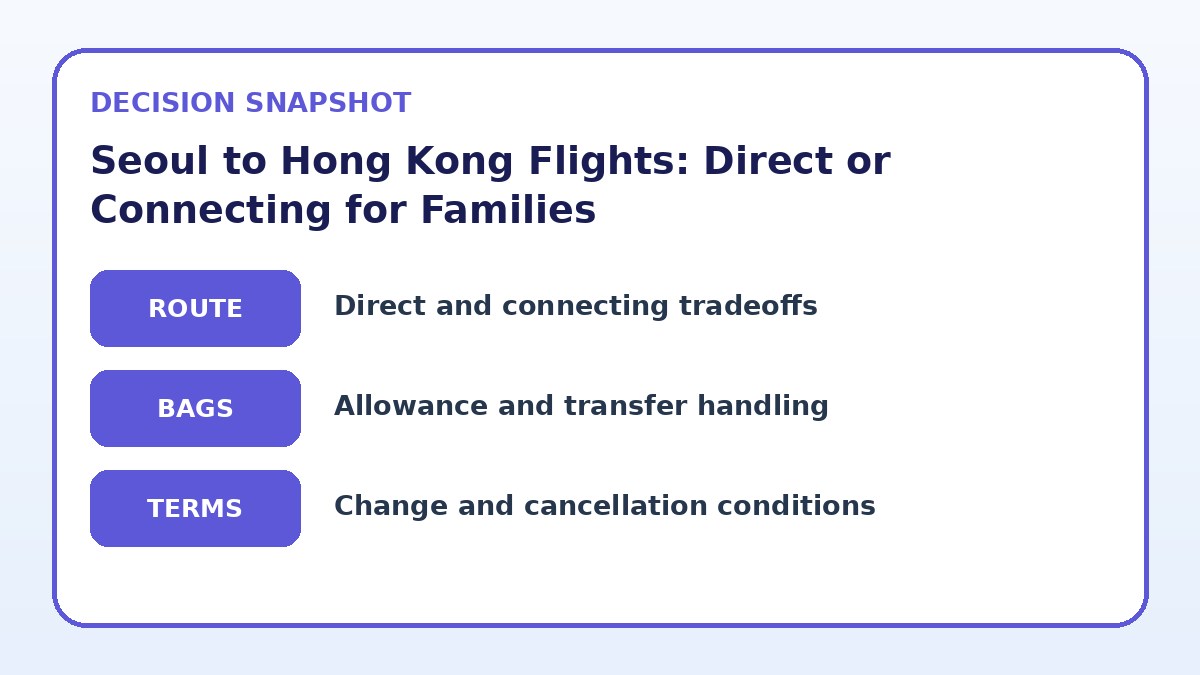
Quick answer: for most families traveling between Seoul and Hong Kong, a nonstop flight wins when you value shorter door-to-door time and simpler logistics; a connecting itinerary can make sense if it significantly lowers flight time windows, improves overnight scheduling for young children, or opens better seat and infant policies. Decide by comparing total travel time, number and length of connections, layover airports’ child-friendly facilities, and the seats and fares available for your family size. Before you book, check baggage allowances, infant and child seating rules, change and cancellation policies, and whether seats together are guaranteed on the final carrier. Use the carrier’s booking page to confirm final rules, and consider Trip.com as one place to compare current availability and connection options before committing.
See current options before you compare the details
Availability and final conditions change. Open Trip.com now or keep reading for the practical comparison.
When nonstop is the better family choice
Nonstop flights between Seoul and Hong Kong tend to be the simplest option for families. With a single boarding, you only manage one round of security, one carry-on organization, and one potential connection for checked luggage. That simplicity matters most when you’re traveling with toddlers who need predictable routines, parents managing infant feeding or naps, or when you want to reduce the chance a missed connection wrecks the whole itinerary. The shorter door-to-door time also reduces the total amount of time children must be confined to seats and waiting areas, which often leads to fewer meltdowns and keeps energy higher for arrival activities.
Choosing a nonstop also helps with logistics like seat assignments and special requests. When every segment is with the same operator the airline’s rules for bassinets, child meals, and seat assignments are clearer and easier to confirm. If you’re using loyalty benefits or need to add special assistance like wheelchair service, dealing with one carrier simplifies communication. Always verify on the carrier’s final booking page whether seats together are guaranteed, what the infant policies are, and how checked baggage is handled for children — those specifics often change and affect comfort more than flight duration.
When connecting flights can work better for families
Connecting itineraries can be appealing when nonstop schedules don’t fit your family’s needs or when connections open otherwise unavailable time slots. A carefully chosen daytime connection can split a long travel day into manageable chunks, allowing younger children to nap between flights or giving parents a chance to stretch in an airport play area. Connecting options may also offer departure or arrival times that align better with hotel check-in or a child’s sleep schedule, which can make the first day in Hong Kong much smoother.
However, connections add complexity. Transfers increase the number of security checks, potential for delays, and the chance a bag doesn’t make the same flight as you. If you consider a connection, pick transfer airports known for family facilities — play areas, family restrooms, and relatively short minimum connection times. Confirm layover duration on the carrier’s booking page, check whether you must recheck luggage and clear immigration in the connecting city, and allow extra buffer for unexpected delays; these are the practical tradeoffs families should weigh against any schedule or pricing advantages.
| Approach | Best for | Tradeoff to check |
|---|---|---|
| Direct nonstop flight | Families prioritizing short door-to-door time and minimal transit stress | Fewer schedule choices and sometimes higher fares or limited seat availability |
| Single daytime connection with family-friendly airport | Families needing flexible timing or better seat options while keeping manageable transfer stress | Longer total travel time and risk of delay affecting onward segments |
| Overnight connection to split long travel day | Families looking to align travel with children’s sleep schedules or to avoid very early departures | More complex logistics and potential need for day rooms or airport naps during layover |
| Mixed-carrier itinerary to access better seating or policies | Families seeking specific infant or baggage rules not offered by a single carrier | Higher risk of mismatched policies, separate check-ins, and reissued tickets during irregular operations |
Ready to check the option that fits your plan?
Use your exact dates and traveler details so the provider page can show the current total and conditions.
How to compare total travel time and hidden delays
Total travel time for families means more than flight duration. Include transit time to and from airports in Seoul and Hong Kong, time spent in check-in lines, security, passport control, and the margin for delays or missed connections. For example, an early-morning nonstop might appear short on paper but could require a very early taxi or train that disrupts kids’ sleep. Conversely, a later connecting itinerary might break the day into tolerable segments, but you must factor in the ground time between flights and the possibility that a delayed first leg eats into your planned layover buffer.
When evaluating options, create a realistic timeline: note when you must leave home, estimated travel to the departure airport, recommended airport arrival times for families, and the expected arrival time at your Hong Kong accommodation. Add contingency time for retrieving checked baggage and customs. If a connection requires changing terminals or re-clearing security, research typical walking times and whether airport shuttle services run between terminals. These practical checks help you compare itineraries on real-world terms instead of just airborne minutes.
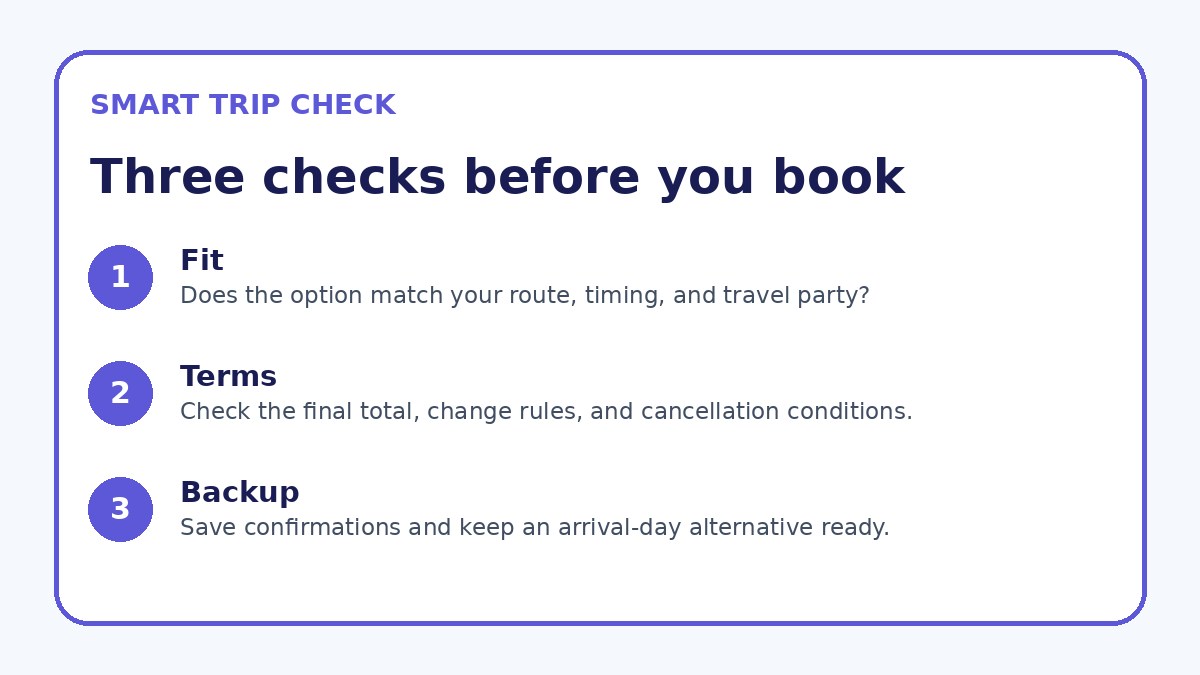
Before you book
- Confirm whether seats together are guaranteed and, if not, reserve seats for all travelers at booking to avoid separation.
- Check the airline’s infant and child policies on the carrier’s final booking page: bassinets, lap infants, and extra seat rules vary by carrier and aircraft.
- Verify whether checked luggage will be through-checked on connecting itineraries or must be reclaimed and rechecked during a layover.
- Research the transfer airport’s family facilities: play areas, nursing rooms, family restrooms, and typical transfer walking times between gates.
- Pack a carry-on with snacks, a change of clothes for each child, basic medicines, sanitized wipes, and quiet activities to handle delays and avoid unnecessary purchases.
- Note local transit times to/from each airport and add at least 60–90 minutes buffer for immigration, baggage claim, and taxi or train rides when planning arrival and departure times.
Seat choice, baggage and family comfort essentials
Seats together and onboard amenities determine much of how the flight feels for children. Even on a nonstop, an awkward seat layout or lack of bassinet availability can make a long flight uncomfortable. When booking, look for seats with convenient access to lavatories, bulkhead rows that may accommodate bassinets if available, and the flexibility to select or change seats for the whole family. Remember that seat assignment policies differ by airline and fare class; always confirm on the airline’s final booking page whether seats together are included or if you must pay to reserve them.
Baggage rules and stroller policies are also decisive for families. Check the allowance for checked bags, whether infants have a separate carry-on, and how strollers and car seats are handled at each airport. If you’ll rely on a connecting airline, verify whether checked luggage will be through-checked to the final destination or whether you must collect and re-check it during a layover. Finally, pack a small carry-on with essentials — snacks, a change of clothes, medications, entertainment, and basic cleaning wipes — because access to shops or family facilities can be limited during tight connections or late-night arrivals.
Frequently asked questions
How do I decide between a nonstop and a connecting Seoul to Hong Kong flight for young children?
Weigh door-to-door time against schedule flexibility. Nonstops reduce the number of transitions and are usually easier with infants and toddlers, lowering the chance of missed connections or lost luggage. Connecting flights can be useful if they let you travel during your child’s normal sleep or provide better seat availability for the whole family. Make a timeline that includes travel to the airport, recommended arrival time for families, and realistic layover buffers. Always confirm infant seating and baggage rules on the airline’s final booking page before booking.
What should I check about layovers to keep a family comfortable during a connection?
Look for layover length, terminal transfer requirements, and family-friendly facilities at the transfer airport. Prefer layovers long enough to recover from a delay but not so long that children get overtired; 90–180 minutes is a common practical window for single-plane-terminal transfers. Verify whether you must re-clear security or immigration, and whether there are play spaces, nursing rooms, and family restrooms. Check online airport maps and the carrier’s transfer guidance, and plan entertainment and snack breaks into the layover to reduce stress.
Can I travel with a stroller and car seat when flying from Seoul to Hong Kong?
Most airlines and airports allow strollers and car seats but policies vary. Many carriers let you gate-check a stroller and accept car seats as checked or carry-on items if you have the appropriate ticketed seat for the child. On connecting itineraries, confirm whether these items will be returned at the gate or at baggage claim, and check whether different carriers in an itinerary have compatible rules. Always verify the exact stroller and car seat allowances, gate-check procedures, and size rules on the airline’s final booking page to avoid surprises at the airport.
Final planning note
Choosing between direct and connecting Seoul to Hong Kong flights for a family trip comes down to priorities: simplicity and minimal transitions versus schedule flexibility and seat availability. Nonstops usually reduce stress and total travel time, which is often decisive with young children. Connections can work well if chosen carefully — pick family-friendly transfer airports, allow realistic buffers, and confirm baggage and seating rules across all carriers involved. Before you commit, review the airline’s final booking page for seat guarantees, infant policies, baggage allowances, and whether checked luggage is through-checked on connecting itineraries. Compare current availability and conditions on a booking site like Trip.com if you want one place to review options, then finalize with the carrier to lock in specifics that matter most to your family.
Continue planning
Check current options and final conditions
Use the provider page to confirm live availability, the final total, cancellation terms, and every condition that matters to your trip.
This evergreen planning guide was created with AI-assisted drafting and a structured quality review. It does not display live prices, schedules, availability, visa guidance, or provider rankings. Verify current details before booking. Some links are affiliate links; we may earn a commission at no additional cost to you.