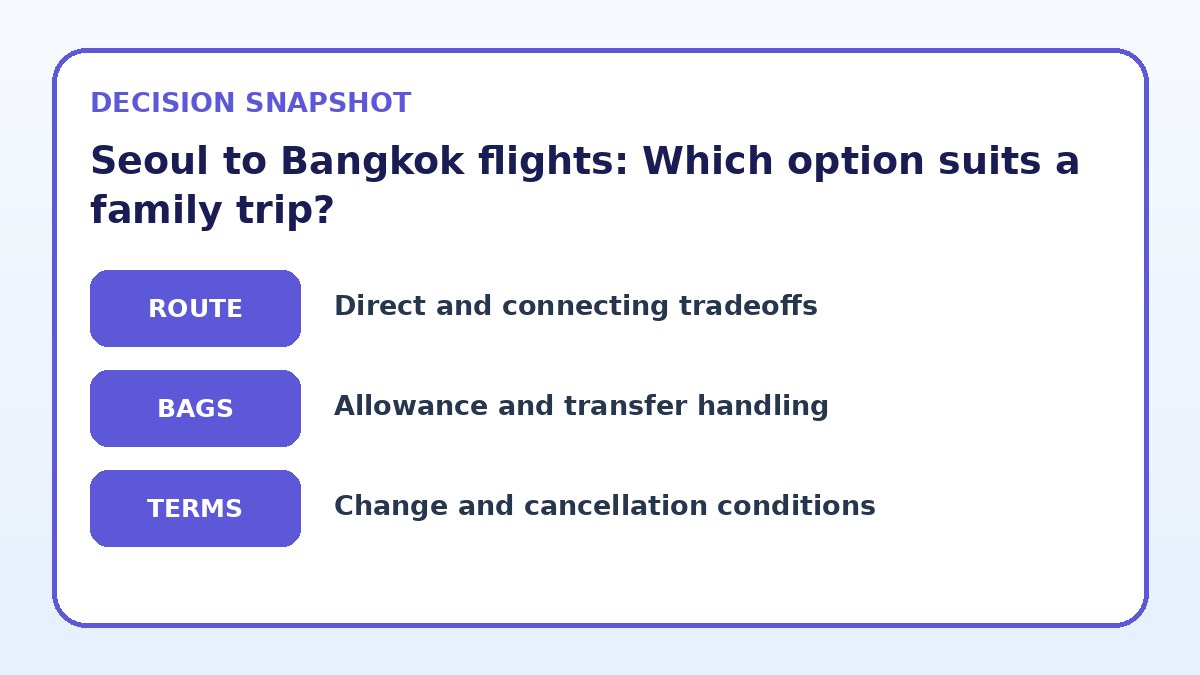
If you’re booking Seoul to Bangkok flights for a family, start by deciding whether convenience (direct flights) or flexibility and possibly lower fares (connecting flights) matter most. For parents traveling with kids, a direct flight reduces airport hustle, missed connections and extra security lines — useful when you’re juggling strollers, carry-ons and temperaments. Connecting options can be attractive if you need lower base fares, want different departure times, or plan an extended stopover to break up travel. Before you pick, confirm total travel time door-to-door, transfer complexity, baggage transfer rules, and cancellation/change policies on the airline or booking page you’ll use. If you want to survey current schedules and fares, Trip.com is one place to compare availability, but always verify final seat assignments, baggage allowances, and connection minimums on the carrier’s official booking page.
See current options before you compare the details
Availability and final conditions change. Open Trip.com now or keep reading for the practical comparison.
How direct and connecting flights differ for families
A direct flight means no plane changes between Seoul and Bangkok, which usually translates to fewer security checks, no rechecking of bags, and less time in unfamiliar terminals. For families, fewer touchpoints reduce the chance of lost items and simplify mealtimes and bathroom breaks. Boarding and disembarking can still take time, but you avoid the added stress of rushing through another airport between flights. Make sure to verify whether the itinerary is truly nonstop on the carrier’s booking page and whether the aircraft type offers family-friendly amenities like bassinets or bulkhead seating.
Connecting flights involve at least one scheduled stop where passengers switch planes, which lengthens total travel time but can offer more schedule options or price points. Transfers differ widely: an easy airside connection with through-checked bags is far less disruptive than one requiring customs and recheck. For families, a long connection can be a chance to stretch legs and reset nap schedules; a short one can be high-risk if a delay occurs. Check the minimum connection times listed by the operating carriers and whether the layover airport has family facilities, play areas, or quiet spaces that suit your children’s ages.
Time, sleep and itinerary tradeoffs
Total door-to-door time is more meaningful than flight hours alone. A direct flight typically minimizes in-air travel and eliminates transfer waits, but an inconvenient departure time can still disrupt sleep routines. Families often prefer a departure that lines up with kids’ nap windows or evening sleep so much of the flight is restful. When evaluating schedules, create a realistic timeline from home to hotel, including airport transit, recommended check-in times for family travel, and expected arrival timing in Bangkok to assess daylight, hotel check-in, and local transport options.
With connecting itineraries you can sometimes design a trip that breaks up a long day: an overnight stop in the transit city or a medium-length layover can transform travel into two manageable chunks. However, each layover increases the chance of delays eating into that schedule and can require more active time management — feeding, security lines, and navigating terminals. If you plan an overnight stop, confirm where you’ll rest during the layover and whether hotel transfers or childcare options are available at the transit location.
| Approach | Best for | Tradeoff to check |
|---|---|---|
| Direct flights | Families prioritizing minimal logistics and predictable schedules | May offer fewer departure times and sometimes higher base fares |
| Short connecting itineraries | Families needing specific departure windows or slightly lower fares | Higher risk of missed connections and more airport navigation |
| Long layovers or stopovers | Families wanting a break or mini-stopover en route | Adds total travel time and requires planning for rest or accommodation |
| Mixed-carrier connections | Travelers seeking lower cost or niche schedules | Higher baggage and recheck complexity; verify policies on each carrier |
Ready to check the option that fits your plan?
Use your exact dates and traveler details so the provider page can show the current total and conditions.
Budget and baggage considerations for families
Connecting flights can look cheaper at first glance, but families must tally all costs: extra baggage fees for multiple carriers, seat selection fees to keep your group together, transit visas if a transfer requires leaving the sterile area, and meals during long layovers. Some low-cost connectors charge for carry-on or checked bags that full-service carriers include, so compare the total bundled cost on the airline’s final booking page rather than a headline fare. Always check the baggage transfer policy: if the airline doesn’t transfer checked bags, you’ll need time and energy to collect and recheck luggage, which is especially tiring with children.
Direct flights often include more consistent baggage handling and fewer fees across the journey when booked with a single carrier, which simplifies logistics and may reduce hidden costs. Seat assignment policies are particularly important: paying to reserve seats together on any itinerary avoids the stress of being separated. Also consider food: infants and toddlers may need familiar snacks, so check in advance whether in-flight dining, special meals, or the ability to bring your own food is allowed by the operating carrier and airport security rules for each segment.
Before you book
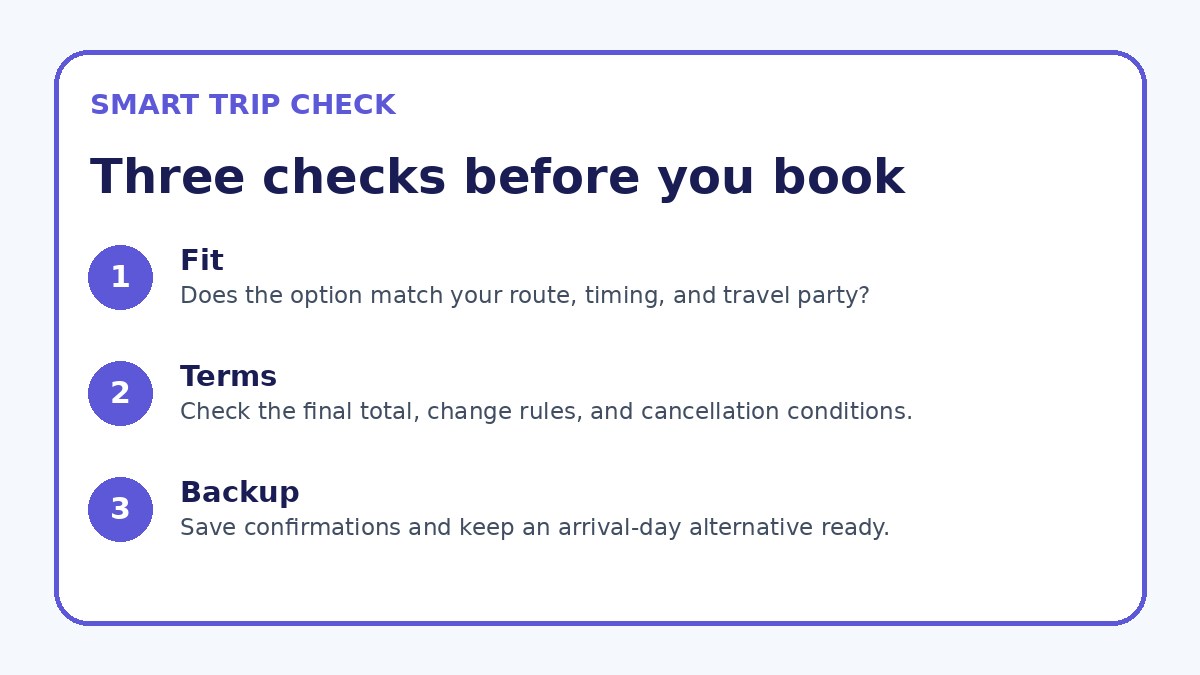
- Confirm whether the itinerary is nonstop or involves plane changes on the airline’s official booking page before paying.
- Compare total door-to-door time, not just flight duration, including transfers, transit to airports, and hotel check-in windows.
- Check baggage rules and transfer policies for each carrier on connecting itineraries to see if you must reclaim and recheck luggage.
- Reserve seats together and pay for bulkhead or extra-legroom seats if necessary to secure space for bassinets or family comfort.
- Verify minimum connection times, terminal layouts, and whether a transit requires immigration clearance at the transfer airport.
- Pack critical items (medications, snacks, diapers, a change of clothes) in a carry-on so a delayed checked bag won’t derail the trip.
Health, safety and practical family tips
Long flights and tight connections both have health implications for children and older travelers. Direct flights reduce the number of times you pass through crowded terminals, while connections increase exposure to different queues and timings. Pack a small health kit, any prescription medication in original containers, and a spare change of clothes for small children in a carry-on. If anyone in your group has a medical condition, check the airline’s policy on traveling with medical devices, oxygen, or special assistance and verify these details during booking and again before departure on the operator’s site.
For smoother travel, apply for family fast-track lanes where available, use stroller gate-check options, and request preboarding if you need extra time to get everyone settled. Photocopy or photograph passports and travel documents and keep digital backups. If your route requires entry forms, health attestations, or specific documentation for minors, confirm the current rules on official government or airline pages before travel. When researching options, compare both total travel risk and convenience rather than selecting solely by fare.
Frequently asked questions
Is it safer for a child to fly direct from Seoul to Bangkok instead of connecting?
Direct flights reduce the number of times you move through airport security, reboard planes, and collect or recheck luggage, which generally limits exposure to logistical hiccups. For children, that means fewer transitions that can cause tiredness or lost items. However, safety also depends on airline procedures, aircraft maintenance, and crew training, which vary by operator and change over time. Always review the carrier’s current travel assistance options for children and confirm safety-related policies on the airline’s official site before booking.
If I pick a connecting flight, how much layover time should I allow with small children?
There isn’t a one-size-fits-all layover length because airports and connections differ. A common approach is to add buffer time beyond the minimum connection time listed by the carrier to allow for restroom breaks, stroller handling, feeding, and potential gate changes. For families, plan for at least 60–90 minutes for domestic-style transfers and longer if the layover involves changing terminals, clearing immigration, or rechecking bags. Check the specific airport map and services on the carrier’s or airport’s site to set a realistic minimum for your group.
Can I bring a stroller and car seat on both direct and connecting flights?
Most airlines allow gate-checking of strollers and carriage of car seats, but policies vary by carrier and by whether the flight is operated by a partner on a connecting itinerary. Verify rules on the operating airline’s final booking page, including size limits, whether the stroller can be used inside the gate area, and how to claim it at arrival. If your connection requires switching carriers, check both airlines’ rules because one might treat stroller handling differently during transfers.
Final planning note
Choosing between direct and connecting Seoul to Bangkok flights for a family comes down to balancing convenience, cost, and the group’s tolerance for transfers. Direct flights simplify logistics and reduce the number of touchpoints, which many families find worth a potential fare premium. Connecting itineraries can open more time and price options — and the chance for a purposeful stopover — but add transfer complexity and possible extra fees. Before you book, compare total door-to-door time, baggage transfer rules, seat assignment policies, and minimum connection times on the carriers’ pages. Use those factors to pick the option that preserves your family’s energy and fits your travel rhythm.
Continue planning
Check current options and final conditions
Use the provider page to confirm live availability, the final total, cancellation terms, and every condition that matters to your trip.
This evergreen planning guide was created with AI-assisted drafting and a structured quality review. It does not display live prices, schedules, availability, visa guidance, or provider rankings. Verify current details before booking. Some links are affiliate links; we may earn a commission at no additional cost to you.