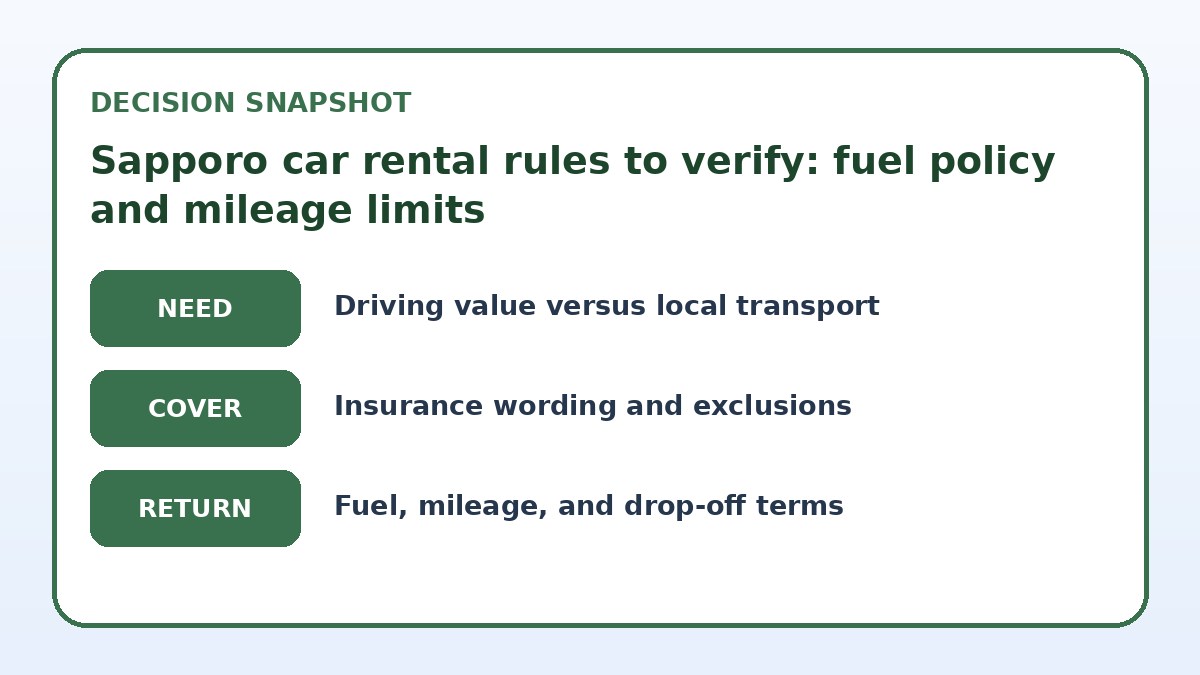
If you’re renting a car in Sapporo for business, the first things to check are the fuel policy and mileage rules — they affect cost, convenience, and how you plan meeting schedules. Fuel policies vary from “pick up full, return full” to pre-purchase or refueling fees that can add unexpected charges if you don’t follow the contract. Mileage caps or daily distance limits change whether a single long day trip outside the city remains economical. Before you finalize a booking, compare the rental agreement language about fuel, mileage, and how providers handle cross-island or cross-prefecture travel. If a provider’s terms are unclear, use the booking page to confirm exact fees and permitted driving areas; note any special conditions for corporate bookings or additional driver names so your expenses and allowances match company reimbursement rules.
See current options before you compare the details
Availability and final conditions change. Open Trip.com now or keep reading for the practical comparison.
How fuel policies work and what to watch for
Fuel policies typically fall into a few patterns: return full, pre-purchase at a set rate, or pay for refueling by the provider after return. Each approach has tradeoffs. “Return full” is straightforward if you can fill up before drop-off; but if you land late at New Chitose Airport or are tight on time between meetings, you may prefer a pre-purchase option that removes the need to stop. Pre-paid fuel sells convenience but can be costlier per litre than local stations. If a provider’s terms mention refueling fees, check whether they charge for service time and an administrative fee in addition to the fuel itself.
When comparing options, use your planned itinerary to estimate consumption. Account for city stop-and-go traffic in Sapporo, plus highway runs to suburbs or nearby towns, and include anticipated toll driving. If the rental contract waives refuelling administration only when you present a pump receipt, retain receipts for any fills. On the provider’s booking page, verify the exact language on fuel refunds, whether partial returns are accepted, and whether pre-paid fuel is refundable for unused litres; these specifics determine whether convenience outweighs potential extra cost.
Mileage allowances and planning long business routes
Mileage rules can be per day, per rental, or unlimited. A daily cap might be small enough that routine trips to client sites around the city consume a meaningful portion of your allowance, while a single trip to a regional meeting could trigger excess charges. If your schedule includes one long journey — for example, a round trip to a coastal meeting or an out-of-city site visit — estimate the total kilometers and compare that to the rental’s per-day and total limits. When a planned trip exceeds a cap, calculate excess-kilometre charges to see whether upgrading to unlimited mileage or choosing a different rate class is cheaper.
Also check how providers measure mileage (odometer vs. GPS) and whether there are rounding rules. Verify whether local driving on toll expressways is treated differently and how the rental records start and end mileage. On the booking page, find the section that specifies the included kilometers and the per-kilometer charge for overages; if a contract leaves ambiguity about charging intervals or rounding, request clarification in writing before you accept the vehicle.
| Approach | Best for | Tradeoff to check |
|---|---|---|
| Return full fuel policy | Travelers with time to refuel before drop-off and who want to avoid pre-paid markups | Requires planning refuel stops and risks fees if you forget or misjudge the tank level |
| Pre-purchase fuel | Busy business travelers who prioritize convenience and avoiding last-minute errands | Often more expensive than local pump prices and may not refund unused fuel |
| Limited daily mileage | Short city-focused trips where overall kilometres will stay low | Can incur significant overage charges if your schedule includes longer regional drives |
| Unlimited mileage upgrade | Itineraries with long drives or unpredictable distances where overage risk is a concern | Higher daily rate that may not pay off for strictly city-only use |
Ready to check the option that fits your plan?
Use your exact dates and traveler details so the provider page can show the current total and conditions.

Insurance, additional drivers, and corporate reimbursement
For business travelers, insurance terms are as important as fuel and mileage. Collision damage waivers, third-party liability, and glass/tyre coverage can be offered at various levels and prices. Corporate policies sometimes require specific coverage levels or approved providers — check with your company car policy before you add excess-reduction options. Also confirm how insurance affects fuel and mileage disputes: some waivers exclude damage arising from unauthorized drivers or driving outside permitted areas, which could complicate expense claims or liability after an incident.
Additional drivers are commonly allowed but may carry extra cost or require documentation. Ensure all potential drivers on your itinerary are listed on the rental agreement and that their licences meet Japanese rental requirements. For reimbursements, confirm the form in which rental receipts and final invoices will be issued — digital receipts, itemized invoices, and a clear record of fuel and mileage help corporate accounting. On the booking page, verify what documents you’ll receive and whether they include both vehicle return mileage and fuel status.
Before you book
- Open the rental provider’s full terms on the booking page and locate the fuel policy, mileage allowance, and overage rate before you finalize the reservation.
- Estimate your planned kilometres (including detours and toll routes) and compare that total to per-day and total mileage limits to determine possible excess charges.
- Decide whether to pre-purchase fuel or return full, then note nearby 24-hour stations along your route if you choose return-full for late arrivals.
- Confirm additional-driver rules and add any colleagues who will drive to the rental agreement to avoid invalidating insurance or incurring penalties.
- Request that the rental company issue an itemized receipt showing fuel status, start and end odometer readings, and detailed fees for corporate expense reconciliation.
- Photograph the odometer and fuel gauge at pickup and drop-off and keep timestamps to support any disputes about mileage or fuel level.
Practical checks before you book and at pickup
Before you hit confirm, read the full rental terms on the provider’s booking or contract page — not just the rate summary. Look for sections covering fuel, mileage, toll handling, cross-prefecture travel, airport surcharges, and late-return penalties. If you need to drive to neighbouring prefectures or return to an airport different from the pickup location, confirm permissions and fees. Some providers note restrictions on routes or impose additional fees for one-way rentals; these appear in the detailed terms and can change the economics of a corporate trip.
At pickup, verify the odometer reading and fuel level on the written contract, take photos of the fuel gauge and vehicle condition, and ensure any pre-existing damage is recorded. Check the spare tyre and emergency kit if your itinerary includes rural drives. Ask staff to point out toll payment devices or instructions for electronic toll collection (ETC) usage, and obtain immediate clarification if the booking page text contradicts what staff say. If any booking detail is ambiguous or different in person, get written confirmation before driving away.
Frequently asked questions
Is pre-paid fuel worth it for a business trip in Sapporo?
Pre-paid fuel is worth considering when your schedule doesn’t allow a convenient refuelling stop before drop-off — for example, if you fly out late or have tightly packed meetings before returning the car. The convenience saves time and stress but often comes with a per-litre markup. To decide, estimate how much fuel you’ll likely use and compare that to local station prices; also confirm whether the provider refunds unused fuel on the booking page. If cost control matters for corporate reimbursement, factor the markup into your expense estimate.
How can I avoid mileage overage charges on regional drives from Sapporo?
Avoid overages by calculating your route in advance, including detours and return trips, then comparing the total to the rental’s limits. If the expected distance exceeds the included allowance, consider upgrading to unlimited mileage or a higher allowance at booking, or choose a different rate class that includes more kilometres. When pricing tradeoffs, run the numbers: multiply daily overage by possible excess kilometres and compare to the upfront cost for unlimited miles. Always verify the exact per-kilometre fee listed on the provider’s terms to prevent surprises.
What should I verify on the booking page versus at the rental desk?
On the booking page, verify written terms for fuel policy, mileage limits, excess fees, cross-prefecture permissions, and included insurance levels. Check whether receipts and invoices are itemized for corporate accounting. At the rental desk, confirm that what staff note matches the online terms: the odometer and fuel gauge readings should be recorded, additional drivers should be listed, and any local instructions (toll devices, restricted roads) should be clarified. If there’s a discrepancy between online terms and desk statements, request written confirmation before driving away.
Final planning note
For business travelers in Sapporo, checking fuel and mileage rules before booking keeps costs predictable and preserves time for meetings. The right choice depends on your itinerary: short city work calls often pair well with a return-full policy or a limited-mileage rate, while regional meetings favour unlimited mileage or a higher allowance. Pre-paid fuel trades convenience for potential extra cost, so confirm refund and resale rules on the provider’s booking page before opting in. Always document odometer and fuel at pickup and return, list additional drivers on the contract, and secure itemized receipts for corporate reconciliation. If you want a quick place to compare current terms and availability, Trip.com can be used as one comparison tool, but always verify fine print on the provider’s final booking page.
Continue planning
Check current options and final conditions
Use the provider page to confirm live availability, the final total, cancellation terms, and every condition that matters to your trip.
This evergreen planning guide was created with AI-assisted drafting and a structured quality review. It does not display live prices, schedules, availability, visa guidance, or provider rankings. Verify current details before booking. Some links are affiliate links; we may earn a commission at no additional cost to you.